
SunFounder AI Fusion Lab Kit
4.6Editor score
Multi-LLM learning platform
Vision and voice components
Pan-tilt tracking hardware
Guided beginner video lessons
Compare the best AI Raspberry Pi kits for learning, vision, robotics, and edge AI, including complete boards, accelerators, sensors, and starter bundles.
AI Raspberry Pi kits combine a capable single-board computer with cameras, sensors, accelerators, robotics components, or structured learning materials. A worthwhile kit should make it easier to explore machine vision, language models, voice interaction, and embedded AI without requiring every component to be sourced separately.
This guide compares ten kits based on the hardware and learning resources stated in their product information, with particular attention to board inclusion, AI acceleration, sensor access, expansion options, and the kinds of projects each package supports. It covers complete systems, Raspberry Pi bundles, add-on accelerators, and project-focused robot kits.
Each review explains who the kit is best suited for and where it falls short. The top selections provide the strongest balance of accessible hardware, useful AI features, and learning support, while the remaining options address more specialized vision, robotics, storage, or compute needs. Prices and availability can change.
4.6Editor score
4.3Editor score

4.5Editor score
The comparison below highlights the major differences among complete learning systems, general Raspberry Pi 5 bundles, dedicated AI accelerators, and a robotics-focused kit. Board inclusion is a key distinction, while accelerator capacity, sensor access, and course materials determine which projects each option supports.

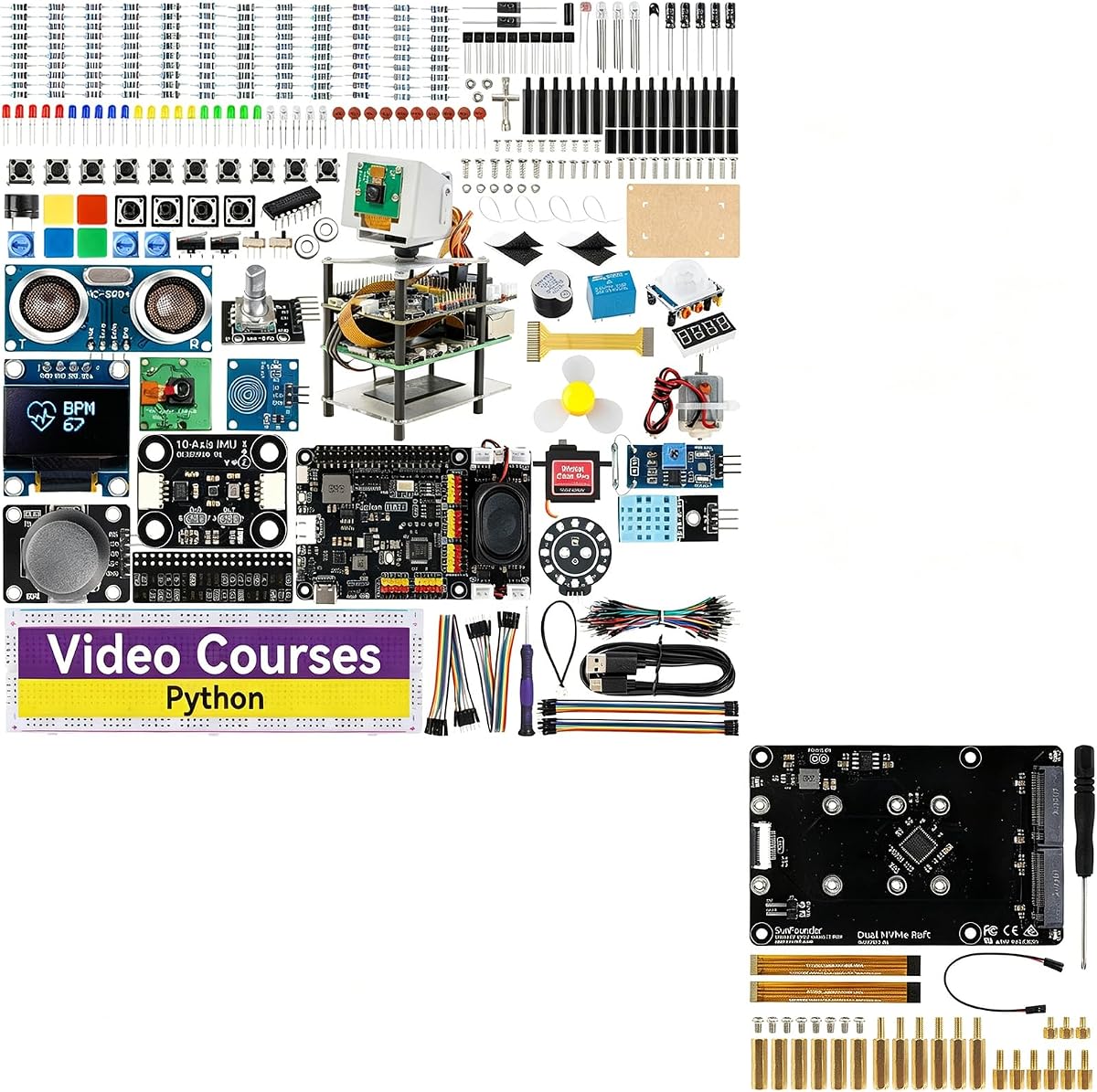


The SunFounder AI Fusion Lab Kit is an ambitious, all-in-one learning platform for turning a compatible Raspberry Pi into an interactive AI workstation. Its 4.6 rating reflects a strong combination of accessible components, multi-LLM support, and structured training. The package supports Raspberry Pi 5, 4B, 3B+, 3B, and Zero 2 W models.
We may earn a commission when you buy through this link, at no additional cost to you.
Its defining feature is the breadth of supported projects. Learners can work with ChatGPT, Gemini, Grok, DeepSeek, Qwen, Doubao, and Ollama, then combine those models with cameras, sensors, voice recognition, and text-to-speech. OpenCV, YOLO, and MediaPipe are also highlighted, while the Pan-Tilt HAT allows vision systems to detect and follow colors, objects, or human movement.
The Fusion HAT+ adds practical system integration through power management, safe shutdown, and a unified Python library. A built-in speaker and microphone support voice interactions, while the 10-axis module, camera, and breadboard components expand the range of sensor experiments. This makes the kit more comprehensive than a simple camera or display bundle, although the Raspberry Pi itself must be purchased separately.
The structured video lessons, sample code, documentation, technical support, and community resources make this a strong choice for beginners progressing from Python toward real-time AI. It is especially compelling for someone who wants language models, computer vision, voice, and movement control in one project platform rather than assembling each subsystem independently.
The main compromise is the need to source a compatible Raspberry Pi and perform initial setup. Buyers should also confirm that their chosen model, power arrangement, and software environment match the lessons. Even so, the combination of educational structure and real hardware interaction makes this our most balanced recommendation for general AI experimentation.
This kit is particularly useful for connecting language, speech, sight, and motion in one project. A camera can identify a visual target, a model can interpret it, and the Pan-Tilt HAT can physically reposition the sensor, providing a more tangible way to understand multimodal AI than a screen-only demonstration.
The video courses, sample code, and unified Python library reduce the initial learning curve. They also help connect individual components into functioning systems, which is valuable for learners who want a repeatable path from basic Python work toward tracking and voice-assisted projects.
We may earn a commission when you buy through this link, at no additional cost to you.
The Vilros Raspberry Pi 5 AI Kit is a complete hardware package centered on an eight-gigabyte Raspberry Pi 5 and a Hailo neural-network accelerator. It holds a 5.0 rating, the highest among the listed products, and is aimed at users who want a ready-made edge-computing platform rather than a collection of individual components.
We may earn a commission when you buy through this link, at no additional cost to you.
The kit includes the Raspberry Pi 5, an AI HAT+ with a choice of accelerator capacity, an Active Cooler, a compatible case, a 128GB microSD card preloaded with 64-bit Raspberry Pi OS, a USB-C power supply, a micro-HDMI-to-HDMI cable, a storage case, and a microSD-to-USB adapter. That broad bundle minimizes the need to source basic accessories.
The Raspberry Pi 5's 2.4GHz quad-core Cortex-A76 processor provides the host-side performance, while the Hailo-8 or Hailo-8L accelerator handles neural-network workloads at 26 or 13 TOPS. The accelerator integrates with Raspberry Pi camera software and is designed for applications such as object detection and segmentation when paired with compatible workflows.
This is not primarily a sensor or robotics teaching kit. Its strength is a polished general-purpose AI computer with storage, cooling, power, and acceleration already coordinated. That makes it appealing for edge inference, computer-vision prototypes, AI development, and self-hosted projects where a complete Raspberry Pi 5 foundation is more important than a large collection of educational modules.
The top recommendation is ideal for builders who want strong hardware integration and acceleration without assembling a Raspberry Pi 5 AI system from scratch. Buyers focused exclusively on interactive sensors or robotics should look elsewhere, but for a complete, high-performance edge AI platform this is the most premium-ready option in the group.
A Hailo accelerator gives supported inference tasks access to dedicated neural-network hardware rather than relying only on the general-purpose CPU. This is useful for camera-based detection and segmentation projects where predictable acceleration and efficient power use matter.
The included operating system, storage, cooling, case, power supply, display adapter, and USB adapter create a convenient starting point. It reduces setup friction, although users will still need appropriate peripherals for their chosen AI workflow.
We may earn a commission when you buy through this link, at no additional cost to you.
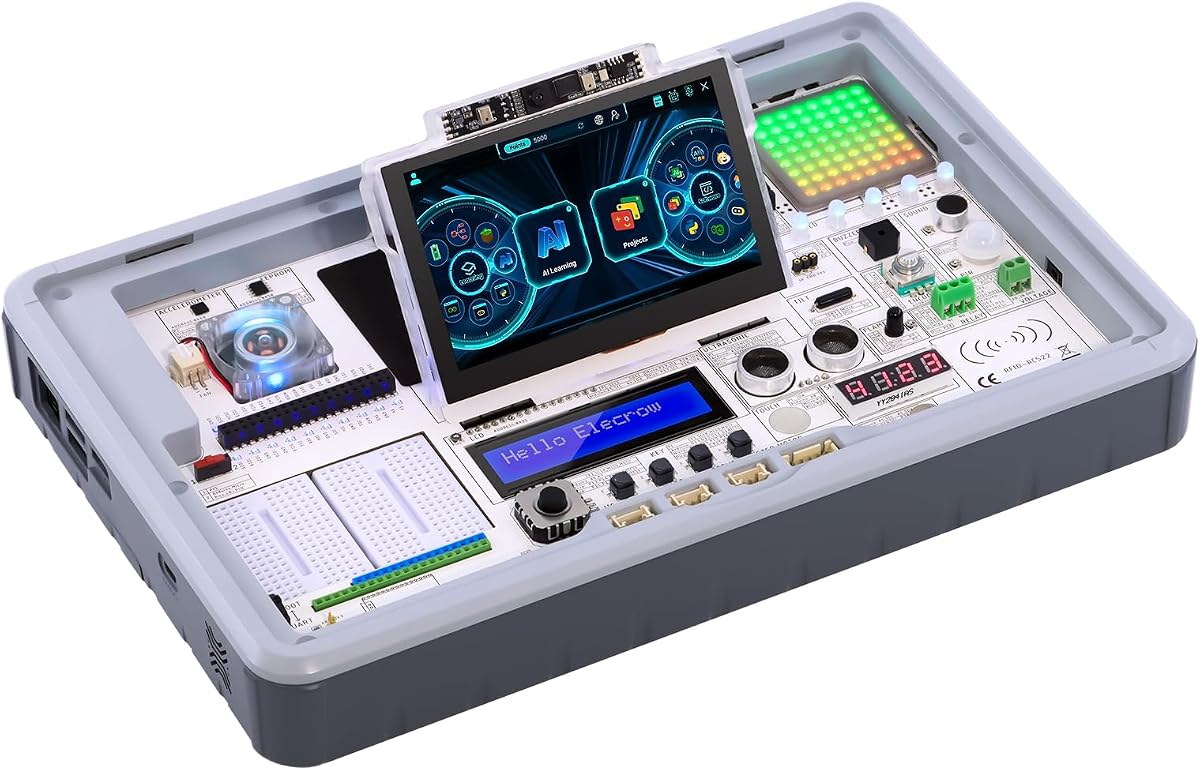
The ELECROW CrowPi3 AI Learning Kit is a broad electronics and AI education platform for Raspberry Pi 5. Its 4.3 rating reflects a well-organized package that makes many hardware experiments approachable, while the absence of a Raspberry Pi 5 in this basic configuration keeps the listing distinct from bundles that arrive with a computer.
We may earn a commission when you buy through this link, at no additional cost to you.
The station includes a 4.3-inch capacitive touchscreen, a two-megapixel camera, and 41 different sensors and modules arranged in a tidy package. This combination makes it possible to explore OpenCV, facial recognition, object detection, and large language model projects without manually wiring every sensor on a breadboard.
Its educational structure is a major advantage. The stated curriculum contains 200 lessons that guide users through identifying components, reading code, and running programs in the terminal. Compatibility extends beyond Raspberry Pi 5 to Arduino Nano, micro:bit, and Raspberry Pi Pico, enabling learners to move between embedded platforms and broaden their hardware experience.
Unlike kits built around a Hailo accelerator, CrowPi3 does not provide dedicated neural-network hardware. Its AI capabilities therefore depend more heavily on the chosen Raspberry Pi, camera, and software stack. That is a meaningful limitation for demanding real-time inference, but it is not a drawback for education, prototyping, facial-recognition demonstrations, or OpenCV exercises.
This is our Editor's Choice because it offers one of the clearest paths from basic electronics to increasingly sophisticated AI projects. It is a strong recommendation for students, educators, families, and self-learners who value guided lessons and access to many components without complicated assembly.
The labeled arrangement of sensors and modules is more approachable than a loose collection of electronic parts. Learners can identify inputs and outputs, connect them according to lessons, and move quickly from simple control exercises to camera and AI demonstrations.
With 200 lessons covering components, code, and terminal use, the station supports a gradual learning path. Its compatibility with several development boards also makes it useful for classrooms or makers who want one platform to serve multiple embedded ecosystems.
We may earn a commission when you buy through this link, at no additional cost to you.
This SunFounder bundle combines the AI Fusion Lab learning platform with a Dual NVMe Raft for Raspberry Pi 5. It is designed for makers who want the interactive camera, voice, sensor, and pan-tilt components of the Fusion Lab while also creating room for high-speed storage or an additional AI accelerator.
We may earn a commission when you buy through this link, at no additional cost to you.
The Dual NVMe Raft adds two M.2 M-Key slots compatible with 2230 through 2280 drives. It supports PCIe Gen 2.0, up to 500MB/s per slot according to the product information, and up to 3A of power per slot. Two SSDs can be configured in RAID 0 or RAID 1, while a single SSD can share the enclosure with a Hailo-8L AI accelerator.
That flexibility makes the package relevant to NAS builders, Home Assistant users, media projects, and Raspberry Pi 5 AI developers who need faster or more resilient storage. OpenMediaVault is also identified as a supported use case. The RAID capability is especially useful when the goal is a small server rather than a single-purpose desktop.
The Fusion Lab side retains the multi-LLM support, camera, 10-axis sensor, rechargeable power pack, voice capabilities, and Pan-Tilt HAT found in the standard learning kit. The added storage board increases complexity, so beginners focused only on AI lessons may find the standard bundle easier to manage. No customer rating is supplied for this specific listing, which also makes it harder to compare its long-term user reception.
This is a specialized recommendation for Raspberry Pi 5 owners who want serious storage expansion alongside AI learning. It is less appropriate for someone buying their first Pi or only experimenting with a single camera project, but it offers a more capable foundation for combined AI and lightweight server workloads.
Two M.2 slots provide room for a high-performance or mirrored storage configuration. This is a meaningful advantage for projects involving large media collections, containerized services, model files, or a compact home-server setup.
The raft can pair one SSD with a Hailo-8L accelerator, allowing storage and AI hardware to coexist on Raspberry Pi 5. That makes the bundle more versatile than a conventional learning kit without requiring a separate PCIe expansion base.
We may earn a commission when you buy through this link, at no additional cost to you.
The CanaKit Raspberry Pi 5 Starter Kit PRO is a polished general-purpose Raspberry Pi 5 bundle for users who want a capable computer before adding AI-specific hardware. It carries a 4.7 rating and includes an eight-gigabyte Raspberry Pi 5 with a 2.4GHz 64-bit quad-core processor.
We may earn a commission when you buy through this link, at no additional cost to you.
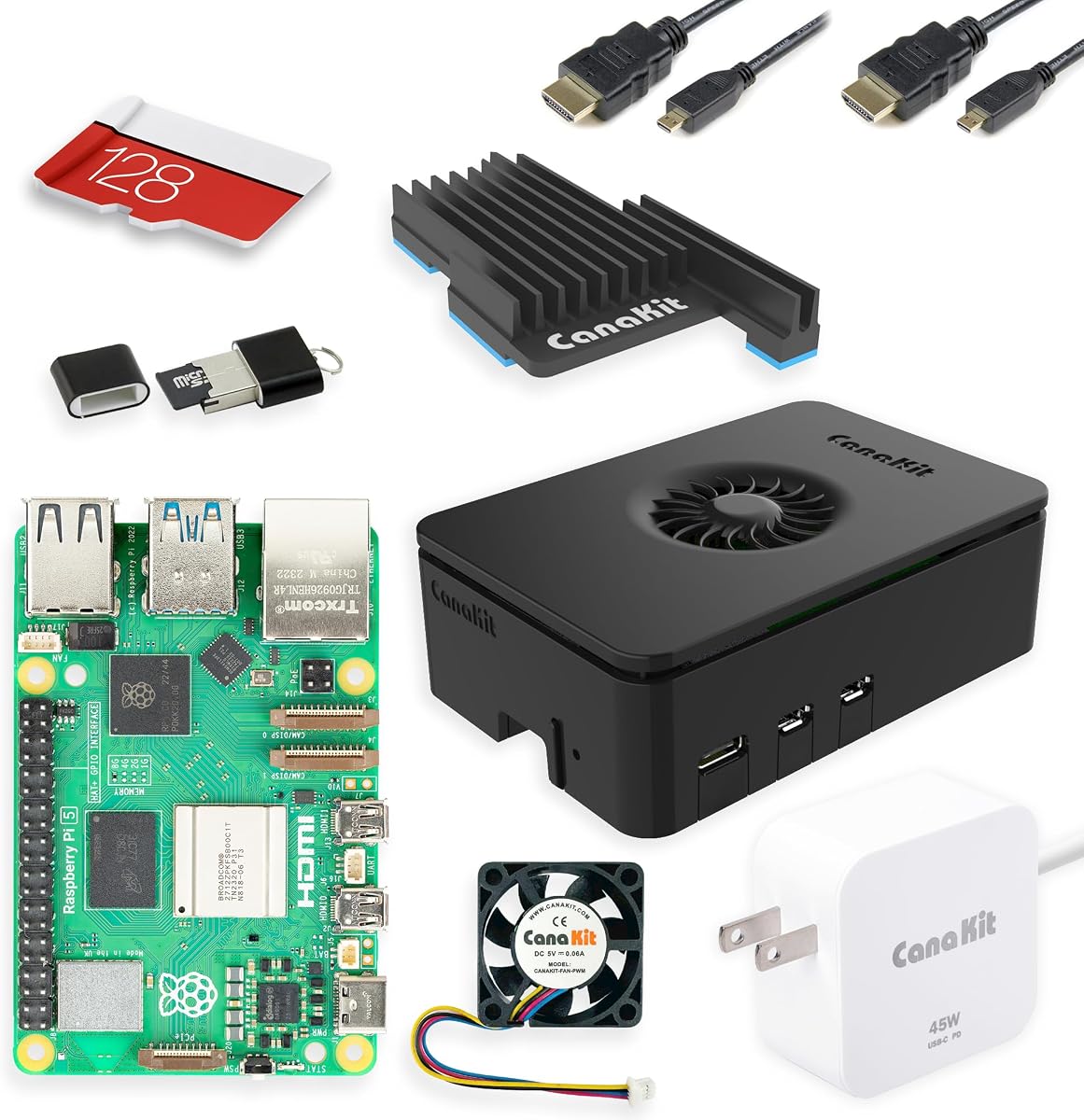
The package includes a 128GB microSD card preloaded with 64-bit Raspberry Pi OS, a USB card reader, a black Turbine case, a low-noise bearing system fan, a black anodized mega heat sink, a 45W PD power supply, and two six-foot display cables. These are practical components for assembling a stable desktop, development system, or robotics controller.
Its included power supply and cooling are especially relevant to AI work because sustained processor loads and attached peripherals can increase heat and power demand. The two display cables also support displays up to 4K at 60p, making the bundle useful for visual dashboards or on-device interfaces.
The kit does not include a Hailo accelerator, camera, display, or large sensor collection. Users must add those according to their intended project. As a result, it is less ready-made for immediate AI vision than the Vilros, SunFounder, or CrowPi options, though it provides an excellent base for custom builds.
This bundle suits experienced beginners, students, and developers who want the familiar general Raspberry Pi 5 ecosystem with useful accessories already selected. Choose it when future project needs may extend beyond AI, such as Docker, automation, home-server use, programming, or electronics control.
An eight-gigabyte Raspberry Pi 5 gives developers useful headroom for containers, automation, robotics controllers, and AI software. The lack of specialized peripherals does not make it less valuable; it simply leaves the final configuration open to each builder.
The fan, large anodized heat sink, 45W supply, and dual 4K-capable display cables cover common setup priorities. These components help create a stable base for visually intensive applications that will later receive cameras, accelerators, or sensors.
We may earn a commission when you buy through this link, at no additional cost to you.
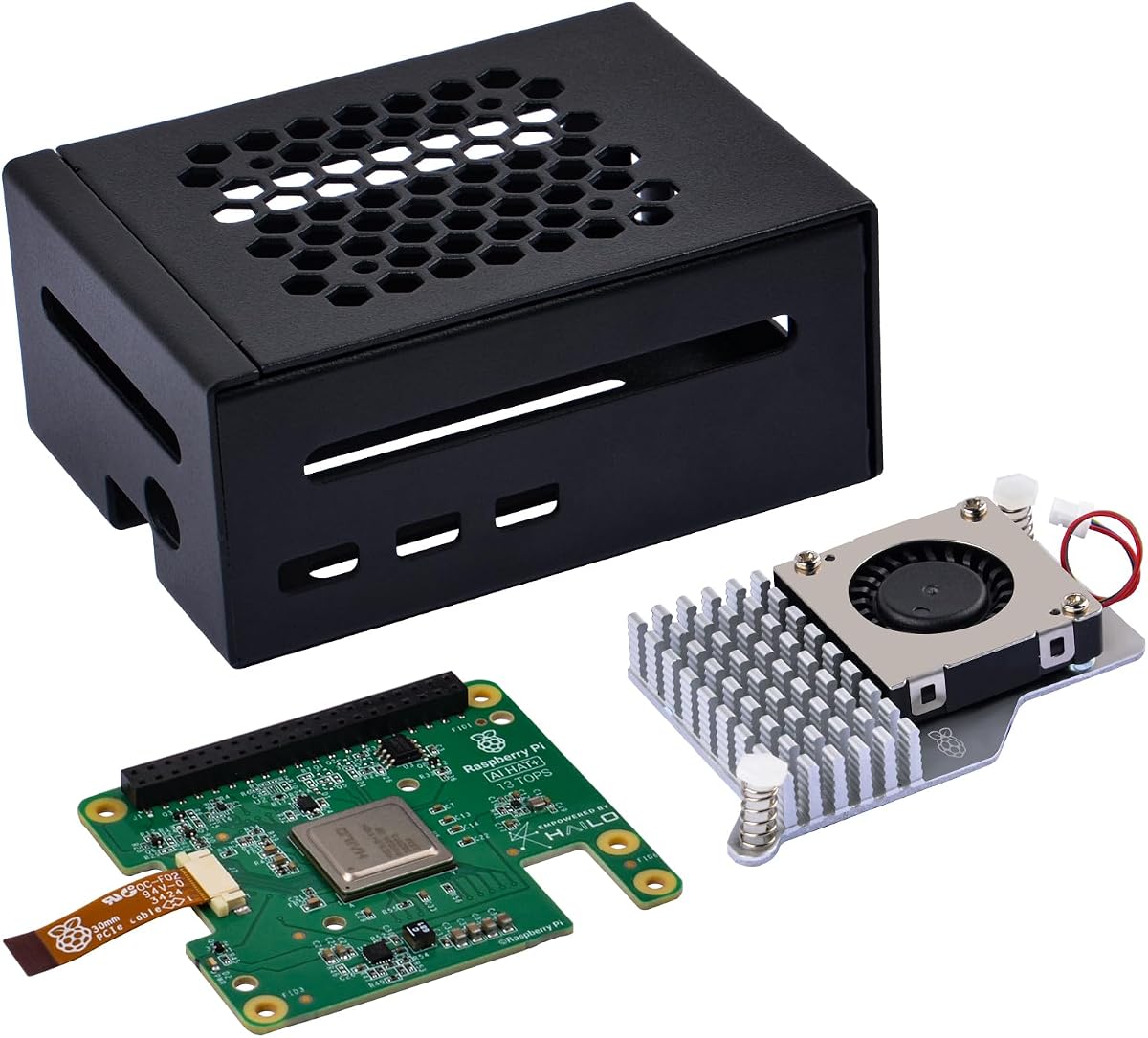
The GeeekPi AI HAT+ kit is a focused Raspberry Pi 5 upgrade for neural-network inference. Its 4.5 rating reflects a useful combination of a 13 TOPS Hailo accelerator, protective metal case, and active cooling. Unlike complete starter bundles, it is designed for users who already own or separately plan to buy a Raspberry Pi 5.
We may earn a commission when you buy through this link, at no additional cost to you.
The accelerator communicates through the Raspberry Pi 5's PCIe Gen 3 interface. With an up-to-date Raspberry Pi OS image, it is automatically detected and its NPU becomes available for supported AI tasks. The built-in rpicam-apps camera applications can also use the accelerator for compatible post-processing, reducing the need for extensive low-level configuration.
The included case protects the Raspberry Pi 5 from scratches, dust, and physical damage while maintaining access to most ports, including USB-C power, micro-HDMI, USB, Ethernet, the SD card slot, power button, and GPIO. Its Active Cooler combines an aluminum heat sink with a PWM fan to support stable operation under sustained workloads.
This package targets a narrower but important need: adding efficient AI acceleration to an existing Pi 5. Users looking for voice hardware, motors, sensors, or educational lessons will need to acquire those separately. Compatibility should also be checked carefully, because the listed hardware and stacking arrangement are designed specifically around Raspberry Pi 5.
It is a strong recommendation for builders focused on object detection, semantic or instance segmentation, pose estimation, and other accelerated inference tasks. The combination of native software integration, camera support, cooling, and protection makes it a practical performance upgrade rather than a standalone learning kit.
Automatic accelerator detection and native rpicam-apps support reduce software friction for camera inference. When the operating system and compatible model are configured correctly, supported post-processing can run on the Hailo NPU.
The metal enclosure and PWM cooling system complement the demands of continuous AI workloads. They also preserve access to essential Raspberry Pi 5 connections, which helps the system remain practical for iterative development.
We may earn a commission when you buy through this link, at no additional cost to you.
The Raspberry Pi 5 Essentials Starter Kit PRO is a complete first-system bundle built around official Raspberry Pi components. Its 4.6 rating is strong, and the package combines an eight-gigabyte board, an official case with active cooling, an official 27W USB-C supply, and a 128GB microSD card preloaded with Raspberry Pi OS.
We may earn a commission when you buy through this link, at no additional cost to you.
That configuration is designed to minimize setup work. Beginners, students, developers, and makers can begin with the operating system already installed, while the active cooling supports demanding workloads such as Docker, media servers, programming, robotics, and AI development.
The included power supply is designed to handle SSDs, AI accelerators, cameras, USB peripherals, and other expansion devices. That makes the kit a sensible foundation even when the current project does not yet involve AI. A user can add a camera, Hailo accelerator, display, or sensor system later without replacing the basic power infrastructure.
No camera, Hailo accelerator, sensor board, robotics components, or formal course library is included. Those omissions make it less convenient than CrowPi or SunFounder for an immediate AI laboratory, but they preserve flexibility and reduce unnecessary duplicate components. It is also a straightforward option for users who already know which AI expansion hardware they want.
This is an excellent balanced starting kit for anyone building a Raspberry Pi 5 workstation. The official components, preloaded storage, active cooling, and appropriately specified power supply offer a dependable foundation, while builders retain freedom to add the exact AI hardware required by their projects.
Official cooling, enclosure, and power components reduce uncertainty when planning future expansions. That matters for accessories such as SSDs and AI HATs that can place additional demands on power delivery and cooling.
The preloaded 128GB card and active-cooled case support immediate use for development, containers, media, robotics, and automation. As an AI platform, it becomes more specialized once a camera or accelerator is added.
We may earn a commission when you buy through this link, at no additional cost to you.
The SunFounder AI Robot Kit is the most clearly robotics-focused product in this guide. It combines a Raspberry Pi Zero 2 W and 32GB TF card with 12 servos, sensors, a camera, microphone, speaker, gyroscope, first-person-view control, and app connectivity. Its 4.3 rating indicates a well-liked kit for hands-on AI and robotics experimentation.
We may earn a commission when you buy through this link, at no additional cost to you.
The twelve servos support 32 stated actions, including walking, sitting, standing, head shaking, tail wagging, and tricks. This makes the platform more expressive than a standard sensor board and allows AI behavior to be demonstrated through visible physical movement rather than only screen output.
Its sensor suite includes ultrasonic, touch, gyroscope, sound, camera, speaker, and microphone components. ChatGPT-4o support is listed for voice interaction and visual recognition, including camera-based math problems and gesture interpretation. Together, these features support experiments that connect language, hearing, sight, navigation, and motion.
Python programming is supported, while online documentation, video tutorials, technical support, and an active forum community help users complete projects. This learning support is important because robotic assembly and servo calibration can otherwise become difficult for newcomers. The kit's scope is also narrower than a general sensor station: buyers interested in AI but not robotics may find the platform unnecessarily specialized.
It is a strong choice for students, hobbyists, and educators who want a complete moving platform capable of voice and vision interaction. The listed compatibility spans Raspberry Pi 5, 4B, 3B+, 3B, and Zero 2 W, although users should verify exactly which board configuration accompanies the chosen listing.
Twelve servos and numerous movement actions make AI behavior visible and engaging. A voice command can lead to a physical response, while the camera and gyroscope allow the robot to interpret its surroundings.
Ultrasonic, touch, sound, camera, microphone, speaker, and gyroscope functions cover several ways of perceiving and responding. The combination supports obstacle awareness, sound recognition, visual questions, gesture interpretation, and programmable movement.
We may earn a commission when you buy through this link, at no additional cost to you.
The ELECROW CrowPi 3 AI Learning and Development Station is a complete teaching platform that requires the user to supply a Raspberry Pi 5. Its 4.1 rating is the lowest in the current selection, but the listed features still make it a credible option for classrooms, makers, and structured self-study.
We may earn a commission when you buy through this link, at no additional cost to you.
The station combines a 4.3-inch capacitive touchscreen, a two-megapixel camera, and a high-sensitivity microphone for visual recognition, voice recognition, and interaction. Its 41 integrated sensors and modules provide a wide range of inputs and outputs, all organized to avoid complicated external wiring.
The course library is unusually broad, covering more than 200 resources across AI interaction, Python programming, Node-RED IoT projects, and additional development topics. Lessons progress from beginner fundamentals toward more advanced work, while compatibility with Raspberry Pi 5, Arduino Nano, micro:bit, and Pico supports broader classroom use.
The listing does not include a Raspberry Pi 5, and there is no dedicated Hailo accelerator. Consequently, advanced model performance will depend on the chosen board and software, while complex wiring would defeat the station's main convenience. The supplied 4.1 rating suggests some variability in the overall experience, so buyers may wish to examine current customer feedback carefully.
Despite that reservation, CrowPi 3 remains a strong educational platform. It is especially compelling for teachers who want a repeatable electronics environment, multiple microcomputer options, and substantial course support from a single organized station.
The display, camera, and microphone support human-computer interaction projects without requiring a separate monitor and webcam. Touch controls can complement the sensors and make results easier for learners to explore.
More than 200 resources and compatibility with four board types make the station suitable for progressive curricula. Learners can move from component identification and Python to Node-RED, IoT, and more involved AI exercises.
We may earn a commission when you buy through this link, at no additional cost to you.
The CrowPi 3 with Raspberry Pi 5 16GB is the most complete premium learning station in the guide. It combines the CrowPi 3 hardware platform with a 16GB Raspberry Pi 5, removing the need to choose and add a separate board. Its 4.5 rating reflects a strong balance of integrated components, educational resources, and immediate usability.
We may earn a commission when you buy through this link, at no additional cost to you.
Vision and voice capabilities are built around a 4.3-inch capacitive touchscreen, a two-megapixel camera, and a high-sensitivity microphone. The 41 onboard sensors and functional modules support computer vision, facial recognition, object detection, embedded control, and general experimentation without complex wiring.
More than 200 structured lessons cover AI interaction, Python, Node-RED IoT, microcontroller development, and hardware control. The platform also supports Raspberry Pi 5, Arduino Nano, micro:bit, and Raspberry Pi Pico, giving educators and advanced learners room to move between ecosystems rather than treating the station as a single-purpose appliance.
The main limitation is the absence of a dedicated neural-network accelerator. Model speed will therefore depend on the Raspberry Pi 5, the chosen software, and the workload. Users seeking maximum throughput for continuous inference may prefer the Vilros bundle or GeeekPi Hailo option. Even so, the 16GB board provides ample memory for many learning and prototyping tasks.
This premium package is ideal for schools, serious hobbyists, and developers who want one coherent system for AI, coding, IoT, and electronics. It offers the lowest setup friction among the comprehensive CrowPi configurations and supports a wide range of projects from first lessons to more advanced prototypes.
Including the Raspberry Pi 5 16GB board makes this package immediately usable with the onboard display, camera, sensors, and modules. It avoids the principal assembly decision associated with CrowPi listings that require users to supply their own board.
The 16GB configuration provides useful capacity for development tools, concurrent services, data-intensive exercises, and larger project environments. It does not replace dedicated inference hardware, but it offers more headroom for general AI experimentation and learning.
We may earn a commission when you buy through this link, at no additional cost to you.
The right AI Raspberry Pi kit depends on whether you want a structured learning station, a complete Raspberry Pi 5 computer, dedicated inference acceleration, fast storage, or a mobile robot. Matching the bundle to your projects and experience will prevent you from buying hardware that is powerful but unnecessarily complex.
Raspberry Pi inclusion is the most consequential distinction in this category. The SunFounder Fusion Lab, basic CrowPi3, CrowPi 3 development station, and GeeekPi AI HAT+ do not include the computer, while the Vilros, CrowPi 3 with a 16GB board, the robot configuration, and several general Raspberry Pi 5 bundles do. Check the package contents carefully rather than assuming that the word kit includes every essential board.
In short, verify whether the Raspberry Pi is included before calculating what else you need to buy.
Different AI tasks place different demands on hardware. Camera detection and segmentation can benefit from a Hailo accelerator, while tutorials using OpenCV, facial recognition, speech, or language models may be designed around standard Raspberry Pi performance. The Vilros and GeeekPi products emphasize dedicated neural-network acceleration; CrowPi and SunFounder emphasize interactive experimentation and educational workflows.
Choose an accelerator for sustained inference, or a learning platform for guided, varied projects.
Sensors determine how much physical interaction a kit supports without extra purchases. CrowPi 3 includes 41 modules, while the SunFounder Fusion Lab and robot products focus on cameras, microphones, speakers, motion sensing, gyroscopes, touch, and ultrasonic distance detection. A large module count is useful for broad education, but it can also make a kit more complex than a focused robotics build.
Prioritize the exact input and output types your planned projects require rather than simply the largest quantity.
Structured lessons can make a substantial difference for beginners. SunFounder provides guided video courses, sample code, documentation, and technical support. CrowPi products provide 200 or more lessons covering Python, electronics, AI, Node-RED, and microcontroller development. A general Raspberry Pi bundle may offer little structured instruction, making it better for experienced users who already know which tools they need.
Choose detailed course materials if you want guided progression; choose a general bundle if you prefer to direct your own projects.
Raspberry Pi 5 systems often benefit from fast NVMe storage, additional accelerators, cameras, displays, and robotics controls. The Dual NVMe Raft supports two M.2 drives, RAID configurations, and a Hailo-8L accelerator alongside storage. Other kits may leave expansion to the standard Raspberry Pi interfaces. Confirm that the physical headers, cooling arrangement, and power supply can support the accessories you intend to add.
Verify expansion headers, cooling, and power capacity before treating a kit as an expandable AI workstation.
A broad learning station and a mobile robot solve different problems. CrowPi is designed for interactive electronics, AI, and programming lessons, while the SunFounder robot emphasizes servos, movement, first-person-view control, obstacle sensing, and physical interaction. General Raspberry Pi 5 bundles are best when your work may include automation, Docker, media, programming, or non-AI peripherals.
Select the platform that matches your intended outcome, not merely the product with the most AI terminology.
AI inference, SSDs, cameras, and robotics components can increase the load on a Raspberry Pi 5. Kits with active coolers, substantial heat sinks, and appropriately specified USB-C supplies are better prepared for extended workloads. The Vilros and GeeekPi packages include cooling, while the official Raspberry Pi bundle and CanaKit use active-cooled cases and purpose-designed power supplies.
Do not overlook cooling and power; they directly affect the stability of sustained AI workloads.
Some products arrive as ready-to-use stations, while others require installing Raspberry Pi OS, wiring modules, assembling a chassis, or learning Python. The SunFounder robot demands more physical setup than a touchscreen learning station, and a general Raspberry Pi bundle provides little guidance for first-time AI experiments. Consider both your technical confidence and how much assembly you actually want to manage.
For the smoothest introduction, favor a documented all-in-one station; for custom builds, choose the flexibility you need.
Begin by identifying the Raspberry Pi configuration and checking every included component against the package list. Install or update the operating system from the included storage when one is supplied, connect the display, keyboard, mouse, camera, and sensors, and perform a basic wired or network setup before installing libraries. For kits with a preloaded card, cloning the card can preserve a known-good starting point.
Follow the course order rather than jumping directly to the most advanced model. For vision projects, verify camera permissions and lighting, test object detection independently, and only then connect movement or voice functions. Keep the AI service and model files organized, use compatible versions of Python and Raspberry Pi OS, and confirm that an accelerator is detected through the operating system's supported tooling.
Protect the hardware from heat, static, dust, and unstable power. Raspberry Pi 5 systems should use their specified supplies, especially when SSDs, cameras, servos, or AI accelerators are attached. Keep the board supported and ventilated, route cables without strain, clean displays and camera lenses with a soft dry cloth, and back up project files and the operating-system image before major configuration changes.
No. Several kits are sold as add-on or basic configurations and require a compatible Raspberry Pi to be purchased separately. The Vilros bundle, the CrowPi 3 package with a 16GB board, and the robot listing include a board, while the basic SunFounder Fusion Lab, basic CrowPi3, CrowPi 3 development station, and GeeekPi AI HAT+ do not. Always review the stated package contents before ordering.
No, but it can be highly useful for suitable workloads. A Hailo accelerator is designed to offload supported neural-network tasks and improve efficient inference for camera-based detection and segmentation. Educational projects using OpenCV, facial recognition, speech, or smaller language-model demonstrations may run without one. The right choice depends on model size, latency, power use, and whether the courseware assumes accelerator hardware.
The CrowPi 3 options are especially convenient because they combine a display, camera, microphone, and 41 labeled modules with extensive lessons. The SunFounder Fusion Lab is another strong choice for beginners interested in YOLO, OpenCV, MediaPipe, voice, and pan-tilt tracking. A general Raspberry Pi 5 starter bundle offers more flexibility but requires you to choose the camera, software, and lesson path yourself.
It depends on the kit and its documented compatibility. The Fusion Lab supports several Raspberry Pi models, and the robot listing also identifies multiple compatible boards. CrowPi 3 is designed primarily around Raspberry Pi 5, while the Vilros bundle and GeeekPi AI HAT+ are explicitly centered on that model. Check the listing, board dimensions, headers, power requirements, and course requirements before choosing a different model.
Some can run compatible language-model projects, but performance depends heavily on the Raspberry Pi model, memory, model size, software, and whether inference is local or connected to a hosted service. SunFounder explicitly lists support for several hosted models and Ollama, while CrowPi supports LLM projects. Local operation can require careful model selection and may be slower than cloud-based responses.
The SunFounder AI Robot Kit is the most robotics-specific option because it includes 12 servos, a camera, microphone, speaker, gyroscope, ultrasonic sensing, touch input, app control, and first-person-view operation. Its 32 stated actions allow AI behaviors to produce visible movement. A CrowPi 3 station is better for broad sensor and programming education, though it can also control external hardware.
The CrowPi 3 stations are specifically designed to minimize complicated wiring by integrating and labeling many modules. SunFounder learning kits also use breadboard-style components and structured instructions, while the robot product requires more physical assembly and servo connection. General Raspberry Pi bundles usually require fewer component-level connections but need suitable peripherals and software for AI tasks.
Keep the board ventilated, use the specified power supply, and check connectors whenever attaching cameras, accelerators, storage, or servos. Update Raspberry Pi OS and compatible libraries cautiously, and keep backups of the operating-system image and project files. Clean the camera lens and touchscreen gently, protect the hardware from dust and static, and verify cooling operation during long inference or robotics tasks.
The SunFounder AI Fusion Lab Kit is the most balanced general recommendation because it combines multi-LLM support, camera vision, voice interaction, sensors, active pan-tilt movement, and guided learning materials. The ELECROW CrowPi3 basic kit stands out for education, offering 41 modules and 200 lessons without requiring users to wire each experiment, while the CrowPi 3 with a 16GB Raspberry Pi 5 is the most premium integrated learning system.
Your priority should determine the category you choose. Pick the Vilros package for a complete accelerated Raspberry Pi 5 computer, the GeeekPi AI HAT+ for focused inference hardware, the Dual NVMe Raft combination for high-speed storage, and the SunFounder robot kit for servo-driven movement. These specialized packages should not be judged as though they were general-purpose course bundles.
Before ordering, verify board inclusion, supported Raspberry Pi models, cooling, power requirements, sensors, and the learning resources that match your experience. Product configurations and prices can change, so check the current listing and current price at the time of purchase to ensure the selected kit still provides the components you expect.