
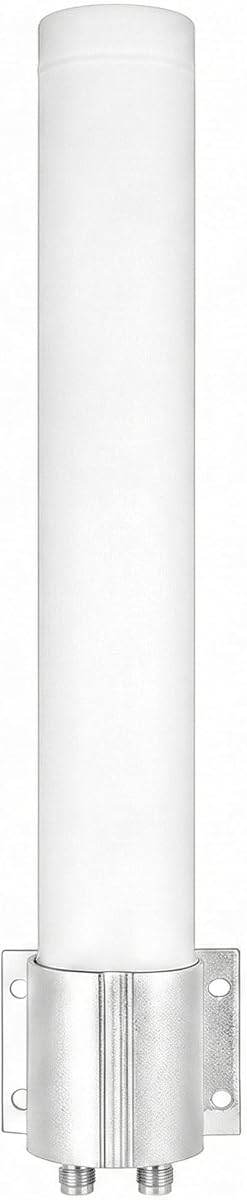
Poynting Omni-496 Dual Band
5.0Editor score
Purpose-built marine construction
Dual-band 8 dBi gain
IP68 weather protection
Explore the best Marine WiFi Antenna options, comparing marine durability, frequency bands, gain, connectors, mounting options, and Wi-Fi compatibility.
A marine WiFi antenna can make a substantial difference aboard a boat, yacht, or other vessel operating near the edge of reliable shore-based coverage. The right model must balance usable gain with weather resistance, corrosion protection, appropriate connector compatibility, and an omni-directional pattern that receives signals from ports, marinas, and nearby shores.
This guide compares ten antennas listed for marine, outdoor, RV, and related wireless applications. We evaluated the supplied specifications for frequency support, gain, mounting hardware, environmental resistance, connector type, MIMO capability, and intended equipment compatibility, while also identifying products that serve broader marine-radio or compact installation needs.
The selections show that there is no single antenna for every vessel. Purpose-built marine models emphasize saltwater resistance, while combination and panel antennas offer practical options for cellular routers, cameras, and Wi-Fi systems. Ratings, availability, and prices can change, so confirm current specifications and costs before making a purchase.
5.0Editor score

The table below compares all ten antennas by their primary role, supported frequencies, connection method, mounting approach, and environmental design, helping distinguish purpose-built marine hardware from general outdoor and wireless alternatives.


The Poynting Omni-496 Dual Band is the strongest purpose-built choice in this group for a vessel that needs dependable Wi-Fi reception in a demanding marine environment. It carries a 5.0 rating in the supplied product data and combines 8 dBi maximum gain with support for 2.4 GHz, 4.9–7.2 GHz, and 3.3–4.2 GHz 5G frequencies. That wider frequency support makes it relevant to Wi-Fi, Wi-Fi 6E, Wi-Fi 7, and other wireless systems operating across the listed bands.
We may earn a commission when you buy through this link, at no additional cost to you.
Its strongest feature is the combination of marine engineering and installation convenience. The antenna includes a 1-inch, 14-TPI marine adapter for a standard feed-through installation and an L-bracket for poles measuring 30–50 millimeters. UV and saltwater resistance address two persistent problems aboard boats: sunlight degradation and corrosion caused by persistent ocean spray. An IP68 water-ingress rating adds another layer of environmental confidence.
The N-Type female connector is conventional for fixed marine and outdoor radio equipment, but it means the installer must plan a suitable low-loss cable and matching cable-end connector. The antenna itself weighs 0.57 kilograms and measures 560 by 75 millimeters, so most owners will want to secure it above the cabin or on a mast rather than directly on a fragile surface. The marine adapter and included pole bracket are useful, although they are not a substitute for sound structural mounting.
This is the most convincing premium pick for owners who prioritize marine-specific construction, broad band coverage, and straightforward fixed mounting over a low-cost generic replacement. It is especially appropriate for a yacht, fishing vessel, cruising boat, or permanently equipped workboat using a compatible external Wi-Fi router or access point.
Salt spray, ultraviolet radiation, and persistent wind make a conventional indoor antenna a poor choice for an exposed deck or mast. This model lists marine-grade UV and saltwater resistance plus IP68 protection, directly addressing the environmental stresses that matter most at sea.
A standard 1-inch feed-through gives permanent installations a familiar route through the cabin or equipment enclosure. The included L-bracket also supports pole mounting, allowing the antenna to gain a clearer view of nearby access points.
We may earn a commission when you buy through this link, at no additional cost to you.
The Pro-Gain 2.4G/5.8G MIMO Antenna is a versatile high-gain option for boats and remote installations where the router or gateway has two external antenna ports. It offers 8 dBi gain, dual-band operation, dual N-Female connectors, and a 360-degree omni-directional radiation pattern. No customer rating was provided for this product, so its appeal rests on its stated specifications rather than a quantified review history.
We may earn a commission when you buy through this link, at no additional cost to you.
The dual MIMO arrangement is particularly useful because modern cellular gateways and enterprise routers may separate transmit and receive paths. Two N-Female connectors allow the antenna to support those paths independently, while the vertical polarization is intended to reduce multipath interference. The listed compatibility includes Cradlepoint, Peplink and Pepwave systems, Cisco equipment, Digi and Sierra Wireless modems, and gateways from major mobile network operators.
The antenna uses UV-resistant fiberglass and is listed as operating from minus 40 to 150 degrees Fahrenheit. Its stated VSWR of 1.8 or lower is also favorable for a high-performance outdoor installation. The package includes an installation manual and U-bolts and screws for attaching the antenna to a standard J-pole or mast. For the full advertised performance, the seller recommends a quality low-loss KMR240 cable run and suggests self-fusing silicone tape at exposed connections.
Its main trade-off is installation complexity. A single-cable antenna is easier to install, but this model gives advanced users a more capable MIMO arrangement. It is a strong choice for a boat with a sophisticated multi-antenna router, two clean cable routes, and a mast that can support the antenna well above obstructions.
Two integrated connectors allow compatible routers to use separate cellular and Wi-Fi radio paths. This makes the model more relevant to modern marine gateways than a basic single-antenna replacement, provided the installer can manage two low-loss cable runs.
The included U-bolts and screws simplify attachment to a standard mast or J-pole. High placement and low-loss cabling are critical because connector losses, sharply bent coax, and a crowded deck can undermine the benefit of a high-gain antenna.
We may earn a commission when you buy through this link, at no additional cost to you.
The Poynting OMNI-496 Coastal and Marine antenna is a sensible value-oriented option for owners who want marine-specific features without moving to a more specialized high-band model. It supports 2,400–2,500 MHz, 3,400–3,800 MHz, and 5,000–6,000 MHz, with a maximum gain of 7.5 dBi. IEEE 802.11a, b, g, n, and ac support covers established Wi-Fi standards.
We may earn a commission when you buy through this link, at no additional cost to you.
Its physical design is tailored to fixed installations on vessels. A feed-through 1-inch marine mount provides a clean way to pass the antenna connection through a cabin wall or equipment housing, while the L-bracket supports a 30–50 millimeter pole. The pole itself is not included, so an owner must have a suitable mast or source one separately. The N-Type female connection means a coax cable is also required.
Environmental protection is a major strength. The antenna is rated IP68 and described as robust, all-weather proof, UV protected, and saltwater protected. These characteristics make it a more credible choice for a permanently exposed vessel than a basic indoor stub antenna. Its omni-directional pattern is appropriate when the strongest access point may be found in different directions as the boat moves.
This model lacks a supplied customer rating, which makes verified-owner feedback unavailable for this comparison. Even so, the listed construction and frequency coverage give it a clear advantage over general-purpose indoor antennas. It is best for boaters seeking a straightforward dual-band, marine-grade, permanently mounted solution.
Saltwater and ultraviolet resistance are essential for an antenna exposed above the deck line. Combined with an IP68 rating, these features make the model better aligned with marine conditions than a basic plastic indoor antenna.
An omni-directional design avoids the need to rotate the antenna toward a particular marina or shoreline access point. Mounting the antenna as high as practical remains important because nearby structures and the vessel itself can still block or reflect signals.
We may earn a commission when you buy through this link, at no additional cost to you.
The 4G/WiFi/GPS 3-in-1 Combination Antenna is the most compact multi-function design in this guide. A 4.2 rating is supplied for this model, and its central appeal is consolidation: cellular, Wi-Fi, and GPS connections are combined in one through-hole puck with 24-inch leads. That can reduce the number of separate roof or cabin penetrations and keep the visible hardware to a single base.
We may earn a commission when you buy through this link, at no additional cost to you.
The listed use of an outdoor, weatherproof, marine-oriented housing makes this antenna relevant to boats with cellular routers, connected navigation equipment, or mixed wireless systems. A low-profile puck is also easier to protect from accidental impact and generally takes up less deck space than a long mast-mounted Wi-Fi antenna. Its through-hole format should be sealed properly during installation.
The available product information is limited, however. It does not provide specific frequency bands, gain figures, VSWR, connector types, or an IP rating. Those details matter because a combination antenna may use different elements for cellular, Wi-Fi, and GPS rather than a single shared radiating element. Buyers should therefore check the connector ends and device requirements before ordering.
This antenna is best for an owner who values a tidy, unified installation and needs more than one wireless function. It is less suitable as an informed choice for a high-gain Wi-Fi system where exact frequency, impedance, connector, and performance data must be confirmed. Its convenience is clear, but specifications should drive the final decision.
Combining cellular, Wi-Fi, and GPS leads can simplify wiring and reduce exterior clutter. It is particularly attractive on small vessels where every deck penetration and visible component matters.
A puck antenna can sit close to the cabin roof, reducing windage compared with a tall radiating element. Its short leads mean the device should be mounted close enough to avoid excessive cable routing, while still providing enough separation to minimize interference.
We may earn a commission when you buy through this link, at no additional cost to you.
The ALFA AOA-2458-59-TF is a lightweight outdoor Wi-Fi antenna with a stated 9 dBi gain and support for both 2.4 and 5 GHz. It has a 4.2 rating in the supplied information. The model's strongest selling point is straightforward integration: an integrated N-Female connector allows a compatible coax cable to be attached without a separate connector junction on the antenna body.
We may earn a commission when you buy through this link, at no additional cost to you.
Fiberglass construction keeps the antenna comparatively light, which simplifies handling during installation. The listed weatherproof design is suitable for outdoor networking applications, including use near an RV, access point, security camera, or marine installation where exposure is unavoidable. Its omni-directional format can help maintain continuity when the boat changes heading or when access points are distributed in different directions.
A caveat is that the supplied description does not explicitly mention saltwater resistance or an IP rating. That does not make the antenna unusable aboard a boat, but it does place more responsibility on the installer to use suitable mounting hardware, weatherproof the connector, and protect the feed-through point. Generic outdoor construction and marine-grade construction are not interchangeable standards.
The ALFA is a good choice for a vessel with one external antenna port and a preference for high nominal gain, simple installation, and minimal weight. It may be especially attractive for owners of smaller boats that cannot support a larger, heavier marine antenna. Confirm connector type, cable routing, and local salt exposure before finalizing the installation.
The integrated N-Female connector creates a single, understandable connection point. A low-loss cable with a matching N-Male termination can then run to the router, access point, or marine networking equipment.
This antenna offers 9 dBi nominal gain in a light fiberglass form. It can be a practical alternative when the installation needs meaningful outdoor gain but does not require a product explicitly certified and described for marine exposure.
We may earn a commission when you buy through this link, at no additional cost to you.
The M19B 2-Lead MIMO antenna is designed primarily for cellular connectivity rather than Wi-Fi reception. It supports cellular 4G LTE, CBRS, and 5G NR, and the supplied rating is 5.0. Its 8.6-inch high-density injection-molded ABS housing is engineered for enterprise, public-safety, marine, machine-to-machine, and Internet of Things applications, with intended use in varied climates and conditions.
We may earn a commission when you buy through this link, at no additional cost to you.
Two one-foot leads with N-Female connectors give an installer a straightforward way to connect separate cellular paths to a compatible MIMO router or gateway. The antenna-only format keeps ownership of the required radio, cable, and networking equipment with the installer. It is also TAA compliant according to the supplied description, which may be relevant for government or institutional purchasing.
Although the product is explicitly referenced for marine use, it should not be mistaken for a dual-band Wi-Fi antenna. Cellular frequencies and Wi-Fi frequencies are different, and the title does not indicate dedicated 2.4 or 5 GHz Wi-Fi elements. A boater whose primary goal is improving a cellular hotspot should consider this antenna, while someone needing shore-based Wi-Fi should choose a Wi-Fi-specific model.
This is a strong choice for a boat with a cellular MIMO router, especially one needing cellular resilience away from conventional coverage. The short included leads may require extensions depending on the equipment location, and all extension cables should be low-loss and properly secured. It is best viewed as a cellular companion, not a substitute for a marine Wi-Fi antenna.
Support for 4G LTE, CBRS, and 5G NR makes the antenna relevant to current cellular gateways. Matching the antenna to the exact modem and carrier bands remains more important than relying on a broad compatibility label.
The two N-Female leads support separate radio paths on a compatible MIMO device. Positioning the antenna high and clear of obstructions is essential because cellular signals can be affected by the vessel, nearby structures, and distant terrain.
We may earn a commission when you buy through this link, at no additional cost to you.
The Bingfu Dual Band WiFi 2.4GHz 5GHz 5.8GHz 3dBi MIMO antenna pair is a compact replacement option for compatible routers, access points, USB adapters, desktop cards, IP cameras, DVRs, industrial gateways, and other wireless equipment. It carries a 4.6 rating, which makes it one of the better-reviewed products in the supplied dataset, although that rating reflects a broader device-accessory use case rather than a dedicated marine installation.
We may earn a commission when you buy through this link, at no additional cost to you.
Each antenna provides 3 dBi gain across 2,400–2,485 MHz and 5,150–5,850 MHz with an omni-directional pattern. The package includes two RP-SMA male antennas, making it a natural choice for a two-antenna MIMO router. It can also improve the receive side of compatible security cameras, FPV equipment, wireless extenders, and remote-monitoring systems found aboard recreational or working vessels.
Connector compatibility is the decisive issue. The RP-SMA male connector has a center hole and no pin, and the supplied description explicitly asks buyers to verify this before purchase. A physical RP-SMA male plug is also not the same connection as an N-Female marine antenna, so this product requires a different cable and device arrangement from the purpose-built models listed above.
It is best for a boat owner seeking a simple, inexpensive way to replace weak router or camera antennas rather than a high-gain, saltwater-rated mast system. The pair can help a compatible device receive stronger signals, but the low-profile antennas should be mounted with clear spacing from metal, fiberglass, and other electronics to avoid severe signal loss.
The two-pack suits routers and devices that expect two external antennas for MIMO operation. Separate the antennas as much as practical, placing them on opposite sides of the device when the manufacturer permits it.
This pair can upgrade an existing system without replacing the router. It is a sensible economical choice for a cabin-mounted device, though it is not intended to serve as a high-gain marine mast antenna.
We may earn a commission when you buy through this link, at no additional cost to you.
The LINOVISION 4G LTE MIMO 3-in-1 Roof Antenna combines two cellular antennas with one dual-band Wi-Fi element. Its 3.2 rating is the lowest supplied customer rating in the group, so buyers should evaluate the product primarily against their specific router, connector requirements, and installation constraints. The combination design is still useful for boats that rely on both cellular service and local or shore-based Wi-Fi.
We may earn a commission when you buy through this link, at no additional cost to you.
Cellular coverage is listed from 698–960 MHz and 1,710–2,690 MHz, while the Wi-Fi element covers 2,400–2,483.5 MHz and 4,900–5,825 MHz. The cellular leads use SMA male connectors, and the Wi-Fi lead uses RP-SMA male. Each RG174 cable is approximately 40 centimeters long, which makes the unit practical for a router or access point mounted immediately beneath the roof or enclosure.
An IP67 waterproof rating and operating range of minus 40 to 85 degrees Celsius support outdoor use. The manufacturer identifies RVs, marine vehicles, remote Internet of Things devices, surveillance systems, and industrial environments as suitable applications. Compatibility is listed with several Linovision and Teltonika routers, while the product description says it can work with most cellular routers that have the appropriate antenna interfaces.
This antenna is best for a compact mixed-network installation where two cellular paths and one Wi-Fi path are required. Its short leads and low 3.2 rating make it less compelling for a dedicated high-gain mast arrangement, and RG174 is better suited to short runs than extended cable routes. Proper sealing and strain relief remain essential despite the waterproof housing.
Two cellular elements and one Wi-Fi element provide a balanced way to support a router with multiple radio requirements. This reduces the number of roof-mounted units when both network types are needed.
The 40-centimeter RG174 leads favor placement directly above the connected equipment. Extending these leads unnecessarily can add loss, so a more substantial outdoor antenna with proper coax may be preferable for a mast installation.
We may earn a commission when you buy through this link, at no additional cost to you.
The Eifagur 9 dBi Long Range Dual Band antenna is an economical high-gain choice for Wi-Fi routers, access points, security cameras, RV cameras, and other compatible wireless devices. Its supplied rating is 4.7, and the product information is clear about its main purpose: strengthening 2.4 GHz and 5 or 5.8 GHz connections without replacing the host networking equipment.
We may earn a commission when you buy through this link, at no additional cost to you.
The stated 9 dBi gain gives it one of the higher nominal figures in the list. That can help when a compatible access point sits near the edge of a marina, campground, or other coverage area, provided the antenna is mounted with a reasonably unobstructed view. Its outdoor-oriented construction also makes it a possible option for exterior camera or access-point installations.
The supplied information does not identify the connector, exact dimensions, operating temperature, or formal environmental rating. It also does not explicitly claim saltwater resistance. Those omissions make this less straightforward than the purpose-built marine options for a permanent exposed installation. A buyer should verify connector compatibility, grounding, and weather sealing before mounting it on a vessel.
The Eifagur is best for owners who want a straightforward antenna swap for an existing router or camera rather than a fully engineered marine network. It may be particularly useful on an RV or boat where the device already has a short lead and a simple external antenna connection. Confirm the missing installation details before relying on it in a salt-exposed location.
A nine dBi nominal antenna can improve margin when the source is weak but still within a usable range. It cannot create a usable link where distance, obstruction, or noise makes the underlying connection impossible.
The antenna is intended as a simple replacement rather than a complete networking system. Match its connector to the router or camera, mount it away from metal obstructions, and avoid extending a short lead with unnecessary signal loss.
We may earn a commission when you buy through this link, at no additional cost to you.
The HYS VHF Marine Antenna is not a Wi-Fi antenna, but it is a useful marine connectivity option for a different purpose: ship-to-ship, ship-to-shore, NOAA weather, and VHF radio communication. It has a 4.7 rating, covers 156–163 MHz, and includes a 22.9-foot, seven-meter RG-58 cable with a PL-259 connector.
We may earn a commission when you buy through this link, at no additional cost to you.
The antenna provides 3 dBi gain, 50-ohm impedance, and a listed VSWR of 1.5:1 at 159.5 MHz, remaining below 2.0:1 across the full band. It is pre-tuned for marine channels, including Channel 16 at 156.8 MHz, and covers the seven NOAA weather frequencies. The PL-259 connector mates with the common SO-239 connection found on many fixed and mobile marine radios.
Its 43.3-inch fiberglass radome has an anti-corrosion finish, while stainless steel hardware is intended to resist galvanic corrosion. A built-in nylon ratchet mount offers 180-degree adjustment and can fold down for storage, transport, or low-clearance passages. These are genuinely marine-focused characteristics, although they apply to radio reception rather than internet access.
This antenna belongs in the guide as a marine communications alternative, not as a Wi-Fi recommendation. It is appropriate for a boat whose VHF radio needs a dedicated, properly mounted antenna. A boater should not attempt to connect it to a Wi-Fi router, and the radio chassis should be grounded correctly according to the radio manufacturer to reduce electromagnetic interference and protect transmitter components.
The pre-tuned broad marine-band coverage supports conventional VHF communications and NOAA weather reception. The specified impedance and VSWR figures are meaningful for radio installations where reliable transmission and reception matter.
The adjustable mount can be positioned for reception and folded when clearance becomes necessary. The included long RG-58 cable gives installers flexibility to reach a radio mounted inside the cabin.
We may earn a commission when you buy through this link, at no additional cost to you.
The best Marine WiFi Antenna is the one that matches your router, signal bands, connector, vessel layout, and exposure level. Gain matters, but mounting height, cable quality, corrosion resistance, and the right radio interface are equally important to a dependable installation.
A permanent marine installation should prioritize UV resistance, saltwater resistance, secure hardware, and a housing designed to tolerate wind and rain. Products described specifically for marine or coastal use often include corrosion-resistant materials and formal ingress protection, while general outdoor antennas may only address moisture and sunlight. Verify the stated environmental rating rather than assuming a fiberglass or ABS housing is automatically suitable for ocean spray.
Choose an explicitly marine model when the antenna will remain mounted above deck for long periods. For a protected cabin location or temporary setup, a general outdoor unit may be adequate if its connector and construction match the environment.
The antenna must support every frequency used by the connected router, access point, cellular gateway, or camera. Common Wi-Fi equipment uses 2.4 GHz and 5 GHz, while some products also cover 5.8 GHz, Wi-Fi 6E, Wi-Fi 7, or cellular bands. A broad headline such as dual band does not reveal whether a required band is included, so compare the explicit frequency ranges with the equipment specification.
Match all active radios before buying. A cellular-only antenna will not improve Wi-Fi, and a Wi-Fi antenna should not be assumed to support a cellular gateway merely because both devices use similar connector hardware.
Gain describes how strongly an antenna concentrates energy in a particular direction, but it cannot overcome severe obstruction, excessive cable loss, or severe noise. Omni-directional antennas are usually preferable on moving vessels because they can receive access points in multiple directions without constant reorientation. Eight or nine dBi models can provide useful link margin, but placement and alignment remain as important as the gain figure.
For a boat that changes heading or rotates in a marina, favor an omni-directional pattern. Consider directional antennas only for a fixed shore installation where the transmitting location is known and will not change.
Check the antenna connector, cable connector, and router connector as a complete system. N-Female is common on marine Wi-Fi antennas, while RP-SMA male appears frequently on smaller routers and cameras. A PL-259 connection belongs to VHF radio equipment, not a Wi-Fi router. The connector type must be identical on both ends of the cable, and an adapter should not be used simply to force an otherwise incompatible connection.
Use low-loss coaxial cable for long runs and minimize unnecessary adapters. Secure both ends, avoid sharp bends, and protect exposed connectors with suitable marine-grade sealing methods.
A MIMO router may use two or more antenna connections to manage independent transmit and receive paths. A dual-connector antenna can provide better performance on a compatible gateway, but the ports must map to the correct radios and cables. A two-pack of small RP-SMA antennas is also useful for a two-antenna router, though it usually offers less gain and less environmental protection than a purpose-built marine antenna.
Determine the router's antenna architecture before selecting a multi-antenna model. Verify MIMO compatibility, connector count, and mounting separation rather than assuming that two antennas automatically create faster or stronger service.
The highest practical location usually produces the best usable result. Mast, rail, hardtop, and cabin-roof placements can reduce blockage from cabins, equipment, people, and nearby structures. The antenna should also be installed where it will not be struck by branches, rigging, passengers, or maintenance activity. A strong signal specification cannot compensate for an antenna buried beneath a roof or mounted beside a large metal object.
Plan the mounting point, cable route, and connector access before drilling anything. The included marine adapter, pole bracket, or ratchet base is helpful, but proper reinforcement may still be required on a fiberglass, wood, or metal vessel.
The antenna housing is only one part of the exposure problem. Connectors, coax entry points, fasteners, and mounting brackets must also resist salt and standing water. A feed-through installation is valuable because it keeps interior connections protected, but the entry point should be sealed according to the antenna and cable instructions. Stainless hardware helps limit corrosion, while dissimilar metals should be isolated where practical.
Inspect the installation periodically. Salt deposits, loosened fittings, cracked sealant, and corroded connectors can degrade performance long before the antenna itself becomes visibly unusable.
A better antenna will not compensate for the wrong radio interface. Some products combine Wi-Fi, cellular, and GPS, while others serve one narrow purpose. Decide whether the vessel needs a dedicated Wi-Fi antenna, cellular MIMO coverage, a combination roof unit, or a conventional VHF marine antenna. Then account for the router, radio, cables, connectors, mounting hardware, and any surge or grounding requirements.
Short-lead rooftop products are convenient for equipment mounted directly beneath them. Long or distant antenna positions benefit from a quality low-loss marine cable, but every added foot and adapter introduces potential loss.
Begin by identifying the radio, frequency bands, connector, MIMO requirements, and available mounting locations. Install the antenna as high as practical with an unobstructed view in all horizontal directions. If using a pole bracket, marine adapter, or ratchet mount, confirm that the attachment point is rigid and reinforced rather than relying only on a thin panel, railing, or decorative cover.
Route the coax with service loops and strain relief, keep it away from sharp edges and moving rigging, and avoid tight bends. Use weatherproof sealing around any feed-through point and secure the cable so wind, vibration, and wave motion cannot pull on the connector. After installation, compare signal strength, stability, and speed at several locations around the vessel rather than judging performance only while stationary at the dock.
Rinse exposed hardware with fresh water when appropriate for the vessel and installation, especially after operation in salt water. Periodically check mounting tightness, connector condition, cable damage, and sealant. Replace damaged or corroded parts promptly, and avoid painting over an antenna radome or covering a connector with an insulating sealant that could trap moisture.
Most boats benefit from a fixed, omni-directional antenna mounted above the cabin or on a mast. It can receive access points in multiple directions without being turned as the vessel moves. A purpose-built marine unit with saltwater and UV resistance is preferable for permanent exposed use, while connector and frequency compatibility determine whether it can work with your router.
No. Higher gain can improve signal strength and reliability when the source is weak but still usable, yet it cannot remove interference, correct a mismatched frequency, or overcome poor cable connections. Antenna height, low-loss coax, clear placement, and a compatible router often influence the final result as much as the advertised gain figure.
A general outdoor antenna can work for a protected or temporary installation if its frequencies and connector match the equipment. For permanent exposure to sun, wind, and salt spray, choose one explicitly described for marine or coastal conditions and protect every connection and feed-through point.
There is no single universal answer because routers use different interfaces. N-Type female is common among purpose-built marine antennas, whereas RP-SMA male is frequent on smaller routers, cameras, and access points. Identify the router's required connector and buy a cable with matching ends rather than relying on an improvised adapter.
It depends on the router. A single-antenna device needs one compatible connection, while a MIMO gateway may require two antennas for separate radio paths. Using the correct number and placement can improve performance, but incorrect port mapping or unnecessary cable extensions can reduce the benefit.
The best location is generally as high and clear as the vessel's structure allows while remaining safe from branches, rigging, passengers, and maintenance work. Avoid placing it immediately beside a large metal object or directly behind a cabin wall. The exact height is less important than achieving a clear view of nearby access points.
A combination antenna can include separate elements for Wi-Fi, cellular, and sometimes GPS, but the connectors and frequency ranges must match each device. Check the supplied specifications rather than assuming every lead on a multi-function antenna supports every radio connected to it.
Inspect the mounting hardware and cable route before and after severe weather, and check them periodically during the boating season. Salt residue, loosened fasteners, worn sealant, and connector corrosion should be addressed promptly because they can reduce both signal quality and the reliability of the installation.
The Poynting Omni-496 Dual Band stands out as the most purpose-built premium choice, with marine and coastal protection, IP68 ingress resistance, 8 dBi maximum gain, and a standard 1-inch marine mount. The Pro-Gain Dual Band MIMO option offers a strong high-gain alternative for advanced routers with two antenna ports, while the Poynting OMNI-496 Coastal model provides a more budget-oriented route to marine-grade dual-band construction.
Prioritize exact frequency, connector, and MIMO compatibility before considering gain. Mount the antenna as high as practical, use low-loss coax, keep connections protected, and confirm that the equipment is designed for the level of weather and salt exposure it will face. Combination antennas can be convenient for cellular and GPS, and compact RP-SMA antennas can improve suitable onboard devices, but neither replaces a dedicated high-gain marine Wi-Fi system.
Ratings, product availability, and prices change over time, and installation requirements differ between vessels. Before ordering, check the current listing, connector, included mounting hardware, cable requirements, and environmental claims, then compare the total installation needs rather than focusing on gain alone.