
Televes DAT BOSS Mix LR
4.6Editor score
Up to 100-mile advertised range
Band-specific intelligent gain control
FM and cellular interference filtering
Discover the best deep fringe TV antenna options for rural homes, comparing range, amplification, filtering, mounting, compatibility, and reception features.
A deep fringe TV antenna is built for viewers whose local broadcast towers are far away, weak, or obstructed by terrain and buildings. The best models combine directional gain, useful VHF and UHF coverage, clean filtering, and installation options suited to rooftops, attics, walls, or outdoor masts.
This guide compares ten antennas using the information supplied for each product, emphasizing advertised reception range, signal amplification, interference filtering, broadcast compatibility, construction, mounting hardware, and ease of setup. It includes premium outdoor models, flexible indoor options, and budget-oriented choices for different homes and signal conditions.
Each review explains where the antenna stands out, which shoppers may benefit from it, and where its design creates trade-offs. The top picks represent the strongest combinations of capability and value, while ratings and listed features provide additional context. Product prices can change, so confirm current availability before buying.
Receiving distant stations is never guaranteed by a range claim alone. Direction to towers, terrain, foliage, building materials, antenna height, cable quality, and interference can all affect results, making local channel maps and careful installation essential parts of the process.
4.6Editor score

4.6Editor score

4.4Editor score
The comparison below places all ten antennas side by side, focusing on advertised range, signal bands, amplification, filtering, installation style, and broadcast compatibility so buyers can identify the most appropriate design for their location.



The Stellar Labs HDTV 80 Mile Deep Fringe Bowtie Television Antenna is a purpose-directed option for households seeking a dedicated outdoor antenna for weak or distant broadcast signals. It carries a 4.2 rating and an advertised 80-mile range, placing its stated reach between the longer-range premium designs and more conventional midrange antennas.
We may earn a commission when you buy through this link, at no additional cost to you.
Its defining feature is the bowtie format, which concentrates reception toward a selected direction rather than treating incoming signals as an undirected indoor pickup. That makes it conceptually suitable for rural properties where one or a small number of broadcast groups sit in a known direction. A targeted pattern can be useful when unwanted transmitters or interference sit in another direction.
The trade-off is that the supplied product information is much less detailed than it is for the Televes models, the GE antenna, and several other options in this guide. It does not provide a band-by-band gain breakdown, a specific cellular filtering claim, mounting inventory, or a clear description of amplifier behavior. Buyers should therefore ask the seller what hardware is included before ordering.
This is a sensible candidate for shoppers who recognize the Stellar Labs name, understand directional outdoor antennas, and want a fringe-focused product without moving to the most complex premium design. It is best when the broadcast direction is known and the installation can be placed with a clear view toward the relevant towers.
Because actual reception depends on terrain, obstructions, tower direction, and installation height, the 80-mile figure should be treated as a maximum-style advertising claim rather than a promise. Checking local channel availability and confirming mounting requirements before installation is essential.
A directional bowtie is most effective when pointed toward the desired broadcast cluster. It can reduce receptions from other directions, so accurate aiming and tower-location research are more important than they would be with a broad indoor antenna.
The Stellar Labs model prioritizes the core fringe antenna concept rather than listing an elaborate feature ecosystem. That makes it worth comparing with models that provide more explicit gain control, filtering, and included installation hardware.
We may earn a commission when you buy through this link, at no additional cost to you.
The GE Outdoor HD Digital TV Antenna offers a balanced combination of long-range intent, broad compatibility, and practical mounting flexibility. Its 4.4 rating and stated reception distance of more than 70 miles make it one of the most approachable outdoor choices for households trying to replace a recurring television subscription with over-the-air channels.
We may earn a commission when you buy through this link, at no additional cost to you.
The antenna is designed to capture both VHF and UHF broadcasts, which matters because local stations are distributed across both frequency bands. It also supports ATSC 3.0 where available, though users need compatible hardware. Standard coax connections broaden compatibility with television brands and converter boxes, while the weather-resistant construction permits attic, roof, or mast placement.
Compared with the Televes products, the GE model does not publish detailed band-specific gain figures or a sophisticated intelligent amplification system. That means it may be less precisely specified for difficult fringe sites. It is also not described as having the same integrated filtering for FM and cellular sources. The practical advantage is a simpler proposition with fewer specialized installation components.
This pick makes the most sense for suburban and rural buyers who want an outdoor-rated antenna, can position it high, and prefer a recognizable consumer-electronics brand with technical support. It is also a stronger budget option than a basic indoor flat panel because it is explicitly designed for outdoor and attic installation.
Users should still verify the available stations with a channel map, connect through quality coax, and rescan after each major positioning adjustment. Its advertised reach is a guideline, not a guarantee, especially where hills, dense woods, or buildings interrupt the line between towers and home.
Attic mounting can preserve a discreet appearance, while outdoor placement gives the antenna a clearer path to transmitters. The housing is described as weather resistant and outdoor rated, giving shoppers options beyond a temporary indoor arrangement.
Standard coax connections and ATSC 3.0 support make the antenna relevant to a broad range of current and newer televisions. A limited lifetime replacement pledge and free U.S.-based technical support add reassurance for first-time antenna installers.
We may earn a commission when you buy through this link, at no additional cost to you.
The Televes DAT BOSS Mix LR is the most technically specified product in this guide and the strongest candidate for demanding fringe conditions. Its 4.6 rating, 100-mile advertised reach, stacked triple-boom construction, and built-in TForce amplifier distinguish it as a premium outdoor antenna rather than a basic broadcast pickup.
We may earn a commission when you buy through this link, at no additional cost to you.
The BOSS-Tech system adjusts amplification independently by band, with the product information listing 38 dBi for High VHF and 46 dBi for UHF. This approach is valuable where strong and weak channels arrive together, because uniform amplification can overload nearby signals while leaving distant ones underpowered. Integrated FM and LTE/4G/5G filtering further improves the odds of a clean result in developed or cellular-heavy areas.
Its directional geometry offers multiple directors and reflectors, with claimed front-to-back ratios of 12 dB for High VHF and 25 dB for UHF. The weather-resistant aluminum, stainless steel hardware, and durable ABS components are designed for extended outdoor exposure. A UL-listed dual-output power inserter, mast clamps, wrench, and weather boot are included, and compatible mast diameters run from 0.78 to 2.4 inches.
The antenna can operate with power for amplified reception or pass signals passively if power is unavailable, providing useful flexibility. It also supports current HDTV and UltraHD broadcasts and is designed for ATSC 3.0 signals where available. An ATSC 3.0 tuner is required for those next-generation broadcasts.
This is the recommendation for buyers with genuinely difficult signals who value precise gain management, interference rejection, and a complete outdoor installation package. Its complexity, larger directional structure, and professional orientation may be unnecessary for urban households with strong nearby signals, but fringe installers receive the most technically mature package listed here.
Independent High VHF and UHF adjustment helps preserve weak distant channels without amplifying stronger neighboring broadcasts to the point of overload. This is especially relevant for fringe locations where stations arrive from several towers at very different distances.
The stacked triple-boom design focuses energy toward broadcast towers and improves rejection of signals arriving from behind. Aluminum elements, stainless steel hardware, and included mast fittings support stable outdoor use when the antenna is properly aimed and secured.
We may earn a commission when you buy through this link, at no additional cost to you.
The Televes Ellipse Mix blends premium signal processing with a more compact footprint than the DAT BOSS Mix LR. It carries a 4.6 rating and a stated 75-mile range, making it a strong all-around option for suburban, rural, and fringe households that want professional features without the largest specialized design.
We may earn a commission when you buy through this link, at no additional cost to you.
Its built-in TForce preamplifier uses automatic gain control independently for High VHF and UHF, with listed figures of 36.5 dBi and 40 dBi respectively. The system is intended to stabilize reception as conditions fluctuate while reducing the chance of overload. FM and cellular filtering helps suppress common interference, and curved reflectors focus reception toward transmitters.
The compact 38.8 by 34 by 27-inch shape is a meaningful advantage where a larger boom antenna would be awkward. It can be mounted on a rooftop, wall, balcony, or mast, and the included mast clamp accommodates diameters from 0.78 to 2.4 inches. Assembly is described as tool-free and taking under 60 seconds, making the package more approachable than one requiring extensive construction.
The antenna includes a UL-listed 12V dual-output power inserter and can pass signals passively when power is unavailable. That dual mode provides a useful fallback during an outage and also allows informed installers to compare amplified and unamplified reception. ATSC 3.0 readiness depends on having a compatible tuner.
The Ellipse Mix is the most balanced recommendation for shoppers who want intelligent gain, strong filtering, and flexible placement. It is particularly attractive for households that need more capability than a standard indoor panel but do not require the DAT model’s specialized long-range architecture. Proper direction, height, and a quality coax connection remain essential.
The Ellipse Mix brings automatic band control and filtering into a relatively compact directional platform. That combination helps it serve as a practical middle ground between a basic outdoor antenna and a large professional-style array.
Rooftop, wall, balcony, attic, and mast placement make the antenna adaptable to apartments, suburban houses, and rural homes. Its folding or tool-free assembly and included clamp simplify the initial setup, although a compatible mast may be needed.
We may earn a commission when you buy through this link, at no additional cost to you.
The Televes 108381 8-Bay BOSS Mix is built around a distinctive two-panel configuration that can be aimed toward one broadcast cluster or split between different directions. It has a 4.3 rating and an advertised range of up to 70 miles, making it useful in areas where the strongest towers are not all located in one exact direction.
We may earn a commission when you buy through this link, at no additional cost to you.
Each of the two panels contains four stacked dipoles and 12-element flat reflectors. One panel rotates independently, allowing both to face the same direction for maximum gain or allowing the second to target a separate group of transmitters. That versatility is the product's main distinction from conventional single-direction boom antennas.
The integrated TForce preamplifier automatically adjusts gain by band, with total system gain listed up to 36 dB for High VHF and 44 dB for UHF. The antenna is optimized for High VHF channels 7 through 13 and UHF channels 14 through 36, while LTE, 4G, and 5G filtering helps limit cellular interference. It can also operate passively if power is unavailable.
The complete package includes a UL-listed 12V dual-output low-consumption power inserter and mounting hardware, but not a mast. Its aluminum elements, Zamak hardware, and ABS components are designed for outdoor exposure. Buyers will therefore need to source a suitable mast separately and plan how to support and aim the relatively large dual-panel assembly.
This model is best for fringe homes whose local stations arrive from two distinct directions or whose reception needs the option to alter alignment without replacing the entire antenna. It may be excessive for a single strong tower direction, but its rotating panels provide unusual flexibility within this category.
The independent rotation system can concentrate both panels toward one transmitter cluster for greater gain or split the array across different directions. This is particularly useful when a location receives different networks from separate geographic bearings.
A built-in intelligent preamplifier removes the need to purchase and match a separate amplifier. Automatic band adjustment and cellular filtering make the antenna a more self-contained solution for long-range outdoor reception.
We may earn a commission when you buy through this link, at no additional cost to you.
The Ophirs 2026 Digital Antenna is unusual in this lineup because it is positioned as a flexible indoor and outdoor amplified antenna with a 52-foot coax cable and a very large stated reception figure. It carries a 3.7 rating, the lowest among the ten products, so buyers should interpret its marketing claims more cautiously.
We may earn a commission when you buy through this link, at no additional cost to you.
The product is described as a 360-degree indoor system using an amplified signal booster and smart IC chip. Its range claim of more than 7,500 miles is extraordinary for a consumer television antenna and far exceeds the limits implied by the transmission range of most over-the-air broadcast stations. Distance alone therefore should not be treated as a meaningful measure of fringe performance.
More practical advantages include the switchable amplifier, which begins in short-range mode and can be changed to long-range mode if fewer channels are found. The long coax gives users freedom to place the antenna near a window, wall, cabinet, exterior railing, or other location where reception may improve. The housing is described as waterproof and moisture resistant.
The package includes the antenna, attached amplifier, USB cable, power adapter, mounting accessories, and instructions. Cellular and FM filtering is claimed, along with support for HD, 4K, 8K, and 1080p content. The recommended process is sensible: consult the DTV.gov channel map, scan, and then experiment with the amplifier setting and antenna position.
This antenna may suit renters or shoppers who want one flexible product for indoor, RV, balcony, or temporary outdoor use. It is less compelling for a carefully engineered permanent fringe installation because its broad reception pattern and exaggerated range language are not substitutes for the directional gain and detailed specifications found in the premium outdoor models.
The 52-foot cable provides far more placement freedom than a typical indoor antenna. Buyers can move the pickup unit around a home without immediately relocating the television or purchasing additional coax.
The recommended short-range starting position can help identify whether a strong local amplifier setting is needed. This approach is more sensible than immediately relying on the product's very large stated distance figure.
We may earn a commission when you buy through this link, at no additional cost to you.
The Five Star Outdoor Yagi is a compact directional antenna built around a long boom, multiple elements, and an extended receiving structure. With a 4.3 rating and an advertised range of as much as 200 miles, it is positioned as a high-reach option for rural and fringe installations.
We may earn a commission when you buy through this link, at no additional cost to you.
Yagi antennas use a driven element and a series of directors and reflectors to concentrate reception in one direction. This product is described as receiving both VHF and UHF channels while reducing noise. Its extended length and larger receiving elements are intended to improve stability compared with more compact directional designs.
The installation package includes the antenna, 40 feet of coax, and a 20-inch mounting pole. It can be installed on a roof, attic, chimney, eave, mast, or the side of a home. The product information says some sections are preassembled but full assembly is required, making basic construction skills and safe rooftop practices important considerations.
The advertised 200-mile figure is exceptionally broad and should not be interpreted as a guaranteed distance. The product details themselves acknowledge that actual reach depends on the distance to the nearest tower and obstructions between the house and tower. The lack of specific filtering and gain data also makes it harder to compare precisely with the Televes models.
The Five Star antenna is worth considering for buyers who want a traditional, highly directional Yagi, generous included cable, and a pole for immediate outdoor setup. It is best for a clearly defined transmitter direction and a safe elevated mounting point. Checking the channel map and comparing it with a more precisely specified amplifier model remains advisable.
A Yagi boom concentrates energy toward its forward direction, which can help a rural home ignore signals arriving from less useful locations. Accurate orientation and a clear path toward the towers are critical to realizing the design's potential.
Forty feet of coax and a 20-inch pole provide a practical foundation for many installations. Additional mounting hardware may still be needed depending on the roof surface and the chosen attachment method.
We may earn a commission when you buy through this link, at no additional cost to you.
The Antennas Direct ClearStream 4V is a compact outdoor antenna that uses four patented loops, Hi-VHF elements, and reflectors instead of the long directors found on a conventional Yagi. It has a 4.4 rating and is suited to suburban and rural properties that need a focused but space-conscious installation.
We may earn a commission when you buy through this link, at no additional cost to you.
Dedicated UHF and Hi-VHF elements allow the antenna to receive both broadcast groups, while the reflectors concentrate incoming energy and help protect the signal from interference. The listed 43-degree horizontal pattern offers a defined directional approach without requiring the physical span of a full-size multi-element Yagi.
The complete package includes reflectors, a Hi-VHF kit, a 20-inch mast with pivoting base, all-weather mounting hardware, an adjustable mast clamp, and instructions. The pivoting base allows the assembly to be installed on vertical or horizontal surfaces, which is useful on roofs, walls, and other structures. A manufacturer lifetime warranty is also listed.
Unlike many amplified competitors, the product information does not claim a large numeric reception range or describe an active preamplifier. That is not necessarily a drawback: avoiding a powered component can simplify the system and reduce opportunities for overload or excessive gain. Reception still depends on tower distance, buildings, trees, and the home's location.
This model is a compelling choice for shoppers who prefer a relatively compact outdoor system with a complete hardware package. It also supports NextGen TV, 4K, 8K UHD, and Full HD 1080p broadcasts over the air. It cannot deliver cable-only channels, and buyers should confirm local over-the-air availability before installation.
The loop-based layout occupies less space than a large Yagi while using reflectors to improve forward gain. The result is especially relevant for properties where a long horizontal boom would be inconvenient.
The included mast, pivoting base, reflectors, hardware, and instructions cover the core installation. Because the antenna does not rely on a powered preamplifier, setup avoids a separate power supply and associated signal-chain complexity.
We may earn a commission when you buy through this link, at no additional cost to you.
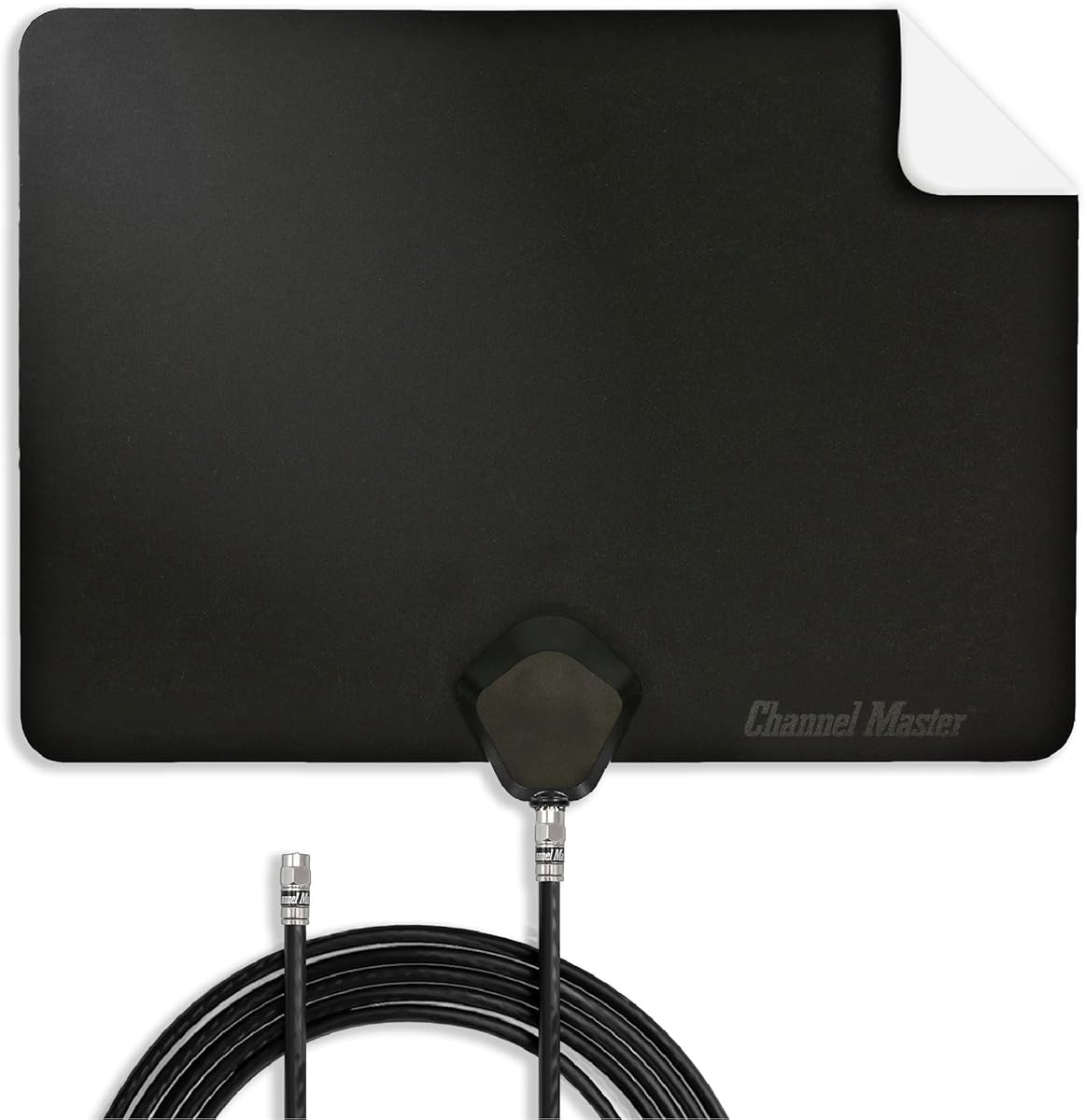
The Channel Master FLATenna is the most compact and visually discreet option in this guide. It has a 4.1 rating and a stated 35-mile range, which makes it more appropriate for urban and suburban homes than for the most demanding rural fringe locations.
We may earn a commission when you buy through this link, at no additional cost to you.
Its thin, lightweight, reversible panel can be placed on a wall, near a window, or on a tabletop. The reversible black-and-white design lets buyers choose the face that looks more suitable for their room. Because indoor antennas cannot be mounted high above surrounding obstructions, every window, wall, and neighboring building can affect reception.
The included 12-foot professional-grade RG6 coax uses enhanced shielding to improve signal reliability. A flat panel that can be moved easily is valuable for experimentation, particularly in apartments where the best window or wall position may change with the season or nearby construction.
The antenna supports ATSC 3.0 and 4K broadcasts and can receive major local network groups such as ABC, CBS, FOX, NBC, PBS, Univision, and Telemundo when they are available in the area. Channel Master describes itself as a television antenna technology provider operating since 1949, adding a long-established manufacturer background.
The FLATenna is best for buyers who want a neat indoor setup, modest space usage, and easy repositioning rather than a permanent roof installation. Those living beyond the reach of strong local towers should consider an outdoor directional antenna, since the panel's modest 35-mile figure and indoor placement limit fringe performance.
The ultra-thin profile avoids the visual bulk associated with outdoor antennas. Its reversible finish and multiple mounting options make it easier to integrate into apartments, bedrooms, and living areas.
The included 12-foot RG6 cable is designed to preserve signal integrity while reducing interference pickup. Its length also gives users practical freedom to move the panel away from electronics or behind obstructing furniture.
We may earn a commission when you buy through this link, at no additional cost to you.
The PBD Amplified Outdoor TV Antenna offers a distinctive installation experience through its 360-degree motorized rotation and wireless remote control. It carries a 4.3 rating and an advertised reception distance of up to 150 miles, positioning it as a long-range option for rural and urban homes.
We may earn a commission when you buy through this link, at no additional cost to you.
Instead of climbing a ladder for every directional adjustment, users can rotate the antenna remotely. This is especially helpful when transmitters lie in different directions or when precise alignment materially affects which stations appear in a channel scan. The built-in high-gain, low-noise amplifier is intended to strengthen received signals and support stable HD viewing.
A second practical feature is the dual television output. Two screens can be connected without a separate splitter, which is useful in bedrooms, kitchens, and other secondary viewing locations. The package includes 40 feet of RG6 coax, mounting hardware, and a detailed guide, so the core installation materials are provided.
The housing is described as weatherproof and durable for year-round outdoor use. It also supports ATSC 3.0 where available, although the available broadcast ecosystem and tuner determine what content can actually be received. The product information does not specify detailed band gains or cellular filtering, so it is less technically specified than the Televes products.
This model is best for households that value remote aiming, dual-screen convenience, and a straightforward amplified outdoor package. Motorized positioning can eliminate repeated manual alignment, although it adds a powered mechanical component that must be protected from weather and operated only within the manufacturer's intended range.
A wireless controller allows the antenna to be rotated after it has been mounted. Users can compare directions without repeated ladder work, making the process much easier when broadcast towers occupy several bearings.
The two television outputs simplify a whole-home connection without requiring a separate splitter. This is especially convenient for households that want local channels in more than one room.
We may earn a commission when you buy through this link, at no additional cost to you.
The right deep fringe antenna depends less on the largest advertised mile figure and more on the broadcast environment at the home. Review signal bands, directional design, amplification, filtering, mounting requirements, and included equipment before choosing a model.
Start with the FCC or DTV.gov channel map for the intended viewing address. Note which network groups are available and their approximate bearing relative to the home. A directional antenna can deliver stronger results when it is aimed toward those towers, but it may perform poorly if rotated toward an empty sector or a source of unwanted signals.
Choose directionality based on the layout of your local transmitters. A compact multi-directional or indoor panel may be adequate when several towers surround the home, while a Yagi, bowtie, triple-boom, or rotating panel becomes more useful when the desired stations are concentrated in one direction.
Local stations may appear on VHF channels 7 through 13, UHF channels 14 through 36, or both. Some antennas allocate more gain and physical elements to one band than the other. High VHF support deserves particular attention in markets where ABC, CBS, NBC, or other important networks occupy the lower broadcast band.
Look for explicit High VHF and UHF support rather than a vague full-band claim. The Televes Ellipse Mix, DAT BOSS Mix LR, and 8-Bay BOSS Mix all publish band-specific information, while the ClearStream 4V identifies dedicated Hi-VHF and UHF elements. Verify the local channel lineup before making the final choice.
Advertised range is a simplified way to describe potential reach, not a guaranteed performance level. Broadcast tower power, directional patterns, terrain, foliage, buildings, antenna height, coax quality, and electrical interference can produce dramatically different results. A distant low-power station may be harder to receive than a stronger station in the same nominal range.
Use the range figure to identify products designed for fringe sites, but base expectations on local channel availability. The 100-mile Televes DAT BOSS Mix LR and 200-mile Five Star Yagi both make strong maximum-style claims, yet the physical direction of the towers and the unobstructed signal path remain more important than the headline number.
An amplifier can make weak signals usable, but excessive gain can overload a receiver and degrade stronger channels. Intelligent or automatic gain systems are particularly useful because they adjust by band as signal conditions change. The Televes models use independent High VHF and UHF control, while the GE option offers a simpler long-range proposition without published band-specific figures.
More amplification is not automatically better. Start with the antenna's recommended setting, use quality RG6 coax, and avoid unnecessary distribution losses. If channels disappear near a transmitter, a preamp may be too strong for that environment, and a passive directional antenna such as the ClearStream 4V may be more appropriate.
FM radio, cellular transmitters, and other electronic sources can disrupt digital television reception, particularly in dense areas. Antennas with dedicated filters may produce cleaner scans and reduce pixelation caused by overload. The Televes DAT BOSS Mix LR and Ellipse Mix include FM and LTE, 4G, and 5G filtering, while the 8-Bay BOSS Mix includes LTE, 4G, and 5G filtering.
Filtering does not repair weak signals, and it cannot remove interference that enters downstream through poor grounding or faulty coax. It is nevertheless an important feature for homes near cellular infrastructure. Pair the antenna with sound cable connections and properly secured mast hardware to prevent additional noise pickup.
The best performing outdoor antenna is usually the one that can be mounted high with a clear view toward the towers. Attics reduce visual impact but may introduce roofing materials and walls that weaken the signal. Rooftop or exterior-wall placement can improve reception, although installers must follow safe working practices and avoid power lines.
Check the included hardware before buying. The Televes DAT BOSS Mix LR supplies mast clamps and a wrench, the Ellipse Mix includes a mast clamp, the Five Star package includes a pole and coax, and the PBD model includes 40 feet of RG6. The 8-Bay BOSS Mix does not include a mast, so its owner must plan that purchase separately.
A large directional array can be inconvenient on a small roof, balcony, or side wall. Compact options such as the Channel Master FLATenna, GE outdoor antenna, and ClearStream 4V require less physical space, although the FLATenna is intended for indoor placement and has a shorter advertised reach.
Consider both the antenna and the path of its coax. A large structure that cannot be aimed properly may be less useful than a smaller antenna pointed accurately at the towers. Motorized options such as the PBD antenna add rotation convenience but also introduce a powered mechanism that requires weather protection.
Look for support for ATSC 3.0, 4K, and 8K UHD where those formats matter in your market. Modern compatibility does not guarantee access to every station because the broadcaster must transmit in the relevant format and the television or tuner must support it. The Antennas Direct model notes that an ATSC 3.0 tuner is required for next-generation broadcasts.
Also confirm that your television or converter box accepts standard coax connections. The GE antenna is explicitly described as compatible with all brands and converter boxes using that connection. Consider future channel changes, regional rebroadcasts, and whether you plan to connect more than one screen before finalizing the installation.
Begin by consulting a local digital channel map and confirming that the intended television or converter box supports ATSC 1.0, and ATSC 3.0 if you expect next-generation broadcasts. Connect the antenna through quality RG6 coax, power the built-in amplifier if applicable, and place the antenna in a starting position with the clearest possible view toward the available towers. Perform an initial channel scan before making further changes.
Fine-tune the direction one small adjustment at a time. For a manual directional model, rotate or reposition it toward the transmitter bearing and rescan after each move. For the PBD motorized antenna, use the remote to compare angles. If a motorized or outdoor model offers amplified and passive modes, test both when practical, because excessive gain can sometimes reduce the number of stable channels. For the Ophirs unit, begin with short-range mode and increase the setting only if needed.
For outdoor care, inspect mounting points, weather seals, cable connections, and the power supply periodically. Tighten loose hardware, keep coax free from sharp edges and standing water, and avoid placing the antenna where tree growth or roof work could disturb it. Do not adjust a rooftop antenna during wet, icy, windy, or otherwise unsafe conditions. If reception changes after major landscaping, construction, or seasonal foliage growth, revisit the position and run another scan.
The best rural antenna is usually a high-gain directional model mounted as high as practical and aimed toward local towers. Features such as High VHF support, intelligent amplification, and cellular filtering can improve stability, but no range claim guarantees every station. Local terrain, tower power, foliage, and installation height may matter more than the model name.
Actual reception distance depends on transmitter power, antenna direction, terrain, buildings, vegetation, and signal interference. Products in this guide advertise ranges from 35 miles to more than 7,500 miles, but those figures should not be compared as direct performance measurements. A strong tower can be received farther away than a weak one, and an obstructed signal can fail much earlier than its nominal reach.
Amplification can help when the correct antenna geometry produces a weak but clean signal. It is less helpful when a strong nearby transmitter overloads the tuner, and too much gain may make reception worse. The Televes models use automatic band-specific gain, while the Antennas Direct ClearStream 4V uses passive reception, illustrating that amplification is not automatically the better approach.
An outdoor antenna is generally better for deep fringe reception because it can be mounted higher and placed with fewer obstructions between itself and the towers. Indoor flat panels are more convenient for apartments and strong urban markets, but walls, windows, and neighboring buildings can severely reduce the number of available stations. Even a compact outdoor model may outperform a larger indoor panel.
Use a local channel map to identify the direction of the transmitters carrying the channels you want, then point the antenna toward that bearing. Scan after each adjustment, since even a small rotation can change the result. A remote-controlled antenna can make this process easier, while a compass or map-based application can help establish the initial direction.
ATSC 3.0 is a broadcast standard that can provide enhanced over-the-air services where broadcasters and receivers support it. An ATSC 3.0-compatible antenna does not create access by itself; the station must transmit the signal and the television or tuner must decode it. For the Televes products in this guide, compatible next-generation tuner hardware is explicitly required.
Use the shortest practical run of quality RG6 cable to reduce signal loss, while leaving enough length to position the antenna safely. The Five Star package includes 40 feet, the PBD model includes 40 feet, and the Channel Master FLATenna includes 12 feet for indoor use. Avoid cheap, poorly shielded substitutions, especially for long outdoor runs.
Possible causes include incorrect direction, excessive amplifier gain, weak or damaged coax, poor connections, nearby interference, and signals blocked by terrain or buildings. Start by checking the channel map, simplifying the signal path, and rescanning. If nearby towers are very strong, trying passive operation or a less aggressively amplified model may help.
The Televes DAT BOSS Mix LR is the strongest premium option for buyers facing difficult long-range conditions, offering independent band gain, integrated cellular and FM filtering, a directional triple-boom design, and a complete installation package. The Televes Ellipse Mix provides a more compact balanced alternative, while the GE Outdoor HD Digital TV Antenna stands out as the best budget-oriented outdoor purchase with broad compatibility and straightforward placement.
Prioritize local channel availability, transmitter direction, and VHF and UHF coverage before focusing on the largest advertised mileage figure. Installation height, quality coax, a secure mount, and careful aiming can influence results as much as the antenna itself. Filtered and intelligent amplification offer advantages in difficult environments, but simpler passive designs can work well when the signal path is clean.
Before purchasing, confirm the product's included mast, coax, power inserter, mounting hardware, television connections, and ATSC 3.0 requirements. Product prices, availability, and seller terms can change over time, so check the current listing and compare the complete package before making a final decision.