
Lian Li A3-mATX PC Case, 415mm GPU, 360 AIO, Wood Black Mesh (A3X-WD)
4.8Editor score
Compact 26.3-liter enclosure
Supports 415mm graphics cards
Accommodates 360mm radiators
Walnut-look front panel
Explore the best horizontal PC cases, comparing slim HTPC designs, compact micro-ATX builds, airflow, cooling, and hardware compatibility.
Horizontal PC cases are built to complement living-room displays, entertainment centers, desks, and other spaces where a traditional tower would feel intrusive. Their defining traits include a low-profile chassis, a restrained exterior, convenient front access, and enough flexibility for modern components. A well-matched case can look like part of the room rather than a piece of computer equipment placed on top of it.
This guide compares ten cases designed for horizontal placement or flexible horizontal-and-vertical operation. The comparison considers motherboard support, graphics-card clearance, CPU-cooler height, power-supply options, radiator capacity, airflow, dust control, connectivity, and the visual treatment of each enclosure. Both dedicated home-theater models and compact cases with a more enthusiast-oriented feature set are represented.
Each selection highlights the qualities that distinguish it from the alternatives, while also noting the compromises buyers should consider. The list includes designs for restrained living-room systems, compact gaming rigs, thermally demanding hardware, and builders who want easy access without sacrificing compatibility. Product availability and prices can change, so confirm current details and component limits before ordering.
4.8Editor score

4.5Editor score

4.5Editor score
The table below compares all ten cases by form factor, motherboard support, graphics-card clearance, cooling capabilities, and defining practical features. Use it as a quick guide before reviewing the detailed recommendations.


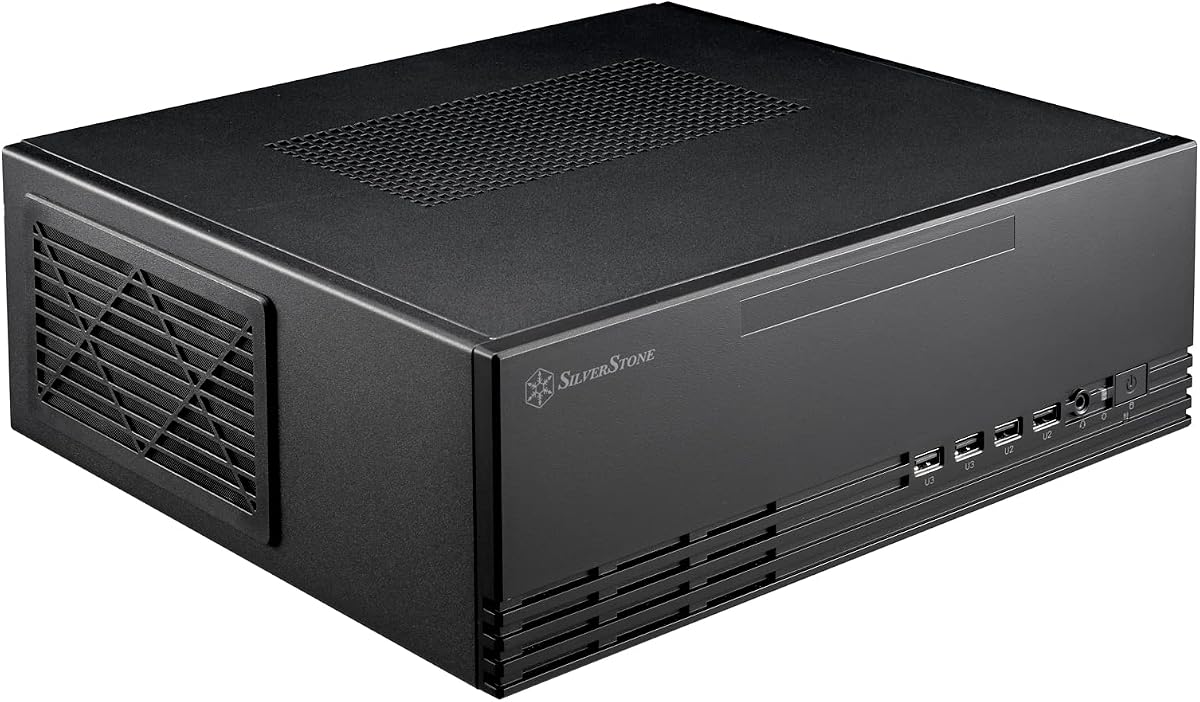
The SilverStone GD09 is a purpose-built home-theater enclosure that earns its place at the top of this list for balancing understated appearance, broad motherboard compatibility, and considered airflow. Its 4.5 rating reflects a generally favorable reception, while the positive-pressure design, quick-access filters, and long chassis make it especially practical for living-room and cabinet installations.
We may earn a commission when you buy through this link, at no additional cost to you.
Its most important strength is the positive-pressure airflow architecture. Rather than relying only on a front intake, the design supports controlled airflow intended to reduce dust while keeping noise under control. The chassis accepts SSI-CEB, ATX, and Micro-ATX motherboards, giving it unusual flexibility for a low-profile case. Support for SilverStone RA02 rackmount ears adds another layer of placement flexibility for home-theater furniture.
The trade-offs center on the fact that it is a specialized HTPC design rather than a general-purpose compact tower. Its 358mm depth is generous for the format, but buyers should still verify graphics-card and power-supply dimensions against the exact components they intend to use. The front-panel feature set is also simpler than that of the most recent gaming cases, so modern USB preferences may influence the decision.
This is the strongest general recommendation for someone building a low-profile entertainment PC that must disappear into a cabinet or sit beneath a television. It suits ATX boards that would otherwise force a much larger enclosure, rewards buyers who value clean airflow and serviceable filters, and avoids many of the visual excesses associated with gaming cases.
The faux-aluminum finish and broad 358mm depth are designed to make the GD09 practical inside home-theater furniture. Its restrained exterior is better suited to a media cabinet than a highly stylized gaming chassis.
Positive pressure helps manage dust, while the included quick-access filters simplify routine cleaning. This combination is particularly valuable in an enclosed cabinet where airflow and maintenance access matter more than decorative lighting.
We may earn a commission when you buy through this link, at no additional cost to you.
The Cooler Master QUBE 540 is a compact mid-tower that can be installed horizontally or vertically, giving it unusual flexibility for a performance-oriented build. Its 4.4 rating and broad hardware support make it a strong option for users who want desktop-class compatibility without committing to a full-size tower. The 415mm graphics-card allowance is especially notable.
We may earn a commission when you buy through this link, at no additional cost to you.
A reversible I/O panel and movable handles make orientation changes more practical. The case supports ITX, ATX, and large E-ATX motherboards up to 11 inches wide, while the full front mesh and pre-installed SickleFlow 120mm fan promote airflow. Front connectivity includes two USB 3.2 Gen1 ports and a USB 3.2 Gen2 Type-C port.
Its main drawback is that the QUBE 540 is still closer to a compact mid-tower than a purpose-built horizontal HTPC enclosure. The tempered-glass area may collect fingerprints, and a horizontally positioned mid-tower can occupy more visual and surface space than the dedicated entertainment cases in this guide. Users seeking a small box for a television cabinet may prefer a more traditional low-profile model.
The case is best for a builder who wants horizontal placement as an option rather than a requirement, especially when using a long graphics card or an E-ATX motherboard. It also works well for a powerful compact workstation that occasionally changes orientation, making its reversible panel and broad compatibility particularly valuable.
Graphics cards up to 415mm can be accommodated when the front fan is absent, opening the case to substantial gaming hardware. Support for E-ATX boards also makes it useful for high-end desktop platforms.
The reversible I/O panel and movable handles reduce the inconvenience of operating the enclosure horizontally or vertically. That flexibility is useful when moving a system between a desk and display area.
We may earn a commission when you buy through this link, at no additional cost to you.
The SilverStone Grandia 11 combines a distinctive stereo-shaped HTPC design with cooling provisions that go beyond many low-profile alternatives. Its 4.5 rating supports a favorable overall assessment, and the 240mm radiator support is the standout specification for buyers considering liquid cooling in a home-theater enclosure.
We may earn a commission when you buy through this link, at no additional cost to you.
The shortened chassis and fully meshed front panel create a large intake surface, while the positive-pressure design is intended to improve cooling and dust prevention. Motherboard support includes SSI-CEB, ATX, and Micro-ATX. An adjustable LED indicator provides a small status display without turning the enclosure into a brightly illuminated gaming product.
The specialized shape and internal layout may not suit every enthusiast, and buyers should confirm the fit of the graphics card, power supply, and radiator before committing. Compared with simpler entertainment cases, the Grandia 11 offers more thermal headroom, but that capability also introduces more dimensional constraints that must be checked against planned components.
Choose this premium option for a media-center PC that needs to handle substantial heat while retaining a purposeful entertainment-room appearance. It is particularly persuasive for builders who want radiator support and a large intake area in a dedicated HTPC format rather than adapting a conventional tower.
The 240mm radiator allowance gives this HTPC case more cooling flexibility than many similarly low-profile designs. It can accommodate a more capable thermal solution for sustained workloads.
The stereo-shaped enclosure and restrained adjustable indicator create a purposeful media-center look. It is visually distinct without relying on the aggressive styling common to gaming cases.
We may earn a commission when you buy through this link, at no additional cost to you.
The Lian Li B4-mATX blends a compact 21.3-liter footprint with a wood finish that suits desktops and entertainment setups. Its 4.5 rating indicates strong customer reception, while the included slim fans and dual positioning make it convenient for builders who want a small system that can sit flat or operate vertically.
We may earn a commission when you buy through this link, at no additional cost to you.
The chassis supports Micro-ATX motherboards, graphics cards up to 358mm, and CPU coolers up to 165mm tall. Two non-RGB 120mm slim fans are pre-installed, providing a useful starting point for airflow. Black walnut and white beech wood finishes give the case a more residential appearance than a conventional metal gaming enclosure.
Cooling configuration depends partly on power-supply choice, which is an important limitation when considering a 360mm AIO. Micro-ATX-only motherboard support is reasonable for a compact model, but builders starting from an ATX component may need to change boards. The wood finish may also be less desirable for a purely utilitarian office build.
The B4-mATX is well suited to a refined small-form-factor system that needs to look at home beside a television or monitor. It works especially well for owners who want good hardware clearance, attractive materials, and orientation flexibility without the footprint of a full tower.
Real wood finishes differentiate the B4-mATX from metal-and-glass gaming cases. The result is better suited to a living room, office, or minimalist desktop arrangement.
Two slim 120mm fans provide immediate airflow without requiring the builder to source every fan separately. Additional cooling remains configurable within the limits imposed by the selected power supply.
We may earn a commission when you buy through this link, at no additional cost to you.
The Cooler Master Q300L V1 is a flexible Micro-ATX enclosure that can be placed horizontally even though it retains a recognizable tower shape. Its 4.5 rating reflects solid customer satisfaction, and the combination of a transparent panel, perforated construction, and adjustable I/O panel makes it a practical entry point for compact builds.
We may earn a commission when you buy through this link, at no additional cost to you.
The interior supports Micro-ATX and Mini-ITX motherboards, CPU coolers up to 159mm, graphics cards up to 360mm, and power supplies up to 160mm long. Its open thermal design promotes airflow, while the modular I/O panel can be placed at the front, top, or bottom on either side. A magnetic dust filter adds a practical finishing detail.
Because the enclosure is not exclusively low-profile, horizontal placement may not produce the same furniture-friendly effect as a dedicated HTPC case. The open, highly perforated structure can expose cables and internal components, and the transparent panel may require more care to keep visually clean. Builders should also check dimensions more carefully because its tower-derived footprint is less compact than several models here.
This is a sensible option for a first compact build that may be upgraded over time. It accommodates a wide range of standard components, offers multiple cooling options including support for a 240mm liquid cooler and five fans, and can be oriented to suit the available space.
The modular I/O panel can move among the front, top, and bottom positions on both sides. This flexibility helps maintain convenient access regardless of orientation or surrounding furniture.
Perforated panels promote cooling while the transparent section exposes the components. The design prioritizes airflow and build visibility over a completely closed, minimalist appearance.
We may earn a commission when you buy through this link, at no additional cost to you.
The Shiny Snake G300 is a 16.8-liter portable small-form-factor gaming chassis designed for users who want performance and transportability. Its 4.4 rating reflects a favorable response, while the military-grade-rated handle, vibration-dampened base, and support for substantial graphics hardware distinguish it from conventional low-profile cases.
We may earn a commission when you buy through this link, at no additional cost to you.
It fits Micro-ATX boards, four-slot graphics cards up to 340mm, CPU coolers up to 164mm, and ATX power supplies up to 140mm when using air cooling. Liquid cooling introduces a key power-supply constraint: an SFX or SFX-L unit allows support for a 240mm or 280mm AIO radiator. The front I/O includes USB 3.2 Gen2 Type-C, two USB 3.0, and two USB 2.0 ports.
Tool-free access and a removable PCI bracket simplify maintenance and component changes. Horizontal power-supply placement is intended to reduce cable interference with the graphics card, but the 16.8-liter volume leaves little room for arbitrary combinations of large parts. The aluminum mesh and claimed 60% dust-intake reduction compared with standard designs still require regular filter and surface care.
The G300 is a strong recommendation for a portable gaming PC intended for LAN events, dorm moves, or frequent transport. It is less natural for a stationary living-room build where a traditional front-panel layout and quieter, more decorative enclosure would take priority.
Support for four-slot graphics cards up to 340mm allows the compact chassis to host serious gaming hardware. The result is more performance-oriented than many entertainment-focused horizontal designs.
A handle rated for 30kg and a vibration-dampened base are meaningful advantages for frequent travel. The removable bracket and tool-free access further support a portable maintenance workflow.
We may earn a commission when you buy through this link, at no additional cost to you.
The Lian Li A3-mATX is the standout value in this collection, combining a 4.8 rating with extensive hardware support in a 26.3-liter horizontal enclosure. Its 415mm graphics-card clearance, 360mm radiator capability, and walnut-look front panel make it more capable than its budget-oriented positioning might initially suggest.
We may earn a commission when you buy through this link, at no additional cost to you.
Steel mesh side and top panels support airflow for high-TDP graphics cards and radiator setups. The case accommodates Micro-ATX and ITX motherboards with four expansion slots, supports up to ten 120mm fans, and offers installation options for ATX, SFX, SFX-L, and LIAN LI EDGE power supplies. A fan-and-radiator placement diagram is included in the product images to help with planning.
The principal limitation is motherboard format: a builder committed to full ATX cannot use this case without changing the board. Power-supply orientation and radiator placement also require advance planning, and the wood aesthetic will not suit every taste. Even so, the combination of clearance and cooling flexibility is unusually capable for a compact horizontal build.
This is the best-value recommendation for a compact system that combines gaming hardware, a restrained wood-look front, and extensive cooling options. It is especially attractive when a 26.3-liter footprint is acceptable and the builder is comfortable using a Micro-ATX or ITX motherboard.
The 415mm graphics-card allowance provides room for long, high-end models despite the 26.3-liter volume. That combination helps builders avoid sacrificing their desired graphics card to save desk space.
A 360mm radiator and up to ten 120mm fans can be supported, giving the enclosure room for substantial thermal hardware. Steel mesh panels complement that capacity by encouraging airflow.
We may earn a commission when you buy through this link, at no additional cost to you.
The SilverStone GD09B-C is a dedicated home-theater case that adds a front USB Type-C port to the familiar GD09 concept. Its 4.3 rating is slightly below the strongest options in the guide, but the specialized layout, positive-pressure airflow, and serviceable filters remain compelling for entertainment-system builders.
We may earn a commission when you buy through this link, at no additional cost to you.
The case supports SSI-CEB, ATX, and Micro-ATX motherboards and can use SilverStone RA02 rackmount ears. Its positive-pressure architecture is designed to promote cooling and quiet operation while limiting dust. The front Type-C connection is particularly convenient for modern accessories, and the quick-access filters make periodic cleaning less cumbersome.
The supplied feature information is less extensive than for several newer designs, so prospective buyers should confirm important dimensions and connector details directly. It is also a purpose-built HTPC product rather than a broad small-form-factor platform, which can mean less flexibility for oversized graphics cards or elaborate cooling arrangements.
The GD09B-C makes sense for a living-room system that values a low-profile enclosure, convenient modern connectivity, and straightforward maintenance. It is a practical alternative to the standard GD09 when front USB Type-C is a deciding requirement.
The front USB Type-C port is a meaningful convenience for frequently connected accessories. It reduces the need to reach around the case or rely entirely on rear connections.
Positive pressure and quick-access filters support a cleaner, quieter installation. These details are especially helpful when the computer lives in a confined entertainment cabinet.
We may earn a commission when you buy through this link, at no additional cost to you.
The SilverStone GD09B is an established aluminum-style HTPC enclosure built around ATX compatibility and a low-profile living-room footprint. Its 4.3 rating indicates a generally positive reception, and the positive-pressure design, removable filters, and substantial depth give it a clear identity as a practical media-center enclosure.
We may earn a commission when you buy through this link, at no additional cost to you.
Motherboard support includes ATX, and expansion cards can measure up to 12.2 inches. The 358mm chassis depth is intended to provide comfortable placement within a home-theater cabinet. Positive air pressure helps with cooling, quietness, and dust prevention, while quick-access filters simplify routine maintenance in a confined environment.
Compared with newer alternatives, its listed specifications focus on the essentials and provide less detail about contemporary port selection or radiator support. The large expansion-card allowance does not guarantee compatibility with every modern GPU, so exact dimensions should be checked. Buyers who require USB Type-C at the front may prefer the GD09B-C version instead.
The GD09B remains a credible choice for an ATX-based entertainment system where quiet operation, clean dust management, and cabinet placement matter. It is especially useful for builders who do not need the styling or extensive feature set of a compact gaming chassis.
The low-profile aluminum appearance and 358mm depth suit placement inside a home-theater cabinet. It is designed to blend into a media setup rather than dominate it.
Full ATX support remains the central advantage for users who want a standard motherboard in a horizontal enclosure. The positive-pressure layout helps manage the thermal and dust challenges associated with confined placement.
We may earn a commission when you buy through this link, at no additional cost to you.
The SilverStone Milo 11 is the most compact dedicated enclosure in the guide, built for office or home-theater use in either horizontal or vertical orientation. Its 4.1 rating is the lowest in this selection, but that figure should be considered alongside a tightly defined set of specialized strengths, including a 10.35-liter volume and support for slim optical drives.
We may earn a commission when you buy through this link, at no additional cost to you.
The enclosure accepts Micro-ATX motherboards and requires a TFX-form-factor power supply, which is sold separately. The restricted power-supply standard helps the case remain slim, and its dual orientation allows it to be used flat on a desk or upright when vertical space is more practical. Support for one 9.5mm slim optical drive is useful for legacy optical-media workflows.
The TFX requirement is the most important trade-off. Prospective owners must source a compatible unit and account for the added complexity of a less common form factor. The Micro-ATX restriction and 10.35-liter volume also limit the kind of hardware that can be installed, making this case less suitable for large graphics cards or expansive cooling systems.
The Milo 11 is best for a highly compact office or media system using Micro-ATX components and a TFX power supply. Buyers should prioritize its small footprint and dual orientation, but they should also verify the full component list before treating it as a general-purpose compact PC enclosure.
At 10.35 liters, the Milo 11 offers a notably smaller volume than the other dedicated cases. It is well suited to understated office and entertainment installations where every inch matters.
The required TFX form factor enables the slim design but demands careful PSU selection. Builders should confirm the exact power supply, motherboard, graphics card, and cooling arrangement as one compatible package.
We may earn a commission when you buy through this link, at no additional cost to you.
A horizontal PC case must balance footprint, appearance, cooling, accessibility, and component compatibility. The right choice depends less on the shape alone than on whether every major part fits and the enclosure can remain accessible in its intended location.
Start with the motherboard because it establishes the case's possible size, expansion-slot count, and internal layout. The SilverStone GD09, Grandia 11, and GD09B-C support ATX and Micro-ATX, while the Lian Li A3-mATX and B4-mATX are limited to Micro-ATX and ITX. The SilverStone Milo 11 accepts Micro-ATX but is much smaller and requires a TFX power supply.
Choose a case that supports the board you own, or budget for a motherboard change. A nominal ATX label alone does not guarantee that every ATX component, including the graphics card and power supply, will fit.
Graphics cards vary dramatically in length, and a long modern GPU can be the decisive dimension in any compact enclosure. Clearance ranges from 340mm in the Shiny Snake G300 to 415mm in the QUBE 540 and Lian Li A3-mATX, with the SilverStone GD09 family supporting expansion cards up to 12.2 inches according to the listed specifications.
Measure the actual card, including its cooler and power connector, rather than relying only on the advertised chip length. Also check whether the listed clearance depends on removing a front fan, as it does in the QUBE 540.
Low-profile cases must use either a low-profile air cooler or a compatible liquid cooler. The Lian Li B4-mATX supports CPU coolers up to 165mm, the Shiny Snake G300 up to 164mm, the Cooler Master Q300L V1 up to 159mm, and the QUBE 540 accommodates large E-ATX boards within a compact ATX form factor.
Check the height from the motherboard surface to the side panel, not just the cooler specification. If the case is already tightly packed, leave enough clearance for airflow and cable routing around the fan.
Cooling capacity varies from simple mesh airflow to substantial liquid-cooling support. The Lian Li A3-mATX accepts a 360mm radiator, the Shiny Snake G300 supports 240mm or 280mm AIO configurations with an SFX-class power supply, and the SilverStone Grandia 11 supports a 240mm radiator. The Q300L V1 supports a 240mm liquid cooler and up to five fans.
Confirm radiator position, fan thickness, and power-supply interaction. A case may advertise several radiator sizes while offering fewer practical combinations once the PSU, storage drives, and cable space are considered.
Power-supply requirements can quietly determine which horizontal case works. The SilverStone Milo 11 requires a TFX unit, the Shiny Snake G300 accepts standard ATX power supplies up to 140mm for air cooling but uses SFX or SFX-L for liquid cooling, and the Lian Li A3-mATX supports ATX, SFX, SFX-L, and LIAN LI EDGE options.
Consider the physical length, mounting orientation, connector clearance, and cable bend radius. SFX units can simplify compact layouts, but a proprietary compact power supply may reduce component choice for the builder.
A horizontal case near a wall or inside a cabinet needs a deliberate path for air to enter and leave. Positive-pressure designs in the SilverStone GD09, Grandia 11, and GD09B-C are intended to reduce dust, while the QUBE 540, Q300L V1, Lian Li A3-mATX, and G300 use extensive mesh or perforated panels to promote ventilation.
Look for removable or quick-access filters, especially in a static media-center installation. Good airflow is not only about adding fans; the case must provide suitable intake and exhaust openings without creating restrictions around the chosen components.
Horizontal cases range from the tiny 10.35-liter Milo 11 to the 26.3-liter Lian Li A3-mATX and the tower-derived QUBE 540. A shallow entertainment design can sit neatly inside a media cabinet, while a compact mid-tower used sideways may still require a substantial open shelf or dedicated section of furniture.
Measure the final placement before buying. Include operating space, cable routing, front-panel reach, and whether the case will be moved frequently. A case that is attractive in isolation may be frustrating if its ports face an inaccessible wall.
Front USB Type-C is valuable for frequently connected devices, while multiple USB-A ports remain important for accessories such as controllers, storage drives, and wireless adapters. The QUBE 540 includes two USB 3.2 Gen1 ports and a USB 3.2 Gen2 Type-C port, and the G300 adds USB Type-C alongside two USB 3.0 and two USB 2.0 connections.
Confirm that the selected port locations are convenient in the final orientation. The Q300L V1's movable I/O panel offers a practical alternative because it can be placed on several sides, allowing builders to keep commonly used ports accessible.
Before installing components, confirm the case orientation and identify the correct front, rear, top, and bottom panels. Install the power supply with its fan facing the direction recommended for the chosen orientation, and use the case's cable-management openings to keep drive and front-panel cables away from airflow paths or GPU power cables.
Build the system with the case laid in its intended position, especially when the motherboard is mounted flat. Connect the power-supply cables only after completing the major internal installation, route cables behind the tray or through dedicated channels, and verify that the motherboard standoffs align correctly before tightening screws.
For routine care, power down and disconnect the system before opening the case. Remove dust filters on the schedule recommended by the manufacturer or sooner if airflow declines, and use compressed air to clear mesh panels and unobstructed fan paths. Keep liquids away from the enclosure, and periodically check that the front ports remain accessible in its final location.
Yes, but only some horizontal cases support full ATX boards. The SilverStone GD09, Grandia 11, and GD09B-C list ATX support, while cases such as the Lian Li A3-mATX and SilverStone Milo 11 are designed for Micro-ATX or smaller layouts. Even with ATX support, verify graphics-card, power-supply, and cooler dimensions.
The case shape itself does not guarantee silence. Horizontal HTPC models often use positive-pressure airflow and restrained styling, while compact gaming cases can support high airflow but require careful fan and radiator planning. Actual noise depends on the selected CPU cooler, graphics card, fans, radiator, and workload.
The best orientation is the one that provides convenient access and adequate airflow in the final location. Many models support both horizontal and vertical placement, but the front I/O panel, handle, and internal cable routes may behave differently. Always check the manufacturer guidance and component orientation before installation.
Usually, standard case screws and motherboard hardware are used, but the exact fasteners can vary by model. Keep the supplied hardware organized, do not force a screw that does not align, and avoid mixing case screws with motherboard standoffs. The product listing and included accessory set should be the source of truth.
No. Radiator support is model-specific, and power-supply placement can further restrict the available combinations. The Lian Li A3-mATX lists 360mm radiator support, while the Shiny Snake G300 supports 240mm and 280mm AIO configurations with a suitable compact power supply. Check both radiator and fan thickness.
Use a chassis with mesh intake areas and removable dust filters, and place the system in a location with reasonable airflow. The SilverStone GD09 family and Grandia 11 use positive-pressure designs intended to improve dust prevention. Cleaning filters and mesh panels on a regular schedule remains important regardless of the airflow architecture.
They can be, provided the enclosure supports the required graphics card, cooler, motherboard, and power supply. The QUBE 540, Lian Li A3-mATX, and Shiny Snake G300 offer more performance-oriented clearance than many traditional HTPC cases, but buyers should compare footprint, cooling, and accessibility before choosing.
Measure every major component, especially the graphics card, CPU cooler, and power supply. Then confirm motherboard format, radiator position, front-port access, dust-filter removal, and the case's final footprint. Availability and prices can change, so review the current listing immediately before making a purchase.
The SilverStone GD09 is the strongest all-around choice for a dedicated home-theater system because it combines ATX support, positive-pressure airflow, and serviceable filters in a purpose-built horizontal enclosure. The SilverStone Grandia 11 is the premium alternative for builders who want 240mm radiator support and a more sculpted media-center design, while the Lian Li A3-mATX delivers the strongest feature-to-cost balance with long GPU clearance and extensive cooling options.
Prioritize compatibility before appearance. Measure the graphics card, power supply, and CPU cooler, then check the motherboard format and radiator arrangement. Noise-sensitive living-room systems should also evaluate positive-pressure airflow and removable filters, while portable gaming builds should value transport hardware, front connectivity, and tool-free access.
Finally, check the current product listing, component dimensions, and price before ordering. Case designs, revisions, and availability can change, and accessories such as TFX power supplies or compact radiators may need to be sourced separately. Use this guide to narrow the field, then confirm that the chosen case and every planned component form a compatible build.
