
Kalence Bluetooth Hard Hat Ear Muffs
4.0Editor score
NRR 28 dB rating
Bluetooth 5.0 connectivity
Up to 50-hour runtime
Included 3.5 mm cable
Cap-style helmet mounting
Explore the best Bluetooth Hard HAT Earmuffs, comparing noise ratings, mounting styles, battery life, connectivity, comfort, and worksite features for workers.
Bluetooth hard hat earmuffs combine hearing protection with wireless audio, hands-free calling, and convenient communication for construction, industrial, forestry, and maintenance work. A good pair should attach securely, provide meaningful noise reduction, remain comfortable through long shifts, and deliver stable Bluetooth performance without interfering with essential job-site awareness.
This guide compares ten products using the specifications and features supplied for each model. The evaluation covers noise-reduction ratings, attachment methods, battery runtime, wireless version, microphone support, wired connectivity, adjustment options, compatibility, and whether the product is an earmuff alone or a complete helmet system.
Each review highlights the strongest reasons to consider a model and its practical limitations, so workers can choose according to their helmet, noise exposure, and communication needs. Product prices and availability can change, so shoppers should confirm current listings, included accessories, and fit requirements before purchasing.
4.0Editor score

4.4Editor score

4.6Editor score
The comparison below places the ten products side by side, focusing on their mounting approach, noise protection, wireless functions, power options, and most important compatibility limitations. One listed model provides hard hat hearing protection without Bluetooth, so its inclusion reflects its relevance to the broader hard hat earmuff category rather than wireless functionality.




The GREEN DEVIL Bluetooth Hearing Protection Ear Muffs offer a well-balanced combination of hearing protection, wireless audio, and worksite convenience. Their 4.4 rating reflects a product that covers several important needs without presenting itself as a complete hard hat system. The standout specifications include Bluetooth 5.3, a 1000 mAh battery, an ANSI S3.19 NRR of 27 dB, and a CE EN352-1 SNR of 32 dB.
We may earn a commission when you buy through this link, at no additional cost to you.
The earmuffs attach to dedicated side accessory slots on compatible GREEN DEVIL and other cap-style hard hats, safety helmets, and face shields. Their earcups can be adjusted and tilted up, down, or into a stored position, which makes the product easier to adapt across tasks. Integrated surround microphones support the SAL active-listening function, while a built-in microphone allows hands-free calls without removing hearing protection.
Bluetooth 5.3 is specified for a wider and more stable connection, and the device can connect with phones, computers, or tablets for music and call control. A 3.5 mm AUX cable and USB Type-C charging add practical flexibility, although the exact runtime is not stated in the supplied information. The primary limitation is compatibility: the product is not intended for full brim hard hats.
This is a strong recommendation for workers who already own a compatible cap-style helmet and want to add wireless communication and audio without replacing their entire helmet setup. Those who wear full brim helmets should choose a different mounting format, while users working near especially loud machinery should verify that the listed protection rating is appropriate for their exposure and fit the earmuffs correctly.
The earmuffs provide a listed NRR of 27 dB, while surround microphones and the SAL function transmit ambient sound for situational awareness. Users should adjust these controls according to site conditions because added environmental audio should support—not replace—required hearing-protection practices.
The mounting attachment fits dedicated side slots, and the adjustable earcups can be tilted or stored when not in use. That flexibility is useful for workers alternating between communication, tool operation, and hearing-protection needs throughout a shift.
We may earn a commission when you buy through this link, at no additional cost to you.
This second GREEN DEVIL earmuff model shares a 4.4 rating and a broad feature set with the first entry. It is designed for users who want a dedicated Bluetooth hearing protector for compatible hard hats rather than a complete helmet with attached accessories. Its main selling points are an ANSI S3.19 NRR of 27 dB, Bluetooth 5.3, active listening, and a 1000 mAh battery.
We may earn a commission when you buy through this link, at no additional cost to you.
The side-slot attachment is intended to secure the earcups to most cap-style hard hats, safety helmets, and face shields. Adjustable earcups can move into different positions or rest along the sides of the helmet. This is useful for users who sometimes need direct hearing access and other times require continuous protection, provided the earmuffs are returned to the correct operating position.
Bluetooth connectivity supports phones, computers, and tablets, while the microphone supports hands-free call handling. The included 3.5 mm AUX cable offers a wired option, and USB Type-C charging uses a common connector. One limitation is that the product data does not provide a measured runtime, so battery endurance should be confirmed directly with the seller before long shifts away from a charger.
This model is a practical choice for workers with a compatible side-mounted safety helmet who value active listening, wireless audio, and a broad selection of connection methods. It is less suitable for full brim helmet users or those who require published battery runtime before purchasing. As with all hearing protection, proper fit and appropriate workplace selection remain essential.
Bluetooth 5.3 is intended to provide a wider range and more stable connection than older standards. The built-in microphone and compatible device controls make it possible to manage calls while keeping both hands available for tools, machinery, or site tasks.
Dedicated side accessory slots provide the intended secure installation. Adjustable earcups may be tilted upward, downward, or stored, giving the wearer a more comfortable configuration during different stages of work.
We may earn a commission when you buy through this link, at no additional cost to you.
The Kalence Bluetooth Hard Hat Ear Muffs provide a relatively direct combination of wireless communication, hearing protection, and long battery life. The product carries a 4.0 rating, while its most notable specifications are a listed NRR of 28 dB, SNR of 34 dB, Bluetooth 5.0, and up to 50 hours of stated battery use. It is designed for cap-style safety helmets with compatible mounting points.
We may earn a commission when you buy through this link, at no additional cost to you.
Its built-in microphone is intended for workplace communication and for answering phone calls without removing the earmuffs. Bluetooth range is listed at up to 80 feet, and a 3.5 mm cable allows the product to continue operating when its battery is depleted. The cup material uses 35D sound-absorbing foam, which the product description associates with reducing distracting noise and preserving the human voice.
The main compromises are the older Bluetooth 5.0 standard and the lack of full brim hard hat support. Unlike several newer premium earmuffs in this list, the product does not describe a USB Type-C charging arrangement or a stated active-listening system. The supplied information also does not confirm the same surrounding-microphone capabilities offered by newer models.
The Kalence earmuffs are best suited to budget-conscious workers who prioritize a strong listed noise-reduction rating, long stated runtime, and the security of wired operation. Buyers should confirm their helmet has compatible side slots and should avoid treating the hearing-protection rating as a guarantee, because actual attenuation depends heavily on fit, positioning, and workplace conditions.
A stated runtime of up to 50 hours reduces the likelihood of a mid-shift power loss on a normal working schedule. The included 3.5 mm connection is especially useful when Bluetooth reception is poor or the rechargeable battery needs time to charge.
The integrated microphone supports hands-free calls and communication among work groups. Bluetooth 5.0 remains serviceable for many tasks, although it is less advanced than the Bluetooth 5.3 models featured elsewhere in this guide.
We may earn a commission when you buy through this link, at no additional cost to you.
The GREEN DEVIL Full Protection Helmet Kit is the most complete solution in this group, combining a vented hard hat, Bluetooth hearing protection, a headlamp, two visor layers, a cooling liner, and a waterproof drawstring bag. It has a 4.6 rating, the highest listed rating among the reviewed products. The helmet meets ANSI Z89.1 Type 1 Class C requirements, while the visors meet ANSI Z87.1-2015 and the earmuffs meet ANSI S3.19 standards.
We may earn a commission when you buy through this link, at no additional cost to you.
Its Bluetooth earmuffs use a 5.3 connection, a built-in microphone, high-quality speakers, and surround microphones for the SAL active-listening function. The listed hearing-protection rating is 27 dB. A purpose-designed headlamp bracket secures the light to the helmet without requiring clips or straps, while adjustable high-definition eye protection and a tinted half-face visor offer two different levels of debris and face protection.
The trade-off is system complexity and bulk. This is not simply a pair of earmuffs for an existing helmet; it is an integrated head-protection package. Buyers must determine whether they need an entirely new helmet, whether the included components meet their site requirements, and whether the combination of helmet, visors, earmuffs, and lamp suits their work environment.
This kit is best for new workers or teams standardizing on a multi-component safety helmet package. It offers the broadest feature set here, including hands-free lighting and wireless communication. Existing owners of a well-fitting helmet may get better value from a dedicated side-mounted earmuff, while anyone working around electrical hazards should review all certification and material requirements independently.
The headlamp uses a helmet-specific bracket to reduce the chance of detachment, while both visor layers slide up or down. Together, these features improve task lighting and eye or face coverage without adding several unrelated accessories.
The helmet, visors, and Bluetooth earmuffs are associated with separate ANSI standards. That makes the package appealing for construction, forestry, manufacturing, mechanics, and scaffolding work, although site managers should verify that every included component is approved for the task.
We may earn a commission when you buy through this link, at no additional cost to you.
BJKing's Bluetooth Hard Hat Ear Muffs offer a 4.0 rating and a balanced mix of hearing protection, wireless calling, and long battery life. The listed protection is NRR 28 dB and SNR 34 dB, supported by 35D-density sound-absorbing foam. Bluetooth 5.0 provides a stated range of up to 80 feet, while the built-in microphone and integrated controls support call handling.
We may earn a commission when you buy through this link, at no additional cost to you.
The earmuffs accept Bluetooth audio or a 3.5 mm AUX input, and the cable is included. A rechargeable battery provides up to 50 hours of stated operation after approximately four hours of charging. The universal mounting attachment is designed to fit most helmets with compatible side geometry, but explicitly excludes full brim hard hats.
It is important to distinguish this product from true active noise-cancellation headphones. The manufacturer specifically notes that it is not ANC; its noise reduction comes from passive sound-absorbing materials. The product description also recommends fit testing and suggests allowing the ears to rest periodically, which reflects the potential discomfort of prolonged earmuff use.
The BJKing model is a sensible choice for general construction, manufacturing, airport, heavy-equipment, and forestry applications where users need wireless communication and passive hearing protection. It works especially well for people who value battery runtime and wired backup. Workers should fit-test the product because real-world attenuation can be lower than the labeled rating when installation or seal is poor.
The earmuffs reduce noise through sound-absorbing foam rather than electronic active noise cancellation. This distinction matters for users who need to hear approaching vehicles, coworkers, or alarms and should not expect an ANC-style experience.
The included 3.5 mm AUX cable provides a useful fallback when wireless reception is unreliable or the battery needs charging. Built-in controls simplify operation without requiring the earmuffs to be removed for basic call management.
We may earn a commission when you buy through this link, at no additional cost to you.
The UM ULTRAMAXX Bluetooth Hard Hat Ear Muffs are designed for cap-style helmets and compatible safety gear, with a 4.0 rating. Their combination of Bluetooth 5.3, a 1000 mAh battery, USB Type-C charging, and a 3.5 mm cable places them among the more modern electronics in this comparison. The hearing-protection specification is ANSI S3.19 NRR 27 dB and CE EN352-1 SNR 32 dB.
We may earn a commission when you buy through this link, at no additional cost to you.
The microphones support hands-free calling, and the earcups connect to phones, computers, or tablets for music and call control. Dedicated side accessory slots create a snug fit on compatible UM ULTRAMAXX and other cap-style helmets, safety helmets, and face shields. The earcups can be adjusted and tilted into different positions, including a stored position when they are not being worn.
The lack of a published runtime makes it harder to compare battery endurance directly with products that state 50- or 70-hour figures. The 1000 mAh capacity suggests that the earmuffs are designed for extended work, but the actual duration can depend on volume, calls, connection stability, and active-listening use. Full brim hard hats are also outside the stated compatibility range.
This is a practical recommendation for workers who want newer Bluetooth technology, a large battery, and flexible wired or wireless operation. It fits particularly well with compatible cap-style helmets. Those who require full brim support should select a behind-the-head or universal non-conductive model, and users who need a precise runtime should ask the seller for verified operating information.
Bluetooth 5.3 is specified to offer a wider working range and more stable connection than earlier versions. Pairing with a phone, computer, or tablet supports music and calls while the microphone allows hands-free operation.
The side-slot interface and adjustable earcups are designed for worksite helmets. Tilting the cups upward or storing them along the helmet makes the product easier to use when full-time deployment is not required.
We may earn a commission when you buy through this link, at no additional cost to you.
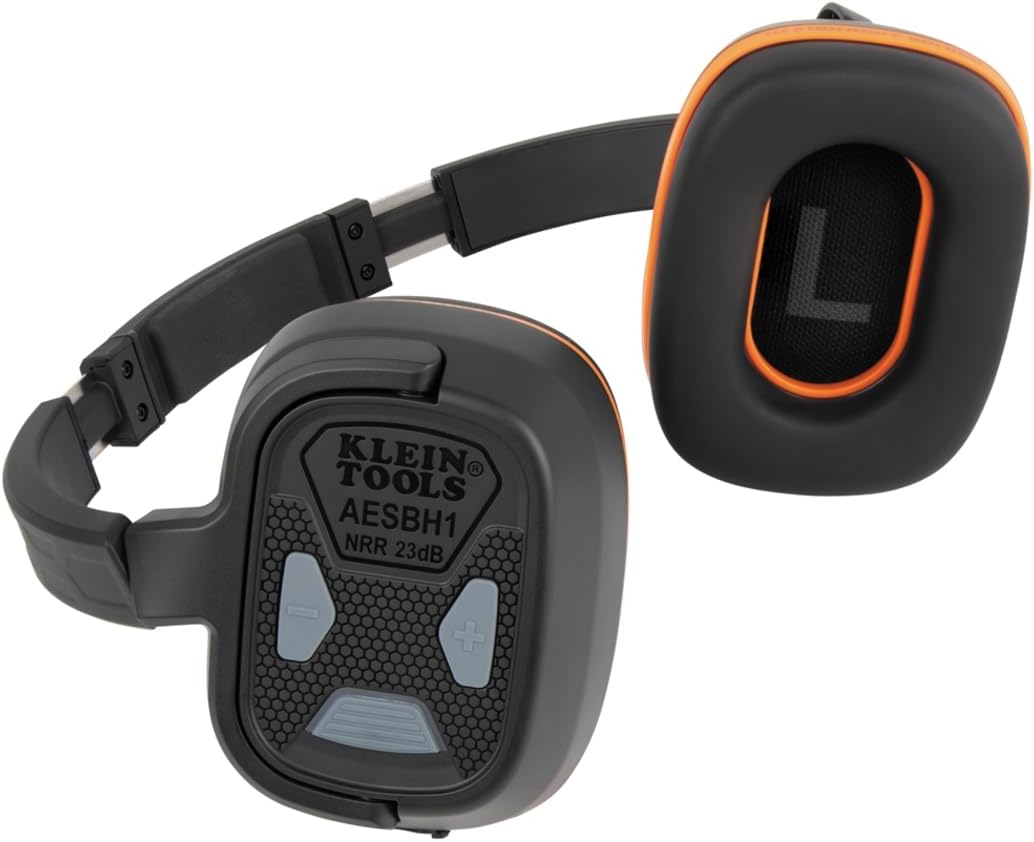
The Klein Tools AESBH1 stands apart with a behind-the-head design, a stated 70-hour rechargeable runtime, and an NRR of 23 dB. Its 3.9 rating is slightly below the other products, but the distinctive configuration may appeal to workers who need an over-the-head style and unusually long stated battery life. It is intended to work with hard hats and caps.
We may earn a commission when you buy through this link, at no additional cost to you.
The adjustable headband extends to create a more personalized fit, while angled soft foam cushions support an acoustic seal. Pivotable ear cups can rest around the neck when not in use, making them easier to put on and remove without removing an entire helmet. Bluetooth connectivity supports music and calls through a built-in microphone, although the supplied information does not name the Bluetooth version.
The main trade-off is the lower 23 dB NRR compared with the 27- and 28 dB figures listed for many cap-mounted products. That does not automatically make the Klein model inadequate, because protection requirements depend on the measured workplace noise, and the behind-the-head design may suit some users better. It should not be assumed to provide the same attenuation as a higher-rated model.
The AESBH1 is a strong candidate for workers who prioritize long battery life, easy on-and-off use, and compatibility with a range of headwear. It may be especially helpful during extended assignments where charging opportunities are limited. Buyers should compare the listed NRR with their exposure assessment and confirm that the headband and cushions sit correctly beneath or around their hard hat.
The stated 70-hour runtime is the longest specific figure in this group. It reduces charging interruptions during multi-day jobs, remote assignments, and long periods between accessible power sources.
The pivoting cups move away from the ears for rest or communication and return for protected work. An adjustable headband and angled foam cushions are intended to distribute weight and improve the acoustic seal.
We may earn a commission when you buy through this link, at no additional cost to you.
This UM ULTRAMAXX model delivers the same core design as another product in the list: Bluetooth 5.3 hearing protection for compatible cap-style helmets, with a 3.9 rating. It offers a 1000 mAh battery, USB Type-C charging, a 3.5 mm AUX cable, hands-free calling, and a listed ANSI S3.19 NRR of 27 dB with CE EN352-1 SNR of 32 dB.
We may earn a commission when you buy through this link, at no additional cost to you.
Its earmuffs mount into dedicated side accessory slots on most safety helmets except full brim designs. The earcups tilt and adjust to fit the user's preferred position, while the microphones and Hi-Fi speakers support both calls and wireless audio. Because the product connects with phones, computers, and tablets, it can serve as a work communication headset as well as a hearing-protection accessory.
Compared with the related UM ULTRAMAXX entry, the supplied information is slightly more limited, including a truncated description of the wireless connection. The rating is also a little lower. Buyers who require a specific Bluetooth version, battery runtime, active-listening feature, or mounting standard should review the current product page carefully rather than assuming every detail matches the related model.
This earmuff is a reasonable option for workers seeking a straightforward side-mounted design with modern wireless connectivity and a large stated battery. It suits users of compatible cap-style helmets who need music, calls, and passive hearing protection. The lack of full brim support and the absence of a published runtime should be checked against the user's work requirements before purchase.
The earcups snap into dedicated side slots and can be adjusted or tilted after installation. This makes them easy to integrate with compatible hard hats without relying on a separate over-the-head band.
A built-in microphone supports hands-free communication, while the 3.5 mm cable provides an alternative to wireless playback. Bluetooth 5.3 and the 1000 mAh battery form a modern foundation for everyday worksite use.
We may earn a commission when you buy through this link, at no additional cost to you.
This GREEN DEVIL Full Protection Helmet Kit combines Bluetooth earmuffs with a vented hard hat, dual visors, a headlamp, a cooling liner, and a waterproof drawstring bag. Its 4.6 rating places it among the strongest products in the guide. The helmet meets ANSI Z89.1 Type 1 Class C requirements, the visors meet ANSI Z87.1-2015, and the Bluetooth earmuffs meet ANSI S3.19 standards.
We may earn a commission when you buy through this link, at no additional cost to you.
The six-point suspension is designed to improve shock absorption and overall comfort, while a replaceable sweatband with a porous coating is intended to manage perspiration. A molded chin cup adds stability, and the adjustable helmet size covers a stated range of 53-63 cm, or 20.86-24.80 inches. These details make the kit more relevant than a simple earmuff for users who need a complete head-protection setup.
The included Bluetooth earmuffs provide 27 dB noise reduction, 5.3 connectivity, hands-free calls, music, and surround microphones for active listening. A bracket-mounted headlamp keeps the light secured to the helmet, while two adjustable visor layers allow workers to vary eye and face coverage. The number of integrated parts may make the helmet less convenient for every task, particularly in confined spaces.
This kit is recommended for new purchases where protection, lighting, visibility, and communication must all come from one coordinated system. It is less suitable for workers who already own a well-fitted hard hat and only need Bluetooth earmuffs. Confirm the fit, helmet range, visor requirements, and site approvals before replacing an existing helmet.
A six-point suspension, replaceable porous sweatband, and molded chin cup collectively support stability and comfort. The ventilated hard-hat design can also help manage heat during demanding outdoor work.
The helmet, headlamp bracket, visors, and Bluetooth earmuffs form a complete package. This can simplify procurement for teams, but each component should still be checked against the specific hazards and standards required by the worksite.
We may earn a commission when you buy through this link, at no additional cost to you.
The Klein Tools 22029 is a non-Bluetooth hard hat earmuff, making it an exception within a wireless-focused roundup. It earns its place because it provides up to 27 dB of noise reduction and is specifically designed for use with Klein Tools Class E-rated hard hats. Its 4.4 rating indicates a well-regarded product among buyers looking for a straightforward passive earmuff.
We may earn a commission when you buy through this link, at no additional cost to you.
The mounting system snaps into Klein Tools hard hats and is compatible with full brim, cap style, and safety helmets. A single-arm ball joint lets the earmuffs pivot into a storage position or into use, while rivets on the arm allow adjustment for a more personalized fit. Soft foam cushions are intended to reduce pressure and support extended wear.
There is no Bluetooth radio, microphone, battery, or wired audio input in the supplied specifications. Consequently, workers who want music, phone calls, or team audio should treat this as a specialist alternative rather than a true wireless product. Its main advantage is the non-conductive design and support for Class E-rated Klein helmets in electrical environments.
The 22029 is a good selection for electricians and other workers who prioritize electrical-safety compatibility over entertainment. It also supports full brim helmets, unlike many cap-mounted wireless options. Users should still follow the required fit-testing, hearing-protection, and helmet procedures, and should not assume a non-conductive label makes any other product safe for every electrical task.
The earmuffs are non-conductive when used with Klein Tools Class E-rated hard hats. This focused design makes them more relevant to electrical work than ordinary Bluetooth accessories with unspecified material properties.
Unlike many cap-mounted models, these earmuffs support full brim, cap-style, and safety helmets. The pivot and riveted arm allow the user to move them out of the way or adjust their position for a more comfortable seal.
We may earn a commission when you buy through this link, at no additional cost to you.
The right Bluetooth hard hat earmuff depends on your helmet geometry, workplace noise, communication habits, and shift length. Rather than focusing only on wireless features, buyers should balance mounting compatibility, protection, fit, battery endurance, and the ability to hear important surroundings safely.
Most Bluetooth earmuffs in this guide use a side-slot attachment intended for cap-style hard hats, safety helmets, and compatible face shields. Some explicitly do not support full brim helmets, while the Klein Tools 22029 and the behind-the-head AESBH1 accommodate broader headwear styles. Before buying, identify whether your helmet has dedicated side accessory slots, whether its geometry matches the supplied attachment, and whether the earmuff can be installed without preventing the suspension or visor from functioning.
Choose a model specifically designed for your helmet configuration. A secure mount is more important than a universal-looking illustration, and workers should not improvise with straps or adhesives that may not maintain a stable acoustic seal.
The listed NRR is a laboratory-style indicator used to compare hearing protectors, not a promise of identical protection for every wearer. Products in this guide range from NRR 23 dB to NRR 28 dB, with several GREEN DEVIL and UM ULTRAMAXX models listed at 27 dB. A higher figure may be useful in louder environments, but selection should also reflect comfort, speech communication, and whether the task permits reduced environmental awareness.
Use the manufacturer's fitting instructions and your workplace noise assessment to make a responsible choice. Fit, positioning, and user behavior can materially change the protection actually achieved, so fit testing is especially valuable.
Bluetooth 5.3 appears on the GREEN DEVIL and UM ULTRAMAXX earmuffs and is described as offering a wider range and a more stable connection. Bluetooth 5.0 models remain practical for music and calls, and the Kalence and BJKing products state an operating range of up to 80 feet. The Klein AESBH1 supports Bluetooth, but the supplied information does not identify its version or range.
Select the wireless standard based on the devices you use and the size of the work area. For large sites, buildings, or jobs where the phone may remain far from the helmet, verify range under the conditions where you will actually work.
Stated runtimes range from up to 50 hours for the Kalence and BJKing models to more than 70 hours for the Klein AESBH1. The GREEN DEVIL and UM ULTRAMAXX side-mount models use a stated 1000 mAh battery, although their supplied descriptions do not provide a specific operating duration. USB Type-C is convenient for those already carrying compatible cables, and a 3.5 mm AUX input offers a backup when a battery is depleted.
Prioritize a runtime that comfortably exceeds your working week without recharging, especially for remote assignments. If a published runtime is absent, ask the seller for the relevant test conditions and treat the battery capacity as incomplete information.
A built-in microphone supports hands-free calls, while some models add surround microphones and a SAL active-listening function. These features can make communication easier without removing hearing protection, but they also require careful volume adjustment. Music or amplified ambient sound should not be allowed to mask alarms, approaching vehicles, machinery, or verbal instructions.
Look for accessible controls and a clear method of switching between calls, music, and environmental audio. Workers should test each mode in a safe setting before relying on it around heavy equipment or other hazards.
Comfort affects whether workers wear hearing protection consistently. Adjustable headbands, soft foam cushions, angled ear cups, pivoting arms, and the ability to tilt or store earcups can reduce fatigue. The GREEN DEVIL helmet kits add six-point suspension, cooling liners, and replaceable sweatbands, while the Klein models emphasize pressure-reducing cushions and flexible positioning.
Choose an earmuff that feels balanced and does not create pressure hotspots during a typical shift. If possible, test the fit with your actual hard hat and confirm that the ear cups seal without preventing communication, head movement, or access to other protective equipment.
A 3.5 mm connection is valuable on job sites where wireless reception is inconsistent or when a worker needs to conserve battery charge. It also allows the earmuffs to continue operating during a power shortage, provided the source is compatible and the product's circuitry supports passive wired listening. The Kalence, BJKing, GREEN DEVIL, and UM ULTRAMAXX models explicitly include or mention AUX connectivity.
Confirm that the supplied cable is included and determine whether it supports calls or only audio. Users should also learn the correct control sequence for switching between Bluetooth and wired modes before they need it in the field.
Most entries are individual side-mounted earmuffs intended to upgrade an existing helmet. The two GREEN DEVIL Full Protection Helmet Kits also include a hard hat, dual visors, a headlamp, cooling liner, and storage bag. A complete system is convenient for new purchases and coordinated team gear, but it may be unnecessary for someone who already owns a suitable hard hat.
Compare the practical value of every included component rather than judging the package only by the number of accessories. Helmet fit, visor suitability, lighting needs, and regulatory approval should determine whether a full kit is preferable to a focused pair of earmuffs.
Begin by confirming that the hard hat has compatible mounting slots and that the earmuff attachment fits without loosening the helmet suspension. Place the earcups over the ears so the cushions form a complete seal, then adjust the headband or arm until the device feels stable without excessive pressure. Charge the earmuffs fully before the first shift, pair them with only one primary phone or tablet, and confirm that the microphone, call controls, and volume work as expected.
During work, set the hearing-protection and awareness levels according to the noise assessment for the site. Avoid raising music above a level that prevents you from hearing alarms, coworkers, vehicles, or machinery. Use the active-listening or awareness function only when permitted and appropriately configured, and remove or store the earcups only when the task permits you to do so safely. Take periodic breaks to reduce ear fatigue, particularly during extended shifts.
Clean the ear cushions and mounting surfaces with a manufacturer-approved method, avoiding excessive moisture around the microphone, buttons, charging port, and speaker openings. Inspect the cushions, attachment, cable, and controls for wear, and replace damaged or hardened cushions because poor condition can compromise both comfort and sealing. Store the device in a dry, moderate-temperature location, recharge it according to the instructions, and remove the battery from long-term storage if the manufacturer permits that step.
Bluetooth earmuffs can provide passive hearing protection when their listed NRR is appropriate for the workplace, but they should not be selected solely because they support music or calls. Workers should review the noise assessment, fit the product correctly, and follow site rules and applicable hearing-protection standards. Active-listening features may improve awareness, but they do not automatically make the product safe for every noise level.
No. Many cap-mounted models require dedicated side accessory slots and do not fit full brim helmets. The Klein Tools AESBH1 uses a behind-the-head format, while the Klein Tools 22029 supports full brim, cap-style, and safety helmets. Check the exact helmet brand and model, attachment geometry, visor arrangement, and suspension before ordering.
NRR is the U.S. Noise Reduction Rating used with ANSI hearing-protection standards, while SNR is the European attenuation value associated with EN standards. The GREEN DEVIL and UM ULTRAMAXX models list ANSI NRR 27 dB and European SNR 32 dB, while the Kalence and BJKing products list NRR 28 dB and SNR 34 dB. Ratings cannot simply be treated as guaranteed real-world reduction for every wearer.
Several products in this guide support a 3.5 mm AUX connection, including the Kalence, BJKing, GREEN DEVIL, and UM ULTRAMAXX models. Their descriptions indicate that wired operation can continue when the battery is depleted. Check the manufacturer instructions to learn how to activate the wired mode, and do not assume every wired connection supports microphone calls.
Not necessarily. The BJKing model explicitly states that it is not active noise cancellation; its reduction comes from passive sound-absorbing materials. Some other models use surround microphones for an active-listening function, which is intended to help users remain aware of surrounding sound. Buyers should distinguish situational awareness from ANC that electronically cancels noise.
Follow the manufacturer’s fitting instructions and the fitting method required by your employer or safety program. Position the earmuffs correctly, check for gaps or interference with glasses and facial hair, and confirm that the mounting system remains stable on the helmet. Because actual attenuation can be lower than the labeled rating, formal fit testing is particularly valuable for workers exposed to high noise levels.
A longer runtime is useful, especially for remote or multi-day assignments, but it is only one part of the decision. Consider charging connector, battery health, volume level, call use, and whether a wired backup is included. A model with a published 50-hour runtime may be more useful to a buyer than one with a larger stated capacity but no verified operating time.
Electrical suitability depends on the complete safety system and applicable site rules. The Klein Tools 22029 is specifically described as non-conductive when used with Klein Tools Class E-rated hard hats, making it a notable option for electrical environments. Other wireless models do not provide equivalent material guidance in the supplied information, so workers should verify compatibility with their safety program before use.
The GREEN DEVIL Bluetooth Hearing Protection Ear Muffs provide the strongest overall balance for a worker who already owns a compatible cap-style helmet, combining a listed 27 dB NRR, Bluetooth 5.3, active listening, hands-free calls, and flexible positioning. The Kalence Bluetooth Hard Hat Ear Muffs stand out as a budget-conscious option with a 28 dB NRR, 50-hour stated runtime, and wired fallback, while the GREEN DEVIL Full Protection Helmet Kit is the premium all-in-one choice for workers who also need a helmet, visors, and headlamp.
Prioritize compatibility and fit before entertainment features. Confirm the mounting style, verify that the listed protection rating matches your workplace assessment, and consider whether call handling, situational awareness, battery endurance, and wired operation align with your duties. A lower-priced model can be a better fit than a premium one if it protects correctly, communicates reliably, and remains comfortable throughout the workday.
Finally, check current prices, availability, included cables, warranty terms, and the exact specifications when the listing is ready to purchase. Product configurations and manufacturer details can change, and prices fluctuate over time. Comparing the current Amazon listing with the needs of your helmet, team, and safety program is the final step in making a well-informed choice.