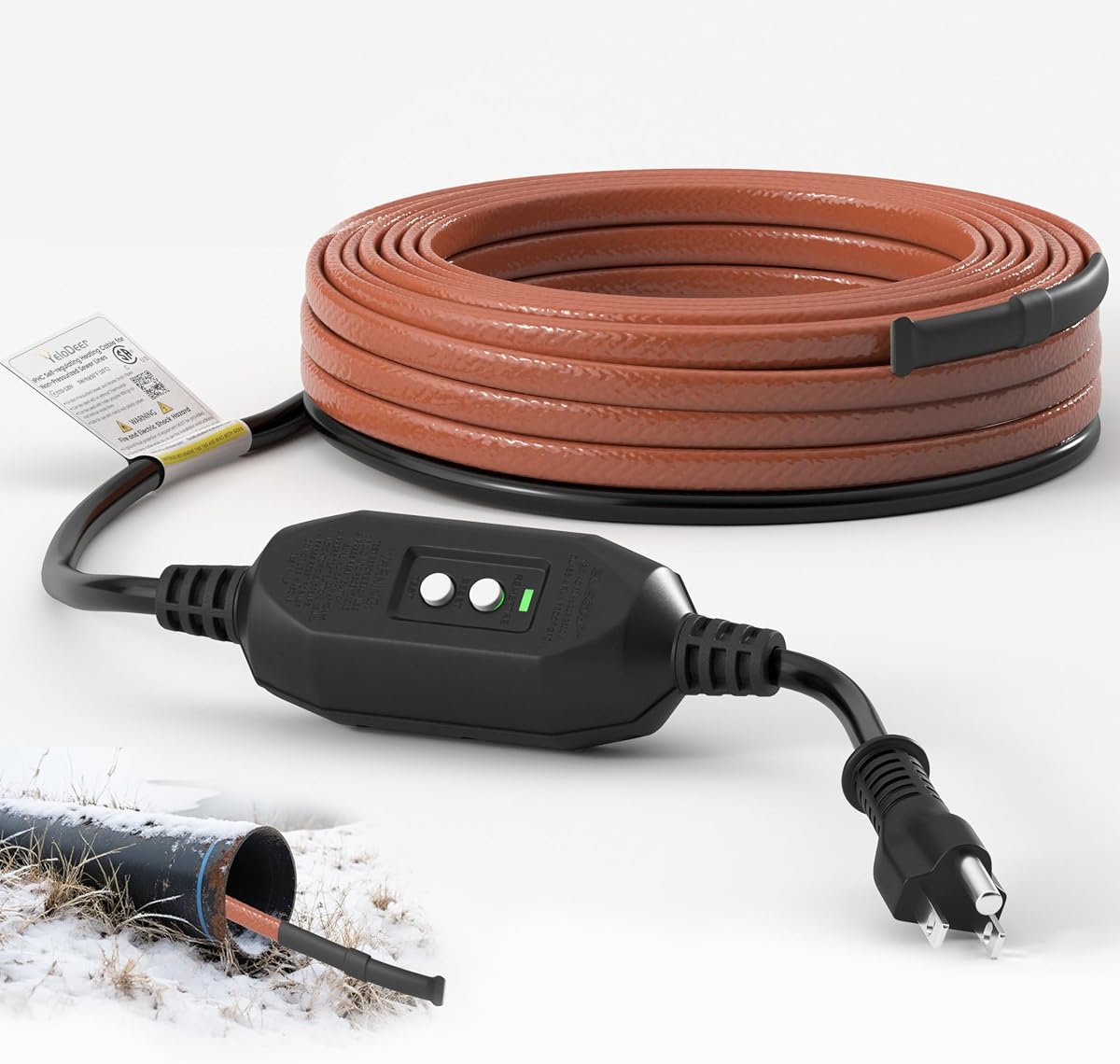
120 Ft Inside Drain Pipe Heating Cable
Long in-pipe installation
Built-in GFCI protection
Self-regulating heat output
Our expert guide compares 10 heating cables for drain pipes, covering certifications, length, wattage, materials, safety features, and installation options.
Heating cables for drain pipes help protect wastewater lines, sewer sections, condensate drains, and sump-related plumbing from freezing. A strong cable should combine suitable length, controlled heat output, chemical-resistant construction, and installation methods appropriate for the pipe and drainage environment.
We compared ten products using the information supplied with each listing, focusing on certification, cable length, heat output, jacket material, water resistance, GFCI protection, intended applications, and installation flexibility. The guide includes both in-pipe options and external pipe-heating cables for use around drain systems.
Each review explains the stand-out benefits and practical trade-offs, while the comparison table and buying guide make key differences easier to assess. Product details and availability can change, so readers should confirm dimensions, electrical requirements, and current listing information before buying.

5.0Editor score

4.6Editor score
The table below compares the ten cables by certification, length, heat output, construction, and key installation or safety features, helping readers identify the option that best matches their drain pipe layout.


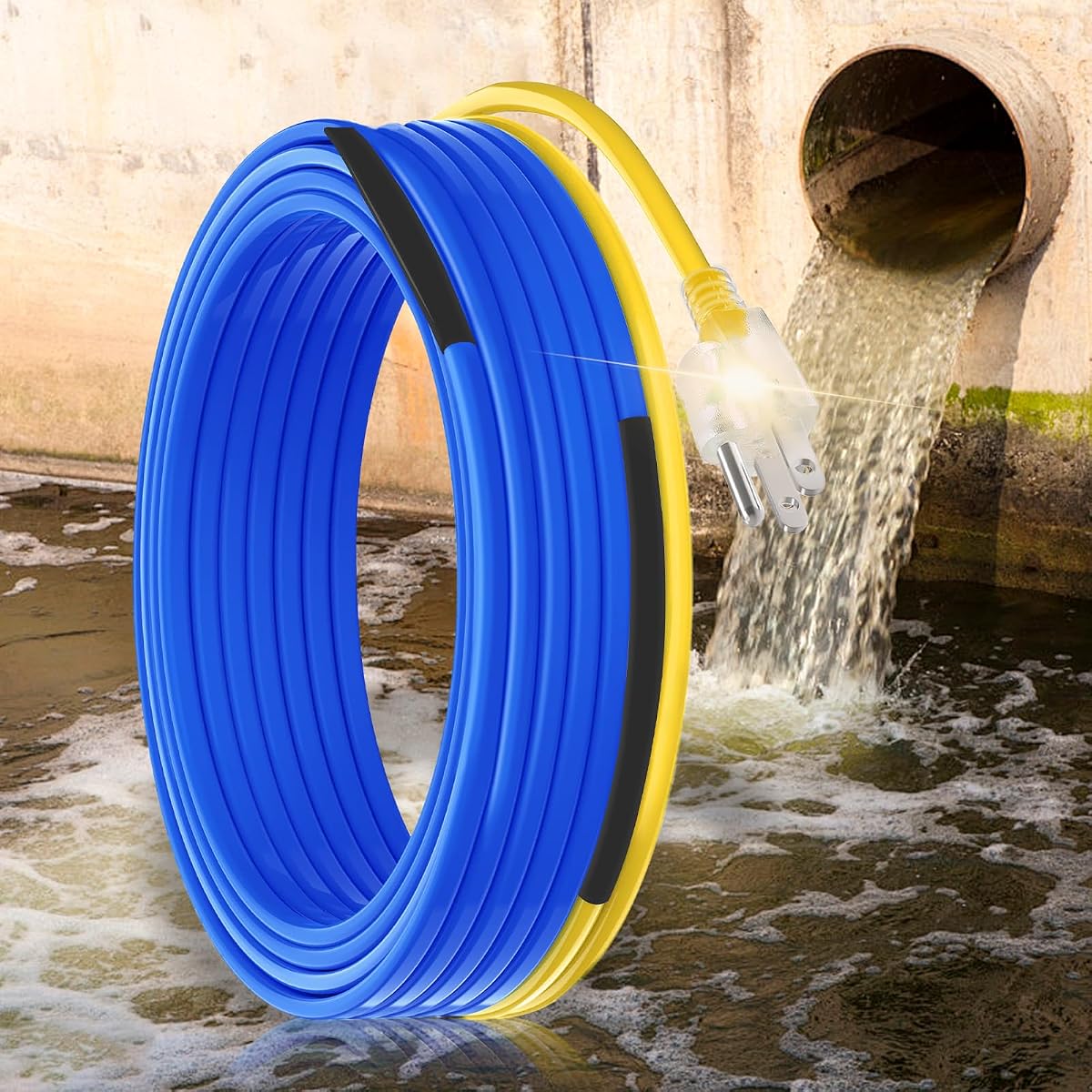

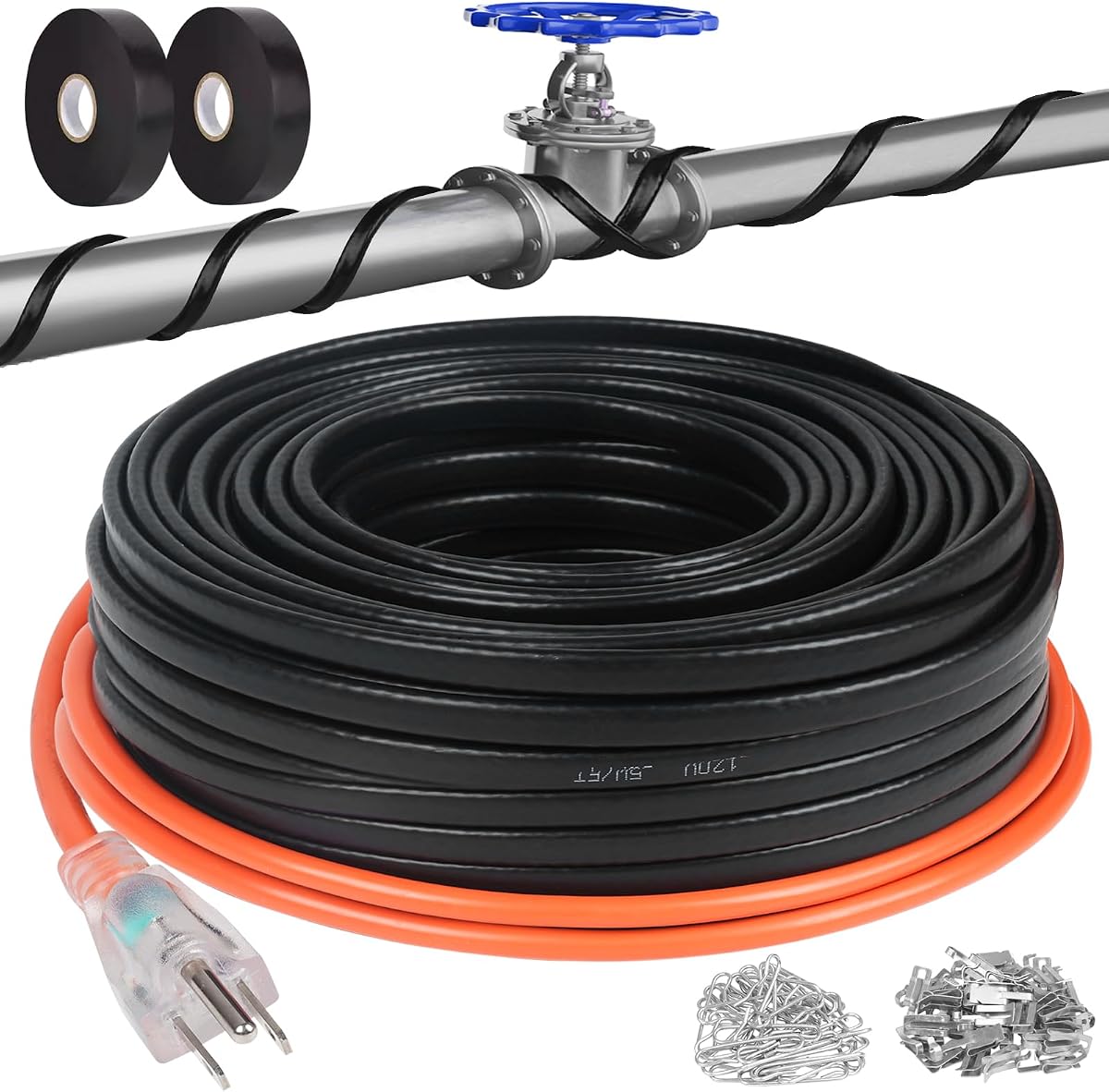

The 30ft Heavy-Duty Drain Pipe Heating Cable is a strong all-around choice for homeowners and property owners who need focused freeze protection for a drain or sewer line. It has a 5.0 customer rating and stands out through its 5W/ft output, complete CSA certification, and a fluoropolymer jacket designed to tolerate demanding plumbing environments.
We may earn a commission when you buy through this link, at no additional cost to you.
The self-regulating core is one of the most useful features. It increases output as temperatures fall and reduces output as the cable warms, reducing the risk of localized overheating. The listing also states that the cable may be safely overlapped or crossed, making it practical for drain layouts that require turns or concentrated coverage around vulnerable sections.
Its construction is well suited to wet and wastewater settings. The outer jacket is described as drinking water grade, resistant to solvents, acids, and bases, and capable of handling pressure up to 100 PSI. The cable can be inserted internally or used in submersion, giving it flexibility for kitchen drains, roof downspouts, sewer sumps, septic pipes, and freezer condensate lines.
The main limitation is the 30-foot length, which is less convenient for long sewer runs. A built-in GFCI is not stated in the supplied product information, so buyers should confirm how their installation will be protected. Even so, the strong output, certification, and installation flexibility make this a well-balanced recommendation for a medium-length drain section.
The 5W/ft rating is greater than the 3W/ft output offered by several alternatives in this guide. Combined with self-regulating behavior and an operating capability stated for temperatures down to -40°F, it is a compelling option for exposed or poorly insulated drain lines in severe winter conditions.
The fluoropolymer jacket and stated pressure tolerance make this cable appropriate for drain and sewage applications where moisture, chemicals, and abrasion may be encountered. Its ability to work internally or underwater also broadens the range of plumbing arrangements it can support.
We may earn a commission when you buy through this link, at no additional cost to you.
The HEATIT 10ft in-pipe heat cable is a premium-oriented short-run solution for drain lines, sewer sections, and wastewater pipes. Its 5.0 rating, complete CSA certification, and built-in GFCI plug distinguish it from many conventional pipe heat tapes that rely on a separate outlet or protection device.
We may earn a commission when you buy through this link, at no additional cost to you.
Heat output is rated at 5W/ft at 50°F and rises to 10W/ft at 32°F. Because it is self-regulating, the cable can provide more heat in freezing conditions and reduce output as its surroundings warm. It is also designed for both internal and external pipe installations, making the short length less limiting for localized freeze protection.
The industrial-grade fluoropolymer jacket is intended to resist chemicals, corrosion, and abrasion, which are relevant considerations for sewer and drain environments. The integrated GFCI is particularly relevant in wet or submerged locations because it cuts power when electrical leakage is detected. That feature can provide an added layer of protection for a permanently installed cable.
Its primary compromise is length. At 10 feet, it is best suited to a drain trap zone, short sewer connection, sump area, or another focused section rather than an entire property's waste line. Buyers should also plan around the proper use of GFCI-protected electrical service. For a short but electrically protected installation, this is a compelling premium pick.
A built-in GFCI makes this cable easier to specify for wet environments because the protection is integrated into the supplied plug. It can interrupt power quickly if leakage is detected, supporting safer operation around wastewater and submersion applications.
The stated 10W/ft output at 32°F gives the cable additional heat-producing capacity during the conditions when freeze protection matters most. Self-regulation then moderates the output as the cable and pipe warm.
We may earn a commission when you buy through this link, at no additional cost to you.
The 120 Ft Inside Drain Pipe Heating Cable is the leading choice here for long sewer, septic, and wastewater runs. It lacks a published customer rating in the supplied data, but its combination of 120-foot length, CSA certification, GFCI protection, and in-pipe positioning makes it especially useful when a short cable would not cover the installation.
We may earn a commission when you buy through this link, at no additional cost to you.
The cable is purpose-built for non-pressurized sewer lines, septic systems, and wastewater drains. Its self-regulating construction changes output according to ambient temperature, providing more heat in cold conditions and less in warmer surroundings. This makes it suitable for installations where consistent freeze protection is needed across a substantial section of pipe.
The industrial-grade fluoropolymer jacket is designed to withstand harsh environments and can be used for in-pipe or external installations. Output is specified at 5W/ft at 50°F and 6W/ft at 32°F. A GFCI is included, adding leakage protection for wet and outdoor environments where an unprotected heating cable would be less desirable.
The tradeoff is that the 120-foot run requires more planning than a compact model. Installation must account for proper routing, fittings, drainage access, and any manufacturer-specific placement requirements. No rating is shown, so buyers should not treat the absence of a score as evidence either for or against performance. For long in-drain coverage, however, this is a focused and technically complete option.
A 120-foot cable can address a full drain run, multiple connected wastewater sections, or a long route through a property. That scale reduces the need to join separate heating sections and makes the product attractive for rural, farm, septic, and seasonal-property installations.
The product is designed for internal placement as well as external use. Routing it within a compatible drain or sewer line can protect the pipe section directly, provided the installation follows all electrical and plumbing requirements.
We may earn a commission when you buy through this link, at no additional cost to you.
The HEATIT JHSF1-CT is a balanced 50-foot option for drain pipe freeze protection and earns a 4.6 customer rating. It combines complete ETL certification, self-regulating operation, a fluoropolymer outer jacket, and enough length for many medium-sized plumbing routes without moving to a much larger system.
We may earn a commission when you buy through this link, at no additional cost to you.
At 5W/ft at 50°F, it provides meaningful freeze-protection output for water-filled pipes. It can be installed on plastic or metal pipes and used in straight, spiral, or overlapping layouts. The product information says it can protect pipes up to 2.5 inches in diameter, making it suitable for many common residential drain and water lines.
Its installation details deserve attention. The black heating cable, including the end seal, has an IP68 waterproof rating and can be submerged, but the waterproof connection between the orange cold lead and black heating cable must remain above water with an IP65 rating. The listing also recommends at least half an inch of insulation, increasing that recommendation to one inch below -20°F.
Those requirements make the product less convenient for a completely exposed, improvised installation, but they are sensible precautions for a wet drain environment. With a grounded plug, indicator light, certification across the full cable, and useful installation flexibility, it remains an affordable long-run option for a carefully planned project.
Straight, spiraled, and overlapped layouts allow the installer to work around bends, junctions, and areas needing concentrated coverage. This flexibility is valuable when a drain line cannot be heated with one simple straight pass.
The IP68-rated heating section and fluoropolymer jacket support use in wet or submerged drain applications. Keeping the cold-lead connection above water and using suitable insulation helps preserve the intended operating conditions.
We may earn a commission when you buy through this link, at no additional cost to you.
The MAXKOSKO 120 ft GFCI in-pipe sewage drain heating cable combines long coverage with a heavy-duty GFCI plug and complete CSA certification. Its 5.0 rating and stated suitability for sewer, wastewater, septic, sump, and condensate applications make it a serious option for large residential, commercial, RV, or seasonal-property drain runs.
We may earn a commission when you buy through this link, at no additional cost to you.
The cable produces 5W/ft at 50°F and self-regulates as its surroundings change. A fluoropolymer outer jacket is specified for sewage exposure, while the system is stated to have been tested for electrical integrity and water pressure up to 230 PSI. That combination addresses both the chemical and mechanical conditions commonly associated with wastewater plumbing.
Its built-in GFCI is a notable advantage for wet environments because it is intended to cut power within milliseconds if leakage is detected. The listing also states that the cable can be used for pressurized and non-pressurized systems, including sewer lines, septic tank inlets, sump-pump discharge pipes, and commercial condensate drains.
A 120-foot cable requires careful planning, particularly when it will be inserted into a drain line. The supplied information does not detail every fitting or routing requirement, so those should be confirmed before installation. Even so, the combination of reach, GFCI protection, strong cold-weather output, and sewage-specific design makes this one of the strongest large-system choices.
The fluoropolymer jacket is intended to withstand sewage exposure and resist degradation in wastewater settings. That makes the construction more relevant to drain applications than a general-purpose tape with a less chemically resistant outer layer.
The heavy-duty GFCI plug adds a direct safety function for installations near water or sewage. Automatic interruption of power after leakage detection can help reduce electrical risk in harsh wet environments.
We may earn a commission when you buy through this link, at no additional cost to you.
The MAXKOSKO 35 ft fluoropolymer sewage drain heating cable offers a moderate-length option for wastewater, sump, sewer, septic, and outdoor drainage systems. It has a 4.3 rating and emphasizes chemical resistance, broad temperature tolerance, and the ability to operate both inside and outside a pipe.
We may earn a commission when you buy through this link, at no additional cost to you.
Its output is 3W/ft at 50°F and 6W/ft at 32°F. The increase in cold conditions provides useful freeze protection, while the self-regulating design reduces output as the cable warms. For a drain line that is well insulated or experiences less extreme exposure, the lower baseline rating may provide adequate performance without the higher output used by 5W/ft models.
The aerospace-grade fluoropolymer jacket is described as highly resistant to corrosion, and the cable is stated to withstand up to 100 PSI. Its listed temperature range extends from -112°F to 482°F. Applications include freezer condensate drains, basement wastewater, sumps, sewage lines, rainwater collection, septic systems, pool pumps, and irrigation plumbing.
The 35-foot length and 3W/ft starting output make it less compelling for a long, uninsulated sewer line in severe cold. Its 4.3 rating also indicates some variability in user satisfaction. Nevertheless, for a shorter drain section where chemical resistance, broad temperature handling, and flexible placement matter most, it is a practical choice.
Moving from 3W/ft at 50°F to 6W/ft at 32°F allows the cable to respond more strongly as freezing conditions approach. This makes its lower normal output less concerning in appropriately insulated or moderate installations.
The product applies to both domestic and outdoor wastewater arrangements, including sumps, condensate drains, rainwater collection, septic systems, and sewage lines. Its internal or external installation flexibility further expands the possible uses.
We may earn a commission when you buy through this link, at no additional cost to you.
The 35 FT Fluoropolymer Corrosion Proof Drain Pipe Heating Cable is designed for demanding wastewater settings where acids, alkalis, sewage, and standing water may be present. Its 4.4 customer rating reflects a generally positive reception, and the product's stated corrosion resistance is central to its appeal.
We may earn a commission when you buy through this link, at no additional cost to you.
The cable delivers 3W/ft at 50°F and 6W/ft at 32°F, using self-regulating technology to adjust its output as conditions change. It is suitable for freezer condensate drains, basement wastewater lines, sumps, sewer and sewage pipes, rainwater catchment systems, and septic applications. The supplied information also identifies in-pipe and external installations as possible configurations.
Durability is supported by an aerospace-grade fluoropolymer jacket, a stated pressure tolerance of 100 PSI, and resistance to extreme temperatures from -80°C to 250°C. The product is intended not to corrode or release toxins in the wastewater environments described by the manufacturer, making its material specification more meaningful than a generic durability claim.
Its limitations are the relatively short 35-foot length and lower baseline output compared with 5W/ft products. That makes it better suited to a defined drain zone or a moderately exposed line than an extended sewer run in extreme cold. For installations where chemical exposure is the primary concern, it remains a focused and sensible selection.
Fluoropolymer construction is the defining advantage here. Its stated resistance to acids, alkalis, corrosion, and temperature extremes supports use in wastewater systems where ordinary jacketed heating tape may deteriorate more quickly.
The cable can be submerged and used for in-pipe or external arrangements. This makes it relevant for drain sections that may collect water, including sumps, condensate routes, and wastewater lines in wet environments.
We may earn a commission when you buy through this link, at no additional cost to you.
The 80FT Pipe Heating Cable is a versatile freeze-protection option with a 4.6 rating and an 80-foot configuration. It is designed primarily for water-filled metal or plastic pipes, including copper, PVC, PEX, and stainless steel, and can be useful where a drain needs exterior freeze protection rather than internal insertion.
We may earn a commission when you buy through this link, at no additional cost to you.
Its 5W/ft output and stated operation down to -40°F make it appropriate for cold outdoor plumbing. The self-regulating approach helps conserve energy by producing more heat when conditions are colder. A pure copper core, aluminum winding shield, and weather-resistant TPE outer jacket create a three-layer construction intended to improve heat uniformity, impact resistance, and environmental durability.
The outer jacket has an IP67 rating, while the cable is described as suitable for exposed or buried pipe applications and tested for more than 10,000 bend cycles. Installation can be straight, spiraled, or overlapping, giving installers flexibility around bends and pipe transitions. The grounded plug includes an indicator light for operating status.
The product warns against use on fuel lines and gutters without water, because the absence of water can lead to overheating. That limitation is important: this is a water-pipe heating cable, not a universal freeze-protection solution. For an exterior drain or sewer line that remains water-filled, it offers a strong combination of length, output, and construction.
The copper core, aluminum shielding, and TPE jacket provide distinct forms of protection for outdoor or buried installations. This layered design is particularly relevant where pipes may encounter physical impact, moisture, chemicals, and ultraviolet exposure.
Straight, spiral, and overlapping installation choices help the cable follow bends and distribute heat around a pipe. That flexibility is useful for exterior drain lines that do not follow a simple linear route.
We may earn a commission when you buy through this link, at no additional cost to you.
The FYSFLYA 3FT-200FT Pipe Heating Cable provides several length choices, allowing users to select a run that better matches a drain pipe without carrying a cable much longer than required. It holds a 4.6 rating and is designed for water-filled pipes, with a 5W/ft output at 120V.
We may earn a commission when you buy through this link, at no additional cost to you.
Its updated design includes intelligent heating and temperature-sensing functions, while the stated operating range extends down to -40°F. The cable works with copper, PVC, and stainless steel pipes, making it a broad external pipe-heating option. A 12-foot indicator plug provides a visible operating-status indicator.
Installation flexibility is another strength. The pre-assembled design can be placed in a straight line, wound in a spiral, or overlapped. That allows the cable to negotiate drain-line bends and concentrate coverage around a vulnerable point, although the product is intended for pipe protection rather than being exclusively marketed for internal sewer placement.
The main caveat is that the product is not presented as a drain-specific, chemically certified in-pipe system. It also carries broader snow-melting and roof applications, so buyers should focus on the water-pipe and freeze-protection instructions. For exterior drain protection with flexible sizing, it is a capable and well-rated choice.
The stated 3-foot to 207-foot range creates a useful choice when pipe runs vary substantially. Buyers can avoid both an undersized cable and excess length that would complicate routing or installation.
Support for copper, PVC, and stainless steel broadens the product's usefulness for mixed-material plumbing systems. The stated thermal design is intended to maintain effective freeze protection across those pipe types.
We may earn a commission when you buy through this link, at no additional cost to you.
The 12FT Self-Regulating Heating Cable is a compact option for a short drain, sewer connection, inlet pipe, or other localized freeze-risk section. It has a 4.1 rating and offers complete ETL certification, a fluoropolymer outer jacket, and an IP68 waterproof rating for the black heating cable.
We may earn a commission when you buy through this link, at no additional cost to you.
The cable's pipe-protection output is 5W/ft, and the product is stated to remain effective down to -40°F. It works with plastic and metal pipes up to 2.5 inches in diameter. Self-regulating technology changes the output as conditions change, while straight, spiral, and overlapping configurations offer routing flexibility.
The jacket is described as more durable and ultraviolet resistant than ordinary PVC, which is useful for outdoor and industrial environments. Although the product also supports roof snow melting at 10W/ft at 32°F, that stated roof use is separate from its pipe-freeze function. The supplied information also notes that clips and hangers are not included with the package.
Its most obvious constraint is length. Twelve feet cannot cover a typical long sewer line, but it can protect a compact vulnerable area without excess cable. The lower 4.1 rating suggests buyers should evaluate the installation closely, while the certification and waterproof construction remain meaningful strengths. It is best treated as a targeted drain-pipe solution rather than a whole-line system.
The compact cable is useful for a short drain trap, exposed sewer connection, RV inlet, or another area where freeze damage is most likely. It can be routed close to the vulnerable pipe without carrying a much longer heating section.
The fluoropolymer jacket and IP68 rating for the black cable support use in wet and submerged settings. The UV resistance adds value for outdoor drain sections exposed to sunlight.
We may earn a commission when you buy through this link, at no additional cost to you.
The right heating cable depends on pipe length, placement, local cold, water conditions, and electrical safety. These factors help narrow the field before comparing installation requirements and product construction.
Choose the installation method that matches the plumbing design. Do not place a cable inside a drain unless the product is explicitly described for that use.
Match the cable to the measured route rather than buying solely by drain type. Account for bends, branches, and service access before ordering.
Higher output is not automatically required, but severe cold and limited insulation favor stronger specifications. Follow the manufacturer's stated temperature and operating limits.
Verify the certification statement in the current listing. Electrical codes and approval requirements can vary by location.
Use appropriate GFCI protection in wet environments and keep any cold-lead connection above water when the manufacturer requires it.
Prioritize a jacket suited to the actual contaminants and exposure. A cable intended for clean water should not automatically be assumed suitable for sewage.
Confirm the pressure rating, waterproof level, and orientation together. An IP rating alone does not replace compatibility with the plumbing system.
Plan the complete route before installation. Serviceability and access to the electrical connection are as important as raw cable length.
Begin by identifying the pipe material, the section that can freeze, and whether the cable will be installed internally or externally. Compare that route with the cable length, temperature rating, pressure rating, and certification information. Confirm that the intended environment is appropriate for the specific product, especially when the cable will contact sewage, standing water, chemicals, or extreme temperatures.
Install the cable according to the manufacturer's instructions. External cables may run straight, spiral, or overlap, while in-pipe cables require suitable entry and routing. Keep the cold lead and any waterproof connection above water when required, use the specified grounded plug and electrical protection, and provide access for future inspection. Add recommended insulation when the product instructions call for it, particularly in extremely cold weather.
Before each heating season, inspect visible cable sections for damage, pinching, cracking, exposed conductors, or disturbed fittings. Clear debris that could obstruct the drain and confirm that the cable is not being used where it could overheat without a heat source. After installation, monitor the indicator light or operating status and check that the surrounding plumbing remains accessible for service and inspection.
Only use a cable that is specifically described as an in-pipe or submersible product. Several options in this guide support internal installation in wastewater, sewer, septic, sump, and condensate lines. The cable must be routed without damaging its jacket, and the electrical connection must remain in a location permitted by the manufacturer.
Both can provide freeze protection, but they are not identical. A 5W/ft cable generally offers greater output at the stated 50°F reference, while some 3W/ft products increase to 6W/ft at 32°F. Exposure, insulation, pipe length, and local temperatures should determine which specification is most appropriate.
A cable installed in or near wet locations should use appropriate ground-fault circuit interrupter protection. Some products in this guide have a built-in GFCI plug, while others may require GFCI protection elsewhere in the electrical circuit. Local electrical codes and the manufacturer's instructions should determine the final installation.
The supplied information for several self-regulating cables states that straight, spiral, and overlapping layouts are supported. Overlapping can improve coverage around bends or junctions, while spiraling distributes heat around a pipe. Buyers should still follow the specific product instructions and avoid creating a condition that could cause overheating.
It depends on the product and exposure. The HEATIT JHSF1-CT listing recommends at least half an inch of insulation, and one inch when temperatures fall below -20°F. Insulation helps retain heat and improves freeze protection, particularly on long or exposed runs, but the product's installation requirements should take priority.
Only if its length and electrical reach are sufficient. The 120-foot options are better suited to long runs, while 10-, 12-, 35-, and 50-foot cables are more appropriate for localized sections. Measure the route, account for bends and fittings, and ensure the plug can reach a suitable power source.
A fluoropolymer jacket is a strong choice for sewage and wastewater because the products in this guide describe it as resistant to corrosion, acids, bases, solvents, and abrasion. Other construction layers may improve mechanical protection, but chemical compatibility with the actual drain contents is the priority.
Inspect the cable and its electrical connection before freezing weather, looking for visible damage, crushing, pinching, cracking, or moisture intrusion. Keep the drain clear of obstructions and ensure the cable remains accessible for service. If a section is damaged or operating improperly, disconnect power and follow the manufacturer's replacement guidance.
The 30ft Heavy-Duty Drain Pipe Heating Cable is the most balanced overall recommendation because it combines 5W/ft output, complete CSA certification, a corrosion-resistant jacket, and flexible internal or external installation. The 120 Ft Inside Drain Pipe Heating Cable stands out for long-run applications and integrated GFCI protection, while the HEATIT JHSF1-CT offers a practical 50-foot alternative with complete ETL certification.
Prioritize the details that match your actual site: certification, correct in-pipe or external design, sufficient length, suitable heat output, and a jacket that tolerates the drain environment. GFCI protection, waterproof ratings, pressure limits, insulation, and service access are especially important for pipes in wet, buried, or difficult-to-reach locations.
Before purchasing, confirm the current listing details, electrical requirements, dimensions, included components, and installation instructions. Product specifications, ratings, and availability can change, and current pricing should also be checked directly. A careful match between the cable and the drain layout is the best route to dependable freeze protection.