
FreAire HAP605
4.8Editor score
Coverage up to 2,600 square feet
PM2.5 sensor with Auto Mode
Washable reusable pre-filter
Quiet 20 dB Sleep Mode
Red filter replacement reminder
Outdoor smog can infiltrate apartments, offices, and bedrooms through open windows, ventilation systems, doors, and everyday entry points, making indoor air quality harder to manage during severe pollution events. A well-sized air purifier can capture fine airborne particles, reduce odors, and create a more comfortable breathing environment without requiring you to keep every window shut.
The products in this guide were compared using the supplied specifications, certifications, filtration systems, room coverage, noise levels, sensors, controls, maintenance features, and customer ratings. The list includes compact and high-capacity models for city apartments, large open-plan rooms, pet households, and spaces where quiet operation or smart monitoring is especially useful.
Each review explains who should consider the model, what distinguishes it from the alternatives, and where its compromises may matter. Ratings and specifications can change over time, while availability and prices fluctuate frequently, so shoppers should verify current details on the linked product pages before making a final decision.
4.8Editor score

4.6Editor score

4.7Editor score
As an Amazon Associate we earn from qualifying purchases.
This side-by-side comparison highlights each purifier's filtration, monitoring, room coverage, and practical features, making it easier to match a model to a city apartment, family room, office, or other smoke-prone space.




The FreAire HAP605 combines a 4.8 rating with a large-room design, PM2.5 monitoring, and an unusually useful combination of automatic and dedicated household modes. Its wide front inlet and two side inlets are intended to pull polluted air from three directions, while the stated coverage reaches up to 2,600 square feet. That makes it a potentially strong choice for metropolitan living rooms, open offices, and pet-friendly homes.
We may earn a commission when you buy through this link, at no additional cost to you.
The air-quality sensor is one of its most practical features for city pollution. A PM2.5 reading appears on the display, and Auto Mode raises or lowers the fan as conditions change. During especially dirty periods, the Turbo Pet Mode boosts circulation around pet beds, rugs, sofas, and other areas where hair, dust, and odors accumulate. A red filter reminder also removes some of the guesswork from maintenance.
The main limitation is that the supplied specifications do not include a CADR figure, so room-size claims cannot be compared directly with the AHAM measurements listed for several alternatives. The manufacturer also recommends replacing the main filter every three to six months, and filter life will vary with operating time and pollution exposure. Nevertheless, the reusable pre-filter can be rinsed, dried, and reinstalled, reducing the amount of routine maintenance requiring a replacement.
This is a compelling pick for anyone seeking broad coverage, clear indoor-air readings, and quiet nighttime operation without moving into the premium category. City residents should place it in a central position with unrestricted intake, keep the pre-filter clean, and use the sensor to determine whether Auto Mode is maintaining an appropriate fan speed during smog events.
Drawing air from the front and both sides helps reduce dependence on a single unobstructed direction. This is especially useful against walls, furniture, and room layouts where a conventional purifier could struggle to pull in outdoor pollution that has entered a space.
The PM2.5 display provides a direct indication of changing conditions, while Auto Mode responds without constant manual adjustments. During a pollution alert, this allows the purifier to increase circulation when readings deteriorate and ease back when the air improves.
We may earn a commission when you buy through this link, at no additional cost to you.
The Levoit Core 300-P is a compact, 4.7-rated purifier with independently verified performance and a clear 143 CFM smoke CADR. It is designed around a 222-square-foot room and is especially appropriate for city apartments, home offices, and bedrooms where smoke or outdoor pollution enters through windows and doorways. Its certification and detailed performance data make it easier to evaluate than models that provide only a broad room-size claim.
We may earn a commission when you buy through this link, at no additional cost to you.
Filtration performance is the central attraction. The HEPA-grade filter is reported to remove 99.97% of airborne particles from 0.1 to 0.3 microns, including pollen, dust, and animal dander. The product is also AHAM VERIFIDE, with listed CADR values of 143 CFM for smoke, 153 CFM for dust, and 167 CFM for pollen. QuietKEAP Technology lowers sound to 24 dB in Sleep Mode, and the display can be turned off entirely at night.
Its main compromise is scale. The Core 300-P is intended for smaller spaces than the WINIX 5510, Levoit Core 600S-P, or other high-capacity choices. A 222-square-foot rating may not deliver the same rapid cleanup in a large loft or open-plan apartment, particularly when several windows or doors admit outdoor smoke. The unit is also designed for 120-volt power in the United States, which should be considered by travelers.
The Core 300-P is a strong recommendation for a bedroom or small apartment room where measured smoke CADR, quiet operation, and reliable certification matter more than maximum coverage. Buyers should use genuine Levoit replacement filters, position the unit near the center of the room, and select a higher fan speed when pollution spikes rather than relying only on Sleep Mode.
A published smoke CADR of 143 CFM gives shoppers a more useful basis for comparison than room-size language alone. It indicates how much clean air the purifier can deliver under a standardized smoke test, making it easier to judge performance in a smaller urban room.
Sleep Mode reduces sound to 24 dB, and the display lights can be switched off. These features make the model appropriate for bedrooms, nurseries, and home offices where operating noise or bright controls could otherwise be inconvenient.
We may earn a commission when you buy through this link, at no additional cost to you.
The WINIX 5510 combines a 4.6 rating with AHAM Verified performance, True HEPA filtration, and smart-app control. It cleans a stated 392-square-foot room in one hour and is also listed as handling spaces up to 1,881 square feet within an hour. The measured AHAM capacity gives apartment dwellers a useful figure for judging the unit in a bedroom, living room, or home office.
We may earn a commission when you buy through this link, at no additional cost to you.
The filtration system combines a washable mesh pre-filter, True HEPA media, and an advanced odor-control carbon filter. The supplied data states that it captures 99.99% of airborne allergens as small as 0.01 microns, including pollen, dust, smoke, and pet dander. The carbon stage is particularly relevant in city homes affected by cooking odors, tobacco smoke, and outdoor smell, while the pre-filter intercepts larger airborne debris.
A built-in sensor measures air quality and adjusts the fan in real time. The LED air-quality indicator and Winix Smart App allow remote monitoring and control, which is useful when a person is away during a high-pollution period. The purifier is also nearly silent at 23.5 dB on its lowest speed and can automatically enter Sleep Mode when the room darkens before returning to Auto Mode in light.
The principal drawback is that the model depends on consumable replacement filters and may be more complex than a basic purifier. The app also adds another interface some users may not need. Even so, the WINIX 5510 is one of the most balanced options here, combining verifiable performance, automatic response, strong particle filtration, odor control, and thoughtful nighttime behavior.
Remote monitoring is valuable when smoke conditions change while nobody is home. The sensor-driven Auto Mode still handles fan speed automatically, while the App gives users a way to check status and manage the purifier without physically returning to the unit.
Smog events often bring not only particles but also persistent smells that HEPA media alone does not effectively remove. The dedicated carbon layer provides an additional odor-control stage for cooking, pets, smoke, and outdoor pollution.
We may earn a commission when you buy through this link, at no additional cost to you.
The Levoit Core 600S-P is the premium selection in this guide, pairing a 4.7 rating with a 391 CFM smoke CADR and a stated capacity of 2,933 square feet. It is intended for open floor plans, high ceilings, basements, and large living areas where a compact purifier would need to work much harder to dilute particulate pollution.
We may earn a commission when you buy through this link, at no additional cost to you.
VortexAir Technology 3.0 supports rapid circulation, and the listed CADR provides a particularly strong smoke figure among the products reviewed. The purifier can process the equivalent of 2,933 square feet once per hour or 606 square feet every 12.5 minutes. Its three-stage filtration system reports 99.97% efficiency for airborne particles from 0.1 to 0.3 microns, including pollen, dust, and animal dander allergens.
Auto Mode adjusts the fan according to changing air conditions, reducing the need to manage settings manually during fluctuating city pollution. When paired with Levoit’s Original Filter, the unit operates as HEPA-grade in Sleep Mode according to independent laboratory testing. That premium positioning comes with trade-offs: the model costs more than the other options, and its high-capacity design requires enough open space to maintain effective airflow.
This is the most logical choice for a large city loft, expansive open-plan residence, or basement-level living area. It may offer more capacity than smaller units need, but for a large space affected by recurring smoke intrusion, the 391 CFM smoke CADR and broad coverage make the Core 600S-P a compelling long-term option.
The 391 CFM smoke CADR offers substantial clean-air delivery for a room where particles may enter through several windows, a shared hallway, or a busy street. This capacity is more meaningful than a large coverage number when smoke has already accumulated throughout the space.
Air-quality sensing and Auto Mode allow the purifier to increase or decrease airflow as conditions change. That is particularly useful during variable pollution events, when outdoor air quality can worsen quickly without warning.
We may earn a commission when you buy through this link, at no additional cost to you.
The KNKA APH4000 is a 4.6-rated, AHAM Verified purifier with a 226 CFM smoke CADR and coverage of up to 1,695 square feet. Its dual front-and-back intakes and side outlets create a broad circulation pattern that should suit large apartments, open offices, and family rooms where smoke may enter from more than one direction.
We may earn a commission when you buy through this link, at no additional cost to you.
Two cartridges each use a three-stage system: a washable pre-filter, a high-efficiency filter, and an activated carbon filter. This configuration gives the purifier both particle and odor filtration, while the dual-cartridge design can increase the amount of filtered air moving through the unit. The supplied specifications also note that users should remove the filters’ plastic packaging before installation.
PET Mode raises airflow to address pet hair, dander, and odors, while ECO Mode enters standby when air quality is excellent and restarts when purification is needed. A built-in sensor and color-coded lights show real-time AQI. Sleep Mode operates at approximately 22 to 24 dB, and four fan speeds give users manual control when pollution conditions require a faster response.
The main maintenance consideration is the presence of two filter assemblies. Genuine KNKA filters are recommended, with replacements generally scheduled every three to six months depending on use. In exchange, shoppers receive strong measured airflow, flexible modes, and a broad air-intake design. The APH4000 is especially well matched to larger pet-friendly urban homes.
Two three-stage cartridges provide more filtration capacity than a single compact assembly. They are particularly useful in homes where pet dander, cooking odors, and outdoor smoke can all contribute to a relatively demanding filtration load.
ECO Mode reduces unnecessary operation when air quality is already good, while PET Mode provides a dedicated boost for hair, dander, and odors. Together they make the purifier adaptable to daily household patterns rather than a single fixed setting.
We may earn a commission when you buy through this link, at no additional cost to you.
The MOOKA 2,200 is a 4.5-rated purifier built around a stated 2,200-square-foot capacity and a three-stage filtration system. A larger front inlet and wide dual-side intake are designed to capture wildfire smoke, floating ash, heavy smog, pet hair, and household odors, making its feature set directly relevant to polluted urban environments.
We may earn a commission when you buy through this link, at no additional cost to you.
A high-precision PM2.5 sensor monitors conditions and displays indoor air quality. In Auto Mode, the fan increases when it detects incoming smoke or odors, reducing the need for manual changes during an alert. The filtration stages include a washable pre-filter, a high-efficiency stage for microscopic particles, and activated carbon pellets for odors. Timers can shut the unit off after 2, 4, 6, or 8 hours.
Sleep Mode runs as low as 20 dB and turns off the lights, which is useful for light-sensitive sleepers. The unit also has a child lock and an aromatherapy pad. That pad can add fragrance or help mask persistent smells, although essential oils should be applied carefully and are not a substitute for source control or filtration. A filter reminder appears after 2,000 hours of use.
The key weakness is the absence of a supplied CADR value, making its coverage claim harder to compare with the AHAM-tested models. Filter maintenance also remains necessary despite the washable pre-filter. Even so, the MOOKA stands out for explicit smoke-and-ash positioning, responsive PM2.5 sensing, quiet operation, and practical scheduling controls.
The PM2.5 sensor and Auto Mode are particularly valuable when outdoor pollution enters a home quickly. Rather than waiting for a scheduled fan speed to become inadequate, the purifier can increase airflow as the measured condition deteriorates.
Activated carbon pellets supplement the particle-removal stages, which matters because smoke and smog often carry noticeable odors. The added aromatherapy pad can improve scent comfort, although it should never be used to mask a persistent pollution source that requires ventilation or correction.
We may earn a commission when you buy through this link, at no additional cost to you.
The ECOSELF HAP602 is a 4.7-rated large-room purifier with a stated ability to refresh a space up to 2,400 square feet in 30 minutes. That aggressive room-size claim, combined with 360-degree airflow, makes it worth considering for large city apartments, offices, and open-plan homes that experience a meaningful influx of smoke.
We may earn a commission when you buy through this link, at no additional cost to you.
The built-in PM2.5 sensor displays real-time conditions, and Auto Mode accelerates the fan when air quality declines. A color scale moves through green, blue, yellow, and red to communicate the current state. The three-stage filtration system is intended to remove dust, pollen, pet dander, smoke, and other airborne particles, while the three fan speeds and automatic mode provide flexible control.
The touch panel is designed to be understandable at a glance, and a child lock helps prevent accidental changes by children or pets. Sleep Mode offers a listed 20 dB operating level, making the unit suitable for bedrooms and quiet nighttime use. The product also carries a 4.7 rating, which is among the stronger customer-rating figures in this group.
The chief drawback is that no CADR is provided, so the 30-minute and 2,400-square-foot claims cannot be compared directly with independently standardized figures. The main filter must be replaced every three to six months and must not be cleaned with water or other liquids. Buyers who value rapid stated coverage, clear monitoring, and 360-degree circulation will find the HAP602 compelling.
The stated 30-minute cleanup for a space up to 2,400 square feet is the model’s defining feature. If accurate for the intended layout, that performance could reduce the period during which smoke remains suspended after windows are closed.
A real-time PM2.5 reading and four-color indicator make air quality easy to understand at a glance. This is useful in shared homes where a family member may need to determine whether the purifier is responding appropriately without navigating a detailed menu.
We may earn a commission when you buy through this link, at no additional cost to you.
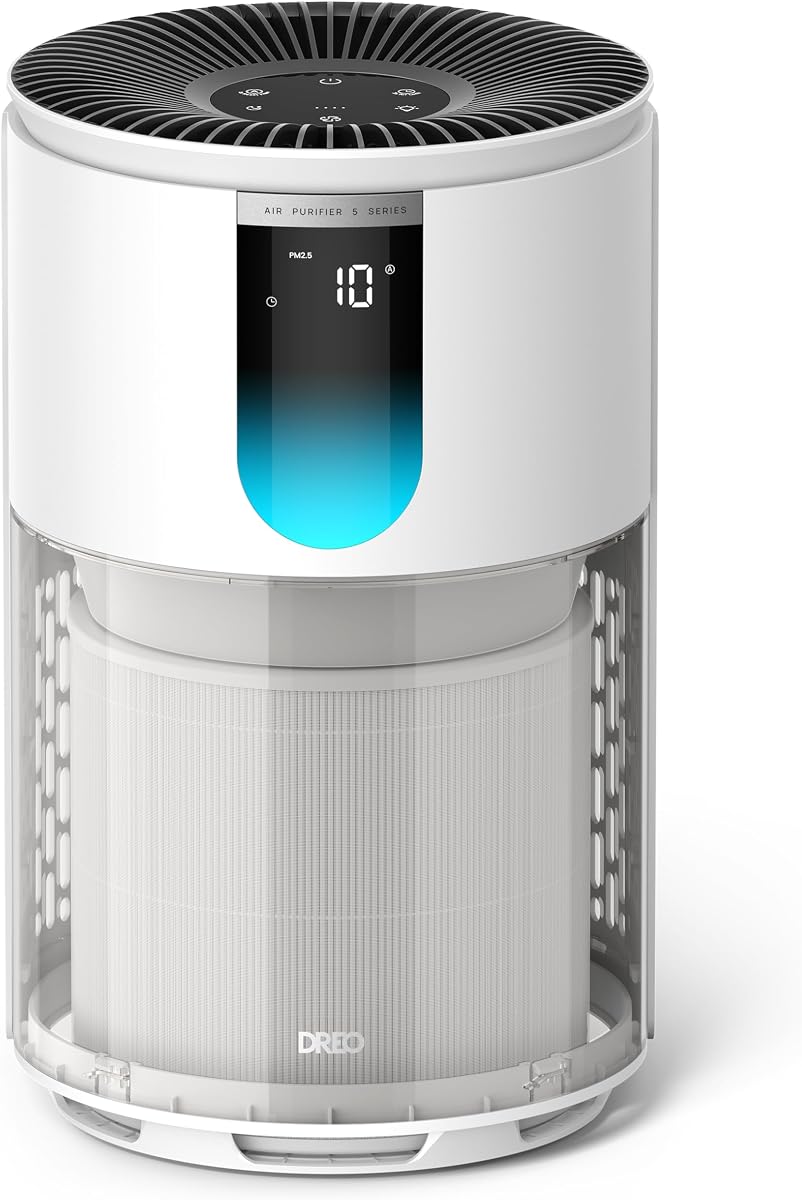
The DREO 539 is a 4.5-rated purifier with an AHAM Verified 158 CFM smoke CADR and a stated one-hour capacity of up to 1,176 square feet. At four air changes per hour, it is also listed as refreshing a 245-square-foot room every 12.4 minutes. These figures make it a sensible middle-capacity option for apartments, bedrooms, and home offices.
We may earn a commission when you buy through this link, at no additional cost to you.
DREO TurboPure combines a large air intake with 360-degree spiral airflow to move air more quickly. Its three-in-one filter includes a pre-filter, a high-efficiency stage, and activated carbon for particles, PM2.5, pollen, dust, smoke, and household odors. A high-precision sensor displays AQI readings from 1 to 999, while a four-color RGB indicator and transparent filter window make status easier to inspect.
Auto Mode adjusts fan speed to air quality, Turbo Mode provides maximum purification for sudden pollution, and Sleep Mode turns off display lights. The BLDC motor and bottom intake are designed to reduce noise, making the purifier practical for bedrooms, nurseries, and offices. ENERGY STAR certification and an estimated annual use of approximately 162 kWh also distinguish it for efficiency-conscious shoppers.
The 4.5 rating is slightly lower than those of the leading selections, and the lower 158 CFM smoke CADR means it will not match the strongest high-capacity models in a large open space. Within its intended room range, however, the combination of AHAM verification, clear AQI feedback, Turbo Mode, and four-speed manual control is well suited to urban use.
When smoke enters unexpectedly, Turbo Mode provides immediate manual access to the purifier’s highest setting. Automatic sensing handles routine changes, while the dedicated mode is available when a resident notices pollution or needs faster cleanup.
The viewing window lets users inspect filter condition and system status without opening the housing, while ENERGY STAR certification and the BLDC motor emphasize operating efficiency. These details support convenient everyday use in compact city spaces.
We may earn a commission when you buy through this link, at no additional cost to you.
The GermGuardian AC4825E is a 22-inch tower purifier with a 4.6 rating and a modest capacity suited to smaller rooms. It circulates and filters air in a 153-square-foot bedroom every 12.5 minutes and in a 743-square-foot space every hour, making it best suited to a compact office, dorm room, or city bedroom rather than a large loft.
We may earn a commission when you buy through this link, at no additional cost to you.
Its HEPA PURE filter captures 99.97% of allergens as small as 0.1 microns, including dust, pollen, and pet dander. An activated carbon layer reduces cooking and pet scents, while an optional UV-C light offers an additional treatment stage. The unit has three speeds, including a quiet Sleep Mode, and the tower format keeps controls and airflow relatively easy to incorporate into a smaller room.
GermGuardian lists the purifier as CARB Certified, ETL Certified, and Zero Ozone Verified, giving shoppers useful safety and compliance information. Standard GermGuardian HEPA Filters B and compatible bulbs are recommended to preserve certified fit and performance. The limited number of speeds and smaller clean-air delivery rate are the main trade-offs compared with feature-rich models in this roundup.
For a small room where floor space is valuable, the AC4825E remains a practical choice. Its stronger selling points are recognizable filtration, independent certification, odor control, and the optional UV-C feature. It is less appropriate for a large, smoke-filled open-plan area where a higher-CADR or larger-capacity purifier would work more efficiently.
The 22-inch tower format is useful in apartments, dorms, and home offices where every inch of floor space matters. Its room coverage is narrower than several larger models, so it should be placed in the space that needs the most attention.
HEPA PURE media targets fine airborne allergens, while activated carbon addresses persistent odors. That combination is useful in dense city environments where indoor spaces can collect both outdoor particles and trapped cooking or pet scents.
We may earn a commission when you buy through this link, at no additional cost to you.
The COWAY Mighty AP-1512HH is a 4.6-rated purifier with a stated one-hour coverage of up to 1,748 square feet and a four-stage filtration system. That combination of capacity and multi-stage design makes it a notable option for large urban homes that need to handle particles and odors from smoke, pollen, pet dander, and other indoor sources.
We may earn a commission when you buy through this link, at no additional cost to you.
The filtration stack includes a washable pre-filter, a deodorization filter, a bipolar device, and a HEPA filter. It reduces 99.97% of 0.3-micron particles, including pollen and other allergens, while also reducing volatile organic compounds and odor. A pollution sensor monitors conditions and drives Auto Mode, allowing the fan to change speed as air quality changes.
A colored LED communicates indoor air quality in real time and can be turned off for sleeping. Eco Mode offers lower-intensity operation, while a timer supports scheduled use. Filter alerts notify users when the filters need replacement and when the pre-filter needs cleaning, providing practical guidance based on the amount of air processed.
Although the supplied data does not provide a CADR or a detailed list of fan speeds, the 1,748-square-foot capacity, four-stage system, sensor, and three-year warranty form a strong overall package. It is particularly compelling for consumers who want a single purifier that combines particle filtration with dedicated odor and VOC treatment and value a longer warranty.
The pre-filter handles larger debris, the deodorization layer targets smells and VOCs, the bipolar stage adds another treatment layer, and the HEPA filter captures fine particles. This broad sequence suits spaces where smoke, allergens, and household odors are concerns at the same time.
Filter and pre-filter alerts help owners maintain airflow, while the stated three-year warranty provides added reassurance. Users should still follow the replacement guidance and use compatible filters to maintain performance over time.
We may earn a commission when you buy through this link, at no additional cost to you.
The most useful air purifier is one that can move enough clean air through the actual space where you spend time. Compare measured smoke performance, room dimensions, filtration, controls, noise, and filter maintenance rather than relying on a single coverage claim.
Clean Air Delivery Rate, or CADR, measures the volume of clean air an purifier can deliver under a standardized test. Smoke CADR is the most relevant published figure for readers concerned about fine particulate pollution, while repeated air changes per hour offer another way to understand performance. A room can be large enough to fit physically but still need several hours for meaningful cleanup if the unit’s delivery rate is too low.
Choose smoke CADR and room coverage together, then compare the manufacturer’s assumptions with your own space. A model rated for a smaller room may still work in a larger one, but it may not respond quickly when smoke enters through several openings.
A purifier’s stated coverage should be treated as a starting point rather than a guarantee for every layout. Ceiling height, furniture, room shape, wall placement, and the number of exterior doors all affect circulation. Wide or multi-direction intakes can be useful in open plans, while a compact tower may be easier to place where a large unit would obstruct traffic.
Measure the room, identify where pollution enters, and leave the manufacturer’s required clearance around vents. For a city apartment, the most important area may be the bedroom where windows are opened for ventilation, while a ground-floor space near traffic may benefit from a high-capacity unit in a common living area.
Fine-particle control generally requires a high-efficiency or HEPA-grade stage, while activated carbon is important for odors and VOCs. A washable pre-filter captures hair and larger debris before it reaches the costlier media. Smog can contain both particles and smell, so a multi-stage design offers more complete indoor treatment than a particle-only configuration.
Look for clear information about which filters are washable and which require replacement. Use the manufacturer’s recommended filters, because poorly fitting third-party components can restrict airflow and may affect warranty coverage.
A PM2.5 sensor or pollution sensor can detect worsening conditions and adjust the fan automatically. Real-time numerical readings are more informative than a single light because they show whether conditions are improving after doors or windows are closed. Color-coded indicators remain useful for a quick status check, especially in a shared household.
Automatic sensing is most valuable during a pollution alert or when the home is unoccupied. Manual and Turbo settings should still be available for unusual odors or rapid changes that a sensor may not identify as specifically as a resident can.
Sleep Mode noise figures in the supplied specifications range from 20 to 24 dB for several of the quieter models. Lower operation is helpful in bedrooms, nurseries, and home offices, particularly when the purifier must run for long periods. A display-off function prevents status lights from interrupting sleep or adding visual clutter.
Compare the lowest sound level with the fan speed that actually provides useful filtration. During heavy smoke, a high setting may be louder, so bedrooms should use the quietest setting that can still bring air quality readings down in an acceptable period.
App support can be valuable when pollution changes while no one is home or when a purifier serves a room that is difficult to reach. Remote status checks and scheduling can reduce unnecessary intervention. Automatic modes remain the core feature for most residents, while apps add convenience rather than replacing good filtration.
Choose connectivity only if it adds value. Households without a reliable phone, stable wireless network, or interest in remote operation may find a purifier with straightforward physical controls and a clear display easier to maintain.
Every HEPA-style purifier requires eventual filter replacement, and some models also use carbon, deodorization, or other consumable filters. Washable pre-filters can lower routine maintenance, but they must be fully dried before reinstallation. Filter reminders and an easy-to-find genuine replacement are useful features for long-term urban use.
Estimate maintenance based on runtime, dust, smoke, and pets rather than a universal date alone. Check the relevant filter’s ASIN or model number before ordering, and avoid cleaning filters that the manufacturer explicitly says not to wash.
AHAM VERIFIDE, UL, ETL, CARB, ENERGY STAR, and Zero Ozone Verified are different types of validation, each providing useful context. They should not be treated as interchangeable, but they can help identify independently examined or recognized products. Properly operating and placing the unit also matters; avoid obstructed vents and keep long-term operation away from sources of heat or moisture.
Check the certification details relevant to your priorities, whether particle performance, energy efficiency, electrical safety, or ozone concerns. If you need the purifier near children or pets, use the child lock where available and allow space around the controls and air outlets.
Place the purifier in the room where you spend the most time and close windows and exterior doors when outdoor pollution is severe. Leave the manufacturer’s intake and outlet clearance unobstructed, and avoid corners where the unit may pull primarily from stagnant air. After installation, remove all filter packaging and confirm that every filter is seated correctly before selecting a high fan speed.
During a pollution event, start with the highest appropriate setting or Turbo Mode until readings begin improving, then use Auto Mode to maintain cleaner conditions. Keep windows closed during peak pollution to avoid continually replacing filtered indoor air, but do not assume a purifier removes every gas or makes indoor air safe in every emergency. Continue to improve indoor air at its source by controlling smoke, cooking emissions, and other indoor pollutants.
Clean the washable pre-filter on the schedule supplied by the manufacturer, especially in dusty or pet-heavy environments. Let it dry completely before replacing it, and replace high-efficiency and carbon filters according to runtime and filter alerts rather than appearance alone. If readings stop responding, check for blocked vents, a removed filter wrapper, or a filter that needs replacement.
The time depends on the purifier’s clean-air delivery rate, the room’s volume, door and window conditions, and how much pollution is present. A smaller room with a high CADR may improve much faster than a large open space, while repeated air changes per hour provide a useful estimate. Run the unit on a higher setting initially, then let Auto Mode maintain the result. An air purifier complements rather than replaces ventilation when indoor air is already clean enough to flush out.
During severe outdoor pollution, keeping windows and exterior doors closed generally reduces the amount of new polluted air entering the space. The purifier then works on the existing particle load and indoor sources. Avoid opening windows for ventilation when outdoor readings are poor, and monitor indoor air quality before changing the setup. If cooking, smoke, or another indoor source is causing the problem, correcting that source remains necessary.
HEPA-grade filtration is particularly effective against fine airborne particles such as PM2.5, dust, pollen, and some combustion debris. Smoke can also contain gases and odors, so activated carbon or another deodorization stage is a valuable addition. No residential purifier should be treated as protection from every component of hazardous smoke, particularly in an evacuation or emergency scenario.
Choose a model based on the room where you need the most improvement, not merely the largest number on the box. Compare the stated coverage with the room’s dimensions, ceiling height, and the level of pollution. A smaller room can be handled more quickly than a large open-plan area, and measured smoke CADR is often more informative than a broad maximum-room claim.
An app is convenient but not essential. A good sensor, responsive Auto Mode, and a clear local display are more important for everyday filtration. Apps are useful for remote monitoring, schedules, and status checks, particularly when outdoor pollution changes while nobody is home. Choose connectivity when it simplifies your routine, not because it necessarily improves filtration.
Replacement frequency depends on runtime, dust, pet hair, smoke exposure, and the specific filter. Many products in this guide recommend replacing the main filter every three to six months, while some provide usage-hour reminders. Washable pre-filters still need regular cleaning, and activated carbon filters may require replacement according to their own instructions. Always follow the manual for the exact model.
Models with activated carbon are better equipped to reduce odors and VOCs than particle-only systems. Carbon works by adsorbing gaseous compounds and odors onto its surface, so the stage must be replaced when saturated. A purifier may improve smell quality, but it cannot repair persistent smoke, dampness, mold, or another source that continues releasing contaminants into the room.
A higher CADR is valuable when pollution enters quickly, the room has high ceilings, or the purifier must serve an open living area. It can restore cleaner air in fewer air changes and leave more headroom during severe events. In a small bedroom with a moderate load, a quieter or less expensive unit may already provide adequate results. Match capacity to the space rather than choosing the highest figure available.
The FreAire HAP605 stands out as the best-value selection because it combines broad stated coverage, PM2.5 monitoring, a washable pre-filter, and a quiet Sleep Mode. The WINIX 5510 is the strongest all-around choice for shoppers who prioritize verified performance, carbon odor filtration, automatic sensing, and app control. For large open spaces, the Levoit Core 600S-P delivers the most impressive smoke CADR and premium capacity.
Before buying, prioritize measured smoke performance, adequate airflow for the actual room, and a filtration system that addresses both particles and odors. Sensor responsiveness matters during sudden pollution alerts, while Sleep Mode and display shutoff determine how comfortably the purifier can run overnight. Filter costs, genuine replacement availability, and the space required for proper circulation should be considered before checkout.
Ratings, room-size claims, certifications, filter guidance, and product availability can change, and prices fluctuate frequently. Review the current product page for the latest specifications, compatibility, warranty details, and replacement filters. Compare those current terms against the room you need to protect and the level of outdoor pollution common in your neighborhood.