
30W Solar Panel Fan Kit
3.9Editor score
Dual exhaust fan design
Thirty-watt solar panel
Eight-foot extension cord
A solar greenhouse fan can remove trapped heat, humidity, dust, and stale air while reducing dependence on conventional electricity. The right unit depends on greenhouse size, available sunlight, ventilation layout, and whether nighttime or cloudy-day operation is essential for your plants or animals.
We compared all ten products across fan size, airflow, solar-panel configuration, battery capability, controls, waterproofing, mounting hardware, cord length, and installation flexibility. The guide covers simple daylight-only kits as well as thermostatically controlled systems with stored solar energy.
Each pick reveals the strongest use case for its design, from compact ventilation to higher-volume exhaust and automatic temperature control. Product specifications and availability can change, so readers should verify current details, dimensions, and pricing before purchasing.
3.9Editor score

4.1Editor score

4.8Editor score
As an Amazon Associate we earn from qualifying purchases.
This side-by-side comparison highlights the key differences in airflow, power resilience, outdoor durability, controls, and installation coverage across ten solar ventilation systems.
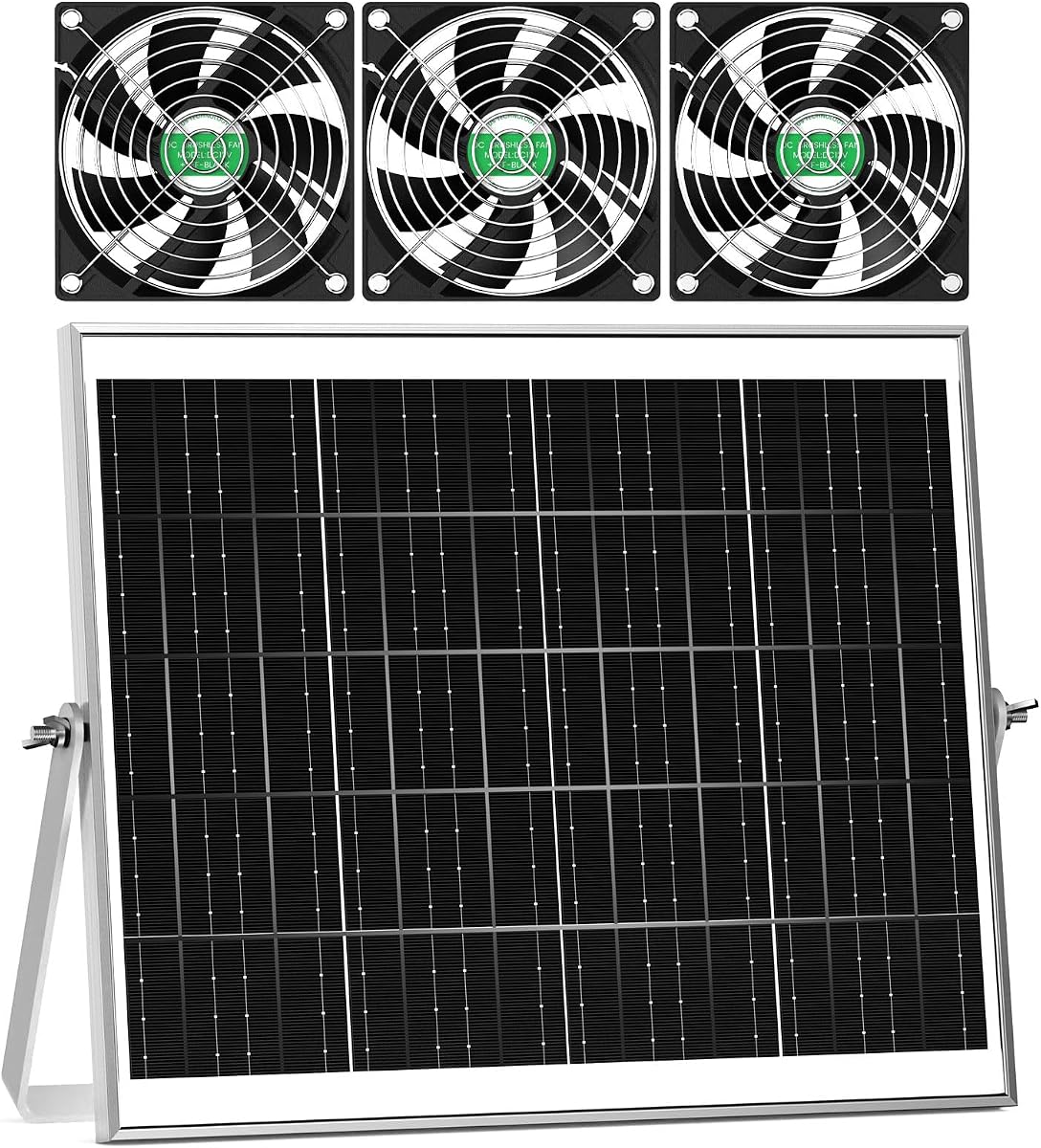


This 30W dual-fan kit offers one of the more approachable ways to ventilate a small greenhouse, chicken coop, shed, or pet house. Its 3.9 rating is the lowest among the ten products, but the underlying design covers several important basics: two exhaust fans, a high-output solar panel, an extension cord, and an IPX7 waterproof rating.
We may earn a commission when you buy through this link, at no additional cost to you.
The separate panel and fan arrangement provides useful placement flexibility. The panel can receive direct sunlight outside the structure while the connected fans move air through a window, wall opening, or vent. Double-layer metal guards help protect the blades and reduce the risk of accidental contact, which is particularly relevant around poultry, pets, and small animals.
The main limitation is that the system has neither a battery nor an on/off switch. It operates only when sufficient sunlight reaches the panel, and airflow changes naturally with available solar energy. That makes it ideal for daytime ventilation in sunny conditions but less suitable for greenhouses requiring overnight temperature control or uninterrupted circulation under overcast skies.
This is a sensible choice for budget-conscious buyers who want more fan output than a compact single-fan unit and do not need stored energy or manual settings. Position the panel where it receives unobstructed sunlight, secure both fans to stable openings, and use one or both for intake or exhaust depending on the greenhouse layout.
Two independently mounted fans can both exhaust hot air, both draw in fresh air, or operate in opposite positions to establish a cross-ventilation path. This arrangement is more adaptable than a single-fan kit and is especially useful in small structures with openings on more than one wall.
Waterproof connectors, an IPX7 rating, metal protective guards, and a corrosion-conscious fan design suit greenhouses, coops, sheds, and pet houses. The pre-drilled panel holes and included hardware simplify mounting, although exposed cords should be routed carefully.
We may earn a commission when you buy through this link, at no additional cost to you.
This two-pack pairs two 7.1-inch solar fans with separate 25W panels and 16.5-foot cords. Its 4.1 rating reflects a strong balance of useful output and installation flexibility, while the listed maximum of 3,800 RPM and 900 CFM places it among the most capable daylight systems in this guide.
We may earn a commission when you buy through this link, at no additional cost to you.
One fan can be installed as intake and the other as exhaust, creating a balanced ventilation path. Both could also be dedicated to the same function when the goal is to purge a larger greenhouse or coop. The long cables make it easier to place each panel in direct sunlight while positioning the fans through separate openings.
Its lack of battery means operation is tied to available solar energy. The product description notes reduced output under cloud cover and continuing reduced performance when the panel is shaded. That is a meaningful trade-off, but for users seeking strong daytime ventilation without conventional power wiring, it can be an effective trade.
This is our Editor's Choice for buyers who want substantial airflow and a two-fan ventilation layout in a space of roughly 150 to 230 square feet, as indicated by the supplied information. It is less appropriate for overnight plant protection, but it offers an effective balance of panel capacity, fan size, and flexible setup.
A pure copper brushless motor and thin blades support the stated high-speed operation and airflow. This combination is designed for quickly moving hot, humid air and refreshing enclosed growing or animal spaces when the panels receive strong sunlight.
Because each fan has its own panel and cable, the units do not need to share a single mounting point. That makes it easier to establish intake on one side and exhaust on another or to serve separate areas within a greenhouse or coop.
We may earn a commission when you buy through this link, at no additional cost to you.
The Solar Greenhouse Fan 3 Kit is a rugged single-panel system designed for exhaust or intake ventilation. Its 4.1 rating and listed 3,800 RPM maximum place it among the faster options, while the 30W monocrystalline panel supplies power without a grid connection.
We may earn a commission when you buy through this link, at no additional cost to you.
Construction features include heavy-duty aluminum, an IP67 waterproof rating, and double metal guards. The supplied hardware supports upright, wall, or roof placement of the panel, secure fan attachment with plates and screws, and suspension with nylon ties. A 16.5-foot plug-and-play cord allows the panel and fan to occupy different sides of a structure.
Unlike many similarly compact products, this kit includes an on/off switch for manual control. It still has no built-in battery, so the fan is expected to run during the day and lose performance in cloud cover or at dusk. The product's stated lifespan exceeding seven years is notable, though actual longevity depends on installation, exposure, and maintenance.
This is a compelling option for a medium-sized greenhouse, shed, or chicken coop where high airflow and robust outdoor hardware matter more than nighttime operation. Its installation flexibility and manual switch also make it easier to manage than a completely automatic daylight-only design.
The aluminum construction, IP67 rating, and double metal guards address the wear and impact risks associated with outdoor ventilation equipment. These features are particularly relevant where fans are mounted in open vents, bird-prone coops, or weather-exposed structures.
The included bracket supports several panel orientations, while plates, screws, and nylon ties give the installer multiple ways to position the fan. The long cord reduces the need to place the panel and fan immediately next to one another.
We may earn a commission when you buy through this link, at no additional cost to you.
The MARBERO Solar Panel Powered Fan Kit earns a 4.4 rating, the second-highest rating among these daylight-focused products. Its 15W monocrystalline panel powers two aluminum fans that can reach 2,500 RPM, delivering enough circulation for small greenhouses, chicken coops, sheds, pet houses, and window-ventilation projects.
We may earn a commission when you buy through this link, at no additional cost to you.
The system is unusually flexible for a compact kit. A 9.8-foot main cable and two 3.2-foot fan cables produce a total combined length of 13 feet. Buyers can use both fans for intake, both for exhaust, or split them between the two functions. The inclusion of mounting plates, screws, and zip ties supports a complete installation.
Durability is addressed through heavy-duty aluminum, an epoxy resin-coated surface, double metal protective nets, and a waterproof brushless motor. However, the absence of a battery means performance can fall significantly under clouds or shade, and the fan does not run at night or during rainy weather.
This kit is well suited to small structures where two moving points of ventilation are preferable to one and an on-off switch is not essential. Its 4.4 rating, sturdy components, and flexible configuration make it a strong alternative for buyers seeking a balanced, non-battery solar fan system.
Two fans can establish a clear intake-and-exhaust circuit, helping replace stagnant air more efficiently than a single fan. Their combined cable reach also allows the solar panel to remain in a bright location while the fans sit at useful ventilation openings.
The epoxy-coated aluminum surfaces and double metal guards add protection in sheds, coops, and pet houses. The waterproof brushless motor is designed to tolerate the shock and exposure associated with outdoor installations.
We may earn a commission when you buy through this link, at no additional cost to you.
This thermostat-equipped exhaust fan stands apart because its 8,800mAh rechargeable battery can keep the fan operating for up to 10 hours after full charging in sunlight. That makes it a stronger option for greenhouses that need ventilation after sunset or during periods when the solar panels cannot generate enough immediate power.
We may earn a commission when you buy through this link, at no additional cost to you.
The battery box includes an intelligent temperature-control system. Users can select the ambient temperature at which the fan switches on and off, while the system automatically changes its power mode according to sunlight. Two 25W bifacial panels support both fan operation and battery charging, although cloudy conditions reduce both functions.
The four-inch fan produces 339 CFM and is listed as suitable for spaces up to 2,540 cubic feet. Cables of different lengths allow flexible placement, and installing fans on opposite sides of a space can create cross-ventilation. The fan blades and plugs carry IP44 waterproof protection.
This is a good fit for gardeners who need automatic, temperature-based control and value nighttime cooling over maximum airflow. It should not be confused with a high-output industrial extractor: its 339 CFM rating is modest, and battery performance still depends on adequate solar charging.
The rechargeable battery distinguishes this model from daylight-only kits. Once charged, it can provide up to 10 hours of additional ventilation, giving greenhouse plants more consistent protection during the evening and cloudy periods.
Adjustable temperature thresholds allow the fan to start and stop according to the user's preferred conditions. This automation reduces the need to monitor and manually operate ventilation during changing daytime temperatures.
We may earn a commission when you buy through this link, at no additional cost to you.
This dual five-inch solar fan package is built for compact spaces such as a small greenhouse, chicken coop, shed, pet house, RV, vehicle, or camping setup. Its 4.0 rating reflects a practical design with two separately mounted fans, a 13-foot system cable, and a supplied collection of brackets, plates, screws, and nylon ties.
We may earn a commission when you buy through this link, at no additional cost to you.
The fans have IPX7 waterproof protection, aluminum housings, and double metal protective nets. Their cords feature individual on/off switches, allowing either fan to be disabled without affecting the other. The panel bracket supports wall or roof mounting, and the fan can be screwed to a base or suspended from a pole or tent structure.
There is no battery, so the power is generated directly by the solar panel. Airflow increases with available solar power and slows when sunlight is weak. The manufacturer suggests this configuration for spaces around six feet by six feet or smaller, which is an important limitation for larger greenhouses.
This kit is attractive to buyers who want a complete, easy-to-install package with two independently controlled fans. Choose it for a compact greenhouse, mobile camping arrangement, or small animal shelter; for a larger growing area, a higher-output model would be more appropriate.
Each five-inch fan has its own on/off switch, allowing a user to operate one fan as intake and the other as exhaust without running both simultaneously. This can also make it easier to test airflow direction during setup.
The stated IPX7 rating and aluminum construction make the system suitable for exposed outdoor use. It is particularly useful where washdowns, humidity, or rain can reach the motor and electrical connections.
We may earn a commission when you buy through this link, at no additional cost to you.
The 7.5-inch two-pack combines large solar panels with two substantial fans for greenhouses, coops, sheds, pet houses, cabins, and other enclosed spaces. Its 4.2 rating is supported by a listed maximum speed of 3,200 RPM and suitability for areas up to approximately 210 square feet.
We may earn a commission when you buy through this link, at no additional cost to you.
Each unit includes a separate monocrystalline panel and split fan-and-panel design. This allows the panels to face direct sun independently of where the fans are mounted. The supplied hardware supports panel placement, rigid fan attachment, or nylon-tie suspension, while each fan cord includes an on/off switch.
Heavy-duty aluminum components, double-layer metal guards, and an IP67 waterproof rating help the system cope with outdoor conditions. The stated service life exceeds five years. As with other no-battery designs, operation is limited to daylight and output falls when sunlight is limited.
This product is a middle-ground option for buyers who want two larger fans without moving to a battery-based premium system. It is well suited to medium greenhouses and animal spaces where daytime cooling, rugged construction, and independent placement are the priorities.
The seven-and-a-half-inch fan size and 3,200-RPM maximum support faster air movement than compact kits. The stated coverage of up to 210 square feet gives buyers a useful reference when comparing this model with larger 10-inch and 12-inch systems.
Two independent 15W panels give the installer freedom to orient each fan according to nearby openings and available sunlight. The split architecture also reduces the need to route both fans from a single panel location.
We may earn a commission when you buy through this link, at no additional cost to you.
This 10-inch solar exhaust fan is designed for high-output ventilation, with airflow listed at up to 1,020 CFM and 790 CFM at the default Level 8 setting. Its 4.1 rating reflects a feature-rich system designed for greenhouses, sheds, attics, garages, workshops, and chicken coops.
We may earn a commission when you buy through this link, at no additional cost to you.
A built-in 60Wh rechargeable battery stores solar energy during the day and is stated to run the fan for more than 10 hours at the default speed. This provides considerably more resilience than daylight-only kits and allows evening, overnight, or cloudy-period ventilation when the battery has been adequately charged.
Users can select from 12 speed levels, use timer controls, and adjust settings with the included remote from up to 26 feet away. A pure copper brushless motor, aluminum blades, and a full-metal housing support durability, while the stated 40–60 dB operating range indicates an emphasis on relatively quiet ventilation.
This is a strong option for larger spaces or users who want precise control and extended runtime. The 10-inch fan, dual panels, battery, and remote create a more substantial installation, so buyers should confirm available wall or roof area and plan cable routing before purchasing.
Up to 1,020 CFM makes this one of the highest-output products in the guide. That capacity is especially relevant for greenhouses and sheds where a single smaller fan may not clear heat and humidity quickly enough during sunny conditions.
Twelve speed levels and timer functions provide finer control than basic on/off models. The remote can make it convenient to change output from a convenient location without repeatedly accessing the fan assembly.
We may earn a commission when you buy through this link, at no additional cost to you.
The 8-inch Solar Ventilation Fan combines a 25W monocrystalline panel with an 8-inch fan rated at up to 430 CFM and 2,300 RPM. Its 4.1 rating is supported by a versatile power arrangement, a 16.4-foot solar cord, and an included AC adapter for household operation.
We may earn a commission when you buy through this link, at no additional cost to you.
Unlike systems that simply stop when sunlight disappears, this model can connect to the included power adapter. That flexibility makes it useful when reliable ventilation is needed during cloudy weather, nighttime hours, or periods when the panel receives insufficient light. The adapter has its own 4.66-foot cable.
An anti-backflow valve with an internal iron block is designed to close when the fan stops, helping keep insects and animals outside. The panel has an IP67 rating, toughened glass, and an aluminum frame, while the fan is stated to operate at about 36 decibels. Installation requires drilling a seven-inch opening.
This is a well-rounded choice for a shed, coop, greenhouse, garage, attic, basement, or RV that needs both solar operation and optional grid power. It may suit buyers who want nighttime reliability without the footprint of a larger battery-based exhaust system.
The included AC adapter gives the fan an alternative power source when the solar panel cannot produce enough energy. This approach differs from battery models because it requires access to household electricity but does not depend on battery charging state.
The internal iron block helps the valve remain closed when the fan is off. That feature can reduce the entry of insects and animals through an exposed ventilation opening, adding an extra layer of practical protection.
We may earn a commission when you buy through this link, at no additional cost to you.
The HG Power 12-inch Solar Powered Exhaust Fan has a 4.8 rating, the highest in this roundup. It combines a 40W bifacial solar panel, a 12-inch shutter fan rated at 764 CFM, an intelligent controller, thermostat, and an included AC adapter for dependable operation beyond direct sunlight.
We may earn a commission when you buy through this link, at no additional cost to you.
Two operating modes provide distinct priorities. Energy Saving mode varies fan speed with sunlight and allows the adapter to provide steady backup airflow. Performance mode uses the adapter and offers a four-level manual speed adjustment. The target temperature can be set from 68 to 113 degrees Fahrenheit for automatic on-and-off operation.
A protective ten-minute delay keeps the fan running after temperatures fall below the selected threshold, reducing frequent on-off cycling and helping protect the motor. The package includes the controller and temperature probe, AC adapter, solar panel, fan, mounting bracket, screw set, and manual, with long cables for flexible positioning.
This is the most complete automatic solution in the guide and our Best Premium pick. It is best for users who value dependable ventilation, thermostat-based control, and flexible power modes over the simplicity of a small daylight-only kit. Confirm the available opening and panel placement before installation.
The controller can start and stop the fan according to a user-selected temperature. This makes the system useful in greenhouses and animal spaces where maintaining a ventilation threshold is more convenient than continuous manual adjustment.
Solar operation is supplemented by the included AC adapter, allowing steady airflow when sunlight is weak. The ten-minute post-cooling delay reduces rapid cycling after the target temperature is reached, which supports longer-term motor operation.
We may earn a commission when you buy through this link, at no additional cost to you.
Choosing a solar greenhouse fan involves balancing space size, airflow demands, available sunlight, installation openings, and the need for continuous or automatic operation. The following factors help separate basic ventilation kits from battery-backed smart systems.
The fan's stated airflow and intended space coverage are the most important starting points. Basic five-inch and dual-fan kits are generally more appropriate for small structures, while eight-inch, ten-inch, and twelve-inch options can move more air through a larger greenhouse or attached shed. Always consider whether the product is rated for square feet, cubic feet, or a smaller suggested enclosure, because these measures are not interchangeable.
Most solar fans in this category run directly from their panels and stop when sunlight becomes inadequate. If plants or animals need ventilation after sunset, look for a rechargeable battery, a temperature-responsive overnight mode, or an included AC adapter. Battery-backed systems provide greater autonomy but occupy more space and depend on the battery receiving a sufficient solar charge.
Panel wattage influences how much power is available to the fans, although fan size, motor efficiency, wiring, and sunlight also affect real-world output. A larger panel generally gives a system more headroom during marginal light. Look for monocrystalline construction when efficiency and low-light performance matter, and consider bifacial or dual-panel designs where broad sun exposure is available.
Effective ventilation usually requires fresh air to enter and stale air to leave. A dual-fan kit can place one unit at an intake opening and another at an exhaust opening, creating cross-ventilation. Also consider the distance between fans, the direction of prevailing wind, and whether screens or grilles could obstruct movement. Larger installations need stable brackets and properly sized wall openings.
Greenhouse and coop fans face humidity, condensation, rain, dust, insects, and physical impacts. Look for a stated IPX7 or IP67 rating, water-resistant connectors, aluminum housing, corrosion-resistant finishes, and double metal guards around the blades. These features are particularly important when a fan is mounted low, near an open vent, or within reach of curious animals.
Some systems operate automatically with sunlight and provide no manual switch. Others include inline on/off controls, a thermostat, programmable timers, or a remote with multiple speed levels. Automatic temperature control is useful when the greenhouse must maintain a consistent threshold, while manual controls are useful for seasonal adjustment, testing airflow direction, and operating only one fan at a time.
A complete kit should include a solar-panel bracket, fan mounting plates, screws, and suitable ties or fasteners. Cable reach is equally important because the panel needs direct sun while the fan needs access to an opening. Measure both distances before installation and route cords through protected paths. A long cord is not a substitute for a secure, weather-resistant connection.
Solar ventilation systems still require occasional attention. Dust and plant debris can reduce blade performance, while insects can interfere with guards or moving parts. Check the panel for accumulated dirt, inspect connectors for moisture, and confirm that fasteners remain tight. Battery-based models also need periodic charge monitoring, while mechanical louvers and valves should be checked for smooth operation.
Begin by identifying the hottest or most stagnant area in the greenhouse and selecting a fan size appropriate for the enclosure. If using two units, position one as intake and one as exhaust, ideally on opposite walls, and confirm that the required opening dimensions and mounting surfaces are suitable before cutting or drilling.
Mount the solar panel in direct sunlight using the supplied bracket, then route the cable neatly to the fan. Secure the fan to a stable frame, wall, roof, or pole and confirm that the guard cannot contact plants, branches, or structural edges. For automatic models, set the desired temperature, speed, and timer; for manual models, test both intake and exhaust positions before operating the system for a full day.
Inspect the panel and fan regularly, especially after storms or seasonal changes. Remove accumulated dirt, leaves, and insects, tighten loose hardware, and check that waterproof connectors remain seated. Clean battery-backed units according to the manufacturer guidance, avoid prolonged operation with a depleted battery, and arrange conventional ventilation or backup power if critical conditions persist through cloudy weather or overnight hours.
It depends on the model. Most products in this guide operate directly from their solar panels and stop at night or when sunlight is insufficient. Models with a rechargeable battery or an included AC adapter can continue running after sunset, although runtime depends on the battery charge or the availability of household power.
Solar fans may still operate under cloudy skies, but airflow usually decreases because the panels receive less energy. A model with a larger panel, battery storage, or AC backup offers more consistent performance. Installers should place the panel in the brightest available location and avoid shade whenever possible.
Using one fan for intake and another for exhaust generally creates stronger, more balanced cross-ventilation than forcing a single fan to perform both functions. Mount the fans on opposite sides when practical and check the prevailing wind direction so outdoor air does not short-circuit directly back out.
The appropriate size depends on the greenhouse's square footage, cubic volume, heat load, and ventilation openings. Compact dual-fan kits are intended for smaller areas, while eight-inch, ten-inch, and twelve-inch models suit progressively larger spaces. Compare the manufacturer's capacity guidance with the dimensions of the greenhouse rather than selecting only by fan diameter.
Many of the listed products include double metal guards to protect people and animals from direct contact with the blades. A suitable safety mesh can provide additional protection. Position the fan securely, inspect guards regularly, and make sure no wiring or blade area is accessible to curious animals.
Most solar-only kits use plug-and-play connections between the panel and fan and do not require household wiring. An adapter-based model can also run through an ordinary outlet when its included power adapter is connected. You still need to mount the panel and fan securely and route their cables safely.
Position the panel in direct sunlight with the fewest obstructions possible. Orientation should favor available sunlight throughout the day, and the panel should not be shaded by a greenhouse roof, trees, walls, or equipment. Secure the bracket firmly because wind can place substantial load on a poorly anchored panel.
A single fan may be sufficient for a small greenhouse with good cross-ventilation openings, but larger or densely planted spaces usually benefit from matched intake and exhaust units. High humidity, tall plant growth, and limited openings can restrict circulation, so assess the entire ventilation path rather than judging only by fan diameter.
The 30W Solar Panel Fan Kit is the budget-oriented choice for small spaces, the 7.1-inch two-pack is the strongest all-around option for substantial daytime airflow, and the HG Power 12-inch system is the premium pick for thermostat-based control, flexible operating modes, and dependable solar or AC power.
Prioritize airflow capacity, direct solar exposure, and the correct intake-exhaust layout before considering convenience features. If nighttime cooling is essential, choose a battery-backed or adapter-compatible model; if the primary goal is simple daytime ventilation, a no-battery kit can be more compact, less complicated, and easier to install.
Before making a final purchase, verify the fan dimensions, required wall opening, included accessories, and current product specifications. Pricing, promotions, and availability can change, so checking the latest listing can help ensure the selected model still matches your greenhouse, coop, shed, or pet-space requirements.