
JST 1.25mm 1.25mm 6 Pin Connector Kit
5.0Editor score
Ten pre-crimped connector pairs
1.25mm pin pitch
100mm tinned copper leads
UL1571 26AWG wire
Compare the best 6 Pin Micro Connectors for RC models, LED strips, PCBs, robotics, and DIY wiring, with pitch, wire, fit, and application details.
Six-pin micro connectors are compact wired plugs used to join modules, controllers, lighting systems, and small electronic assemblies. A suitable connector must match the device pitch, wire size, housing style, and circuit requirements. The best option balances reliable contact, easy installation, serviceability, and suitability for the intended project.
The products in this guide were compared using their stated pitch, conductor construction, cable length, package contents, locking design, current and voltage limits, and intended applications. The list covers JST-style and Molex-compatible systems ranging from 1.0mm to 3.0mm pitch, including pre-crimped leads and housing-and-terminal kits.
Each review explains what distinguishes its connector and where it fits best, from compact RC wiring to multi-circuit harnesses and LED projects. Ratings and specifications reflect the supplied listings, while product details and availability can change. Readers should verify dimensions, pinout, and electrical limits before purchasing.
5.0Editor score

5.0Editor score

4.3Editor score
The table below compares all ten connector kits by system family, pitch, cable arrangement, and practical use. It is a quick identification aid, while the detailed reviews explain construction, compatibility, and project suitability.


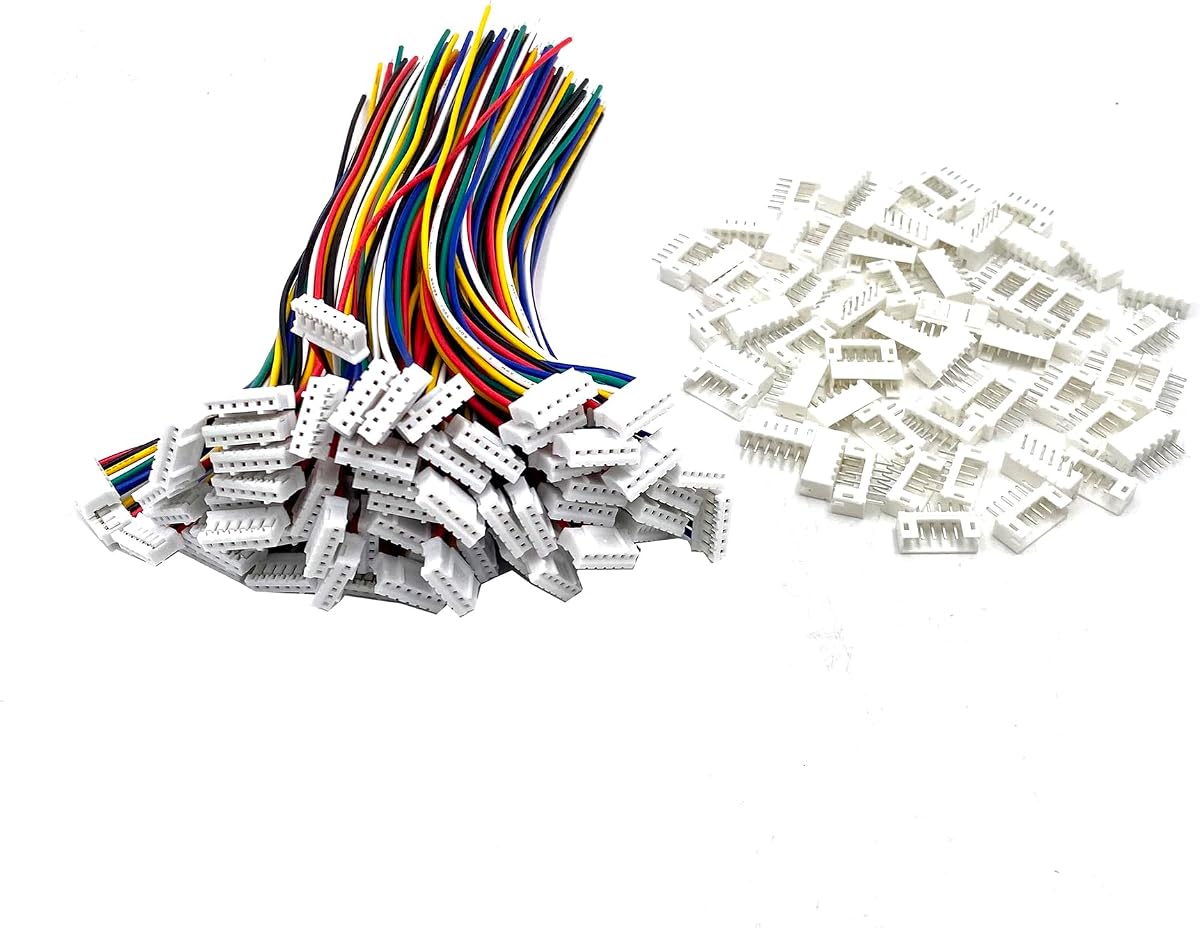

This JST 1.25mm six-pin kit combines ten male plugs and ten female sockets, each supplied with approximately 100mm of UL1571 26AWG cable. Its 5.0 rating reflects a broadly favorable user response, while the small 1.25mm pitch makes it especially suitable for compact devices. The kit is designed for projects where neat, repeatable plug-in connections are more valuable than a large assortment of unrelated parts.
We may earn a commission when you buy through this link, at no additional cost to you.
The supplied wire uses a tinned copper core, and the listing describes a 0.9mm external wire diameter with a 2mm tinned tail. That combination should be useful when working on RC helicopters, robots, LED strips, battery-powered equipment, and control panels. Because each lead can be cut and soldered, the cable can also be shortened to suit a specific enclosure or routed around a fixed component.
The main limitation is that 100mm leads are relatively short for a spread-out installation, and the 1.25mm format is unforgiving when the mating housing has a different pitch. A nominal JST designation does not guarantee compatibility with every similarly named connector, so physical measurement and pin-layout confirmation remain important. The ten-pair quantity is also a moderate amount rather than a bulk supply.
This is a strong choice for hobbyists, LED builders, and repair technicians who want a manageable set of compact, pre-crimped connectors without moving to a larger harness format. Choose it when the target device specifically uses a 1.25mm six-pin layout and the short cable length suits the available space. For those requirements, it offers the best balance of usefulness, quantity, and simplicity.
The 1.25mm center spacing is useful in RC models, robots, and compact control boards where a larger plug may prevent the housing from closing. Pre-crimped leads reduce the work needed to create a basic pigtail.
UL1571 26AWG cable can be cut to the required length and soldered to a board or module. The stated 2mm tinned tail gives a defined section that can be worked without stripping an unusually long run of wire.
We may earn a commission when you buy through this link, at no additional cost to you.
This set offers twenty matched pairs of JST SH 1.0mm six-pin connectors, giving it an exceptional amount of compact wiring in one package. Its 4.7 rating indicates strong user satisfaction, and the 1.0mm pitch is useful when even a 1.25mm plug would be too large. The male assemblies include 150mm leads, making the set relevant to slim RC toys, LED assemblies, and miniature battery-powered equipment.
We may earn a commission when you buy through this link, at no additional cost to you.
The contacts are described as tin-plated internal copper, while the cable is tinned copper wire. The listing also highlights cold and high-temperature resistance, durable plastic heads, and an antioxidant surface coating. These features are sensible for a connector intended to be unplugged, routed through a model, and exposed to normal handling during assembly or servicing.
A notable packaging detail is that the female plugs are stated not to have cables. As a result, users who require both sides to arrive pre-wired may need to crimp or solder the female side themselves. The extremely small housing can also be difficult to hold and align, particularly for first-time users working without magnifications. Pin spacing and latch orientation should be checked before installation.
The kit is best for builders with several compact devices to connect, especially when a 1.0mm pitch is confirmed and the ability to terminate the female housing is acceptable. It offers a larger usable quantity than most alternatives in the list, but technical confidence and the correct crimping process are more important here than simple plug-and-play convenience.
At 1.0mm, this system can reduce connector bulk in miniature electronics. That makes it a logical option for tightly packed RC models and small modules, provided the receiving connector uses the same pitch and mating layout.
Twenty pairs suit makers who are wiring several boards, lighting runs, or model components. The tinned copper construction and plated contacts support dependable conductivity in compact assemblies.
We may earn a commission when you buy through this link, at no additional cost to you.
This Micro-Fit 3.0 kit provides the most complete harness-building package in the roundup: four sets of six-pin male and female housings plus 30 pairs of pin and socket terminals. The supplied information describes 68 pieces per set, giving a builder the parts needed to assemble several terminated harnesses. Its 5.0 rating and 7A current capability make it particularly convincing for lower-voltage power and signal work.
We may earn a commission when you buy through this link, at no additional cost to you.
The 3.0mm system uses a 3.0mm pitch and a dual-row, six-circuit layout. Its PA66 housings are stated to withstand temperatures from -40°C to 105°C, while phosphor copper contacts with tin plating offer conductivity, low contact resistance, and corrosion resistance. A precision locking design helps keep the halves connected, which is useful in automotive equipment, 3D printers, motorcycles, and workshop projects where vibration or frequent handling is possible.
The tradeoff is size and assembly skill. A 3.0mm housing is substantially larger than a 1.0mm or 1.25mm plug, so it may not suit a miniature model with limited internal volume. Terminal retention depends on correct crimping, and installers should confirm the intended wire gauge and the appropriate crimp tool. Although the listing names compatible Molex part numbers, visual similarity alone is not enough to guarantee interchangeability.
This kit is the most versatile option for technicians, engineers, and serious hobbyists creating reusable custom looms. It is especially valuable when several circuits need reliable locking connections and the wiring must handle more current than a light signal lead. For that use, the extensive terminal assortment and stated electrical performance outweigh the added bulk.
Separate housings, male pins, and female sockets allow the harness to be built around the actual wire lengths and routing plan. That flexibility makes the kit useful for repair benches, custom vehicles, and repeatable production-style assemblies.
Support for 20–24AWG wire and a stated rating up to 7A provides more headroom than the fine-wire kits in this roundup. The plated phosphor copper contacts are designed to maintain low contact resistance across multiple circuits.
We may earn a commission when you buy through this link, at no additional cost to you.
This JST 1.25mm set is distinguished by its approximately 20cm cables, twice the lead length of the first-ranked kit. It includes ten six-pin sets of male plug cables and female sockets, based on the selected option. The 4.7 rating suggests consistent satisfaction, while the longer wires make this package easier to use when the connection points are not immediately adjacent.
We may earn a commission when you buy through this link, at no additional cost to you.
The wire is UL1571 26AWG tinned copper, and the listing explicitly states that it can be cut to any length and soldered. That flexibility lets a builder retain the full lead during initial layout and remove excess only after confirming the route. The 1.25mm pitch remains small enough for RC helicopters, LED strips, robots, speakers, and PCB control panels.
Longer leads are not universally better. Inside a small RC model, 20cm of wire can be difficult to route without adding bulk or creating unintended loops. The product title also presents several possible pin counts, so buyers must ensure the chosen variation is the six-pin set rather than a two-, three-, four-, or five-pin option. As with all miniature connectors, the physical housing and wire order must be checked.
This is a good option for general hobby work where moderate reach and easy soldering matter more than the shortest possible lead. It may be especially convenient for breadboard-style prototyping, appliance repairs, and LED installations where the final distance is uncertain. Choose it when 1.25mm is confirmed and a 20cm service loop is genuinely useful.
The 200mm lead gives an installer room to position a module before trimming. It can reduce awkward splices and makes temporary prototyping easier when the final wire path has not yet been decided.
Because the cable can be shortened and soldered, one connector type can serve both permanent wiring and temporary experiments. Keeping unneeded length until final assembly also helps prevent accidental cuts.
We may earn a commission when you buy through this link, at no additional cost to you.
This JST PH 2.0mm kit provides five matched male and female six-pin plug assemblies with 100mm flexible silicone leads. It carries a 5.0 rating, and its main appeal is the unusually flexible 22AWG tinned copper wire. Soft cable is easier to route in a confined assembly and less prone to taking a sharp bend than a stiffer lead of comparable size.
We may earn a commission when you buy through this link, at no additional cost to you.
The 2.0mm pitch is a widely encountered size in small electronics, giving this kit a useful middle ground between fine JST formats and larger 2.54mm or 3.0mm connectors. Each lead contains one of six colors, which assists identification during installation. The listing describes the cable as heatproof and resistant to melting, making it relevant to lighting, battery, automotive interior, robot, and control-panel wiring.
The package contains fewer pairs than most competitors, so it may require another purchase for a large installation. The silicone insulation is also less convenient to strip or cut than ordinary PVC wire, and users still need to confirm that the receiving connector matches both the 2.0mm pitch and the six-position layout. Color order is useful, but it should not replace a verified wiring diagram.
This set is best for builders who value routing flexibility and frequently rework small assemblies. It is particularly suitable for a handful of modules rather than a bulk production run. The secure plug connection, 22AWG wire, and straightforward 2.0mm format make it a practical option for LED strips, RC projects, speakers, robots, and household electronics.
Soft silicone leads bend gently around switches, boards, and structural pieces without immediately taking a sharp set. This makes assembly less frustrating in compact devices where a stiffer wire would press against nearby components.
Six differently colored wires help users follow individual conductors through a crowded harness. The colors make errors easier to spot, although electrical functions and polarity should still be verified independently.
We may earn a commission when you buy through this link, at no additional cost to you.
This JST SM 2.54mm kit contains ten pre-crimped male leads and ten female extension sockets, each with approximately 150mm of 22AWG cable. Its 4.6 rating reflects a generally positive reception, and the 2.54mm spacing is easier for many builders to identify and handle than a sub-millimeter connector format.
We may earn a commission when you buy through this link, at no additional cost to you.
The nylon shells and tinned copper contacts are designed for straightforward installation and reliable conductivity. The larger pitch makes the connectors suitable for signal and wire-to-wire links, light-fixture wiring, modules, and other low-voltage assemblies. The listing also identifies compatibility with Molex PicoBlade, though users should check the physical dimensions and contact arrangement rather than relying only on the family name.
Serviceability is a meaningful advantage. Once a lead is installed, a module can be disconnected for inspection or replacement without cutting and re-soldering multiple wires each time. The tradeoff is bulk: a 2.54mm assembly may be too large for a tiny drone, wearable, or tightly molded enclosure. It also lacks the low-profile profile of JST SH, 1.25mm, or PH options.
Choose this kit when plug-and-play maintenance is the priority and the device can accommodate a standard 0.1-inch-style layout. It works well for bench prototypes, programmable lighting, and small modules that need repeated disconnection. The 150mm length gives enough reach for common wiring layouts without creating a very large cable bundle.
A male plug and female socket allow a connected module to be removed cleanly. That is useful when troubleshooting LED fixtures, testing control boards, or replacing a small powered component within a larger installation.
The 2.54mm spacing is easier to work with than ultra-fine formats. It can suit users who want a recognizable grid-like arrangement without moving to the larger Micro-Fit 3.0 system.
We may earn a commission when you buy through this link, at no additional cost to you.
This six-pin JST SM set is tailored to flexible 5050 RGBWW, RGBCCT, and SMD FCOB LED strip projects. It includes ten male plugs and ten female plugs with approximately 140mm of wire, and its 4.0 rating places it in the middle of the group. The focused design makes it appealing for installers who want a repeatable connection method across several compatible strips.
We may earn a commission when you buy through this link, at no additional cost to you.
Rather than functioning as a general-purpose loose connector assortment, the product is explicitly associated with the six-pin FCOB RGB PWM strips identified in the listing. Its six individual wires can carry the multiple control or power lines required by those products. Plug-in assembly also allows a strip to be disconnected for relocation, repair, or testing without repeating all six solder joints.
Compatibility is the principal constraint. The connectors should not be assumed to work with every six-wire LED strip, since housing dimensions, conductor order, and control requirements can differ. The listing explicitly advises checking wire colors and polarities before connection. A visually similar plug can still produce incorrect control behavior, reversed polarity, or damage if its pinout is not verified.
This is the most targeted LED choice in the roundup and is best for users working with the specified FCOB RGB strip models or a connector that has been confirmed to match exactly. For those projects, ten pairs offer useful installation flexibility. It is less appropriate as a general stock of micro connectors for RC vehicles, robotics, or mixed electronics.
The six-wire format is intended to support multi-channel RGB and adjustable-white LED strips. Matching connectors reduce the chance of soldering six individual conductors into each fixture by hand.
A plug-and-socket joint allows lighting sections to be separated during installation or troubleshooting. This is valuable when a display is being built in several sections and later adjusted.
We may earn a commission when you buy through this link, at no additional cost to you.
This Molex Micro-Fit 3.0 package is a traditional-looking option for six-circuit, dual-row connections. It includes three complete sets of male and female receptacles with terminal sockets and carries a 4.2 rating. Its appeal lies in a standardized 3.0mm form that may suit technicians seeking a familiar replacement format for compatible equipment.
We may earn a commission when you buy through this link, at no additional cost to you.
The Micro-Fit 3.0 system is commonly associated with compact but relatively robust wiring interfaces, making it more appropriate than ultra-fine JST formats for higher-current or more frequently handled connections. The product title clearly identifies the dual-row, six-circuit layout and the inclusion of terminal sockets. That makes it a more structured repair kit than a bundle of loose, unidentified terminals.
The supplied listing has no detailed technical notes, so wire range, current rating, temperature limits, and exact terminal references cannot be confirmed from the available information. Buyers should inspect the component markings and compare the housing dimensions, circuit arrangement, and terminal tooling with the original device. The 3.0mm format also consumes more space than the smaller connectors in this guide.
This product is best for repair work involving a known Micro-Fit 3.0 device, especially when matched male and female sets make replacement convenient. It is less suitable for a first-time builder who needs clear wire-gauge guidance or for a miniature project where housing size is the priority. Confirm compatibility before ordering, and treat the three complete sets as the defining convenience.
Using a connector family that matches the original equipment can simplify repairs and reduce the need to redesign a harness. Three complete sets also provide spares for future service needs.
The Micro-Fit 3.0 format is larger than JST SH or 1.25mm connectors but smaller than many general-purpose automotive housings. That middle ground works well where a tiny plug would be too fragile.
We may earn a commission when you buy through this link, at no additional cost to you.
This JST PH 2.0mm assortment stands out with 60 matched male and female pairs, far more than the other pre-crimped kits in the guide. Each connection uses a 150mm lead with 28AWG tinned copper wire, and the product carries a 4.3 rating. The scale makes it a practical choice for workshops, production-like prototype batches, and builders assembling many small modules.
We may earn a commission when you buy through this link, at no additional cost to you.
The contacts are described as zinc-copper alloy with PVC insulation, while the cable has a seven-strand zinc-coated core. The listing states a maximum of 24V DC and 1A, which is suitable for many signal, control, lighting, and low-voltage power connections. The solder-ready design supports direct attachment to PCBs, LED strips, Arduino boards, and other small assemblies without requiring a separate crimping operation for every cable.
The primary limitation is the 28AWG conductor size, which is less substantial than the 20–24AWG support offered by the Micro-Fit 3.0 kit. Users should observe the stated current limit and avoid treating it as a high-current connector. The product is also explicitly not compatible with LiPo battery balance ports, a useful warning for RC users who might otherwise assume every small battery plug has the same function.
This is the best choice for builders who need a large number of consistent 2.0mm connections, such as robotics trainers, classroom kits, or a fleet of repaired modules. The length is convenient for common harness layouts, and the broad pair count reduces the likelihood of running short midway through a project. Confirm the target pitch and pinout before use.
Sixty pairs support multiple devices or a sequence of repair tasks without requiring repeated purchasing. Uniform 150mm leads also simplify template-based layouts and batch assembly.
The stated 24V DC and 1A range covers many low-voltage control and lighting applications. Staying within those conditions is especially important because the 28AWG leads are finer than options using heavier conductors.
We may earn a commission when you buy through this link, at no additional cost to you.
This JST MX 1.25mm kit combines twenty sets of six-pin connectors with 150mm, 28AWG cable. Its 4.5 rating reflects solid performance within a specialized compact format. The 1.25mm pitch keeps the connection small enough for electronics projects where a larger connector would consume valuable space, while the 150mm length offers more routing reach than the shortest kit in the list.
We may earn a commission when you buy through this link, at no additional cost to you.
The cable is described as PVC-insulated tinned copper, and the plastic housings are stated to resist cold and high temperatures. An operating range of -40°C to 80°C and a voltage limit of up to 30V are specified. These characteristics make the set appropriate for LED strips, decorative lighting, mini RC helicopters, DIY toys, control panels, and household appliance wiring where low-voltage serviceability is useful.
As with any connector sold under a family name, users should confirm that a device actually accepts the MX housing, its 1.25mm spacing, and its six-position layout. The 28AWG wire is also modest in size, so the kit should be treated as a light-duty connection rather than a high-current power solution. A 2mm tinned tail provides a convenient soldering or crimping section, but the correct attachment method should match the wire and terminal construction.
This kit is best for users who need many compact, moderate-length connectors and work primarily on low-voltage lighting or small control circuits. It combines the space savings of 1.25mm pitch with a 150mm lead, filling a useful gap between very short pigtails and larger 2.0mm or 2.54mm assemblies. Verify the physical connector and pinout before committing to a large project.
The 150mm cable makes it possible to place modules apart without using bulky intermediate wiring. It is a useful middle option for compact housings that cannot comfortably accept a 2.0mm connector.
The stated -40°C to 80°C operating range covers many indoor and moderately cool outdoor conditions. The housing material and tinned copper construction support use in varied DIY and lighting installations.
We may earn a commission when you buy through this link, at no additional cost to you.
Choosing a six-pin micro connector starts with the device rather than the package count. Match pitch, housing geometry, pin arrangement, current requirements, and cable length before considering price, quantity, or included terminals.
Match pitch and physical fit exactly. Do not force a connector into a differently sized housing, and do not rely on a visual impression alone.
Treat the housing family as part of the electrical specification. Check molded markings, product drawings, and the original device documentation whenever possible.
Choose a conductor suitable for both current and installation method. Fine wire suits control signals; heavier wire is preferable for power-carrying harnesses.
Select a length that fits the real route. Keep extra length during planning, then trim it before final installation when practical.
Choose pre-crimped leads for speed and simplicity. Choose loose terminals when custom wire lengths, serviceability, or professional harness construction matter most.
Favor a secure latch and reusable connection when equipment moves or is serviced. Confirm that the connector locks fully and does not require special tools to release.
Use application-specific kits when their supported devices match the project. For everything else, confirm the exact pinout, voltage, and current requirements.
Estimate the number of connections and add a small service margin. Count matched usable pairs, not merely the total number of connector halves.
Begin by disconnecting all power and removing the battery or other energy source. Compare the connector's pitch, row layout, latch direction, and six-contact arrangement with the device. Confirm the function of every wire against a wiring diagram, especially for LED strips, RC battery leads, and control modules. Test continuity with a multimeter before inserting a new connector.
For pre-crimped leads, cut the cable to the required length and strip only the section needed for the attachment point. Keep the connector body away from heat while soldering, and avoid exposing the latch to excessive force. When using loose terminals, select a crimp tool and die that match the terminal and 20–24AWG wire range. A proper crimp is mechanically secure and electrically continuous; a loose or deformed terminal should be replaced.
Route the cable so it is not pulled, pinched, or exposed to sharp edges. Leave a small service loop near the plug and provide strain relief at soldered joints. Keep connectors dry and away from excessive heat, and separate the halves before servicing powered equipment. Periodically inspect for discoloration, looseness, damaged insulation, and bent contacts. Do not mate connectors whose housings, pins, or wire order differ.
No. They may share the same number of contacts while using different pitches, housing shapes, latch designs, and pin orders. A connector can also carry different functions on each wire. Measure the housing and verify the complete wiring arrangement before attempting to mate two products. Physical fit should be checked alongside electrical compatibility, not treated as a substitute for it.
Pitch is the distance between the centers of adjacent pins, so smaller pitches create more compact connectors. The 1.0mm and 1.25mm formats suit miniature devices, while 2.0mm and 2.54mm are easier to handle. The 3.0mm format generally offers greater wire and current capacity. These sizes are not interchangeable even when all are described as micro or miniature connectors.
Only when the connector, pin count, wire order, and electrical rating exactly match the battery and device. One product in this guide explicitly states that it is not compatible with LiPo battery balance ports, which demonstrates why a six-pin label alone is insufficient. Polarity mistakes can damage equipment, and mismatched balance leads can create unsafe conditions. Verify the manufacturer's wiring information before connecting any battery.
A compact 1.0mm or 1.25mm option is usually the most practical starting point, provided it matches the helicopter's receiver, ESC, or other module. The 1.0mm JST SH set offers the smallest pitch, while the 1.25mm kits provide 100mm or 200mm options. Weight, wire stiffness, available mounting space, and the required current should all be considered before choosing the connector.
Choose wire that can carry the expected current without excessive heating or voltage drop. The 20–24AWG Micro-Fit system has more current capacity than the 26AWG and 28AWG kits, making it better suited to power-carrying harnesses. Fine wire is appropriate for signals and light loads. The product's stated current and voltage limits should always take priority over conductor appearance.
Usually not for the cable already attached to the plug or socket, though a soldering tool may still be needed to connect it to a board or module. A crimping tool is necessary if the listing includes loose terminals or if the user intends to create additional custom leads. Check whether the female side is pre-crimped, because the JST SH 1.0mm set states that its female plugs do not include cables.
Count the number of connections rather than the number of devices, then add a few spare pairs for mistakes and future repairs. A module with one plug and one socket uses one matched pair. The 5-pair PH kit suits a small assembly, while 10 or 20 pairs cover typical multi-module builds. The 60-pair set is most useful for batch projects, robotics teams, or frequent repair work.
Use a keyed housing with a matching receptacle and confirm the latch orientation before assembly. If a connector is unkeyed, mark the plug and socket clearly and add a visible label to the cable. Keeping the original housing system whenever possible also reduces the chance of confusing similar six-pin formats. Never force a plug that does not enter smoothly.
The JST 1.25mm 1.25mm 6 Pin Kit stands out as the best value for compact, straightforward hobby wiring, while the Micro-Fit 3.0 Connector Kit is the most capable choice for custom multi-circuit harnesses. The JST PH 2.0mm Bulk Set earns the premium selection for builders who need a large number of matched connections and a useful 150mm lead length.
Above all, match the pitch, housing, pinout, and electrical limits before focusing on package quantity. Fine-wire JST-style leads work well for small controls, LED systems, and RC accessories, while a Micro-Fit format provides more room for heavier conductors and serviceable power connections. The right connector is the one that fits the actual equipment and can safely handle the job.
Product details, ratings, compatibility claims, and availability may change over time, so review the current listing and manufacturer documentation before ordering. Measure the existing connector, confirm the wire functions, and check the stated voltage and current limits. Those final checks can prevent a mismatched housing or reversed connection from turning a simple wiring job into a repair.
