Starlink Mini 12V Adapter
4.6Editor score
9–28V wide input range
30V 3.5A stable output
IP68 sealed aluminum housing
Our Starlink Power Kit for Off Grid Use guide compares adapters, converters, battery kits, and switches for dependable power in RVs, boats, vehicles, and
Keeping Starlink running beyond the reach of household wiring requires a power setup designed for mobile batteries, solar systems, generators, and portable power stations. A suitable kit must convert voltage correctly, deliver enough current, resist outdoor conditions, and connect safely without unnecessary modifications to the satellite equipment.
This guide compares ten Starlink Mini, Standard, and third-generation power solutions, including DC step-up converters, vehicle adapters, tool-battery kits, a replacement power supply, and a waterproof rocker switch. The evaluation focuses on stated compatibility, output specifications, cable design, weather protection, installation method, and practical off-grid features rather than laboratory testing.
The rankings reveal three distinct approaches: direct battery adapters for permanent installations, vehicle-oriented products for travel, and flexible kits for portable power. Each review explains where the option fits best, while noting trade-offs such as device-specific compatibility, included battery needs, or more involved wiring. Prices and availability can change, so confirm current listings before purchasing.
4.6Editor score

5.0Editor score

4.6Editor score
The table below compares the supported Starlink systems, power source, output, and most useful installation feature for every product in the guide.



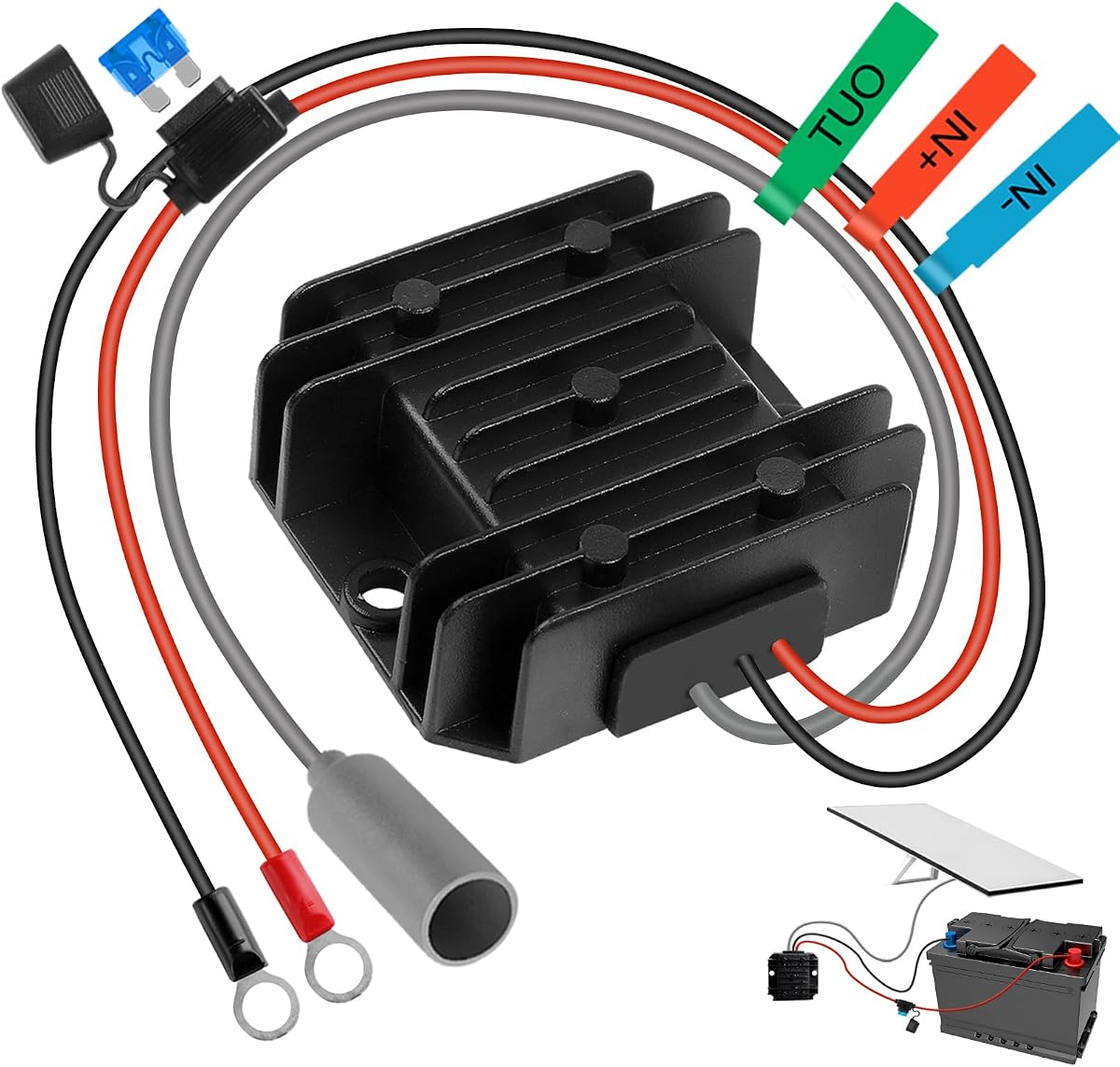
This Starlink Mini 12V Adapter has a 4.6 rating and stands out as a flexible, budget-conscious way to power a Mini dish from a vehicle, solar setup, or battery. It accepts a broad 9–28V input range and steps that power up to a stable 30V at 3.5A, making it useful across common 12V and 24V off-grid sources.
We may earn a commission when you buy through this link, at no additional cost to you.
The strongest feature is the combination of wide input tolerance and physical protection. A black-painted aluminum housing, silicone sealing, and an IP68 rating make the unit well suited to rain, dust, heat, and vibration. Built-in protection against overcurrent, overvoltage, short circuits, and overheating adds practical safeguards for unattended mobile installations.
Setup is straightforward because the kit includes a waterproof DC female plug. The user connects a suitable 12V or 24V source, attaches the cable, and powers the Mini without needing a large inverter. The trade-off is that this is specifically a Mini solution rather than a universal Starlink power system, and users must confirm that their cable and antenna version match.
This is a strong recommendation for RV travelers, boaters, overlanders, and cabin users who want a compact hardwired converter without a complex installation. It offers more source flexibility than many tool-battery kits and stronger weather sealing than basic vehicle adapters, making it a practical first choice for a Starlink Mini off-grid setup.
The 9–28V input range covers common vehicle electrical systems, batteries, solar generators, and portable power stations. That flexibility lets the same adapter serve different trips and installations without tying the setup to one proprietary battery platform.
The IP68 enclosure, sealed connections, aluminum construction, and multiple electrical protections are particularly useful in trucks, boats, and outdoor cabins where moisture, dust, vibration, and changing electrical conditions are common concerns.
We may earn a commission when you buy through this link, at no additional cost to you.
This compact battery adapter carries a 4.2 rating and offers one of the simplest ways to connect Starlink Mini to a vehicle, RV, boat, or solar battery. It accepts 12–36V input and produces a stable 36V at 1.67A, corresponding to approximately 60W of output.
We may earn a commission when you buy through this link, at no additional cost to you.
Its main appeal is installation clarity. The unit weighs only 0.37 pounds, has clearly marked positive and negative terminals, and can be connected to the battery without a complex wiring project. An IP65-rated DC port is designed to fit the original Starlink Mini cable, while overcurrent and short-circuit protection help reduce installation risk.
One limitation is that the lower output rating is less generous than several higher-wattage options in this list. It is also designed around Starlink Mini rather than Standard dishes, and users will need an appropriate battery connection method. These restrictions make it better for compact, dedicated mobile systems than universal use across Starlink equipment.
Buyers who prioritize simple terminal connections, clear polarity markings, and portability should find this option appealing. It is especially suitable for RV and vehicle owners who already know their battery system voltage and want direct DC power without operating a separate inverter.
Connecting the dish to DC power avoids the complexity of a separate inverter. For basic browsing, messaging, and routine internet use in a suitable Starlink Mini installation, that direct approach can be both economical and easy to maintain.
Clearly marked positive and negative terminals help installers identify the battery connections correctly. The compact housing and short stated installation process also make the adapter convenient for mobile use, although appropriate fusing and cable routing remain important.
We may earn a commission when you buy through this link, at no additional cost to you.
This Starlink Gen3 12V to 57V 4.5A Boost Power Converter has a perfect 5.0 rating and earns the Editor's Choice designation for its unusually broad scope. It supports Starlink Gen3, Standard 4, Standard 4X, and V3 antennas, allowing one converter format to cover several popular dish systems.
We may earn a commission when you buy through this link, at no additional cost to you.
The converter accepts 12–24V DC input and delivers up to 57V at 4.5A, with a stated peak output of 256W. Its boost structure is designed to minimize voltage attenuation over longer wire runs, helping maintain a steadier connection in RVs, boats, and off-grid installations where cable distance can create problems.
A zinc-alloy housing, sealed shell, and one-meter 18AWG cable make the product more purpose-built than a basic inline adapter. Overload, overcurrent, overheating, and short-circuit shutdowns provide several layers of protection. The main caution is substantial power demand: continuous operation calls for input above 256W, including at least 18A at 12V or 9A at 24V.
This is the strongest general recommendation for users of Standard, 4X, or V3 equipment who need multiple antenna options and substantial boost capability. It is less appropriate for a Starlink Mini user or a small battery bank unable to supply the stated input current, but for a correctly sized off-grid system it offers convincing compatibility and thoughtful protection.
Compatibility with Gen3, Standard 4, Standard 4X, and V3 antennas gives the converter an advantage for households, installers, and rental operators that may change equipment. That versatility can also simplify spare-part planning.
The stated zero-voltage-drop design focuses on one of the most persistent mobile-installation problems: declining power at the dish over extended cables. A rugged housing and sealed construction complement that electrical approach for outdoor use.
We may earn a commission when you buy through this link, at no additional cost to you.
The Deckit Starlink Mini Battery Adapter Kit has a 4.4 rating and provides a genuinely portable alternative to permanently wired vehicle power. It connects to compatible DeWalt 20V MAX batteries, turning battery packs many outdoor users already own into a compact Starlink Mini power source.
We may earn a commission when you buy through this link, at no additional cost to you.
Its intelligent low-voltage protection cuts power at around 15V, reducing the risk of excessive battery depletion. An independent ON/OFF switch prevents phantom drain and repeated connector handling, while integrated USB-A and Type-C outputs can charge phones and other small devices. The package also includes a five-foot 18AWG cable, waterproof cap, rugged silicone cover, and storage bag.
This system is not as broadly compatible as a standard 12V converter, and the battery is not included. Performance also depends on the capacity and condition of the compatible DeWalt pack. It is also a third-party accessory and is not affiliated with Starlink, SpaceX, or DeWalt, so users should confirm fitment and electrical expectations before relying on it.
The kit is best for campers, tradespeople, and van-life users who want a grab-and-go Starlink Mini power arrangement without modifying a vehicle wiring system. The switch, protection, cable management accessories, and carrying bag make it more complete than a bare battery adapter, while the proprietary battery requirement remains the central compromise.
For users who already own compatible tool batteries, this method removes the need for a dedicated battery and much of the wiring associated with a fixed installation. The result is a modular setup that can move between camp, job site, or vehicle.
The around-15V cutoff is useful when a battery becomes depleted. An independent switch further reduces unnecessary drain and protects the connection from repeated plugging and unplugging during everyday use.
We may earn a commission when you buy through this link, at no additional cost to you.
This waterproof rocker switch has a 4.8 rating and serves a different purpose from the adapters in this guide: it provides clean, accessible power control for an already installed Starlink system. It is compatible with Starlink Mini and Gen 1, 2, and 3 hardware, giving it broader model relevance than a Mini-only adapter.
We may earn a commission when you buy through this link, at no additional cost to you.
The five-pin SPST switch comes with a pre-wired jumper harness and aluminum mounting panel, so installation does not require soldering. An IP68 design suits wet and dusty locations, while a blue LED shows the power state at a glance. Its stated 20A rating at 12V or 24V provides headroom for the intended switching application.
It is not a converter and cannot independently turn 12V into the voltage required by a Starlink dish. It also requires correct wiring and an appropriately protected circuit. Even so, adding a remote switch can make a mobile installation more practical by avoiding repeated unplugging, reducing connector wear, and making it easy to shut the system down.
This switch is best for permanent RV, marine, truck-bed, trailer, or remote-cabin installations where a neat panel-mounted control is desired. Choose it as an installation accessory when a suitable converter or power supply is already present, not as a standalone Starlink power kit.
The aluminum panel and pre-wired harness create a neater finished installation than leaving a loose inline connection exposed. That makes the switch particularly helpful in an RV interior, cabin, or marine console.
Using a panel switch to turn the system on and off avoids repeated manipulation of the Starlink power connector. That can reduce wear while giving occupants a clearly visible indication of the system state.
We may earn a commission when you buy through this link, at no additional cost to you.
This Starlink Mini Battery Adapter has a 5.0 rating and centers on a secure connection to compatible 18V–20V DeWalt battery packs. It is designed for users who want portable satellite internet for RV travel, camping, marine activities, or remote work without relying on a fixed vehicle outlet.
We may earn a commission when you buy through this link, at no additional cost to you.
Integrated USB and Type-C ports support QC2.0 and QC3.0 charging up to 18W, allowing a phone, tablet, or other small device to charge alongside the Starlink connection. A separate DC circuit and low-voltage cutoff below 15V help protect the equipment and battery when the pack approaches depletion.
Its ten-foot, 18AWG tinned-copper shielded cable is rated for up to 20V and 5A, with a stated maximum output of 100W. That length provides practical routing freedom for portable setups, though the tool-battery requirement limits where it can be used. Users must also own compatible battery packs, which are not part of the kit.
This is a compelling pick for owners of compatible DeWalt batteries who value a clean, integrated solution. Its perfect rating is encouraging, and the added charging ports make it more useful than a basic power lead. The main question is whether the battery ecosystem and Starlink Mini requirements align with your specific travel gear.
Fast-charging USB and Type-C ports turn the battery adapter into a small travel power hub. This is useful for keeping essential devices charged during remote work or camping, provided simultaneous loads do not exceed the adapter's capabilities.
The extended shielded cable makes it easier to position the dish where reception is better while keeping the battery nearby. Its stated current rating supports a steadier connection than a light-duty cable, provided the power source and terminations are correctly matched.
We may earn a commission when you buy through this link, at no additional cost to you.
The Eugizmo Starlink Mini Car Adapter has a 4.7 rating and combines a vehicle power connection with a three-in-one charging feature. It powers Starlink Mini from a 12V–24V vehicle socket while adding a 30W PD Type-C port and an 18W QC3.0 port for travel electronics.
We may earn a commission when you buy through this link, at no additional cost to you.
Its real-time LED display shows input voltage from 9V to 30V and flashes when voltage drops too low. That is useful information when a vehicle battery, socket, or auxiliary circuit is under strain. A built-in on/off switch eliminates repeated removal of the adapter, and a 10-foot 16AWG cable provides more routing freedom for cars, RVs, trucks, boats, and campsites.
The product is optimized for a vehicle socket rather than a fixed battery bank, and its 90W rating describes the combined charging capability. The manufacturer specifically advises avoiding high-power USB charging at the same time for best Starlink Mini performance. Although it also mentions off-grid travel, other power methods may be more dependable for stationary use.
This adapter is a strong choice for road trips and mobile travel where quick setup matters. It stands out for useful voltage visibility, sturdy 16AWG wiring, and convenient secondary charging. Drivers who want a permanent hardwired system should consider a converter or power supply instead.
The LED display gives users an immediate indication of the vehicle supply and provides a visible low-voltage warning. This is particularly helpful when testing several sockets or deciding whether an auxiliary circuit needs attention.
The combination of Starlink power, USB-C PD, and USB-A QC3.0 outputs reduces the number of adapters needed on a road trip. Cable length and 16AWG construction support practical routing in larger vehicles and boats.
We may earn a commission when you buy through this link, at no additional cost to you.
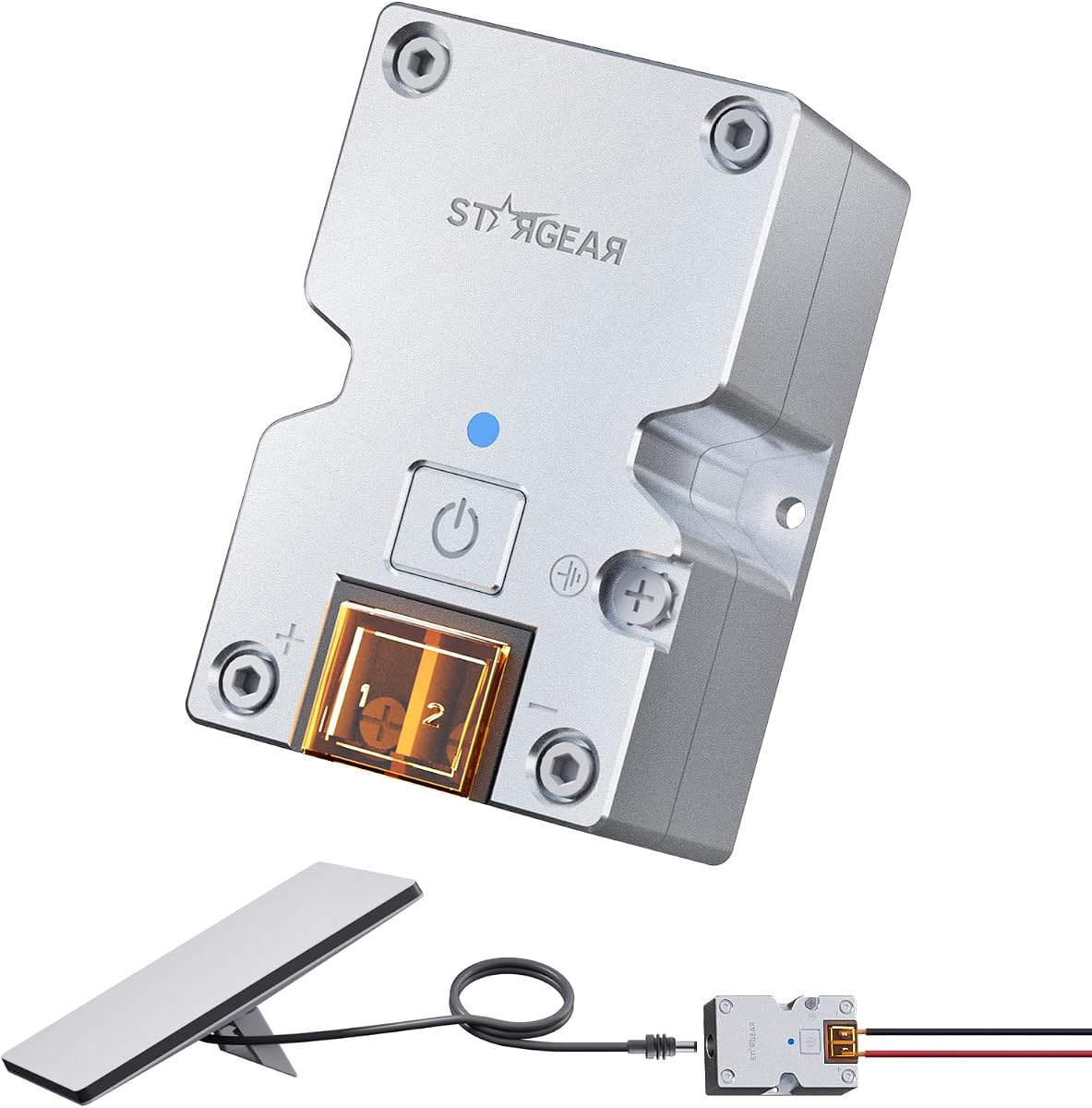
The STARGEAR 12V to 28V converter has a 4.4 rating and is built for users who want a permanent Starlink Mini installation rather than a disposable travel lead. It accepts 12V or 24V sources and steps them up to 28V at a stated 100W output.
We may earn a commission when you buy through this link, at no additional cost to you.
Physical construction is a major selling point. The CNC-machined aluminum alloy housing supports heat dissipation, while short-circuit, overheat, and overcurrent protections guard the installation. An integrated on/off switch and blue LED eliminate the need to unplug the Starlink cable every time the system is used.
A 3.2mm wall-mount hole allows the converter to be secured inside an RV or boat, keeping it organized and reducing the chance of accidental movement. Plug-and-play wiring makes initial setup approachable, although the user remains responsible for connecting the converter to the correct battery polarity and integrating suitable circuit protection.
This converter is a good fit for RV, boat, and mobile cabin owners with a Starlink Mini who value secure mounting and simple daily control. It is less versatile than the 9–28V input model in the ranking, but the stated 100W output and integrated switch make it a focused, attractive permanent-install option.
The mounting hole turns a loose inline accessory into a more permanent component. Securing the converter inside a vehicle or boat helps organize wiring and protects it from being moved during travel.
The integrated switch and status LED make it convenient to manage the system without wearing the Starlink connection. This is helpful in daily use and reduces the temptation to disconnect cables unnecessarily.
We may earn a commission when you buy through this link, at no additional cost to you.
This Starlink Mini Battery Adapter has a 4.5 rating and focuses on reliable direct DC power from batteries, portable power stations, and other mobile sources. Its stated 12–36V input range produces a stable 36V at 1.67A, or roughly 60W.
We may earn a commission when you buy through this link, at no additional cost to you.
The product is designed around the idea that a dedicated DC connection can replace a bulky inverter. That can simplify an RV, boat, or off-grid solar cabin installation while reducing avoidable conversion stages. The stated output is intended to help the Mini remain operational as source voltage fluctuates.
Environmental protection is especially notable. The IP67 housing is sealed with epoxy potting, helping protect internal components from moisture, dust, vibration, and the shocks associated with travel. Overvoltage, short-circuit, overcurrent, and overheating protection further improve suitability for unattended mobile use.
Buyers wanting a rugged, compact direct-battery solution for Starlink Mini should consider this adapter. Its limitations are device specificity and a lower output class than the higher-wattage converters. It is best paired with a battery system and cabling designed to support the load, especially during extended operation.
The IP67 housing and epoxy-potted internals offer a more deliberate approach to environmental protection. These characteristics are useful in trucks, boats, and off-grid cabins where moisture, dust, and road vibration are unavoidable.
A regulated 36V output helps the Mini receive a more consistent supply while the connected battery voltage changes. Direct DC conversion also avoids the need to operate a separate inverter for the satellite connection.
We may earn a commission when you buy through this link, at no additional cost to you.
This Starlink Standard Gen 3/4X/V3 Power Supply Charger has a 4.6 rating and earns the Best Premium designation for its complete, high-output design. It is intended as a direct replacement-style power supply for Standard Gen 3, 4X, and V3 systems in homes, RVs, and off-grid installations.
We may earn a commission when you buy through this link, at no additional cost to you.
The stated 57V at 3.42A output delivers 195W, exceeding the capacity of many lower-wattage generic alternatives. A universal 100–240V AC input supports use in many regions, while the package includes a 1.5-meter AC cord and a two-meter detachable DC extension cable. The detachable arrangement makes it easier to route power over longer distances.
The matte-finished, compact housing is designed to resemble an original-style supply, helping fixed installations look intentional. ETL listing and built-in overload, overvoltage, and short-circuit protection add a professional layer of reassurance. Its main limitation is that it expects AC input, unlike the direct DC converters in this guide, so an inverter or AC source is required.
This is the strongest option for a stationary or semi-permanent installation where a full-power source, polished appearance, and a complete cable package matter. It is less suitable for a pure battery-first off-grid build without additional power-conversion equipment, but it offers a polished solution for cabins, residential installations, and RVs with appropriate AC infrastructure.
A 195W supply is well suited to a complete Standard system and provides more capacity than many compact alternatives. That makes it a logical choice for installations that prioritize stable, full-rated power over minimum size.
The included AC and detachable DC extension cables reduce the need to source basic wiring separately. The modular design also makes long cable routing and eventual component replacement more convenient.
We may earn a commission when you buy through this link, at no additional cost to you.
The right Starlink power kit depends primarily on which antenna you own, the source you plan to use, required output, and the level of installation work you are comfortable handling.
Start with the exact Starlink system rather than treating Starlink as a single universal power standard. Starlink Mini products in this guide are designed around specific 30V, 36V, or 28V conversion arrangements, while the higher-power options support Standard Gen 3, 4X, and V3 antennas. Some switches work with several generations but do not perform voltage conversion themselves. Check the antenna model, original power-supply label, and cable connector before buying any accessory.
Choose only a converter or power supply explicitly listed for your dish. Incorrect voltage, insufficient current, or an incompatible connector can cause resets, failure to boot, or equipment damage.
A useful off-grid kit should match where the energy comes from. A 12V/24V battery, vehicle socket, portable power station, solar generator, and DeWalt tool battery all present different voltage and current conditions. The two Mini adapters with 9–28V and 12–36V input ranges offer especially broad source compatibility, while the tool-battery products require compatible DeWalt packs. The premium Standard power supply uses universal AC input and therefore needs an AC source.
List your actual power sources before selecting a product. The best adapter is the one that works with the batteries and outlets already available in your installation.
Output voltage alone is not enough; current and wattage determine whether the power supply can sustain the dish. Options in this guide range from approximately 60W Mini converters to a 57V, 4.5A boost unit and a 195W Standard supply. Higher-output options are not automatically better, because they can require substantial input current, especially when boosting 12V to 57V. Match the rating to the supported antenna and use a battery bank, cable, fuse, and connector capable of handling sustained demand.
For fixed installations, prioritize the manufacturer's stated power requirements over convenience. Do not use a lower-output adapter merely because it physically connects.
Off-grid equipment may face rain, dust, sunlight, temperature changes, and constant road vibration. Look for a stated ingress rating, sealed cable connections, and a housing suited to the location. Products with IP67 or IP68 ratings offer useful protection, but the rating should be treated as a meaningful advantage rather than a guarantee against every environmental exposure. Cable entry points and connector caps remain important even when the main housing is sealed.
For a permanent outdoor installation, weather resistance and a strain-relieved cable arrangement deserve as much attention as the converter itself.
Some products plug into a vehicle socket, while others require direct battery connections, a hardwired DC lead, or an AC source. The Mini vehicle adapter is among the quickest to deploy. Tool-battery kits prioritize modularity, and the wall-mount converter or rocker switch is better for permanent work. If you are not comfortable identifying polarity, fusing a circuit, or routing heavy-gauge cable, plan to use a qualified installer or choose a simpler socket-based arrangement.
More features are not automatically easier to install. Choose the complexity that matches your technical experience and the permanence of the setup.
Look for overcurrent, overvoltage, short-circuit, and thermal protection. A low-voltage cutoff is particularly valuable for portable tool-battery systems because it can reduce deep discharge and protect the battery. A visible status LED and an independent switch also improve everyday control. These features complement rather than replace correct fuse sizing, sound grounding practices, and manufacturer-specified wiring.
Treat safety claims as one layer of protection. Proper circuit design remains necessary for any installation connected to a vehicle, battery bank, or portable power station.
Cable length determines how freely the dish can be positioned away from its power source. The DeWalt adapters and Eugizmo car adapter provide ten-foot leads, while the Gen3 converter includes a one-meter 18AWG cable and the Deckit kit includes a five-foot cable. Longer leads improve placement flexibility but can introduce more resistance if the wire gauge or terminations are inadequate. For a mobile kit, balance reach against the bulk of storing extra cable.
Measure the intended route before ordering. A slightly longer, properly gauged lead often makes antenna placement easier, but avoid unnecessary excess that can be awkwardly routed or stored.
Some portable kits add USB-A or Type-C charging, while others include an on/off switch, voltage display, mounting hardware, protective covers, or storage bags. These extras can be valuable when the Starlink setup is part of a broader travel workstation. They are most useful in portable systems where every additional charger adds weight or complexity. A fixed RV or cabin installation may benefit more from a remote switch and secure converter mounting.
Prioritize extras that solve a real problem in your routine, rather than treating a longer feature list as automatically better.
Begin by identifying the antenna model, its required input, and the power source you intend to use. Confirm output voltage and current, connector type, polarity, and cable gauge. For a direct battery installation, disconnect the battery before wiring, identify the positive and negative terminals, and install appropriately rated inline fusing as close to the source as practical.
Route the cable away from sharp edges, moving suspension parts, exhaust heat, and areas where standing water collects. Use strain relief at both ends and weatherproof any exposed connection. If the system includes a switch, install it in an accessible and protected location. For portable tool-battery kits, attach the battery only after the cable is positioned and the switch is off.
Test the installation in stages: first verify the source voltage, then connect the adapter without the dish, confirm the expected converted output with an appropriate meter, and finally power the Starlink system. Observe it under real usage, especially during higher demand or when a battery is partly discharged. Clean connectors, keep seals free of debris, and store portable components dry whenever possible.
Not always. A direct DC adapter designed for the appropriate Starlink model can convert battery or portable power-station output without a separate inverter. Products that use the tool-battery format similarly avoid a conventional inverter. The premium Standard power supply, however, accepts universal AC input and therefore requires an AC source or inverter when working from ordinary batteries.
No. Starlink Mini, Standard 4, 4X, Gen 3, and V3 systems use different power requirements, and the converters in this guide are intended for specific models or voltage ranges. The Gen3 boost converter supports several Standard-family antennas, while most Mini adapters are Mini-only. Verify the supported model and original power-supply specifications before purchasing.
A 12V source cannot simply be connected directly to the Mini. Relevant adapters in this guide step 12V or broader battery inputs up to 28V, 30V, or 36V depending on the model. Use the converter specified for your exact Starlink Mini system and observe its stated input current requirements. Connecting a battery directly without proper conversion and protection is not appropriate.
They can be, provided the solar charge controller or battery bank maintains the input voltage and current range required by the adapter. A solar panel should feed a properly regulated charging system rather than the Starlink converter directly. Confirm compatibility with the controller, protect wiring from sunlight and abrasion, and size the battery bank for both the dish and other loads.
The required capacity depends on the adapter's output, the dish's actual consumption, and how long the system must remain online. Higher-output converters also require more input current than a small 12V-to-28V model. Start with the equipment's stated power figure, then account for conversion losses, battery condition, reserve capacity, and any other electrical loads in the installation.
It can be convenient for portable and occasional setups because it uses a familiar battery platform and avoids permanent vehicle wiring. For long-duration use, account for battery capacity, the adapter's low-voltage cutoff, and the need to recharge tool batteries. A conventional deep-cycle battery or portable power station may be more practical for extended off-grid operation.
A waterproof switch is valuable for exposed RV, marine, trailer, truck-bed, or campsite installations where the control may encounter rain or dust. An indoor panel switch may be sufficient in a protected cabin. In either location, use a correctly rated circuit, secure the wiring, and ensure the switch is placed where it can be reached safely.
Start with a converter or supply explicitly compatible with the antenna and its required output. Use adequately gauged wiring, secure terminations, correct polarity, and sound fusing, then verify the source voltage under load. Avoid long undersized cable runs and do not leave the battery near its cutoff point. An integrated voltage display or indicator can help identify unstable power before the system disconnects.
The strongest overall off-grid converter in this guide is the Starlink Gen3 12V to 57V boost unit because it supports Standard 4, 4X, Gen3, and V3 antennas while providing substantial output and built-in safeguards. For Starlink Mini users, the wide-input 12V adapter is an excellent budget choice, while the 57V Standard power supply is the most complete premium package for fixed AC-powered installations.
Prioritize compatibility first, then source flexibility, output capacity, weather resistance, and installation convenience. Tool-battery kits are ideal for portable use with compatible DeWalt packs, a rocker switch improves a finished permanent build, and rugged Mini battery adapters serve direct 12V or 24V systems. The best choice is the one matched to the antenna and the way you actually travel.
Before ordering, confirm the current product listing, supported devices, included cables, connector type, and electrical specifications. Product designs, compatibility claims, and availability can change, and current prices vary. Checking those details at the time of purchase helps prevent an otherwise suitable kit from becoming an installation problem.
