
MIXJOY 250W Ceramic Heat Emitters
4.4Editor score
High-output 250W design
Temperature display sticker
Two-bulb configuration
Ceramic heat emitter bulbs compared for wattage, heat output, light emission, durability, safety, and suitability for reptiles and small pets.
Ceramic heat emitter bulbs provide concentrated infrared warmth without adding visible light, making them useful for reptile terrariums, amphibian habitats, brooders, and incubators. A good bulb should match the enclosure size, animal species, required temperature, and fixture, while providing reliable, controllable heat.
This guide compares ten ceramic heat emitter bulbs across factors such as power output, heating speed, construction, light emission, socket compatibility, claimed lifespan, and intended applications. It includes options from 25W to 250W, single bulbs and multipacks, for small habitats as well as larger reptile environments.
Each selection highlights the strongest reason to consider that model, along with practical limitations and safety considerations. Ratings reflect the supplied customer feedback, while product details may change over time. Always check current listings, enclosure requirements, and manufacturer instructions before purchasing.
4.4Editor score
4.6Editor score

4.6Editor score
The table below compares the ten featured bulbs by output, construction, light emission, package format, and stated use cases, helping readers narrow the field before checking the detailed reviews.



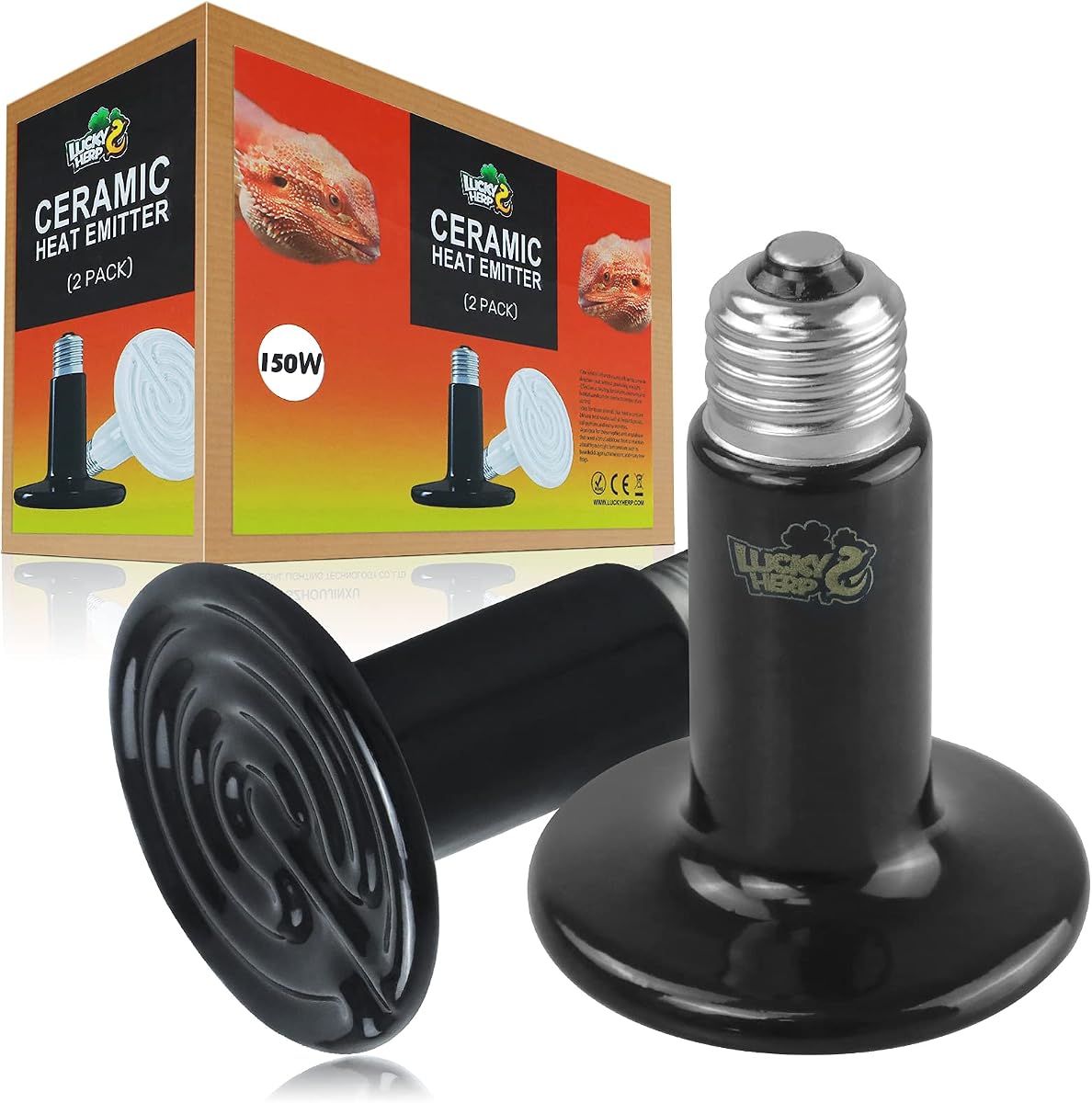
The LUCKY HERP 150W Ceramic Heat Emitter is a two-bulb, non-light-emitting heat source with a 4.6 rating. It is designed for reptiles, amphibians, chickens, dogs, and cats, giving it broader utility than a bulb designed exclusively for terrariums. Its central advantage is rapid heating: the manufacturer reports a noticeable temperature rise after 10 seconds and rated temperature after about four minutes.
We may earn a commission when you buy through this link, at no additional cost to you.
The bulbs use thick ceramic construction, which is intended to provide greater durability than ordinary heating lamps. A claimed lifespan of up to 10,000 hours adds long-term appeal for setups that require steady warmth. Installation is straightforward because the emitter uses a standard E26 base and operates at 120 volts, making it suitable for many existing reptile and brooder fixtures.
The main limitation is heat intensity. A 150W emitter can generate substantial surface heat, so the manufacturer instructs users to keep it more than 30 centimeters from reptiles and use a good-quality ceramic holder. It should also be allowed to cool before being switched back on, making careful control essential. These constraints are reasonable for a high-output bulb but limit its suitability for very small enclosures.
This is a strong choice for medium or larger habitats needing rapid, consistent supplemental heat without visible light. It is particularly appealing to owners of nocturnal reptiles, amphibians, poultry brooders, and other animals that benefit from a dedicated nighttime heat source. For those applications, the fast warm-up and multipack configuration justify its top position.
The stated warm-up timeline makes this emitter practical when an enclosure needs to reach its heat target quickly. Rapid heating can also support consistent thermal zones in larger setups, provided the bulb is positioned and monitored correctly.
Because it emits heat without visible light, this bulb can support overnight warmth while preserving the animal's natural photoperiod. It can complement a separate daytime basking light without adding nighttime illumination.
We may earn a commission when you buy through this link, at no additional cost to you.
The 50W Reptile Heat Lamp is a compact, non-light-emitting option with a 4.4 rating. It is sold as a two-pack and positioned for terrariums, brooders, incubators, and habitats containing turtles, lizards, bearded dragons, snakes, chicks, birds, amphibians, or other small pets. Its lower wattage offers more flexibility than a 150W or 250W emitter.
We may earn a commission when you buy through this link, at no additional cost to you.
The manufacturer describes industrial-grade ceramic, a pure tungsten filament, and a claimed lifespan five times longer than standard bulbs. It also claims energy savings of 30 percent. Those figures come from the product information and should be treated as manufacturer claims rather than independent test results, but the ceramic construction and non-light-emitting operation are clearly relevant to the product's design.
A 50W bulb will not create the same high-temperature zone as a 150W or 250W model, and enclosure dimensions matter significantly. It may need to be positioned closer to create a suitable warm area, which increases the importance of a high-quality ceramic socket and careful distance control. The two-pack is useful for backup or creating separate heat zones.
This option best suits owners who need moderate, continuous warmth rather than intense radiant heat. It is worth considering for small or medium habitats, incubation applications, and users who want a spare bulb without moving to a high-wattage setup.
The 50W rating can be useful when a more powerful emitter would create excessive temperatures. A thermostat and accurate enclosure thermometers are still important for maintaining a safe range.
The second bulb can serve as a replacement during an unexpected failure or provide heat in another zone. It may also be divided between two appropriately sized habitats.
We may earn a commission when you buy through this link, at no additional cost to you.
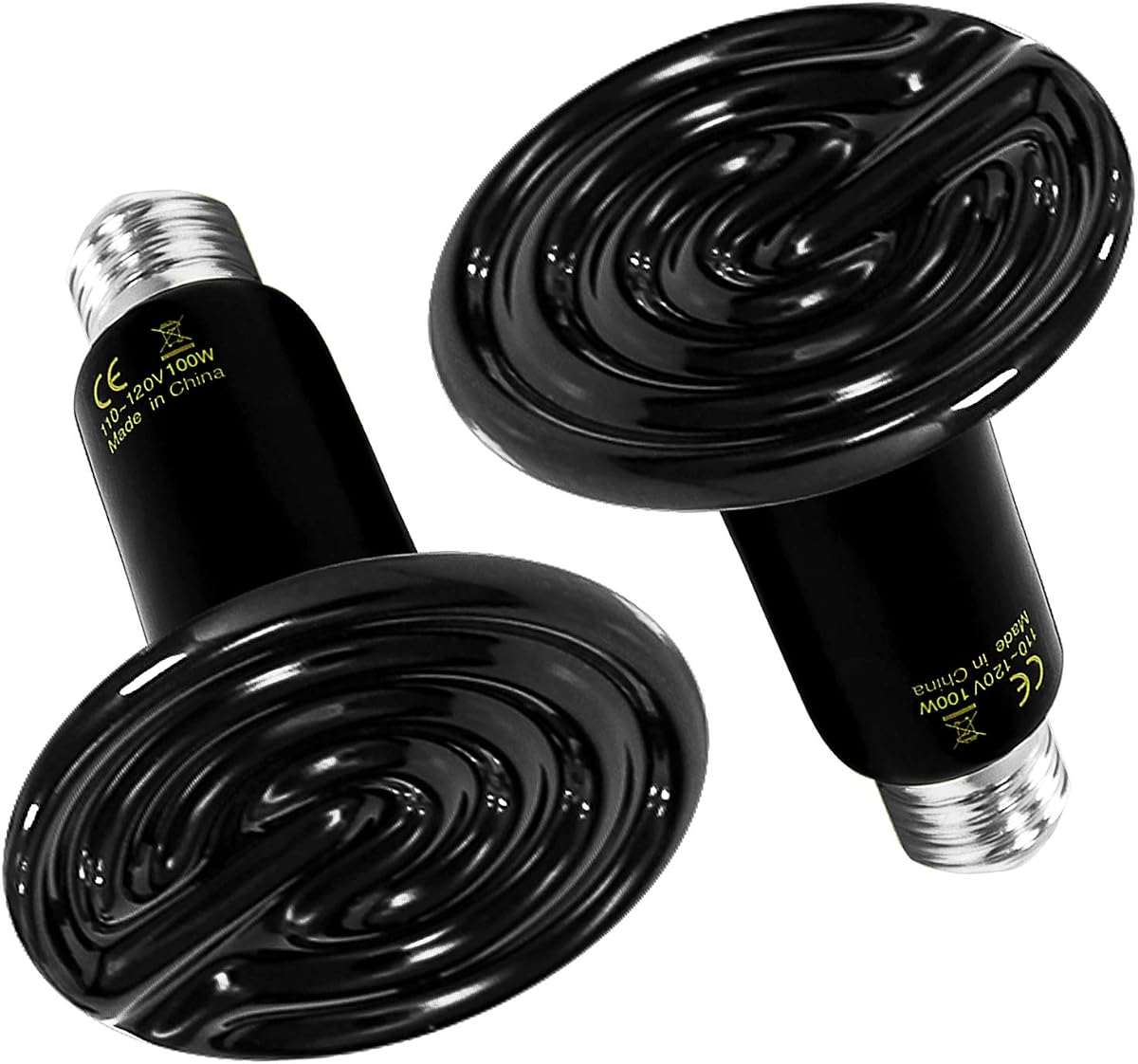
The LUCKY HERP 100W is a single-bulb ceramic heat emitter with a 4.6 rating. It produces no visible light and is marketed for reptiles, amphibians, poultry brooders, egg hatching, and keeping young pets warm. A 100W output offers a middle ground between low-output bulbs and the strongest heaters in this guide.
We may earn a commission when you buy through this link, at no additional cost to you.
Its stated heating performance is notable: the manufacturer says a significant temperature increase is noticeable within 10 seconds and the bulb reaches rated temperature in approximately four minutes. The ceramic material is rated for a claimed lifespan of up to 10,000 hours, and compatibility with a standard E26 holder simplifies replacement in an existing setup.
Because it is a single-bulb pack, buyers who want immediate backup or two separate heat zones will need to purchase another bulb. The safety guidance also calls for a high-quality ceramic lamp base and at least 30 centimeters of clearance from reptiles. Its broad compatibility is useful, but enclosure size and target temperature still determine whether 100W is appropriate.
This is a practical choice for a single medium-sized habitat or for owners who want a straightforward replacement bulb. It combines useful output with fast heating, a well-known socket format, and the sleep-friendly no-light design.
At 100W, the emitter can deliver meaningful radiant heat without using the highest output in the category. This makes it easier to fine-tune the distance between the bulb and the basking area.
The standard E26 connection means existing compatible reptile fixtures can be reused. Consumers should confirm that the socket, enclosure, and temperature controls are suitable for a 100W ceramic heater.
We may earn a commission when you buy through this link, at no additional cost to you.
The REPTI ZOO 60W is a two-pack ceramic emitter with a 4.6 rating. It is intended to provide around-the-clock warmth for reptiles and amphibians while avoiding disruption to their natural sleep patterns. The product description highlights compatibility with turtles, bearded dragons, geckos, lizards, snakes, and chickens.
We may earn a commission when you buy through this link, at no additional cost to you.
One of its more distinctive selling points is the stated CE certification and RoHS compliance. The emitter is made from high-purity ceramic and is described as crack-resistant, which is particularly relevant in humid glass terrariums. Its claimed 10,000-hour lifespan and compatibility with common E26 sockets support long-term use in compatible fixtures.
The manufacturer states that infrared heat penetrates skin tissues and supports blood circulation, although the practical effect still depends on distance, enclosure construction, and the animal's behavior. As with every ceramic emitter here, the hot surface requires care. Buyers must preserve clearance from the animal and combustible enclosure materials, especially in an improperly ventilated setup.
REPTI ZOO is a balanced option for a household that wants a moderate-output two-pack and values stated compliance and material specifications. It is most appropriate when a 60W bulb can establish a safe warm zone without excessive ambient heat.
The stated crack-resistant ceramic construction is a meaningful advantage in humid habitats. Proper ventilation, stable mounting, and routine inspection remain necessary regardless of the material.
CE certification and RoHS compliance provide useful purchasing context, while the E26 base supports straightforward integration. Confirm enclosure dimensions and fixture heat ratings before installation.
We may earn a commission when you buy through this link, at no additional cost to you.
The DOMICA 150W two-pack has a 4.5 rating and targets larger reptile tanks, brooders, and habitats requiring substantial heat. It emits no visible light, making it appropriate for nighttime heat when a separate daylight basking source is already in place. The listing specifically calls out bearded dragons, turtles, lizards, snakes, amphibians, birds, and other small pets.
We may earn a commission when you buy through this link, at no additional cost to you.
Its standout construction is described as high-density ceramic with resistance to temperatures up to 500 degrees Fahrenheit. The listed dimensions are 3 by 3 by 4.3 inches, which the manufacturer presents as more compact than bulky heat-bulb arrangements. It also promises rapid warm-up and consistent heat distribution, while a standard E26 base simplifies installation.
The 150W output is demanding. The product instructions specify a fixture rated for 150W or higher and warn against nearby flammable materials. That makes this less forgiving than a lower-wattage option, particularly for beginners or small enclosures. The claimed heat performance should also be evaluated with thermometers rather than assumptions.
This product is a good candidate for an established large-tank setup that already has a properly rated ceramic fixture. The two bulbs offer redundancy, the material is designed for demanding thermal conditions, and the no-light operation supports overnight heating.
The 150W rating is aimed at larger habitats that need a strong, directed heat source. It is less suitable for small enclosures where output cannot be moderated safely.
The listed high-density ceramic body and relatively compact dimensions combine durability with practical placement. The housing must still be mounted in a fixture approved for the bulb's wattage.
We may earn a commission when you buy through this link, at no additional cost to you.
The MIXJOY 250W is the highest-output model in this roundup, with a 4.4 rating. Its two ceramic emitters provide non-light-emitting heat for geckos, lizards, bearded dragons, turtles, snakes, and chickens. It is also listed for poultry brooders, egg incubators, and keeping young animals warm.
We may earn a commission when you buy through this link, at no additional cost to you.
A useful feature is the upgraded temperature display sticker, which gives the owner a visual reminder of when the bulb is heating. The product data reports a noticeable temperature increase within 10 seconds and optimal temperature in three to five minutes. Its high-purity ceramic construction is described as crack-resistant and moisture-resistant, while a claimed 10,000-hour lifespan supports long-term use.
This is the most demanding bulb in the list. The 250W output needs a large enough habitat, a suitable porcelain or ceramic socket, and a fixture capable of handling the load. The instruction to adjust distance carefully is especially important because too much heat can overheat the habitat. Although it uses a standard E26 base, wattage ratings remain more restrictive than the base shape suggests.
MIXJOY is best for experienced owners with large reptile enclosures or brooders that need powerful, concentrated infrared heat. The multipack provides a backup, and the stated six-month warranty adds some reassurance. It earns the premium designation because of its unusually high output and added temperature-indicator sticker, not because it is suitable for every habitat.
The 250W rating is appropriate for large habitats that need a powerful warm zone. It offers limited margin for error, so independent temperature monitoring is essential.
The temperature display sticker provides a quick visual indication that the emitter is active. It complements rather than replaces thermometers, thermostats, and routine observation of the animal.
We may earn a commission when you buy through this link, at no additional cost to you.
The Simple Deluxe 100W two-pack has a 4.6 rating and provides light-free ceramic heat for reptile and amphibian terrariums, poultry brooders, and incubation. It uses a standard E26 base, accepts 110-120V AC power, and is made from ceramic, metal, and NiCrAl according to the specification.
We may earn a commission when you buy through this link, at no additional cost to you.
The product is rated for up to 10,000 hours and produces no visually detectable light, which makes it useful for maintaining warmth without changing the enclosure's day-night cycle. A 100W output is versatile enough for many medium-sized reptile habitats and can be paired with a daytime basking lamp to provide a separate light source.
Safety requires careful attention. The surface temperature is described as generally high, and the instructions advise maintaining an appropriate distance from pets and flammable materials. The manufacturer also recommends waiting at least one hour after shutdown to avoid scalding during the cool-down period.
This is a sensible choice for owners seeking a conventional 100W ceramic emitter and a spare bulb. It is especially useful for continuous heat in compatible habitats, brooders, and incubation setups where visible light is undesirable.
The non-light-emitting design supports nighttime heating and preserves a controlled photoperiod. A separate basking lamp can provide daytime light and a visible basking site.
The one-hour cooling recommendation is important during cleaning, repositioning, or switching between bulbs. Secure the housing before power is restored.
We may earn a commission when you buy through this link, at no additional cost to you.
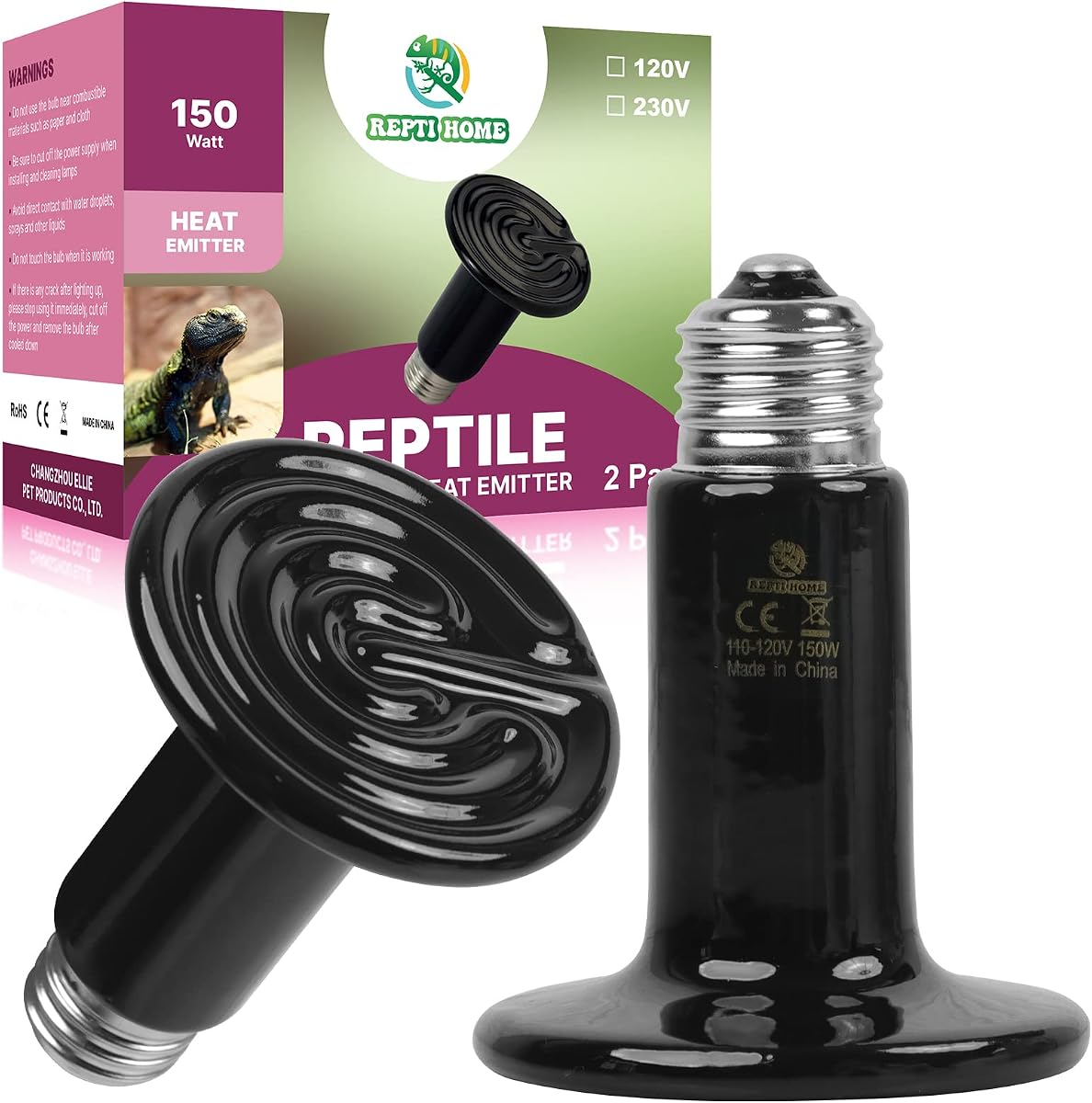
The REPTI HOME 150W Ceramic Heat Emitter two-pack has a 4.6 rating. It is designed to provide directional infrared heat without visible light for reptiles, amphibians, poultry, dogs, cats, and other animals. The product description gives particular attention to animals that need a constant 24-hour source or supplemental overnight warmth.
We may earn a commission when you buy through this link, at no additional cost to you.
The emitter uses a solid ceramic element and is claimed to last up to 10,000 hours. Heat is described as rising within 10 seconds and reaching rated temperature in about four minutes. Its standard E26 base and 120-volt operation allow it to fit many common lamp holders, and compatibility with temperature control is another stated advantage.
The operating guidance is strict: use a good-quality ceramic holder, maintain more than 30 centimeters of separation from reptiles, avoid checking temperature by hand, and do not switch the bulb on immediately after turning it off. Frequent cycling should also be avoided. These are meaningful limitations for anyone considering automated or multi-zone switching.
REPTI HOME is best for established reptile keepers seeking a fast, directional 150W source and a backup bulb. It suits animals such as leopard geckos, ball pythons, monitors, bearded dragons, chameleons, and tree frogs when the enclosure and fixture are properly sized.
Directional infrared output can establish a localized heated zone in a larger habitat. Positioning should be adjusted while monitoring the animal and measuring the enclosure's hot and cool sides.
The long operating design is intended for habitats needing steady heat. Avoiding frequent on-and-off cycling helps the bulb operate within its intended use pattern.
We may earn a commission when you buy through this link, at no additional cost to you.
The HealSmart 100W two-pack carries the highest rating in the supplied lineup at 4.7. It delivers non-light-emitting heat for reptile and amphibian terrariums, poultry brooders, egg incubation, and keeping cubs warm. The product listing specifically mentions lizards, bearded dragons, turtles, and snakes as suitable applications.
We may earn a commission when you buy through this link, at no additional cost to you.
Its internal heating element is described as a Ni-Cr-Alloy resistance wire inside high-purity pottery clay, offering crack prevention, moisture resistance, and faster temperature rise. The emitter is also advertised for continuous day-and-night use with stable heat delivery and a claimed 10,000-hour working life. Dimensions are listed as 85 millimeters in diameter by 100 millimeters in length.
As with the other ceramic options, the surface reaches a high temperature. The instructions warn against testing it with bare hands and advise adjusting spacing to prevent habitat overheating. The standard E26 connection is convenient, but the fixture still needs to be appropriate for a 100W ceramic heater. Users must not treat a familiar socket shape as proof that every fixture is safe.
HealSmart stands out for its combination of the highest listed rating, two-bulb packaging, and detailed material construction. It is a strong option for medium habitats, nighttime heat, brooders, and incubation applications, especially for buyers who prefer a 100W output over a more powerful heater.
The listed Ni-Cr-Alloy resistance wire is intended to provide efficient heat with a fast temperature rise. Actual results will depend on the fixture, distance, ventilation, and enclosure size.
Owners gain a backup bulb and the option to divide the pair between compatible zones. Each installation still requires its own safe socket, clearance, and temperature monitoring.
We may earn a commission when you buy through this link, at no additional cost to you.
The Simple Deluxe 25W Ceramic Heat Lamp is the lowest-wattage option in this guide and holds a 4.6 rating. It is a two-pack intended for reptile and amphibian terrariums, poultry brooders, and egg incubation. Its modest output makes it a useful starting point for small habitats or supplemental warming applications.
We may earn a commission when you buy through this link, at no additional cost to you.
Like the other choices, it emits no visually detectable light and uses a standard E26 base. The manufacturer rates the bulbs for up to 10,000 hours and specifies a 75-millimeter heating-surface diameter. Materials are listed as ceramic, metal, and NiCrAl, with AC 110-120V operation.
The principal tradeoff is heat capacity. A 25W emitter cannot produce the broad or intense warming of a 100W, 150W, or 250W bulb, so the fixture may need to be positioned closer to the animal. That makes precise monitoring especially important. The instruction to wait at least one hour for cooling also applies because the ceramic surface can remain dangerously hot.
This is the best budget-oriented selection for a small enclosure, delicate setup, or user who needs a basic light-free heat source and a spare. It is best for buyers who understand that lower wattage means more careful placement and closer temperature monitoring.
The 25W output can be useful where stronger heat would overwhelm a small habitat. Measure the basking area and monitor the animal rather than relying on the bulb's rating alone.
The pair provides a backup and can be split across two suitable setups. The small heating surface does not remove the need for clearance and safe mounting.
We may earn a commission when you buy through this link, at no additional cost to you.
Choosing a ceramic heat emitter involves balancing heat output, enclosure size, fixture capacity, operating schedule, and safety. The most suitable bulb is the one that can create a stable target zone without exceeding the animal's tolerated temperature or the fixture's limits.
In short, begin with the enclosure's needs, then verify the chosen wattage with thermometers. More power is not automatically better.
Measure before buying and plan for both a heated zone and a cool side. Thermometers should be placed in both areas.
Match the entire fixture to the wattage, not just the bulb to the socket. When in doubt, replace the holder with an approved ceramic model.
Use light-free heat for nighttime or supplemental warmth, and provide separate visible lighting when the species requires it.
Rapid heating is useful, but consistent temperatures matter more. Use a thermostat where appropriate and verify the enclosure's response.
Choose a location that preserves clearance and cannot be reached by the animal. Never use touch to assess temperature.
A second bulb can be valuable as a backup or for a separate zone. Do not install or power both without checking the combined heat load.
Choose durable ceramic construction for humid habitats, but keep electrical connections dry and inspect bulbs and sockets regularly.
Begin by confirming that the enclosure, socket, and wiring are suitable for the emitter's voltage and wattage. Install the bulb securely in a high-quality ceramic lamp holder, keep the housing stable, and position it to create a warm zone while preserving a cooler retreat. Use reliable thermometers in the warm and cool areas, and adjust the distance rather than assuming the listed wattage alone will produce the correct temperature.
Operate the emitter according to the animal's natural schedule and the manufacturer's guidance. A ceramic heat source works well at night because it adds warmth without visible light, but a separate daytime basking light may still be required. Avoid frequent switching, never touch the hot bulb, and never test its temperature by hand. Keep the bulb away from animals that can reach it and from flammable materials inside the enclosure.
During maintenance, switch off the power and allow the bulb to cool for at least the period recommended by its manufacturer; several listings advise waiting an hour. Clean the fixture and bulb only after they are cool, and avoid water around electrical components. Inspect the ceramic for cracks, discoloration, or damage, check the socket for heat-related deterioration, and replace the bulb when wear is visible or heat output becomes inconsistent.
The ceramic heat emitters in this guide are designed to radiate heat without visible light. That makes them useful for nighttime heating because they do not change the enclosure's apparent light cycle. They do not replace visible basking lamps when an animal needs daytime light for normal behavior or basking.
Choose an output that can create the required warm zone without overheating the enclosure. A 25W or 50W model may suit smaller and supplemental applications, while 100W to 250W options suit medium or large habitats. Enclosure size, material, ventilation, and target temperature matter more than wattage alone.
Only if the entire socket and fixture are rated for the bulb's wattage and high operating temperature. These bulbs generally use an E26 base, but the base shape does not guarantee that every household fixture is safe. A quality ceramic or porcelain reptile lamp holder is the preferred choice.
Follow the manufacturer's instructions and maintain the recommended clearance. Several products in this guide specify at least 30 centimeters, while others simply require an appropriate distance from animals and flammable materials. Measure the actual surface and basking-zone temperatures before leaving the setup unattended.
Several listed models specifically recommend waiting at least one hour after switching off before handling them. The ceramic surface may remain dangerously hot even when the air in the enclosure feels comfortable. Always follow the specific product instructions and disconnect power before cleaning or replacing it.
A thermostat can improve temperature control in setups that require a stable range, provided it is compatible with the bulb, fixture, and enclosure conditions. The bulb should still be positioned safely and monitored with independent thermometers. A thermostat does not justify placing the bulb too close to an animal.
It can provide continuous radiant heat if the species and enclosure do not require a separate visible basking light. Many keepers pair a ceramic emitter with a daytime basking lamp, then use the ceramic source overnight. This approach provides warmth throughout the day while preserving the animal's natural light cycle.
A two-pack provides a backup if one bulb fails, allows separate heat zones, and simplifies replacement. It can also be useful in critical brooder or incubation applications. Do not run both bulbs at once unless the combined output and enclosure temperatures have been evaluated.
The LUCKY HERP 150W is the leading all-around choice for owners who want rapid heating, no visible light, and a two-bulb package. The MIXJOY 250W stands out as the premium high-output option for large habitats, while the Simple Deluxe 25W is the practical budget selection for small setups and supplemental warmth. Each serves a different thermal need rather than fitting every enclosure equally well.
Prioritize the animal's required temperature range, the enclosure's size, and the fixture's heat rating before considering small feature differences. A lower-wattage bulb can be safer and more appropriate in a compact habitat, while a larger enclosure may need more output and stronger heat distribution. Accurate thermometers, secure ceramic sockets, suitable clearance, and safe cool-down procedures are essential with every model.
Product listings, customer ratings, availability, and prices can change, so check the current details and manufacturer instructions before buying. Confirm the voltage, wattage, socket requirements, package quantity, and intended application on the current listing to ensure the chosen ceramic heat emitter bulbs fit your setup.