
HDM61 HDMI to Coax Adapter, HDMI to RF Modulator NTSC Format
5.0Editor score
Fixed NTSC-M channel output
Supports common HDMI resolutions
No driver installation required
Our HDMI RF Modulator guide compares 10 models for NTSC or PAL output, channel support, HDMI compatibility, resolution, setup ease, and reliability.
An HDMI RF Modulator connects modern HDMI source devices to televisions and displays that accept only analog RF, antenna, or coaxial input. A worthwhile model should provide a stable signal, match your country’s television format, and support the devices you already own without complicated configuration.
We compared ten products across input compatibility, output standards, supported resolutions, channel flexibility, installation requirements, and intended installation scale. The list covers compact one-way adapters for a single legacy television as well as professional encoders designed to distribute digital channels over coax networks.
Each review highlights the product’s strongest use case and practical limitations, including format restrictions, included accessories, and control options. Ratings and specifications can change over time, and current availability or pricing may also vary, so confirm the final details before purchasing.
5.0Editor score

5.0Editor score

4.7Editor score
The following comparison shows the major distinctions among the ten selected HDMI RF modulators, ranging from simple NTSC adapters to professional digital distribution encoders.
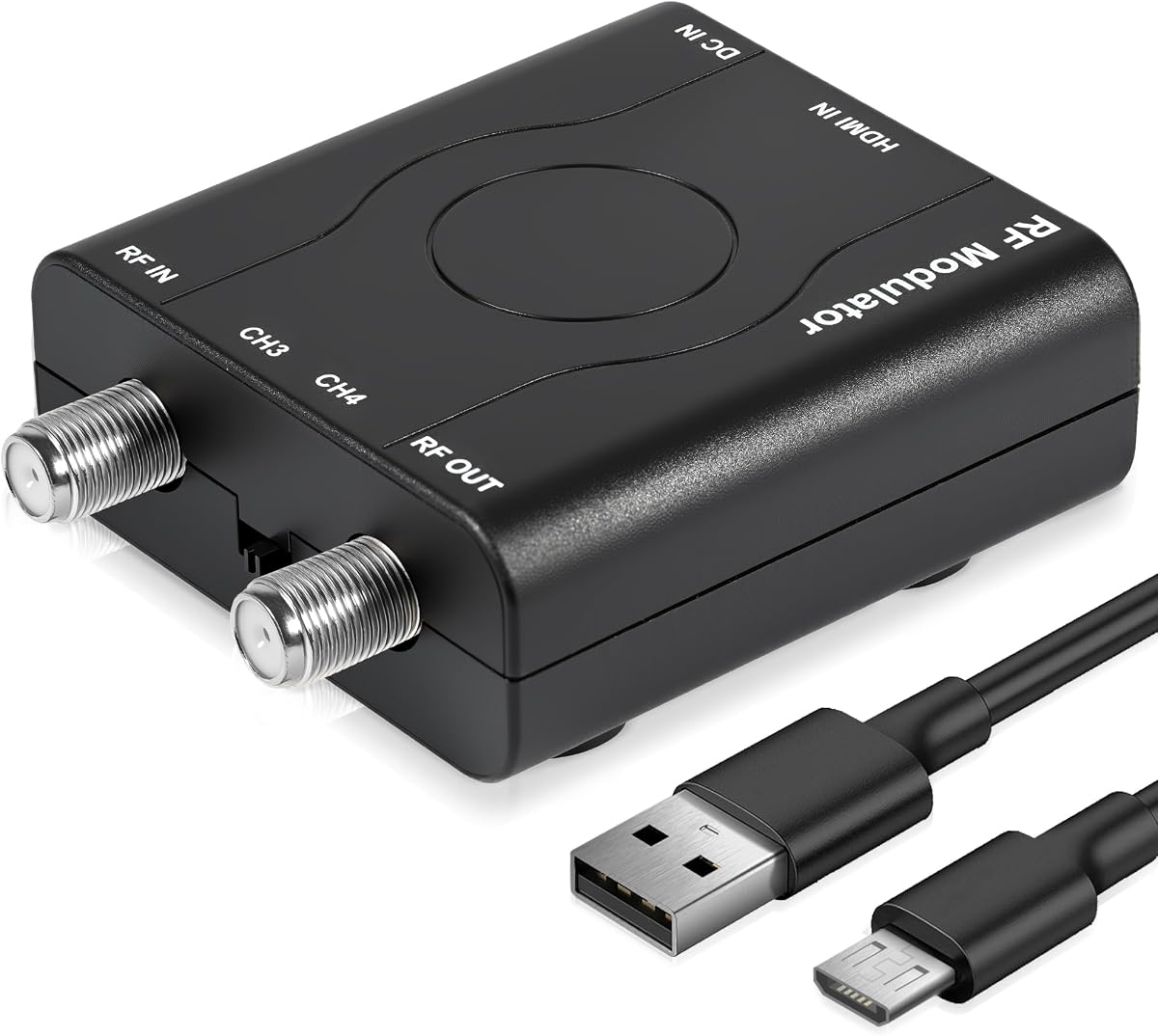


The HDM61 VHF HDMI Converter is a straightforward one-way adapter for putting an HDMI source onto a television that has antenna-style RF input. Its 4.2 rating reflects a generally capable design, with useful support for common video formats, simple setup, and compatibility across PCs, consoles, cameras, disc players, and set-top devices.
We may earn a commission when you buy through this link, at no additional cost to you.
The primary strength is its combination of NTSC output and broad source compatibility. It provides CH3 at 61.25 MHz and CH4 at 67.25 MHz, while accepting 1080p, 1080i, 720p, 576p, 576i, and 480p HDMI input. PLL frequency control, HDMI 1.4, HDCP 1.4, and plug-and-play operation make it useful for a first conversion project.
Its limitations come from the simple analog design. Output is restricted to NTSC, so it is not a suitable solution for a PAL-only television, and the two fixed VHF channels offer little room for adjustment. The adapter also has no claim of digital channel encoding or advanced distribution control. Those restrictions are understandable for a compact home converter but distinguish it from professional encoders.
This is a sensible choice for someone in an NTSC region who wants to connect a console, laptop, camera, DVD player, or television box to an older RF television. It is less suitable for multi-channel coax distribution or international systems using PAL. For a straightforward NTSC installation, it provides the essential functions without unnecessary complexity.
The supported device list makes this converter practical for mixed household equipment. It can serve as a bridge between modern HDMI playback and an older analog television without requiring changes to the source device.
Fixed CH3 and CH4 operation simplifies installation because the television can be tuned to a known channel. Users should confirm their television supports the selected NTSC standard before connecting the system.
We may earn a commission when you buy through this link, at no additional cost to you.
The HDMI to RF Modulator Kit is a well-equipped one-way converter for NTSC televisions and RF-input displays. Its 4.4 rating places it among the stronger compact models here, and the inclusion of an HDMI cable, power adapter, power cable, and user manual reduces the chance of an incomplete setup.
We may earn a commission when you buy through this link, at no additional cost to you.
It accepts common HDMI resolutions through 1080p and outputs NTSC analog RF on CH3 or CH4. PLL control supports frequency stability, while the specified output level and standard NTSC-M audio system make it suitable for a conventional analog television connection. Compatibility information explicitly covers major streaming devices, game consoles, and disc players.
One important limitation is that 1080p describes the accepted HDMI input, not the analog RF output. The device also does not support RF-to-HDMI conversion, and its listed compatibility excludes Mac Mini systems and laptops. NTSC-only output means it will not satisfy a PAL-only installation, while the lack of digital encoding limits it to a basic television hookup.
Buyers who want a ready-to-connect kit for an older NTSC television will find this package especially convenient. It is best for streaming sticks, current game consoles, and Blu-ray or DVD sources. Anyone needing laptop support, PAL output, digital channel distribution, or advanced channel control should select a more specialized model.
The bundled 1.2-meter HDMI cable and complete power set make this a convenient choice for a new installation. Only the appropriate coaxial television connection must be supplied separately if it is not already available.
The product description clearly distinguishes input resolution from RF output and states that conversion works only from HDMI to RF. These details reduce the chance of buying it for an incompatible direction of conversion.
We may earn a commission when you buy through this link, at no additional cost to you.
The SatLink ST-7000 is designed for a fundamentally different task from simple analog adapters. It takes HDMI or RCA source material and encodes it as an HD ATSC or QAM J.83B channel for distribution through a coax network, making it a better fit for multiple modern televisions connected to shared cabling.
We may earn a commission when you buy through this link, at no additional cost to you.
Its 4.2 rating is supported by a specification focused on 1080p video delivery and digital modulation. Rather than occupying a single legacy channel with analog NTSC, it can present a digital channel over coax, which is more useful in homes, hospitality installations, or other environments where RF infrastructure is already in place.
The trade-off is complexity. This is an encoder and modulator rather than a simple one-way plug-in adapter, so users should expect a more involved setup than selecting CH3 on a television. It also addresses a different need: distributing a digitally modulated channel rather than providing a low-cost adapter for one analog set.
The ST-7000 is the appropriate consideration for installers or technically experienced users who need digital channel generation over coax. A homeowner connecting one console to one legacy television will find a compact analog converter easier to operate. Choose the SatLink when network distribution and digital RF output outweigh setup simplicity.
ATSC and QAM J.83B support gives this unit a modern pathway into a coax network. It can serve televisions designed around digital RF input instead of forcing an HDMI source through an old analog channel.
This model is most useful when more than one display needs access to the same source. The coax-based approach also integrates naturally into buildings that already use structured cable wiring.
We may earn a commission when you buy through this link, at no additional cost to you.
The QAM ATSC RF Encoder is a professional-oriented HDMI modulator with a notably broad feature set. It supports QAM, ATSC, DVB-T, and ISDB-T output, dynamic modulation switching, web-based network management, and software updates delivered through the web interface.
We may earn a commission when you buy through this link, at no additional cost to you.
Its headline capability is support for source video up to 1080p at 60Hz. The encoder also handles MPEG-2 video, AAC audio, and Dolby Digital AC3 audio. Closed captions can be supplied through analog CVBS input, and the stated 50–100 millisecond latency is useful for applications where responsiveness matters.
This level of control carries a substantial setup requirement. Web-based management and dynamic standards selection indicate an installation environment rather than a casual television connection. The supplied listing also does not provide a customer rating, so the 4.2-equivalent numeric field in this review is represented as unavailable rather than a fabricated score. HDCP compliance is another consideration for protected source content.
This encoder is best for integrators, broadcasters, or technically experienced users who need broad digital-standard support and network management. It is excessive for a simple home adapter but compelling where low latency, caption handling, remote control, and professional RF formats justify the added complexity.
Supporting QAM, ATSC, DVB-T, and ISDB-T allows the unit to adapt to different television ecosystems. Dynamic switching also makes it more versatile than converters locked to one analog output format.
The web-based control system separates this model from simple consumer adapters. Installers can manage settings and updates over a network, which is valuable in a rack or multi-display environment.
We may earn a commission when you buy through this link, at no additional cost to you.
The VHF UHF AV Converter combines HDMI and composite RCA inputs with analog RF output, offering more flexibility than converters that accept HDMI alone. Its 4.1 rating indicates a competent design with broad connection options, adjustable output, and support for both PAL and NTSC television formats.
We may earn a commission when you buy through this link, at no additional cost to you.
Resolution support includes 1080p, 1080i, 720p, 576p, 576i, and 480p, while the device can operate across VHF and UHF frequencies. F female connectors provide a familiar coax connection, and an adjustable AV output level helps match the signal to different equipment. Its ABS and metal construction adds a more substantial feel than an all-plastic adapter.
The principal drawback is that its flexible functions do not produce a fully universal result. Users still need to select the correct television format and frequency, while the 4.1 rating does not place it among the highest-rated products in the list. It is also a one-way converter and does not describe the digital encoding features found in higher-end distribution units.
This is a good option for a home user with both HDMI and legacy composite sources, particularly when a television tuner does not provide convenient channel placement. It also makes sense for PAL and NTSC regions where changing sources or output frequencies is useful. For the simplest fixed-channel setup, a simpler NTSC model may be easier to operate.
The combination of HDMI and CVBS RCA inputs lets the converter serve newer and older source equipment. That is particularly useful for camcorders, conventional video gear, and legacy media players.
VHF and UHF support provides more tuning options than a fixed CH3 or CH4 device. The adjustable AV level also helps when a receiving television or display has a different sensitivity.
We may earn a commission when you buy through this link, at no additional cost to you.
The Thor Broadcast HDMI to Coax Modulator is the premium professional choice in this roundup, combining HD MPEG-2 encoding, AC3 Dolby audio handling, and an internal digital modulator. Its 4.7 rating is the highest among the products with published scores, reflecting a feature-rich solution for professional distribution.
We may earn a commission when you buy through this link, at no additional cost to you.
It converts HDMI sources into DVB-C, DVB-T, ATSC, or ISDB-T RF output. Supported HDMI resolutions include 720p, 1080i, and 1080p, and the unit accepts sources such as set-top boxes, satellite receivers, HDMI cameras, disc players, and computers. Control through Thor Broadcast’s proprietary graphical interface on a PC makes detailed configuration manageable.
Professional capability comes with a steeper learning curve than a consumer adapter. Buyers must understand the desired broadcast standard, channel setup, network architecture, and computer-based control process. The device is not intended for someone who simply wants to connect one console to one old television and tune CH3.
The Thor Broadcast model is ideal for installers, schools, churches, hospitality spaces, and other coax-based distribution systems. Its combination of broad RF-standard support, internal encoding, and graphical control justifies the premium position. For a single-room analog connection, one of the compact NTSC adapters would be more economical and easier to manage.
Integrating HD video encoding, AC3 audio processing, and digital modulation in one unit reduces the need for separate encoder hardware. The result is designed to place an HDMI source onto a coax television network.
The proprietary PC graphical interface gives operators more control than a fixed-channel appliance. It is a stronger fit for professional workflows where channel and encoding settings require deliberate configuration.
We may earn a commission when you buy through this link, at no additional cost to you.
The HDMI to RF Coax Converter earns the Editor’s Choice position as the most balanced option for common home and light-commercial applications. Its 5.0 rating is the highest published score in the group, and its core proposition—converting modern HDMI audio and video into coax output—addresses the category’s central need directly.
We may earn a commission when you buy through this link, at no additional cost to you.
Compatibility is one of its strongest attributes. The stated device list covers streaming players, gaming consoles, Blu-ray and DVD players, cable boxes, satellite receivers, computers, laptops, cameras, and other HDMI-enabled equipment. The product also presents existing coax cable systems as a practical way to distribute HDMI content to multiple televisions in homes, classrooms, hotels, and businesses.
Setup is designed to be approachable. The package contains a modulator, a four-foot HDMI cable, a power cable, power adapter, and a user manual with step-by-step instructions. The absence of detailed channel-frequency and television-format information means buyers should still verify compatibility with the receiving display, but the included kit reduces the chance of missing essential components.
This is the recommendation for most people who want a general-purpose HDMI-to-coax bridge and want support for a wide range of source devices. It is especially useful when coax wiring already reaches several screens. It is less obviously suited than the professional models to advanced digital encoding, network management, or precise broadcast-standard configuration.
The unusually broad source compatibility makes this model useful for mixed entertainment setups. Users can connect consoles, computers, media players, and disc devices without changing the overall conversion approach.
Using existing coax infrastructure can be easier than finding another route for HDMI in a finished room. The converter’s stated distribution focus makes it useful for more than a single nearby television.
We may earn a commission when you buy through this link, at no additional cost to you.
The HDM61 Coax Adapter is a compact fixed-channel solution for NTSC televisions, combining a 4.5 rating with broad source support. It accepts HDMI input through 1080p and converts that signal to analog RF on CH3 at 61.25 MHz or CH4 at 67.25 MHz.
We may earn a commission when you buy through this link, at no additional cost to you.
Its compatibility list includes personal computers, laptops, game consoles, game switches, cameras, television boxes, DVD players, CCTV equipment, and DVR systems. HDMI 1.4 and HDCP 1.4 support make it relevant to a broad range of modern and legacy equipment, while PLL control is intended to keep the VHF output stable.
The fixed NTSC approach limits flexibility. It is explicitly an HDMI-to-RF converter rather than a reverse RF-to-HDMI device, and users cannot select a broader range of digital channels or standards. As with other analog adapters, a PAL-only television would not be a suitable target.
This model is a good middle ground between a basic one-purpose adapter and a more advanced distribution encoder. Its 4.5 rating, simple operation, and compatibility with both entertainment and surveillance sources make it attractive for a straightforward NTSC installation where users value a small, dependable unit.
The two known channel positions remove the need for advanced tuning. Once the television is configured for the appropriate NTSC channel, the source can generally be changed without reconfiguring the converter.
Support for computers, consoles, cameras, DVD players, CCTV, and DVR systems broadens the possible applications. That versatility is useful for monitoring rooms, demonstration spaces, and legacy display setups.
We may earn a commission when you buy through this link, at no additional cost to you.
The HDM61 NTSC Coax Adapter is the value-focused selection, offering a 5.0 published rating and a focused feature set for people who only need to connect an HDMI source to a basic NTSC television or RF-input display. Its operation is uncomplicated, with no driver or software installation required.
We may earn a commission when you buy through this link, at no additional cost to you.
The device accepts HDMI audio-video and outputs analog RF coax at fixed frequencies of 61.25 MHz for CH3 and 67.25 MHz for CH4. It supports HDMI 1.4 and HDCP 1.4 and uses 1080p PLL frequency control, though the supplied information specifically identifies 480p as the resulting RF output resolution.
The key limitation is that the product is tightly focused on NTSC-M and fixed channels. It cannot convert RF back into HDMI, does not cover PAL systems, and does not provide digital channel encoding. Its molded ABS housing and compact form suit a simple one-display installation, but they do not make it a professional coax distribution head-end.
This is the best budget choice for a straightforward analog television connection, especially when the user already knows the television uses NTSC and can tune CH3 or CH4. It avoids unnecessary controls and provides a clear one-way path from modern HDMI equipment to a legacy RF display. More demanding installations should look toward the digital or multi-standard products.
The adapter concentrates on the essential conversion task without adding installation software or complex settings. It is a practical choice when the source and receiving television are already known.
The listing distinguishes accepted HDMI specifications from the resulting 480p RF output. Buyers seeking full-resolution digital television distribution should not mistake this inexpensive analog bridge for a professional encoder.
We may earn a commission when you buy through this link, at no additional cost to you.
The PAL NTSC Universal Converter is the most broadly formatted analog option in the list, supporting both PAL and NTSC output along with HDMI and composite AV input. Its 4.6 rating is among the strongest and makes it appealing to users working across different television standards or source equipment.
We may earn a commission when you buy through this link, at no additional cost to you.
Its operating frequency range extends from 47 to 868 MHz, with 6 MHz, 7 MHz, and 8 MHz bandwidth options. Both VHF and UHF are supported, and F female connectors are provided for coax output. The unit accepts 1080p, 1080i, 720p, 576p, 576i, and 480p source formats while offering an adjustable output level.
Some specifications require careful attention. The listed resolution is 720×480, and the product operates as a modulator rather than a digital broadcast encoder. Users still need to select the correct PAL or NTSC setting and tune the television to the assigned channel. The 90–240V power specification is unusual but contributes to international placement flexibility.
This converter is well suited to international analog installations, mixed HDMI and composite equipment, and situations where a wider tuning range is valuable. Its compact dimensions make it practical beside a television. Users prioritizing professional digital standards or simple fixed NTSC channels should choose one of the dedicated alternatives instead.
PAL and NTSC support removes one of the most common compatibility barriers in analog television setups. It is particularly helpful for imported equipment, travel-oriented installations, and mixed television systems.
Support across VHF, UHF, multiple bandwidths, and a broad frequency range offers more placement options. The adjustable output level helps accommodate televisions and displays with different signal expectations.
We may earn a commission when you buy through this link, at no additional cost to you.
The right HDMI RF modulator depends primarily on your television format, how many displays need the signal, and whether you need simple analog conversion or professional digital channel distribution. Consider these factors before choosing a model.
The most important distinction is whether you need analog NTSC or PAL RF output or a digital channel encoded as ATSC, QAM, DVB-T, or ISDB-T. Analog adapters are simpler and fit older televisions with antenna-style tuners. Digital encoders are more appropriate for modern coax networks, structured cabling, and installations where the receiving televisions expect digital RF channels. Do not assume that a product advertised as a modulator can create every format; check the supported standard before purchasing.
Choose analog for a simple legacy television, and choose digital for professional or multi-display distribution. Match the output to the tuner used by the receiving equipment.
NTSC and PAL are not interchangeable television standards. Many compact converters are locked to NTSC and offer only CH3 and CH4 at 61.25 MHz and 67.25 MHz. Products that support both PAL and NTSC provide greater flexibility, particularly for international equipment or mixed regional setups. Confirm which format the destination television expects and whether it can select the channel or frequency produced by the modulator.
For a home in an NTSC region, a fixed CH3 or CH4 adapter may be sufficient. Choose a multi-format tuner when the television is PAL, the equipment is imported, or the installation may move.
Most HDMI RF modulators convert in one direction only: HDMI to RF. They cannot turn an antenna signal into HDMI, and that reverse function requires a separate tuner and converter. You should also verify support for the source device. The featured devices commonly support game consoles, streaming sticks, disc players, computers, cameras, television boxes, and other HDMI equipment, but some compatibility lists explicitly exclude laptops or particular platforms.
Write down every source you intend to connect and compare it with the manufacturer’s supported device list. Do not assume a generic HDMI label guarantees that a restricted operating system or streaming service will work.
Input resolution and RF output resolution are different specifications. A device may accept 1080p HDMI while producing a lower-quality analog or digitally encoded channel. Compact NTSC adapters often accept 1080p input but output 480p, while professional encoders may preserve higher resolutions within supported standards. HDMI 1.4 and HDCP 1.4 support are common, but the most important issue is whether protected content will pass through the chosen conversion path.
For basic viewing, a 480p analog result may be acceptable. For professional distribution, review the actual output resolution, frame rate, audio format, and HDCP behavior rather than relying on input specifications alone.
A single television can often be served by a compact plug-in converter, while several televisions connected through existing coax wiring benefit from a professional encoder. Fixed-channel devices require little configuration. Web-based network management, dynamic modulation switching, and PC graphical interfaces provide greater control but demand technical knowledge. Consider cable loss, channel planning, television compatibility, and whether the modulator should be reachable after installation.
Use a compact adapter for one or two nearby displays. Choose a networked digital encoder for buildings, schools, hotels, or other installations where centralized management and multiple outputs matter.
Fixed CH3 and CH4 output is easy to configure, but it can conflict with local broadcast signals or existing coax channels. Modulators with VHF and UHF support provide a wider selection, while multi-bandwidth models can suit different television markets. Professional digital devices can place an encoded channel where it best fits the network plan. A broad frequency range is useful, although users still need to follow local broadcast and installation rules.
Check the available channels before committing to a fixed model. Choose a tunable or professionally managed unit when the installation already contains television channels or other RF equipment.
A complete package may include an HDMI cable, power adapter, power cable, and user manual. That can make a new installation more convenient, although a suitable coaxial cable is still required. Some compact models use USB power, while professional encoders need their own power and network configuration. Plug-and-play wording is most accurate for simple consumer converters; professional units may require channel maps, encoding settings, and browser-based control.
Inventory the cables and connections you already own before buying. For a simple setup, prioritize a complete kit and clear instructions. For a professional system, prioritize documentation and control features over a bundled consumer HDMI cable.
Compact ABS housings are common for portable home adapters, while metal components and larger enclosures are more likely in professional equipment intended for installation. A small enclosure is easier to place beside a television or conceal near existing wiring. It should still receive adequate ventilation and remain accessible for connections. Reliability depends on using the specified power supply and avoiding stress on the coax or HDMI connectors.
For permanent installations, prioritize secure placement and suitable connectors. For temporary event use or testing, a compact housing and plug-and-play setup may be more useful.
Begin by identifying the television’s tuner format and available channel range. Connect the HDMI source to the modulator using a compatible HDMI cable, then connect the modulator’s RF output to the television or coax distribution point with suitable coaxial wiring. Select the required PAL or NTSC format, choose an available channel, and power the unit according to its instructions.
Use the source device’s normal menu to select the desired video and audio content. Tune the television to the configured channel and adjust the modulator’s output level only if the picture is weak, excessive, or unstable. Avoid changing the output format while the unit is active, and do not connect the RF output to an HDMI input, because these products are generally one-way converters.
For care, keep the modulator in a dry, ventilated location and avoid placing heavy objects on top of it. Do not sharply bend the coaxial cable at the connector, and unplug the power before moving the unit. If the picture freezes or disappears, test the HDMI source directly, reseat both cable ends, confirm the television is on the correct channel, and verify that the selected format matches the television’s standard.
Usually not. The featured products are primarily one-way HDMI-to-RF converters, so they send an HDMI source to a television with RF or antenna input. Converting a broadcast antenna signal into HDMI requires a separate digital tuner or over-the-air converter followed by an HDMI output device.
No. The television must support the same analog format and channel range produced by the modulator, or it must include a tuner capable of receiving the digital standard from a professional encoder. Checking NTSC versus PAL, channel 3 versus channel 4, and connector type can prevent an incompatible purchase.
Not necessarily. Many devices accept a 1080p HDMI signal but convert it to a lower-resolution analog RF output, often 480p. Professional digital encoders may deliver higher-quality results, but the actual output depends on the selected broadcast standard and configuration.
Yes, if the console has a compatible HDMI output and the modulator supports the relevant source. Several products explicitly list current game consoles, while one package notes compatibility with PlayStation, Xbox, and Nintendo systems. A compatible HDMI cable and a television tuned to the correct channel are also required.
First confirm that the source is working on another display and that the modulator is powered. Next, verify the selected PAL or NTSC format, the television channel, the coax connection, and the input direction. Protected HDMI content may also require supported HDCP handling, so checking the compatibility requirements can reveal the issue.
It depends on the installation. A compact adapter can feed a coax distribution network, but every television must tune the same channel and support the same signal format. Professional digital encoders are usually better for multiple rooms because they support network control, selected digital channel standards, and installation features designed for structured coax systems.
VHF and UHF are different RF frequency ranges used by analog television systems. Fixed NTSC adapters commonly use CH3 and CH4 in the VHF range, while models supporting VHF and UHF offer more tuning choices. Check the television and local channel plan before choosing the output frequency.
Compact consumer adapters generally require no drivers or software and work through basic channel or format settings. Professional networked encoders do need computer-based or web-based configuration, however. Their additional controls provide flexibility for channel planning, standards selection, encoding, and remote management.
The HDMI to RF Coax Converter is the strongest all-around recommendation for common source compatibility, a complete accessory kit, and a 5.0 published rating. The HDM61 NTSC Coax Adapter stands out as the value-focused option for a simple CH3 or CH4 connection, while the Thor Broadcast digital modulator is the premium choice for professional coax distribution and PC-based control.
Prioritize television format, conversion direction, source compatibility, and intended distribution scale before comparing other features. A fixed NTSC adapter is easiest for one legacy television, a PAL-and-NTSC model offers more geographic flexibility, and a digital encoder is the right tool when a modern network needs centrally controlled channels.
Finally, check the current product listing, supported standards, package contents, and customer feedback before ordering. Modulator specifications, availability, and pricing can change, and the most suitable model is ultimately the one that matches your television, source equipment, and installation plan.