
NZXT C1000 Gold Core
4.6Editor score
ATX 3.1 and PCIe 5.1
Fully modular embossed cables
Zero-RPM 135mm FDB fan
Native dual-color 12V-2×6
Explore the best 1100W PSU options for demanding PCs, comparing efficiency, modular cabling, connectors, protection features, acoustics, and overall build
A high-capacity power supply gives demanding workstations, gaming rigs, and multi-GPU systems the electrical headroom they need for stable operation. The most useful 1100W PSU is not merely powerful on paper: it should also provide efficient conversion, clean voltage regulation, useful protections, modern graphics-card connectors, manageable noise, and cables that are practical to route.
This guide compares ten products that are relevant to shoppers searching for an 1100W-class power supply, including exact 1100W server units and closely related high-capacity ATX 3.1 models rated at 1000W or 1050W. We evaluated the supplied efficiency, modularity, connector, cooling, protection, warranty, and design information without claiming that any unit was personally tested.
Each review explains the product's strongest benefits, practical limitations, and most suitable build type. The top selections show why modern efficiency, native 12V-2×6 support, and straightforward installation deserve close attention, while compatibility with an existing server chassis remains essential. Prices and availability can change, so confirm current listings and connector requirements before purchasing.
4.6Editor score

4.7Editor score

4.7Editor score
The comparison below covers exact 1100W enterprise units plus high-capacity 1000W and 1050W alternatives. It highlights efficiency class, modularity, modern connector support, cooling, and the type of system each unit is best suited to serve.



The CORSAIR RM1000e (2025) is a modern 1000W ATX 3.1 power supply that brings the scale and flexibility associated with an 1100W-class unit into a widely adaptable desktop platform. Its 4.7 rating reflects a well-received balance of modern transient handling, modular construction, effective cooling, and practical features for powerful gaming and workstation builds.
We may earn a commission when you buy through this link, at no additional cost to you.
The strongest argument for this model is its combination of ATX 3.1 compliance and PCIe 5.1 readiness. It is designed to withstand two transient power excursions from a compatible GPU, an important consideration for processors and graphics cards that can draw sharply during startup, rendering, or compute workloads. Fully modular cabling eliminates unused leads, while the 120mm rifle bearing fan uses a calculated curve to limit noise even at full load.
The tradeoff is that its nameplate capacity is 1000W rather than the literal 1100W searched by some buyers. It also relies on 105°C-rated capacitors for reliability rather than a more exotic component hierarchy. For most high-end desktop systems, however, the practical distinction between 1000W and 1100W is less important than sustained power quality, transient response, connector fit, and whether the total system demand stays within the unit's operating envelope.
This RM1000e is a strong recommendation for a modern gaming PC, rendering workstation, or creator system using a current ATX 3.1 motherboard. Choose it when quiet modular operation, current graphics-card support, and a 4.7 customer rating matter more than an exact 1100W label. Verify the supplied cable set against the graphics card before ordering.
ATX 3.1 certification and support for two GPU transient excursions are the model's most consequential advantages. That behavior is particularly relevant to high-end graphics cards that can briefly demand more power than their steady-state figures suggest.
Because every cable can be omitted when unnecessary, the fully modular design simplifies airflow and keeps the interior of a powerful PC less cluttered. The emphasis is particularly valuable in cases with large radiators, multiple storage devices, and tightly packed cable channels.
We may earn a commission when you buy through this link, at no additional cost to you.
The Dell 1100W EPP 80+ Platinum PSU, identified as part 450-AEBL and associated with the PowerEdge R730, is one of the few products here that delivers the exact capacity implied by the 1100W PSU keyword. It is intended for a specific enterprise environment rather than being designed as a broad-range enthusiast upgrade.
We may earn a commission when you buy through this link, at no additional cost to you.
Its defining feature is the combination of 1100W output and 80 Plus Platinum efficiency. In a compatible server installation, that capacity can support processor-heavy configurations and demanding accelerator or storage systems without relying on a collection of separate power supplies. The platform-specific design is an advantage when replacing a known failed unit because form factor, wiring, and management expectations are already established.
There are important limitations. The supplied listing does not provide a customer rating, and the unit should not be assumed to use the same modular connectors, dimensions, or signaling as a standard consumer ATX power supply. A buyer also needs to verify the exact chassis, part number, airflow direction, and cable requirements. The absence of a stated fan-control profile or modern PCIe 5.1 feature set further limits its usefulness for new custom gaming builds.
This Dell unit is best for an administrator or homelab builder replacing a compatible PowerEdge R730 power supply. It is less suitable for an ordinary desktop where an ATX 3.1 model, native 12V-2×6 connector, and consumer-standard modular leads are required. Confirm the system documentation and the physical replacement before buying.
The platform association and listed part number make this a more focused choice than a general ATX unit. For a matching R730 configuration, that specificity can be more useful than the broader connector flexibility sought by desktop builders.
When a search requirement is expressed in exact watts, an 1100W model removes ambiguity. The trade-off is reduced universality, so system fit should be confirmed before treating this as a general-purpose 1100W solution.
We may earn a commission when you buy through this link, at no additional cost to you.
The renewed Dell 1100W EPP 80+ Platinum PSU stands out with an exact 1100W capacity, 80 Plus Platinum efficiency, modular cables, and a 5.0 customer rating. Its listing describes enough power for graphics-intensive gaming systems, although the underlying platform identity and supplied component reference suggest it is primarily a server-derived unit.
We may earn a commission when you buy through this link, at no additional cost to you.
The main appeal is straightforward: buyers who need precisely 1100W in a compatible system do not have to settle for a nearby capacity. Platinum efficiency can reduce waste heat and operating cost in sustained workloads, while modular cabling can simplify installation when the supplied leads match the target chassis. The perfect 5.0 rating is encouraging, though the number of underlying customer reviews is not supplied and should still be considered when assessing the evidence.
Renewed status is the defining tradeoff. Buyers may encounter wear from previous service, and visual or cosmetic differences should be expected. Warranty details, return terms, fan cleanliness, connector wear, and the presence of every required cable are particularly important for a used enterprise power supply. Modern ATX 3.1 transient support and a native 12V-2×6 lead are not established by the supplied data.
This product is a practical choice for refurbishers, home-server builders, and owners of a compatible Dell environment who prioritize exact capacity and efficiency over newest desktop features. It is not the first choice for a new ATX 3.1 gaming build. Check the part number, cable set, dimensions, and warranty before making the purchase.
A renewed unit can deliver the required capacity at a lower acquisition cost, but buyers should account for prior use. Confirm the return policy, inspect the housing and contacts promptly, and verify that all essential cables are present.
80 Plus Platinum efficiency is particularly relevant when the system remains heavily loaded for long periods. Lower conversion losses can mean less waste heat inside a dense chassis, although the exact cooling arrangement remains a system-specific concern.
We may earn a commission when you buy through this link, at no additional cost to you.
The CORSAIR RM1000x ATX 3.1 combines a 1000W rating with a 4.7 customer score, native 12V-2×6 support, and polished modular cable management. It is an attractive high-end desktop PSU for a modern gaming or workstation build where a clean installation and direct GPU connection matter.
We may earn a commission when you buy through this link, at no additional cost to you.
Its defining features are ATX 3.1 compliance, PCIe 5.1 readiness, transient-spike resistance, and a native 12V-2×6 connector. That means compatible graphics cards can connect without relying on an adapter. Fully modular construction lets builders leave unused cables out of the chassis, while embossed, flexible cables and low-profile combs help with routing in confined spaces. Cybenetics Gold certification is rated for efficiency up to 91%.
The main limitation is that it supplies 1000W rather than 1100W, so it does not literally match every part of the search phrase. Its efficiency class is also below the Platinum options in this list. At the same time, a carefully selected 1000W unit can be preferable to a higher-wattage model if it has the efficiency, transient response, and build quality needed by the actual system.
Choose this RM1000x when your motherboard and graphics card use contemporary ATX 3.1 connections and you value tidy, quiet installation. It is well suited to a modern high-end gaming PC or content-creation system, provided your calculated peak demand remains safely below its rated envelope.
The native 12V-2×6 connector is the model’s headline practical feature. It reduces the need for a multi-connector adapter and makes cable management more direct in a build designed around a current graphics card.
Fully modular wiring, embossed cable jackets, and low-profile combs create a tidy installation without sacrificing routing flexibility. This is especially useful in cases where the PSU sits behind a compact tray or beside a large liquid-cooling radiator.
We may earn a commission when you buy through this link, at no additional cost to you.
The Thermaltake Toughpower GF A3 provides 1050W, ATX 3.1 compatibility, and two true 600W 12V-2×6 connections. Its 4.5 rating and ten-year warranty make it a compelling high-capacity option for advanced builds, particularly those involving current NVIDIA RTX 50 Series graphics hardware.
We may earn a commission when you buy through this link, at no additional cost to you.
The product title and feature list distinguish two high-current 12V-2×6 connectors on the PSU itself. That arrangement is intended for demanding graphics-card power delivery without relying on adapters. The unit also supports PCIe 5.1, 80 Plus Gold efficiency, SLI and Crossfire readiness, a high-amperage single +12V rail, and fully modular low-profile flat cables.
Its biggest caution is physical and platform compatibility. A connector that fits a graphics card does not guarantee that every motherboard, case, or multi-GPU arrangement can accommodate the required cable bend radius. Users should also consider the 1050W rating rather than assuming it delivers exactly 1100W. Finally, multi-GPU support depends on motherboard lanes, operating-system support, physical spacing, and the workload being performed.
The GF A3 is well matched to a high-end gaming rig, visualization system, or enthusiast workstation with substantial graphics hardware. Its warranty is a notable strength for a component expected to serve for years. Confirm case clearance, motherboard guidance, graphics-card power requirements, and cable routing before ordering.
Two 12V-2×6 leads give the unit flexibility for power-hungry graphics configurations. They are most valuable in builds where adapter use would be inconvenient or where multiple high-powered cards need dedicated connections.
A 1050W rating places the Toughpower GF A3 closer to the 1100W search target than many modern ATX alternatives. The ten-year warranty adds reassurance, while the high-amperage +12V rail supports demanding component combinations.
We may earn a commission when you buy through this link, at no additional cost to you.
The Asus ROG Strix 1000W Platinum White is the most feature-oriented premium PSU in this comparison. It pairs a 4.7 customer rating with 80 Plus Platinum efficiency, ATX 3.1 support, GaN MOSFET technology, intelligent voltage stabilization, and a white finish intended for coordinated enthusiast systems.
We may earn a commission when you buy through this link, at no additional cost to you.
The GaN MOSFET stage is presented as delivering efficiency improvements of up to 30% and enabling a more organized internal layout for cooler operation. GPU-first voltage sensing is a distinctive addition, with the listed intelligent stabilizer designed to enhance graphics-card voltage delivery by up to 45%. Large ROG heatsinks, dual ball bearing fans, and a 0dB mode support quieter operation, particularly at light loads.
The compromises are capacity and positioning. Despite the premium construction, the unit is rated at 1000W, not 1100W. That distinction is unlikely to matter in a well-engineered system that stays within the intended load, but it matters for builds that need additional headroom. Its white styling and specialized feature set are more compelling for enthusiasts than for someone who only needs reliable conventional power delivery.
This is an excellent choice for a showcase build with a high-end GPU, powerful processor, and coordinated white components. It is also well suited to creators who value refined acoustics and voltage delivery. Confirm the exact motherboard, case, and graphics-card requirements, and compare its cost with the less ornate RM1000x alternatives.
The intelligent voltage stabilizer focuses on delivering power to the graphics card, with the manufacturer claiming improvement of up to 45%. This is particularly relevant to a premium system where the GPU is one of the largest and most dynamic power loads.
GaN MOSFETs, large heatsinks, dual ball bearing fans, and a 0dB mode form a high-end cooling strategy. The fan can remain stopped during lighter activity, while the larger heatsinks are intended to help the unit run cool under harder loads.
We may earn a commission when you buy through this link, at no additional cost to you.
This black CORSAIR RM1000x delivers 1000W through an ATX 3.1 and PCIe 5.1 platform, combining a 4.5 rating with fully modular wiring and a native 12V-2×6 connector. It is a straightforward option for builders who value modern GPU support and familiar RM-series styling.
We may earn a commission when you buy through this link, at no additional cost to you.
The key technical benefits are resistance to transient power spikes, direct support for the latest graphics-card connector, and Cybenetics Gold efficiency rated at up to 91%. Fully modular construction lets users connect only the leads required, while embossed cables and low-profile combs make routing easier. These qualities fit a high-end PC where a conventional 650W or 750W supply would be inadequate.
Compared with the newer RM1000e, this model has a slightly lower customer rating, and its 1000W capacity still falls short of an exact 1100W requirement. The supplied data also does not detail every protection or acoustic specification. Buyers should therefore compare the exact cable bundle and current product details rather than assuming that all RM1000x versions are identical.
The RM1000x is a good recommendation for a modern gaming desktop with one current high-power GPU, provided the system is engineered to remain within its 1000W envelope. It also suits creators who want a fully modular ATX 3.1 unit. Confirm connector quantity and compatibility before purchase, particularly if a multi-GPU configuration is planned.
Native 12V-2×6 support and transient-spike resistance make this a contemporary choice for recent GPUs. The direct connection also avoids the cable bulk associated with some multi-connector adapter arrangements.
The fully modular arrangement and embossed cables make the unit approachable for builders familiar with the RM family. Low-profile combs help organize the final presentation without demanding excessive space around the connectors.
We may earn a commission when you buy through this link, at no additional cost to you.
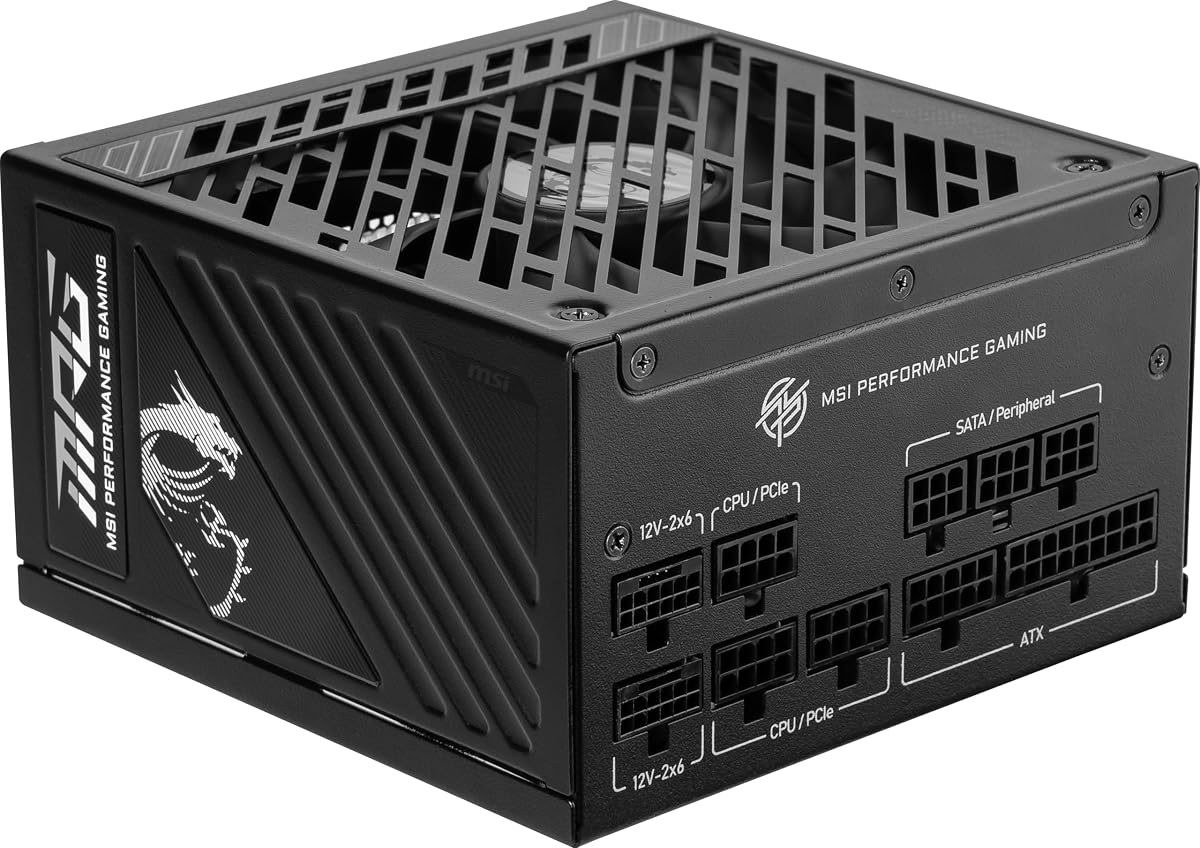
The MSI MPG A1000GS PCIE5 II is a 1000W gaming PSU with two native 12V-2×6 cables, ATX 3.1 and PCIe 5.1 readiness, 80 Plus Gold efficiency, and a 4.3 customer rating. It combines a broad protection suite with a ten-year warranty, making it an interesting option for builders who value practical safeguards.
We may earn a commission when you buy through this link, at no additional cost to you.
Two native 12V-2×6 connections provide flexibility for demanding NVIDIA GeForce RTX 50 Series cards and other high-current hardware. The unit also includes three 8-pin PCIe connectors and explicitly supports AMD VGA hardware. All-server-grade 105°C capacitors support its reliability positioning, while embossed cable jackets are intended to improve bending and routing. Its protection list includes OCP, OTP, OPP, SCP, OVP, UVP, SIP, and NLO.
Its 4.3 rating is the lowest among the rated products, so it deserves more deliberate comparison. It is also a 1000W unit rather than an exact 1100W product, and the presence of both native high-current and legacy 8-pin connectors may confuse shoppers who do not carefully match the GPU requirements. Cable quantity does not itself determine whether a card is adequately powered.
The MSI is most suitable for a modern gaming system that values native connectors, extensive protection, and long warranty coverage. It can also serve a mixed-GPU workstation where legacy PCIe power remains useful. Review the exact output data and connector assignment, and compare its acoustic characteristics with higher-rated alternatives.
The broad set of overcurrent, over-temperature, overpower, short-circuit, overvoltage, undervoltage, and other protections helps guard the PSU and connected hardware. These safeguards are particularly reassuring in a system containing expensive graphics hardware.
Dual native 12V-2×6 leads address current high-power cards, while three 8-pin PCIe connectors preserve compatibility with additional or older graphics hardware. The included embossed jackets support easier routing in a crowded case.
We may earn a commission when you buy through this link, at no additional cost to you.
The be quiet! Power Zone 2 1000W is built for users who prioritize both efficiency and acoustics. It carries a 4.6 rating, 80 Plus Platinum and Cybenetics Platinum certification, ATX 3.1 support, and a semi-passive 140mm Pure Wings 3 cooling fan.
We may earn a commission when you buy through this link, at no additional cost to you.
The supplied information states efficiency of up to 94.0%, which can reduce waste heat and support quieter operation under demanding loads. The large 140mm fan moves air efficiently, while the fan stops completely at low load. It then requires a two-to-five-minute post-ventilation cooldown before stopping again, a design intended to avoid frequent starts and stops. LLC topology is included for voltage regulation and efficiency.
For modern graphics cards, the PSU includes native 12V-2×6 integration and three PCIe 6+2-pin connectors. A 90-degree angled 12V-2×6 lead is included, easing routing at the side of a case. The compromise is that 1000W is below the exact search capacity, and even a large fan cannot guarantee silence from every load or ambient condition.
This Power Zone 2 is an excellent match for a quiet high-end workstation or gaming PC, especially one that places a premium on thermal efficiency. It is also a strong choice for creators who value a refined acoustic environment. Make sure the graphics card uses the appropriate connector and leave enough room for the PSU and cable bend.
Up to 94.0% efficiency means the unit wastes less energy as heat than lower-rated alternatives. In a premium system, that can support a cooler interior and reduce the amount of work required from the cooling solution.
The 140mm Pure Wings 3 fan stops during light demand and operates when cooling is needed. Its post-ventilation cooldown avoids rapid fan cycling, though users should allow the specified brief interval before the unit becomes silent again.
We may earn a commission when you buy through this link, at no additional cost to you.
The NZXT C1000 Gold Core is a 1000W ATX 3.1 PSU that combines a 4.6 rating with a fully modular design, modern GPU connectivity, and a quiet cooling strategy. It stands out as a balanced option for powerful desktop builds that want current standards without moving to a premium enthusiast model.
We may earn a commission when you buy through this link, at no additional cost to you.
Its dual-color 12V-2×6 connector is rated for 105°C and supports current NVIDIA graphics cards without an adapter, while three 8-pin PCIe cables cover many existing GPUs. The 135mm fluid dynamic bearing fan includes a zero-RPM mode for light workloads. Cybenetics noise certification lists A++ for the lower C750 and C850 models and A+ for the C1000, placing its stated noise range at 15–20 dBA.
Efficiency labels can appear contradictory at first glance: the product is named for 80 Plus Gold, while the description also cites Cybenetics Platinum efficiency. They refer to different certification programs and testing approaches, so buyers should not assume the two ratings are directly interchangeable. Its 1000W capacity is also lower than the exact 1100W target, though the 7-year warranty and protection features make it a well-rounded modern option.
The C1000 Gold Core is a strong recommendation for a high-end gaming PC or creator workstation with a single current GPU. It is especially attractive to builders who want modular cables, a quiet fan, and modern ATX 3.1 support. Confirm that the case offers sufficient clearance and that the supplied connectors match the planned hardware.
ATX 3.1 and PCIe 5.1 readiness prepare the system for current graphics hardware, and the native dual-color 12V-2×6 lead supports a direct connection. Three 8-pin PCIe cables also provide useful backward compatibility.
A 135mm fluid dynamic bearing fan with zero-RPM mode supports quiet operation, while fully modular embossed cables simplify routing. Premium 105°C-rated capacitors and a seven-year warranty add support for long-term ownership.
We may earn a commission when you buy through this link, at no additional cost to you.
Choosing a high-capacity PSU begins with the computer rather than the wattage label. Consider the processor, graphics card, motherboard, case, existing hardware, connector layout, electrical standards, and desired acoustic character before comparing otherwise similar 1000W, 1050W, and 1100W models.
Choose enough capacity for the expected load without assuming a larger rating automatically improves every system. Confirm the PSU's continuous rating and connector limits rather than relying on short-term promotional peaks.
For a new desktop, an ATX 3.1 model is usually easier to integrate. For a server replacement, the correct part number, dimensions, fan orientation, and connector set matter more than general wattage.
For a modern enthusiast build, ATX 3.1 with a native 12V-2×6 lead is the most practical combination to prioritize.
Platinum is attractive for long-running, heat-sensitive builds, while a well-made Gold unit can still be an excellent choice when the purchase is value-focused.
Modularity is most useful when the case has limited cable space. Measure first, and never sharply fold a high-current cable immediately at the plug.
Prioritize a documented fan curve and semi-passive behavior if noise matters, but leave realistic expectations for sustained maximum load.
Favor documented protection, a meaningful warranty, and a reliable seller. For renewed hardware, confirm exactly what the return policy covers.
Make a physical connector checklist from the manual for every major component before buying. The right capacity matters only if the system can actually be powered.
Install the unit in a powered-off system with the mains cable disconnected. If it is a standard ATX model, position it with the fan and vent aligned according to the case design, secure it with the correct screws, and attach only the cables required by the motherboard, processor, graphics card, drives, and accessories. For a Dell server replacement, follow the chassis service procedure and use the specified part and cable set.
Connect modular cables without force, route them around fans and sharp edges, and preserve a gentle bend near every plug. High-current 12V-2×6 connections especially should not be folded tightly or loaded sideways. Connect the motherboard and processor cables before the graphics card, and verify that all sockets are fully seated without forcing a misaligned connector.
After assembly, power on the system and check for unusual fan behavior, buzzing, connector odor, or immediate shutdowns. Monitor temperatures and load behavior when the machine is stable, and ensure that cables are not touching hot components or moving fans. Periodic visual inspection is useful in dusty environments: unplug the system, check for blocked vents, loose connectors, and accumulated dust, and follow the manufacturer or seller's maintenance guidance rather than opening a sealed premium PSU.
A 1000W PSU can be suitable if the complete system's expected and peak demand remains comfortably within its operating range. Modern ATX 3.1 units also handle transient behavior better than older alternatives. However, a builder who genuinely needs more sustained headroom should choose a model with the appropriate rating rather than relying on a search term that says 1100W.
Both listings identify an exact-capacity Dell 1100W EPP unit with 80 Plus Platinum efficiency, but one is associated with the PR21C and part 450-AEBL for PowerEdge R730 use, while the other is a renewed CMPGM listing. Buyers should compare the physical unit, part number, condition, included cables, warranty, and return policy rather than assuming the listings are interchangeable.
ATX 3.1 is strongly recommended for a new high-end system because it addresses transient power excursions and supports current PCIe 5.1 graphics hardware. It also pairs naturally with a native 12V-2×6 cable. The card's manufacturer documentation remains the authority on which power connectors and adapter arrangements are acceptable.
They come from separate certification programs with different test methods and rating scales. A product can be described as 80 Plus Gold while also citing a strong Cybenetics result, as the NZXT C1000 Gold Core does. These labels should be read as separate evidence of efficiency rather than treated as if one necessarily replaces the other.
It should not be assumed that a Dell server PSU can power a standard ATX motherboard and modern graphics card. Form factors, connector types, signaling, airflow, and cable routing may differ substantially. A Dell unit is most appropriate when replacing a compatible server supply or when a builder has independently confirmed every electrical and mechanical requirement.
A fully modular PSU allows unused cables to remain out of the case, which can improve airflow and make a dense system easier to service. It still requires proper routing of the cables that are used, and thick native GPU leads need adequate space. A modular design is helpful but does not eliminate the need for careful case planning.
A renewed unit can make sense when it provides the correct capacity, part number, and cable configuration at a compelling cost. The condition, fan cleanliness, connector wear, warranty, and return policy deserve closer scrutiny than they would for new hardware. Never power a server with a renewed PSU unless its fit and electrical requirements have been confirmed.
Headroom should reflect the processor, graphics card, other components, and realistic short-term peaks rather than an arbitrary percentage. Some builders prefer additional reserve for future upgrades, while others only need enough capacity for their planned hardware. Use component power guidance, account for sustained multi-GPU or compute loads, and leave the system comfortably within the PSU's continuous rating.
The NZXT C1000 Gold Core stands out as the best budget-oriented modern choice, combining ATX 3.1 support, a native 12V-2×6 connection, modular cabling, quiet cooling, and a seven-year warranty. The CORSAIR RM1000e (2025) is the editor's choice for balanced high-capacity performance, while the Asus ROG Strix Platinum White occupies the premium position with GaN MOSFETs, advanced voltage sensing, and refined cooling.
Prioritize the parts of the PSU that affect your actual build. Confirm chassis fit, calculate sustained and transient demand, match every required connector, and decide whether quiet operation, efficiency, modularity, or platform-specific replacement is more important. An exact 1100W Dell unit may be ideal for a compatible server, while a modern 1000W ATX 3.1 design may be a more natural choice for a new gaming desktop.
Current prices, availability, cable bundles, and warranty terms can change, so check the latest listing before ordering. Take time to review the power requirements of the processor and graphics card, inspect the case, and use only the cables intended for that power supply. Those final checks can make the difference between a merely high-wattage purchase and a dependable, well-integrated system.