
Thermaltake Toughpower GT 850W
4.5Editor score
Up to 90% efficiency
Native 450W connector
Smart Zero Fan control
Fully modular cabling
Discover the best 80 Plus Gold power supplies, comparing efficiency, wattage, modularity, noise control, connectors, protection, and build fit.
An 80 Plus Gold power supply converts wall power to system power more efficiently than lower-certified units, reducing waste heat and helping quieter PCs run cool. The best models also balance usable capacity, clean cables, reliable protections, and compatibility with modern graphics cards and processors.
We compared ten Gold-rated units across wattage, efficiency standards, modularity, fan behavior, connector support, transient handling, capacitor quality, warranty coverage, and intended build type. The list includes compact 600W and 750W choices, versatile 850W models, and a premium design for builders who favor established support.
Each review explains the product's strongest attributes, practical limitations, and ideal PC configuration. Rankings reflect the supplied specifications and customer ratings rather than personal laboratory testing, and current prices, availability, warranty terms, and product details should be confirmed before purchasing.
4.5Editor score

4.7Editor score

4.8Editor score
This side-by-side comparison highlights the major differences among the ten featured power supplies, including capacity, efficiency certification, cable design, modern GPU support, cooling, and warranty coverage.
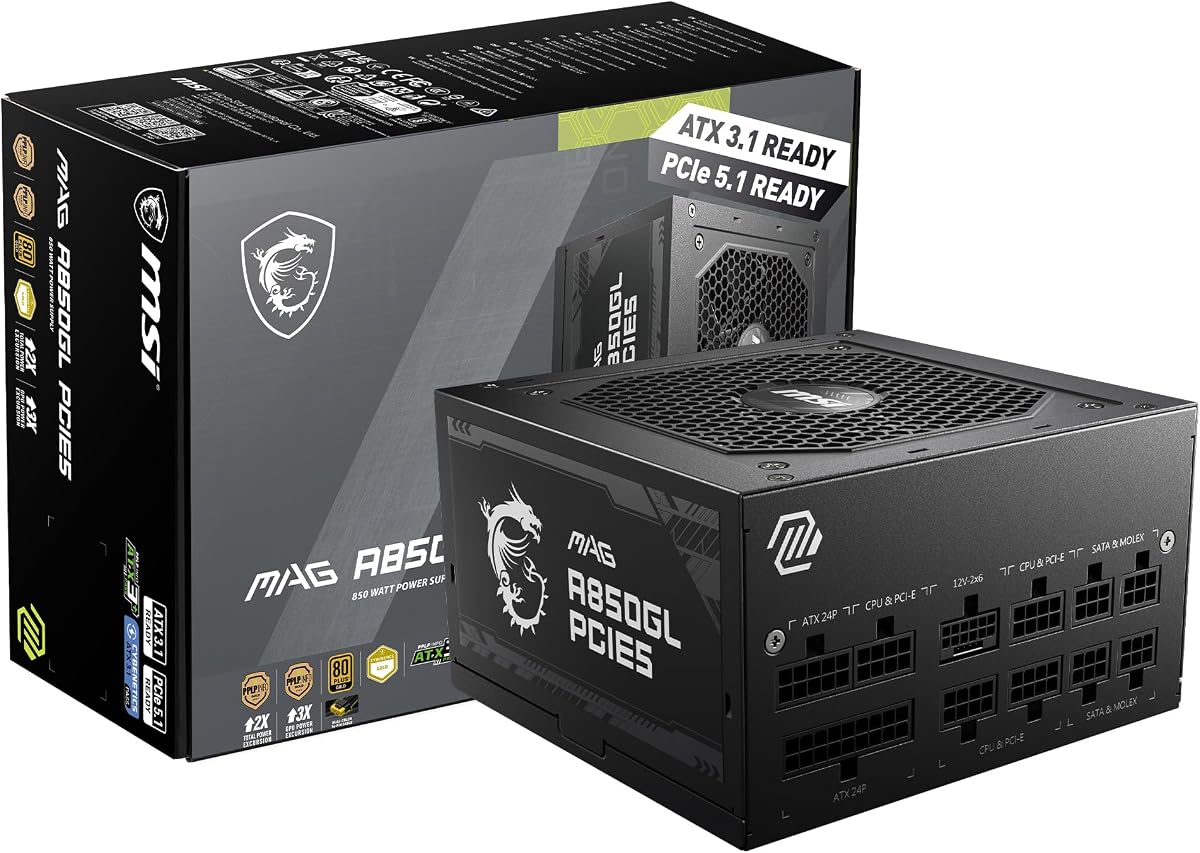


The MSI MAG A850GL PCIE5 combines an 850W capacity with 80 Plus Gold efficiency in a compact, fully modular enclosure. Its 4.5 customer rating reflects generally favorable experiences, while the supplied specifications distinguish it with ATX 3.1 and PCIe 5.1 readiness, a native dual-color 12V-2×6 cable, and a 10-year limited warranty.
We may earn a commission when you buy through this link, at no additional cost to you.
The strongest feature is its combination of useful capacity and physical flexibility. An 850W unit provides ample room for a demanding gaming configuration without forcing a builder toward a larger multi-GPU-oriented power supply. Full modularity removes unused cables, which can improve airflow and make the behind-tray area easier to maintain. The native dual-color 12V-2×6 connection also provides a straightforward route for compatible modern graphics cards.
Gold certification remains the defining efficiency feature, helping reduce conversion losses and internal heat. Modern platform support is especially relevant for builders using current-generation processors and graphics cards that may produce brief power excursions. The 10-year limited warranty also offers meaningful reassurance, although buyers should verify its exact regional terms and coverage process with the seller and manufacturer.
This is a compelling choice for a high-powered gaming PC that needs modern connectors, full modularity, and a relatively compact format. It may be especially attractive to builders who value the long warranty and recognizable gaming-brand presentation. Confirm the enclosure dimensions, included connector inventory, and graphics-card power requirements before ordering, as those details are essential for a clean installation.
ATX 3.1 and PCIe 5.1 readiness make this model relevant to current graphics-card platforms. The native dual-color 12V-2×6 cable can provide a direct connection when the GPU and PSU cable are compatible, simplifying a modern gaming build.
Full modularity allows builders to route only the required cables, improving visual cleanliness and potentially helping case airflow. Its 850W capacity provides useful headroom without moving into much larger power-supply formats.
We may earn a commission when you buy through this link, at no additional cost to you.
The Thermaltake Toughpower GT 850W delivers the most approachable blend of modern compatibility and practical features in this guide. It combines 850W of capacity, up to 90% Gold efficiency, ATX 3.1 support, a native 450W PCIe 5.1 connector, full modularity, and a five-year warranty. Its 4.5 customer rating supports its position as a balanced budget-focused recommendation.
We may earn a commission when you buy through this link, at no additional cost to you.
Its native 12V-2×6 connection is an important advantage for builders with compatible current-generation graphics cards. Instead of relying on a multi-cable adapter, the PSU can use a direct 12+4-pin-style cable. The high-amperage single +12V rail also provides a straightforward modern platform for gaming and workstation components, while the low-profile flat black cables should simplify a tidy installation.
Smart Zero Fan technology adjusts fan speed according to load, reducing unnecessary noise during lighter workloads. Because this model does not promise the same semi-passive fan-stopping behavior as some alternatives, buyers who place exceptional value on complete fan silence during idle periods should verify the current manual and operating behavior. Its Gold certification still helps reduce heat and energy use under typical loads.
The Toughpower GT 850W is well suited to a modern gaming PC that wants direct GPU power without sacrificing modular cabling. Its main compromise is the five-year warranty, which is shorter than the ten-year coverage highlighted on the MSI MAG A850GL PCIE5 and EVGA SuperNOVA 850 G+. For builders prioritizing modern connectors, clean installation, and balanced efficiency, it remains an excellent choice.
The native 450W PCIe 5.1 connector is particularly useful for compatible modern GPUs. It offers a direct power path and avoids the extra bulk of a multi-wire adapter when the graphics card supports the standard.
Smart Zero Fan behavior adjusts cooling to the current load, helping reduce audible fan activity when the system does not demand intensive power. This makes the unit practical for both gaming and general-purpose builds.
We may earn a commission when you buy through this link, at no additional cost to you.
The CORSAIR RM850e (2025) is a strong all-around Gold-rated power supply with a 4.7 customer rating, one of the highest in this collection. Its 850W output, ATX 3.1 certification, PCIe 5.1 readiness, fully modular cabling, 120mm rifle bearing fan, and 105°C-rated capacitors make it suitable for a broad range of contemporary performance PCs.
We may earn a commission when you buy through this link, at no additional cost to you.
ATX 3.1 compliance is a central advantage because the platform is designed to withstand transient power excursions from a GPU. The supplied information specifically notes support for two such excursions. That focus on short-duration power spikes makes the RM850e especially appropriate for systems using current graphics cards, provided the unit is paired with the correct compatible cable.
Noise management is handled by a 120mm rifle bearing fan with a specially calculated fan curve, while 105°C-rated capacitors are designed to support steady electrical performance and dependable operation. Modern Standby compatibility adds fast wake-from-sleep behavior and better low-load efficiency. These details make the unit more than a basic Gold supply; it targets a polished daily-driving experience as well as gaming performance.
The RM850e (2025) is the editor's choice for readers who want a balanced, modern 850W PSU without committing to the premium category. It suits high-end gaming systems and capable workstations that benefit from modular wiring and transient handling. Before buying, verify the included GPU cable configuration and the exact lead length against your case and graphics-card requirements.
Intel ATX 3.1 certification directly addresses short-duration GPU power excursions. This makes the RM850e a logical fit for modern graphics cards whose instantaneous demand can rise sharply during certain workloads.
A calculated fan curve and a 120mm rifle bearing fan support lower operating noise, while 105°C-rated capacitors strengthen the reliability proposition. Together, they make the unit well suited to long-running desktop systems.
We may earn a commission when you buy through this link, at no additional cost to you.
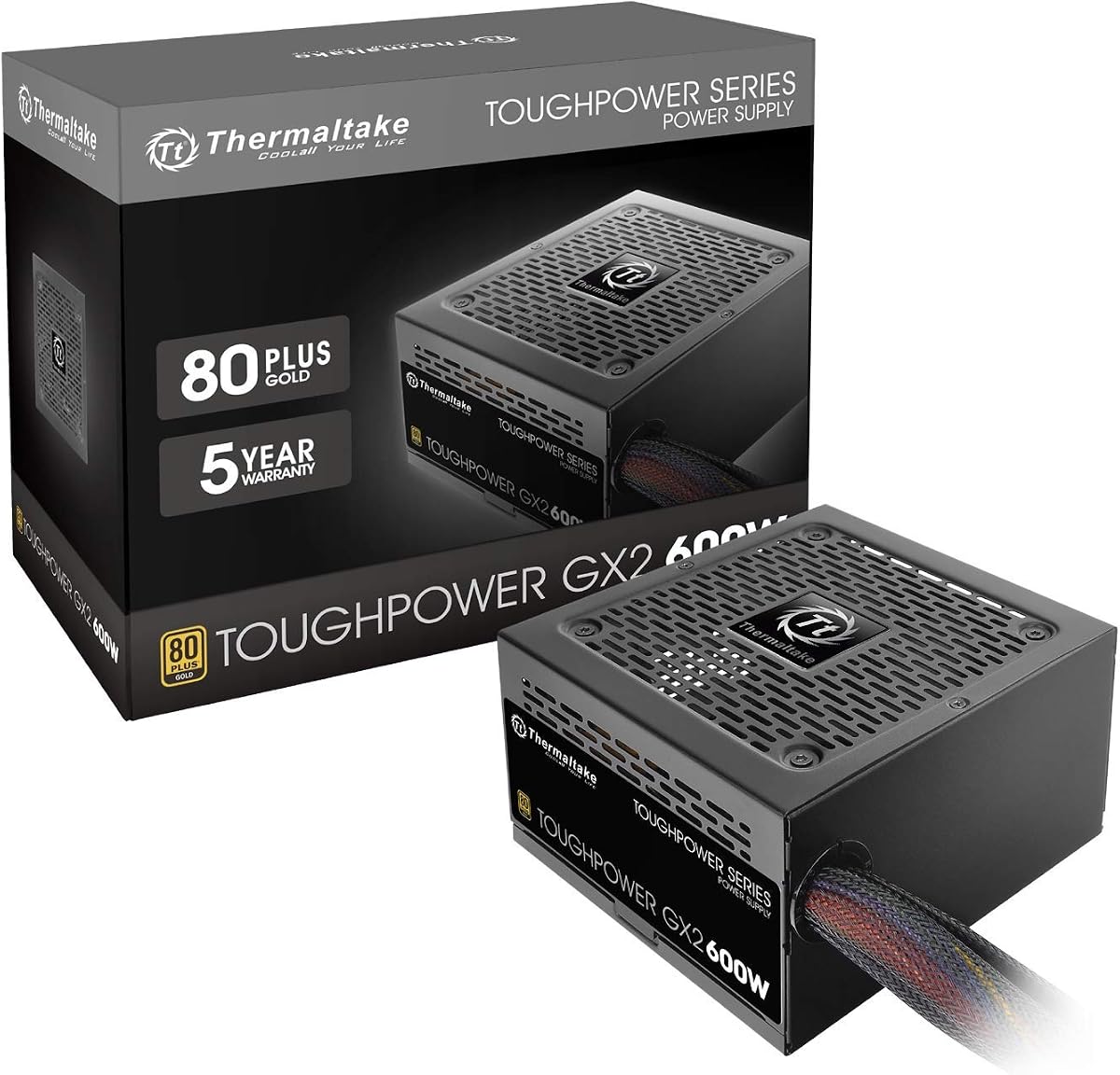
The Thermaltake Toughpower GX2 offers 600W of continuous power with 80 Plus Gold efficiency of up to 90%. Its 4.6 customer rating makes it a credible option for midrange gaming PCs and workstation configurations that do not require an 850W unit. The five-year warranty and SLI/Crossfire-ready positioning add flexibility for compatible multi-GPU builds.
We may earn a commission when you buy through this link, at no additional cost to you.
The supply uses a single +12V rail with DC-to-DC conversion, supporting stable delivery to demanding graphics cards and other 12V-focused components. Low-ripple noise is another notable strength because cleaner output can help performance-sensitive hardware operate reliably. Industrial-grade protections cover over-power, over-voltage, under-voltage, and short-circuit conditions, adding practical safeguards.
The primary compromise is its non-modular cable design. Every necessary lead remains attached, so excess cables must be gathered and hidden behind the motherboard tray or elsewhere in the case. The ATX 12V V2.4 and EPS V2.92 platform designation also places it behind newer ATX 3.1 units in terms of contemporary GPU transient specifications. Its two PCIe 6+2-pin connectors may be more appropriate than a native 12V-2×6 connection for older GPUs.
The Toughpower GX2 is best for a builder who values 600W capacity, efficient operation, and proven protections without needing the newest connector standard. It is less attractive for a compact showcase build where visible excess wiring would be undesirable. It also deserves careful consideration for any modern GPU whose manufacturer specifies ATX 3.1 power delivery.
A single high-amperage +12V rail gives compatible graphics cards and other major components a dependable source of power. The stated DC-to-DC design supports stable conversion across the unit's operating range.
Over-power, over-voltage, under-voltage, and short-circuit protections provide multiple layers of operational safeguards. Low-ripple output further supports the unit's suitability for performance-oriented desktop builds.
We may earn a commission when you buy through this link, at no additional cost to you.
The be quiet! Pure Power 13 M 850W is designed for builders who prioritize silence and efficiency. Its supplied specifications list up to 94.4% efficiency, ATX 3.1 support, full modularity, a native 12V-2×6 connection, and semi-passive cooling that stops the fan completely under low load. Its 4.6 customer rating indicates strong overall reception.
We may earn a commission when you buy through this link, at no additional cost to you.
The efficiency target distinguishes this model within the roundup. Lower conversion losses can contribute to cooler and quieter operation, while semi-passive zero-RPM cooling prevents fan noise during light tasks. An airflow-optimized be quiet! fan and LLC topology add further support for quiet operation and voltage regulation. These qualities make the PSU especially attractive for a silent workstation or restrained gaming system.
Power delivery remains a major strength. The unit provides 850W of continuous power on one massive 12V rail and can handle excursions up to double its rated power according to the supplied information. It includes a native 12V-2×6 connection for compatible next-generation cards plus four PCIe 6+2-pin connectors for supported current-generation graphics cards. Builders should count connector types carefully if they own a GPU requiring several conventional leads.
The Pure Power 13 M is a compelling recommendation for quiet builds that want modern transient support without sacrificing modularity or efficiency. Its stated maximum efficiency may occur only at particular load levels, so the 80 Plus Gold certification remains the more practical basis for comparison. Confirm cable compatibility and case clearance before purchase, then use the appropriate native connection with a supported graphics card.
Semi-passive zero-RPM cooling stops the fan when low load does not require active cooling. Once demand rises, the optimized fan resumes operation, making the unit well suited to quiet computing and media-creation environments.
The stated efficiency of up to 94.4% can reduce heat and fan activity, while ATX 3.1 compatibility and transient handling support modern high-load platforms. A single 12V rail also simplifies power distribution across major components.
We may earn a commission when you buy through this link, at no additional cost to you.
The Thermaltake GF1 combines an 850W rating with full modularity, Gold efficiency, and fan-focused design. Its 4.4 customer rating is the lowest in this group, yet the supplied specifications show a capable design for gaming PCs and workstations, including a 140mm fluid bearing fan, Smart Zero Fan mode, and a high-amperage single +12V rail.
We may earn a commission when you buy through this link, at no additional cost to you.
The oversized 140mm fan can move air effectively while operating at a comparatively low speed, supporting the unit's ultra-quiet positioning. Smart Zero Fan mode minimizes unnecessary sound under lighter loads. Intel C6/C7 state and ErP readiness indicate attention to low-power behavior, while the DC-to-DC single-rail design focuses dependable power delivery on modern 12V equipment.
Fully modular cabling is a meaningful convenience for builders who want a clean case. It allows unused leads to remain out of the chassis, reducing visual clutter and potentially improving airflow. Industrial-grade protections add reliability safeguards, although the supplied listing does not detail the same modern transient-handling platform or native 12V-2×6 emphasis found among several newer rivals.
The GF1 is most appropriate for a builder seeking 850W capacity, quiet cooling, and modular wiring at a value-oriented position. It is less compelling when the graphics card requires a native 12V-2×6 cable or strict ATX 3.1 behavior. Check the complete cable inventory, connector dimensions, and graphics-card recommendations before ordering.
The 140mm fluid bearing fan is designed to move substantial airflow with low acoustic output. Smart Zero Fan control further reduces noise during lighter workloads when active cooling is unnecessary.
A high-amperage single +12V rail with DC-to-DC conversion gives modern components a consistent power source. Full modularity keeps unused cables out of the chassis and simplifies visual maintenance.
We may earn a commission when you buy through this link, at no additional cost to you.
The CORSAIR RM850x combines 850W of capacity with a premium cable treatment and modern ATX 3.1 support. Its 4.7 customer rating places it among the strongest-rated products here, while Cybenetics Gold certification of up to 91% efficiency, full modularity, a native 12V-2×6 connector, and low-profile cable combs define its appeal.
We may earn a commission when you buy through this link, at no additional cost to you.
The embossed cables are ultra-flexible and are paired with low-profile combs, improving both installation and presentation. Because every cable is detachable, builders can use only what the system needs, while the streamlined combs help keep a modular bundle tidy. This makes the RM850x especially attractive for builds in which visible cable quality matters as much as performance.
ATX 3.1 compliance provides support for PCIe 5.1 platforms and helps the unit resist transient power spikes from a GPU. The native 12V-2×6 connector enables a direct connection to compatible newer graphics cards without an adapter. Cybenetics Gold efficiency of up to 91% also means lower power consumption, less heat, and potentially lower fan activity than less efficient designs.
The RM850x is an attractive premium choice for a polished modern gaming PC, particularly when aesthetics and cable presentation are priorities. Its efficiency rating is not as high as the be quiet! Pure Power 13 M's stated maximum, but it combines strong efficiency with premium cabling and current platform support. Confirm the exact included cable lengths and case-routing space before installation.
Embossed ultra-flexible cables and low-profile combs create a polished finish while keeping connections manageable. Full modularity removes unnecessary leads and leaves more room for airflow and visual organization.
ATX 3.1 compliance helps the PSU accommodate transient spikes from current graphics cards. A native 12V-2×6 connector offers a clean direct route for compatible cards without relying on a bulky adapter.
We may earn a commission when you buy through this link, at no additional cost to you.
The Cooler Master MWE Gold 750 V3 offers 750W of continuous power with 90% Gold efficiency and PCIe 5.1 readiness. Its 4.6 customer rating reflects a favorable reception, while ATX 3.1 support, a durable 90-degree 12V-2×6 cable, and an emphasis on thermal performance make it relevant for contemporary gaming systems.
We may earn a commission when you buy through this link, at no additional cost to you.
The right-angle 12V-2×6 connector is designed to improve electrical durability and safety while helping with cable routing in tight spaces. Its ATX 3.1 cable specification can deliver up to 450W to the GPU, a useful capability for compatible cards with substantial power requirements. This approach helps the 750W model serve systems that might otherwise appear better matched to an 850W supply.
Cooling is handled through a hexagonal fan cover with an 80% airflow intake and a dedicated heat sink. These features are intended to improve thermal performance and keep the unit operating at lower temperatures. Gold-level efficiency at 90% also helps limit power loss and heat generation, complementing the physical cooling design.
The MWE Gold 750 V3 is well suited to a modern gaming PC where 750W is sufficient and the builder values current connector standards. It is a less obvious fit for heavily overclocked systems or power-hungry multi-GPU configurations that may benefit from more capacity. Since the supplied specifications do not explicitly identify the cable layout as modular, buyers should check the connector inventory and cable configuration before purchase.
The 90-degree 12V-2×6 connector can improve routing in crowded cases while supporting up to 450W GPU delivery. ATX 3.1 compatibility makes the unit appropriate for modern platform requirements.
A hexagonal fan cover, 80% airflow intake, and a dedicated heat sink are designed to improve cooling around the power electronics. This works alongside 90% Gold efficiency to limit wasted energy as heat.
We may earn a commission when you buy through this link, at no additional cost to you.
The EVGA SuperNOVA 850 G+ earns the highest customer rating in the roundup at 4.8 and stands out for its 10-year warranty. It delivers 850W of continuous power, 80 Plus Gold efficiency, full modularity, a 135mm fluid dynamic bearing fan, and a comprehensive set of electrical protections. The included power-on self tester is a distinctive practical addition.
We may earn a commission when you buy through this link, at no additional cost to you.
Gold certification provides the stated efficiency of 90 percent with 115-volt AC input and 92 percent with 220-volt AC through 240-volt AC under typical loads. Full modular cabling keeps unused leads out of the chassis, while the fluid dynamic bearing fan supports smooth, durable cooling. The broad protection package covers over-voltage, under-voltage, over-current, over-power, short-circuit, and over-temperature conditions.
This model's principal limitation is its older design generation. Although the capacity and efficiency remain relevant, the supplied specifications do not mention ATX 3.1 certification, PCIe 5.1 transient handling, or a native 12V-2×6 connector. Builders using a modern GPU that specifically requires those standards should verify whether an appropriate adapter or alternative cable is permitted by the GPU manufacturer.
The SuperNOVA 850 G+ is the premium recommendation for buyers who prioritize long warranty coverage, a strong customer rating, and established modular functionality. It is especially attractive for a traditional high-performance gaming PC built around an 850W-class GPU. Verify modern connector requirements and current manufacturer support before ordering, since the product's age makes platform details more important than usual.
A 10-year warranty is a major advantage for a component expected to remain inside a desktop for many years. It gives the model a clear premium position alongside the MSI MAG A850GL PCIE5.
Over-voltage, under-voltage, over-current, over-power, short-circuit, and over-temperature protections provide broad coverage. The built-in self tester also offers a convenient way to confirm basic operation.
We may earn a commission when you buy through this link, at no additional cost to you.
The CORSAIR RM850e (2023) combines 850W capacity, 80 Plus Gold efficiency, ATX 3.1 certification, and PCIe 5.1 compliance in a proven fully modular design. Its 4.6 customer rating indicates a well-regarded unit, particularly for builders who want modern transient handling without moving beyond the familiar RM850e family.
We may earn a commission when you buy through this link, at no additional cost to you.
ATX 3.1 certification supports GPUs that produce brief power excursions, while the listed PCIe 5.1 compliance aligns the unit with current platform expectations. A 120mm rifle bearing fan uses a specially calculated fan curve to reduce noise, even under full load. The 105°C-rated capacitors are intended to provide steady electrical performance and dependable operation over time.
Modern Standby compatibility is another useful feature, offering fast wake-from-sleep behavior and better low-load efficiency. Fully modular cabling allows the installer to connect only the leads needed by the system, simplifying routing and reducing clutter. This combination makes the RM850e effective for both gaming machines and work-oriented PCs that spend time in sleep or standby states.
The main consideration is that the 2025 RM850e in this guide provides updated product positioning and explicitly notes support for two transient excursions. Buyers should compare the current specifications and included cables of both versions before deciding. Nevertheless, the 2023 model remains a strong fit for an 850W modern gaming PC that values modularity, low noise, and reputable component specifications.
The RM850e's modular approach reduces unused wiring and makes it easier to service or upgrade a system. Its 850W rating offers useful capacity for a broad range of modern gaming and productivity builds.
Modern Standby support enables rapid wake-from-sleep behavior and better efficiency at light loads. This makes the unit more convenient for systems used intermittently rather than running continuously.
We may earn a commission when you buy through this link, at no additional cost to you.
Choosing a Gold-rated power supply requires more than comparing wattage and efficiency logos. The right unit must fit the case, support the graphics card, provide enough clean power, and match the builder's noise and cable-management priorities.
Start with the combined power demands of the processor, graphics card, memory, drives, fans, and expansion devices, then leave sensible headroom for transient loads and future upgrades. A 600W unit can suit a modest gaming PC, while 750W provides a useful middle ground for many performance systems. An 850W model gives compatible high-end GPUs and power-hungry processors more room without stepping into much larger supplies. Do not rely on peak wattage alone; continuous output quality and connector limits matter just as much.
Choose the lowest capacity that comfortably covers your actual hardware and likely upgrades. A correctly sized unit is easier to run efficiently and may offer more appropriate fan and acoustic characteristics than an unnecessarily oversized model.
Modern graphics cards can create short power excursions, and ATX 3.1 power supplies are designed around that behavior. If your GPU manufacturer recommends ATX 3.1 or a native 12V-2×6 connection, prioritize a unit that provides it. A native cable also reduces clutter, but compatibility must be checked carefully because cable designs and GPU connector instructions can vary. Older ATX 12V or non-modular units may still work with some hardware, yet they offer less margin for current transient-intensive platforms.
For a new build centered on a modern GPU, ATX 3.1 support is usually the safer specification. Treat the graphics-card manufacturer's power guidance as the deciding factor rather than assuming every 850W unit is equivalent.
80 Plus Gold indicates that the supply operates above defined efficiency thresholds under standardized test loads. Higher efficiency generally means less energy is lost as heat, which can reduce internal temperatures and help the fan operate more quietly. Some products are also certified under standards such as Cybenetics, and one unit in this guide advertises a higher maximum efficiency. These figures occur at particular loads and should not be interpreted as constant performance, but they can help distinguish models within the same Gold category.
Prioritize reliable Gold certification over a single headline efficiency number. Good thermal design, fan quality, and the ability to remain fully passive under light loads are equally important parts of a quiet system.
A non-modular PSU keeps every cable permanently attached, which can make a small case crowded and leave excess wiring to conceal. A fully modular unit lets you install only the leads needed by your components, improving airflow and visual cleanliness. Semi-modular designs sit between these approaches, with a permanently attached bundle and optional detachable peripheral cables. Cable quality, bend radius, connector length, and the presence of low-profile combs also influence how neatly a finished system looks.
For a new build, fully modular cabling is usually the most convenient choice. Ensure the included lead lengths suit your case and that the graphics-card cable can reach without forcing a tight bend.
Quiet operation depends on more than the bearing type listed in a specification. Fan diameter, curve, bearing design, internal thermals, and semi-passive behavior all influence sound. A large fan can move the required airflow at a lower rotational speed, while a well-designed fan curve delays audible activity until the PSU genuinely needs cooling. Some products stop completely under low load; others merely reduce speed. If silence is a priority, look for explicit zero-RPM or semi-passive operation and consider whether your workload keeps the system at low load.
A modest background fan under heavy graphics loads is normal, but unnecessary high-speed noise should not be. Read the product description carefully because terms such as ultra-quiet often describe only low-load behavior.
Count the connectors required by the graphics card, motherboard, storage devices, fans, and accessories. Pay particular attention to the number of PCIe 6+2-pin leads and whether a native 12V-2×6 cable is present. Also check the 24-pin motherboard connector, CPU power connector, SATA connectors, peripheral connectors, and any dedicated cable for a particular fan or accessory. Cables from different PSU brands and series should not be assumed to be interchangeable even when the connectors look similar.
Build a simple cable checklist before buying and compare it with the package contents. If a GPU requires multiple eight-pin connectors or a specific adapter arrangement, verify the required quantity and the permitted connection method.
A dependable PSU should include protections against common electrical faults, including over-voltage, under-voltage, over-current, over-power, short-circuit, and over-temperature conditions. Capacitor temperature ratings are another useful indicator, with 105°C-rated components commonly used in higher-quality units. Fan-bearing type, electrical layout, and manufacturer support also contribute to long-term confidence. These specifications do not guarantee failure-free operation, but they show how seriously a product approaches protection and component quality.
Look for a broad protection suite and reputable component specifications rather than relying on wattage alone. Long warranty coverage can add useful reassurance, although buyers should verify exclusions and regional service terms.
Power-supply dimensions matter because larger modular units may conflict with tight cases, drive cages, or cable-routing space. Check the physical length, width, and height rather than assuming all 850W models share a universal format. Warranty length can differentiate otherwise similar models: this roundup includes five-year, ten-year, and other coverage descriptions. Review the terms carefully if the PSU will remain in a system for many years or if you intend to transfer it to a future build.
Measure the available bay before ordering and confirm connector clearance around the PSU fan. A longer warranty is valuable, but correct fit, electrical compatibility, and cable access are the priorities.
Before installation, read the PSU manual and identify every connector required by the motherboard, processor, graphics card, storage, cooling system, and accessories. Compare the supplied cable inventory with that checklist. Never assume that a visually similar modular cable from another unit is safe to use; use only the cables specifically supplied for the power supply.
Install the unit in a clean, well-ventilated area with the fan oriented toward an unobstructed intake. Connect the motherboard and CPU power cables first, followed by storage and peripheral devices, and connect the graphics card last using its manufacturer-approved native cable or adapter method. Route wires carefully, avoid sharp bends, and secure connectors without using excessive force.
After assembly, inspect every connection and make sure no unused modular cable is stored near the PSU fan. Test the system under realistic load and listen for unusual fan or coil noise. Keep the PSU vents clear, use compressed air to remove accumulated dust, and check that all cables remain dry, undamaged, and free of excessive heat. For any electrical fault or unusual behavior, stop using the system and consult the manufacturer's support resources.
Yes, provided the unit has enough continuous capacity and supports the power requirements of the selected graphics card. For many current gaming systems, 750W is adequate, while 850W offers additional headroom for high-end GPUs and demanding processors. ATX 3.1 and native 12V-2×6 support are worth prioritizing for compatible modern graphics cards.
The difference is the amount of continuous power available to the PC. A 750W model may be enough for many mainstream gaming configurations, while an 850W model offers more room for a power-hungry graphics card, high-end processor, multiple drives, fans, and future upgrades. The correct choice depends on actual component requirements rather than the wattage label alone.
It is advisable for a new PC built around a current-generation GPU that recommends ATX 3.1 power. The standard addresses short-duration GPU power excursions and can be paired with a native 12V-2×6 connection. If the graphics-card manufacturer specifies another approach, follow that guidance and verify the PSU and cable compatibility before installation.
Fully modular units are usually easier to install cleanly because unused cables can be left out of the chassis. They can improve visual organization and potentially leave more room for airflow. A non-modular PSU can still perform perfectly well, but its permanently attached leads may be harder to conceal in a compact or display-focused system.
It means the power-supply fan can remain stopped during light demand and start only when internal temperatures or load require active cooling. The behavior is especially useful in quiet office PCs and lightly loaded gaming systems. Under substantial graphics or processor workloads, the fan may run continuously, so the overall acoustic design still matters.
No. Modular power-supply cables may look interchangeable but can have different pinouts, conductor gauges, and connector designs. Use only the cables supplied with the specific unit, and consult its manual and the component manufacturer's instructions if an adapter or alternate connection is required.
Not necessarily. A correctly sized unit adjusts its conversion efficiency to the load, so a larger supply does not automatically consume more power than a smaller one. Choose adequate capacity with sensible headroom rather than selecting the highest available wattage without a reason.
Inspect it whenever the case is opened and clean dust if airflow appears restricted. A computer in a clean environment may need little attention, while systems in dusty or pet-heavy spaces may require more frequent checks. Always disconnect power and use compressed air carefully so debris is not pushed deeper into the unit.
The CORSAIR RM850e (2025) is the most balanced editor's choice because it combines 850W capacity, ATX 3.1 certification, PCIe 5.1 readiness, modular cabling, quiet fan behavior, and 105°C-rated capacitors. The Thermaltake Toughpower GT 850W stands out as the budget pick for its native 450W connector and modern modular design, while the EVGA SuperNOVA 850 G+ leads the premium group with its 4.8 rating and 10-year warranty.
Prioritize ATX 3.1 support and the correct GPU cable when building around a modern graphics card. After that, confirm continuous capacity, connector inventory, case dimensions, fan behavior, electrical protections, and warranty terms. Smaller systems may need only 600W or 750W, while higher-power gaming PCs generally benefit from 850W and meaningful headroom.
Ratings and specifications can change as revised models enter the market, and current prices, availability, bundle contents, and warranty terms should be checked at the time of purchase. The links in this guide provide convenient access to the listed products, but the final choice should reflect the complete needs of your motherboard, processor, graphics card, case, and planned upgrades.