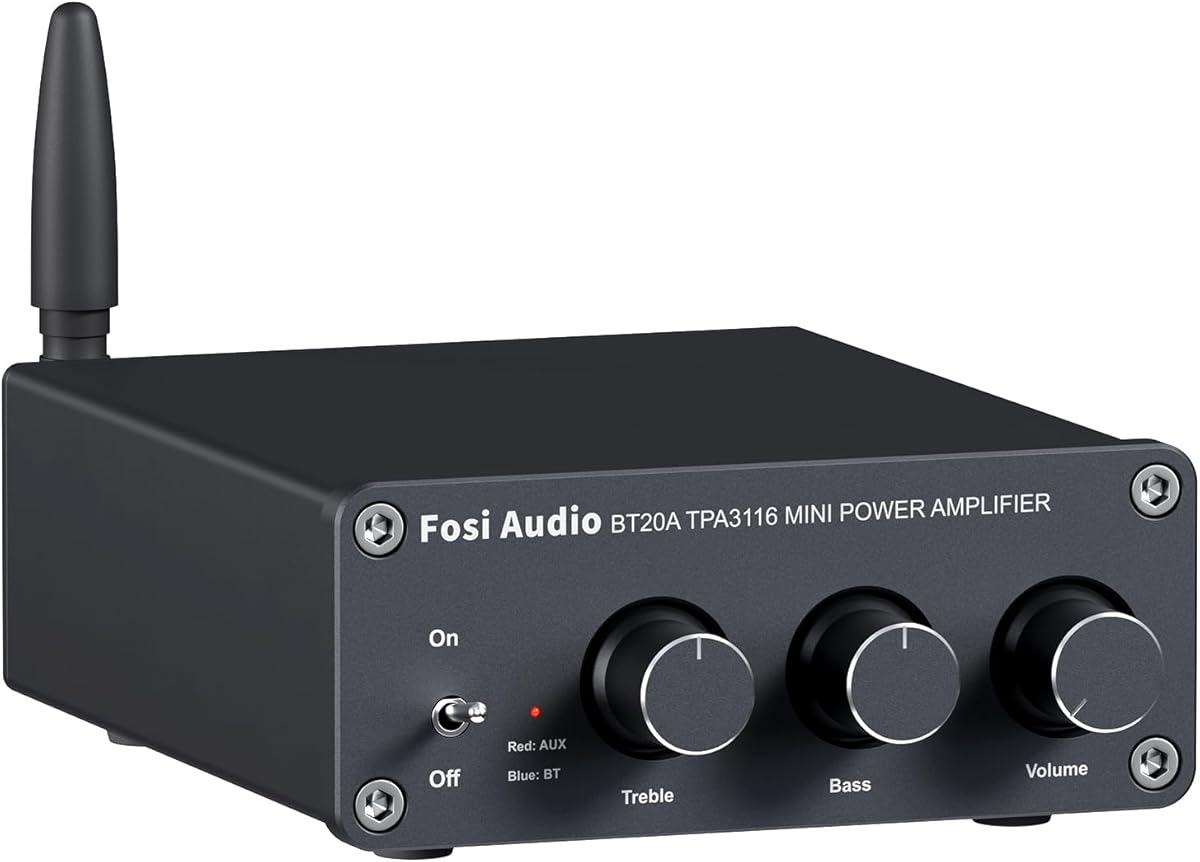
Fosi Audio BT20A
4.5Editor score
100 watts per channel
Bluetooth and RCA inputs
Compact all-black enclosure
Explore the best amp for bookshelf speakers with ten expert-compared models covering power, connectivity, sound controls, compactness, and system flexibility.
A capable amplifier can transform a pair of passive bookshelf speakers into a complete, satisfying stereo system. The right model should deliver adequate power, accept the sources you actually use, provide useful tone controls, and fit naturally into your room. It should also be simple enough for everyday listening without hiding the strengths of the speakers themselves.
This guide compares ten compact amplifiers using the specifications and features supplied for each model. We look at channel power, speaker compatibility, wired and wireless inputs, DAC functions, headphone support, tone shaping, physical size, and useful extras such as triggers, remote controls, pre-outs, and subwoofer integration. The list covers models for simple hi-fi systems, streaming, home theater, and more specialized listening setups.
Each pick highlights a different practical advantage, from straightforward Bluetooth amplification to tube warmth, streaming control, balanced connections, and configurable filtering. Ratings reflect the supplied customer feedback, while technical claims come from the product descriptions. Product prices and availability change, so compare the current listing, connector requirements, and speaker specifications before purchasing.
4.5Editor score

4.5Editor score

4.4Editor score
The comparison below highlights each amplifier's most important characteristics, including rated power, source options, system features, and physical design. Use it to narrow the field before reading the detailed reviews.


The Fosi Audio BT20A is a straightforward entry point for anyone wanting to drive passive bookshelf speakers without assembling a complicated separates system. It carries a supplied rating of 4.5 and combines a compact Class D design with a stated maximum output of 100 watts per channel. Its appeal comes from the balance between useful power, straightforward operation, and a small footprint.
We may earn a commission when you buy through this link, at no additional cost to you.
Bluetooth streaming and an RCA input cover the two most common listening arrangements. A phone can send music wirelessly, while a streamer, CD player, computer, or other line-level source can use the wired connection. Separate bass and treble controls let listeners shape the output, and the one-touch power switch keeps daily operation uncomplicated. The all-black enclosure is designed to sit neatly on a shelf beside passive speakers.
The main limitation is its deliberately simple feature set. There is no balanced input, HDMI ARC, integrated DAC, multi-room control, or advanced filtering. Compared with feature-heavy streaming amplifiers, the BT20A offers less control over source switching and room setup. Nevertheless, it addresses the fundamentals cleanly: sufficient rated power for bookshelf speakers, familiar analog input, convenient wireless playback, and basic tonal adjustment.
This is the most accessible recommendation for a first amplifier, a secondary room, or listeners who want a compact Bluetooth amplifier rather than a network-heavy centerpiece. It is particularly suitable for a straightforward two-speaker setup with passive bookshelf models and a nearby phone or streamer. Choose it when ease of use and compactness matter more than extensive connectivity or automated room correction.
Bluetooth makes the BT20A particularly convenient for everyday music, while RCA preserves a direct path for existing analog components. Having both options means the amplifier can serve casual streaming and a more permanent hi-fi setup without requiring extra network hardware.
The mini enclosure leaves room for the speakers rather than the electronics, making this model suitable for apartment living, offices, bedrooms, patios, garages, and other spaces where a full-size receiver would be cumbersome.
We may earn a commission when you buy through this link, at no additional cost to you.
The Fosi Audio MC331 combines a tube preamp, digital-to-analog converter, stereo power amplifier, and headphone amplifier in one compact component. Its supplied 4.4 rating reflects a feature-rich design aimed at listeners who want a visually engaging centerpiece and several source options. The maximum output is listed at 105 watts per channel at four ohms, making it suitable for driving bookshelf speakers.
We may earn a commission when you buy through this link, at no additional cost to you.
Source flexibility is the MC331's defining strength. Bluetooth, USB, coaxial, optical, and RCA inputs support computers, phones, CD players, and turntables with built-in phono preamps. A pre-out allows the unit to serve as a source for another amplifier, while the 3.5mm headphone output adds private listening. The remote control handles source selection and bass or treble adjustments from across the room.
Its visual design is as important as its connectivity. Visible vacuum tubes and a VU meter give the amplifier a warm, retro appearance that contrasts with the minimalist look of most Class D components. The replaceable tube design also lets owners alter the sound signature. Those same visual and tonal choices make it less appropriate for someone who wants an invisible, purely functional black box.
The MC331 is best for a dedicated hi-fi shelf system built around one or two passive speakers, a digital source, and careful component matching. It suits listeners who value DAC performance, tube presentation, and a broad input selection in a single enclosure. Those seeking only Bluetooth convenience or a streaming-focused amplifier may find simpler options easier to operate.
The integrated DAC removes the need for a separate converter when using compatible digital sources. USB, optical, coaxial, Bluetooth, and RCA make it easier to build a flexible system without filling the shelf with unnecessary boxes.
Visible tubes and a working-style VU meter give the amplifier a distinctive character, while replaceable tubes and remote tone adjustment provide more involvement than a basic Bluetooth mini amplifier.
We may earn a commission when you buy through this link, at no additional cost to you.
The Fosi Audio V3 is our editor's choice for listeners who want serious power and component-level flexibility in a compact stereo amplifier. It has a supplied rating of 4.5 and is built around the TPA3255 Class D chip, with the product description citing output capability up to 600 watts. That headline figure should be considered alongside the amplifier's stated specifications and the requirements of the speakers being connected.
We may earn a commission when you buy through this link, at no additional cost to you.
Its internals are designed to appeal to enthusiast-minded buyers. The description highlights Japanese NCC, ELNA, and German WIMA capacitors, Japanese Sumida inductors, a signal-to-noise ratio up to 110 dB, and SINAD up to 88 dB. Socketed 8-pin dual op-amps can be replaced with several compatible families, allowing the sound character to be adjusted over time.
Thermal design is another standout feature. Vents at the top and bottom combine with a whole-body heatsink to move heat away from sensitive components. That design supports the V3's higher-power positioning while preserving a small footprint. The optimized pre-out also follows the main volume control, which makes it easier to connect an active subwoofer, active speakers, or another power amplifier.
The V3 is a strong all-around recommendation for a serious passive bookshelf system that needs more headroom than a basic mini amp. It works particularly well for buyers who appreciate op-amp customization and high-power Class D design. Its limitations are the need for an external power supply and a relatively simple input selection, so network streamers and TV users may need additional equipment.
The V3 delivers an unusually ambitious power specification for an enclosure this compact. It is a strong match for a two-channel setup where the speakers benefit from greater dynamic headroom or where one amplifier needs to serve a larger listening area.
Swappable op-amps let owners move beyond the supplied configuration without replacing the amplifier. This is a meaningful advantage for listeners who enjoy comparing circuit changes, though first-time buyers can simply use the included components.
We may earn a commission when you buy through this link, at no additional cost to you.
The Fosi Audio BT20A Pro upgrades the basic concept of the original BT20A with Bluetooth 5.0, a TPA3255 amplifier chip, and a stated 300-watt-per-channel output. It has a supplied rating of 4.4 and combines wireless convenience with a more enthusiast-oriented design. It is a logical choice for a compact bookshelf system that wants more rated power than the entry model.
We may earn a commission when you buy through this link, at no additional cost to you.
Bluetooth pairing includes useful conveniences such as a memory function, an alert tone, and a reset procedure performed by holding the volume control. A signal-to-noise ratio of at least 108 dB and total harmonic distortion of no more than 0.005% are listed in the product description. These figures indicate that the manufacturer is positioning the Pro as a low-noise, low-distortion source for home audio.
Like the V3, the BT20A Pro accepts replaceable plug-in op-amps. Supported options include the LME49720HA, MUSES02, OPA2604AP, OPA2134PA, LM4562, and NJM4556AD. Bass and treble controls provide straightforward tonal shaping, and the supplied package includes the amplifier, Bluetooth antenna, 32-volt power adapter, AC cord, and manual.
It is best for a listener who wants wireless playback plus more power and circuit customization than the standard BT20A. The lack of USB, optical, coaxial, HDMI, and balanced connections keeps it from being the best central hub for a broad entertainment system. For a two-speaker shelf setup, though, those omissions may matter little.
The pairing memory and dedicated reset process simplify daily use. That makes the amplifier easier to treat as a regular part of a home audio setup rather than a device requiring repeated configuration.
The TPA3255 platform and replaceable op-amps provide a more advanced foundation than a basic entry amplifier. Users can keep the supplied circuit or experiment with alternative dual op-amps for a different sound signature.
We may earn a commission when you buy through this link, at no additional cost to you.
The Fosi Audio TB10D is a versatile mini power amplifier built around the TPA3255 chip and rated by the manufacturer at 600 watts across two channels. Its supplied customer rating is 4.5. The design is aimed at listeners who want enough stated power for bookshelf speakers and the option to add a bass shaker to a compatible home theater or gaming setup.
We may earn a commission when you buy through this link, at no additional cost to you.
The amplifier uses RCA input and passive speaker output, making it familiar to anyone assembling a conventional stereo system. Phones, computers, DVDs, CD players, PCs, laptops, and TVs can serve as line-level sources when their available outputs are appropriate. Built-in protection circuits are designed to support stable operation and help protect connected equipment.
Separate bass and treble knobs make daily adjustments direct, and a dedicated power switch adds convenience. The TB10D is more specialized than many of the other models here because its bass-shaker support broadens its use beyond traditional two-channel music listening. It can also serve as a desktop amplifier, home theater component, or compact power stage.
The lack of wireless and digital inputs makes it less appealing as the sole hub for a modern entertainment system. A separate streamer or Bluetooth receiver can fill that gap. For an owner focused on passive speakers, analog sources, tactile controls, and flexible sub-bass integration, the TB10D remains a practical and well-rated option.
The ability to work with a bass shaker gives the TB10D an angle that many compact amplifiers lack. It can complement front speakers and powered subwoofer arrangements without requiring a full-size surround receiver.
RCA input, physical tone knobs, and a front power switch create an uncomplicated path for familiar analog components. The amplifier is easy to integrate when the rest of the system is already built around line-level connections.
We may earn a commission when you buy through this link, at no additional cost to you.
The WiiM Amp is the most comprehensively connected amplifier in this guide and carries the highest supplied rating at 4.6. It combines a compact enclosure with 60 watts per channel at eight ohms and 120 watts per channel at four ohms, enough for many passive bookshelf speakers. Its real distinction is the integration of streaming, television audio, voice control, and multiroom functions.
We may earn a commission when you buy through this link, at no additional cost to you.
The WiiM Home App supports major music services, room-by-room management, favorites, alarms, EQ, and speaker synchronization. Voice commands are available through Alexa, Google Assistant, and Siri, and an included remote offers hands-free control. Playback specifications reach up to 24-bit/192 kHz from supported services or a personal library, with gapless playback and advanced room correction.
HDMI ARC makes the amplifier useful for television programs, films, and games in addition to music. A powered subwoofer can be added for more low-frequency impact. The WiiM Home ecosystem also supports multiroom audio with AirPlay 2 speakers, Amazon Echo, Google Home, and other WiiM devices. One important limitation is that the amplifier receives AirPlay but does not transmit AirPlay to other speakers.
This is the strongest recommendation for someone who wants a network-connected centerpiece rather than a simple power block. It is particularly suited to living rooms where the same speakers serve streaming and TV audio. Listeners who prefer only physical inputs and do not want an app-based setup will find less value in the additional connected functionality.
HDMI ARC allows a pair of passive bookshelf speakers to become a compact stereo television system. That makes the WiiM Amp more versatile than models designed exclusively around analog audio or phone-based Bluetooth playback.
The app-based ecosystem gives the amplifier broad service support, room correction, independent EQ, alarms, and multi-device coordination. It is a natural center for a connected household, although AirPlay is receive-only.
We may earn a commission when you buy through this link, at no additional cost to you.
The AIYIMA A07 Premium is a compact Class D stereo power amplifier designed for passive bookshelf speakers and desktop hi-fi systems. Its supplied rating is 4.4. It uses a Texas Instruments TPA3255 chip with integrated feedback and high-speed gate-driver error correction, while the enclosure incorporates Japanese ELNA capacitors, filter capacitors, and WIMA capacitors.
We may earn a commission when you buy through this link, at no additional cost to you.
The amplifier supports 2- to 8-ohm passive speakers and is rated for up to 600 watts by the manufacturer. The included 32-volt, 5-amp power adapter is included, while a 48-volt, 10-amp adapter is described as an optional upgrade for maximum stated output. Buyers should match the supply to the amplifier's requirements and avoid unsuitable industrial power units.
A 3.5mm auxiliary pre-out provides a full-range signal controlled by the main volume. It can feed active speakers, another power amplifier, or a powered subwoofer amplifier, making it possible to construct a 2.1-channel desktop system. The supplied NE5532 dual op-amps are replaceable with compatible OPA, LM, and MUSES series alternatives for owners who want to experiment.
The A07 Premium is best for a two-channel desktop or shelf system built around wired components. Its metal housing and op-amp flexibility provide enthusiast appeal, while the auxiliary pre-out broadens system-building options. It does not include Wi-Fi or Bluetooth, so a separate source or streamer is necessary for modern wireless listening.
The auxiliary pre-out makes it possible to add a powered subwoofer or additional active device without giving up the main stereo output. Its level follows the amplifier's volume control, reducing the need for separate preamp controls.
Socketed dual op-amps make internal experimentation possible without changing the main amplifier. This is especially attractive for hobbyists who understand the importance of matching component specifications and handling sensitive boards carefully.
We may earn a commission when you buy through this link, at no additional cost to you.
The Fosi Audio ZA3 is built for listeners who want balanced connectivity and the option to reconfigure a two-channel unit as a mono amplifier. It has a supplied rating of 4.5. In stereo mode, the description lists output up to 180 watts; in mono mode, maximum output rises to 235 watts. Two units can be combined in a mono configuration for a more substantial system.
We may earn a commission when you buy through this link, at no additional cost to you.
Its combo balanced input accepts XLR or quarter-inch TRS plugs, offering a professional-style connection that can reduce interference and help maintain a lower noise floor. A 12-volt trigger input synchronizes power-on and power-off behavior with other compatible equipment, reducing the need to operate separate components independently.
The TPA3255-based design includes Japanese NCC, ELNA, German WIMA, and Japanese Sumida components, with listed SINAD up to 89 dB and SNR up to 106 dB. The chassis is larger than the earlier mini designs, and side vents plus dust covers improve airflow. Five swappable op-amp positions cover the left and right outputs, balanced input, and subwoofer output.
The ZA3 is ideal for a dedicated stereo setup using a balanced source or for owners who may later want mono amplification. Its trigger input also makes sense in a larger system where power management matters. For casual Bluetooth listening, however, it lacks the convenience of the BT20A or WiiM Amp, and buyers must account for its external 48-volt supply.
The XLR and TRS input options allow compatible balanced sources to keep their signal path balanced. This can be valuable in systems where cable placement, interference, or a desire for professional-style connections matters.
Switching between stereo and mono modes lets one compact enclosure serve different roles. A second matching unit can create a dedicated mono pair, adding flexibility for larger or more specialized speaker arrangements.
We may earn a commission when you buy through this link, at no additional cost to you.
The Douk Audio D1 is a feature-rich compact amplifier that combines Bluetooth 5.2, a digital VU display, balanced input, a high-pass filter, tone controls, and a subwoofer pre-out. Its supplied rating is 4.4, and the product description presents it as an updated collaboration built on the Douk Audio A5. It is designed for listeners who want visible operation and extensive system integration.
We may earn a commission when you buy through this link, at no additional cost to you.
The OLED screen displays real-time information and offers seven VU styles in yellow, blue, or black. An adjustable high-pass filter from 30 to 200 hertz removes low frequencies from the main speakers, helping them focus on mids and highs in rooms where placement causes boominess. The separate pre-out delivers a full-range signal to active subwoofers, amplifiers, or active speakers.
Signal options include Bluetooth 5.2 and a TRS balanced input. A 12-volt trigger and infrared remote simplify control, while one-touch mute and a Bluetooth reset improve daily operation. Tone adjustment covers plus or minus 10 decibels. The design also includes internal RGB lighting, pluggable NE5532 op-amps, PFFB technology, a four-layer printed circuit board, and a GaN 48-volt power adapter.
The D1 is a good match for a modern bookshelf system that combines music with home theater. Its display and lighting make it visually engaging, while the high-pass filter and pre-out support proper subwoofer integration. The abundance of functions may feel excessive for a simple two-speaker setup, but owners who appreciate detailed control will find the feature set unusually complete.
The digital VU display provides immediate visual feedback while preserving a classic meter aesthetic. Multiple display styles and colors make it easier to match the amplifier to the room or distinguish operating states.
An adjustable high-pass filter can declutter the main speaker output, while the full-range pre-out supplies a dedicated subwoofer path. Together they support a more disciplined 2.1-channel bookshelf system.
We may earn a commission when you buy through this link, at no additional cost to you.
The Douk Audio A5 is a compact two-channel Class D amplifier with a stated 300 watts per channel and an adjustable 30-to-200-hertz high-pass filter. Its supplied rating is 4.3, the lowest among the ten products in this guide, but the feature set is focused rather than basic. It is designed for passive bookshelf speakers, home theater systems, and listeners who want control over low-frequency distribution.
We may earn a commission when you buy through this link, at no additional cost to you.
The high-pass filter is particularly useful when a powered subwoofer handles bass and the main bookshelf speakers should remain free of low frequencies. Removing unwanted energy can improve clarity in the midrange and give the subwoofer a more defined role. The amplifier also offers full-range pre-out functionality according to its broader platform, enabling more flexible system configurations.
A tempered glass access panel gives users quick access to the plug-in op-amp section without fully disassembling the unit. The description highlights Post-Filter Feedback technology, a four-layer immersion-gold printed circuit board, and an indicated total harmonic distortion of 0.002%. A 32-volt power supply is included, and internal LED lighting adds a decorative element.
The A5 is most suitable for a wired home audio or home theater setup where a subwoofer and compact bookshelf speakers form a 2.1 system. Its transparent panel and lighting suit living rooms and studios where the amplifier will be visible. It does not offer built-in Bluetooth, so users wanting wireless sources need a separate streamer or receiver.
The adjustable high-pass filter lets owners choose how much low-frequency energy reaches the passive speakers. That control is especially useful when a separate powered subwoofer is handling bass in a small room.
The tempered glass access panel simplifies op-amp replacement. This keeps the customization process more approachable while preserving the amplifier's clean, modern appearance.
We may earn a commission when you buy through this link, at no additional cost to you.
The right amplifier depends on your speakers, sources, room, and tolerance for technical complexity. Review power, impedance, connectivity, control features, and system role before choosing a model.
A useful starting point is to match the amplifier's continuous or clearly stated output to the speakers' recommended power range. Headline peak figures can look dramatic, so look beyond the largest number and consider impedance, test conditions, and your listening volume. Bookshelf speakers vary widely, and some small models are best served by modest amplification rather than an oversized power source.
Choose enough power for clean dynamics without stressing the speakers. In short: compare rated output with each speaker manufacturer's guidance.
Every speaker model in this guide is described as compatible with conventional passive bookshelf speakers, generally in the 2-to-8-ohm range depending on the amplifier. Confirm the impedance of both speakers and check whether they share a common rating. Some amplifiers behave differently at four ohms than at eight, and specifications based on one impedance may not apply to another.
Do not ignore impedance just because a connector fits. In short: verify load requirements and keep the amplifier within its stated operating range.
RCA is the common baseline for analog sources, while Bluetooth suits phones and casual listening. USB, optical, coaxial, HDMI ARC, and balanced inputs expand compatibility with computers, streamers, CD players, turntables with built-in phono preamps, and televisions. Network-connected models add app control, streaming services, room correction, and multiroom potential.
List every source you expect to connect before buying. In short: prioritize the connectors you will use rather than paying for features that remain unused.
An integrated DAC can simplify a digital system by accepting USB, optical, or coaxial audio and converting it to an analog signal for the power section. The Fosi Audio MC331 combines this function with a tube preamp and Bluetooth. A separate DAC may offer more flexibility, but it also requires another enclosure, power supply, and set of connections.
Decide whether the amplifier should be the system's central source or only its power stage. In short: an integrated DAC is convenient, while a separate DAC offers modularity.
Bass and treble controls are useful for broad preferences but are not a substitute for correct placement or speaker setup. A high-pass filter is more valuable when a powered subwoofer handles bass because it can remove low frequencies that cause main speakers to sound bloated. EQ and room correction in network amplifiers can address more complex spatial and tonal issues.
Use simple adjustments after the system is properly positioned. In short: prefer filters and correction tools that serve a clear purpose rather than excessive boosting.
Pre-out and subwoofer pre-out determine how easily an amplifier can participate in a larger system. A pre-out can feed another power amplifier or active speakers, while a dedicated subwoofer pre-out supports 2.1-channel music and theater. A 12-volt trigger can synchronize power with compatible equipment, reducing the need for separate switches.
Plan for realistic future needs rather than every possible scenario. In short: add pre-outs or triggers only when they solve a real integration requirement.
Bookshelf amplifiers often live beside the speakers they power, so size, ventilation, and appearance deserve attention. Compact Class D enclosures are easier to place, but a large external power supply may occupy nearly as much space. Models with visible tubes, illuminated meters, transparent panels, or RGB lighting create a stronger visual focal point than plain black or gray cases.
Consider how often you will change components or controls. In short: balance shelf space, cooling needs, appearance, and willingness to service internal parts.
A built-in headphone output can make a compact amplifier useful at a desk as well as beside speakers. Remote controls, source selection, one-touch mute, Bluetooth pairing memory, and alerts improve usability, while app-based management provides deeper control for streaming systems. Extra features are most valuable when they reduce friction in everyday operation.
Do not pay for complexity you will never use. In short: favor conveniences that improve your normal routine over isolated headline features.
Begin by checking each amplifier's manual for its power-supply requirements, speaker impedance range, connector layout, and ventilation guidance. Connect passive speakers with the power switched off, use good-quality speaker cables, and confirm that the left and right channels are connected correctly. Connect the source next, then power the amplifier on and begin with a moderate volume.
Place the amplifier on a stable, ventilated surface with clearance around vents and avoid enclosing it in a tight cabinet unless the manufacturer specifically permits it. Keep speakers at an appropriate distance from walls and listening position for the best starting point. If using a high-pass filter with a subwoofer, set the crossover thoughtfully and adjust it only after the basic system is working correctly.
For networked models, complete the app setup and software updates before judging performance. Save preferred EQ, volume, and source settings where supported. To clean a unit, switch it off, disconnect power, allow it to cool, and gently remove dust with a soft dry brush or microfiber cloth. Do not open a powered amplifier or touch exposed circuitry, particularly when upgrading socketed op-amps.
Passive bookshelf speakers need an amplifier that supplies power through their speaker-level terminals. The appropriate amount depends on the speaker's recommended power, impedance, sensitivity, room size, and the volume you normally play. A compact Class D model can work well with efficient nearfield speakers, while lower-sensitivity speakers or louder listening in a large room generally benefit from more amplifier headroom.
Yes, as long as the amplifier has a passive-speaker output and enough compatible power. Bluetooth handles the source connection, while the amplifier sends the received audio through its power section to the speakers. The Fosi Audio BT20A is a simple example, while the WiiM Amp adds network streaming, HDMI ARC, and app-based control for a more connected system.
Class D amplifiers are efficient, compact, and widely used for compact home audio systems. They can drive passive speakers effectively when their power and impedance specifications suit the speakers. The exact topology is less important than using a well-matched, adequately powered unit with clean signal handling.
A full-range pre-out sends the complete signal so another amplifier or active device can reproduce the entire program. A subwoofer pre-out is intended to feed bass content to a powered subwoofer. Some mini amplifiers also include a high-pass filter on the main speaker output so the passive speakers do not receive the lowest frequencies already handled by the subwoofer.
It depends on your sources. The speakers themselves do not require a DAC; a digital source does. If you only use analog components, no DAC is necessary. If you want to play digital music or video through the amplifier, an integrated DAC such as the one in the Fosi Audio MC331 can make the system simpler, while a separate DAC offers more source flexibility.
They are an enthusiast-oriented feature rather than a requirement for good sound. Socketed op-amps allow compatible circuit changes without replacing the amplifier, making models such as the Fosi Audio V3, BT20A Pro, ZA3, AIYIMA A07 Premium, and Douk Audio D1 appealing to hobbyists. Buyers without soldering experience should follow the manufacturer's instructions carefully.
Yes, if it has an appropriate pre-out or subwoofer output and can drive the two passive speakers while leaving bass management to a powered subwoofer. The TB10D supports bass-shaker arrangements, while the D1 and A5 emphasize high-pass filtering and subwoofer integration. Check the exact connectors and output level behavior before choosing.
It depends on how the system is used. Bluetooth is simple and effective for phone playback, while Wi-Fi models generally provide broader streaming-service support, higher-resolution network playback, app control, room correction, and multiroom features. The WiiM Amp is designed for the latter role, whereas the BT20A and BT20A Pro prioritize a smaller, simpler form.
The best choice depends on the system around it. The Fosi Audio BT20A is the simplest starting point, the V3 offers the strongest combination of compact power and enthusiast features, and the MC331 serves as the most complete premium centerpiece with an integrated DAC and tube presentation. The WiiM Amp stands apart for connected streaming, television integration, and multiroom functions.
Before purchasing, prioritize speaker compatibility, real-world power needs, source connections, and the role the amplifier will play. Balanced inputs, high-pass filters, subwoofer pre-outs, triggers, and replaceable op-amps matter only when they solve a present or likely future system requirement. Begin with reliable placement, suitable speaker cables, and moderate settings before making detailed tonal adjustments.
Ratings and product configurations provide a useful starting point, but current product details can change. Review the latest listing, included accessories, power-supply requirements, warranty information, and return terms at the time of purchase. Checking those details can prevent an otherwise capable amplifier from becoming a poor fit for the speakers and sources you already own.