
Mount-It! in-Wall TV Cable Concealer Kit
4.7Editor score
Recessed triple power outlet
ETL in-wall certification
Template and drywall saw included
Discover the best cable hider for wall mount TV options by comparing length, capacity, installation, paintability, and in-wall versus surface-mounted designs.
A wall-mounted television can look polished while the cables beneath it undermine the entire installation. A cable hider for wall mount TV keeps power, HDMI, Ethernet, and audio lines concealed while protecting them from accidental pulls, curious hands, and chewing pets. The best option depends on cable capacity, wall type, routing needs, and whether the wires will remain on the surface or travel behind it.
We compared ten cable-management products using their stated dimensions, installation methods, included components, compatibility details, and customer ratings. The list includes surface-mounted raceways, low-profile hinged covers, large-capacity channels, and in-wall kits with pass-throughs, recessed power, or cutting accessories. Each review highlights the product's strongest use case as well as the installation limitations that shoppers should consider.
The selections show that there is no single cable hider suited to every television wall. Compact units work well for short runs and a few cables, while larger raceways simplify complex entertainment systems. In-wall products deliver the cleanest result but require compatible walls and more involved installation. Ratings and product availability can change, so check the latest listing and current cost before making a final decision.
4.7Editor score

4.8Editor score

4.5Editor score
This side-by-side comparison distinguishes surface-mounted raceways from in-wall concealment kits, showing the supplied dimensions, cable capacity, installation requirements, and most relevant feature of every product.



The YesBes Cord Hider Kit is a 116-inch surface-mounted raceway system with a 4.4 customer rating. Its defining strength is the combination of multiple straight sections, couplings, two L-shaped elbows, and a T-fitting, which makes it practical for routes that turn corners or branch around a television wall. The channel measures 0.96 inches wide internally and 0.57 inches high internally.
We may earn a commission when you buy through this link, at no additional cost to you.
Installation is tool-free: the raceway uses strong adhesive and a tear-and-peel application, while the removable cover allows cables to be inserted after the channel is mounted. The kit can be shortened with scissors or a saw and painted to match the wall. Its UL94 V-0 flame-retardancy rating also makes it a reassuring choice for buyers who want a rigid, protective channel around household wiring.
The main limitation is capacity. A 0.96-inch internal width is adequate for several typical television leads, but it is less generous than the large raceways in this guide. The adhesive is also not suitable for textured walls, so buyers should verify the wall finish before installation. Removing a firmly mounted section may put more strain on the surface than leaving it in a planned position.
This is a good choice when you want a long, configurable surface route with corner pieces and do not need to route unusually thick bundles. Measure both your cables and the available wall space, plan the path before peeling the liner, and test an inconspicuous section if the wall has a delicate finish. It is especially suitable for hiding a few power, HDMI, and network cords below a mounted television.
The included couplings, elbows, and T-fitting allow the raceway to follow more than a straight line. That makes the kit useful behind televisions placed in corners or near entertainment equipment that requires several cable directions.
Because the cover can be cut and painted, the finished channel can blend into a light wall. Accurate planning is still essential, especially because relocating the adhesive raceway can affect the wall surface.
We may earn a commission when you buy through this link, at no additional cost to you.
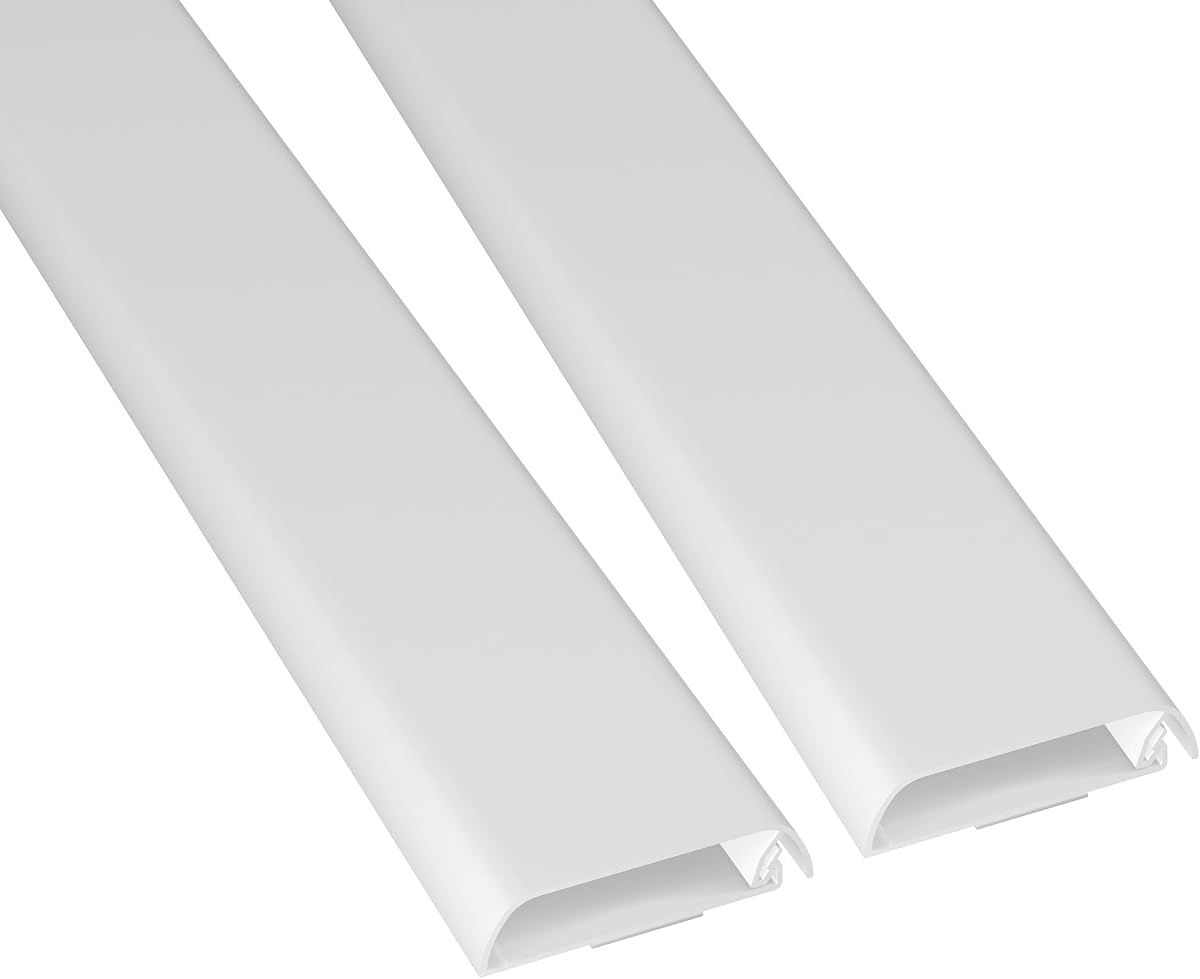
The D-Line TV Wall Mount Cord Hider has a 4.3 rating and emphasizes a refined, low-profile appearance. It includes two 15.7-inch sections for 31.4 inches of combined coverage. Each section measures 2.36 inches wide by 0.59 inches high and uses a concealed flexible hinge, allowing the lid to open without separating the entire cover from the wall.
We may earn a commission when you buy through this link, at no additional cost to you.
Its strongest feature is the click-lock lid. After cleaning the wall and applying the self-adhesive backing, the user can open the channel, place cords inside, and snap the cover shut. The smooth surface is designed to blend into the wall and can be finished with paint after light sanding and two coats. That makes the product a strong option for minimalist media walls where a bulky exposed box would be distracting.
Its dimensions deserve attention. The wide profile can accommodate a useful bundle, but the 0.59-inch height limits how many thick power adapters or oversized connectors can pass through the ends. The total coverage is also more modest than the 116-, 157-, and 306-inch kits in this guide. Buyers need to plan transitions into outlets and around the television mount rather than assuming every cord will fit.
Choose the D-Line when visual neatness is the priority and the cable run is relatively short or moderate. Confirm the depth of your plugs and the space behind the television before purchasing. It is especially useful for hiding a few standard HDMI and Ethernet cables where a flush-looking, paintable cover matters more than maximum routing length.
The flexible hinge keeps the cover attached while allowing repeated access. This is convenient when a cable needs to be added, removed, or replaced without taking the entire raceway off the wall.
The shallow 0.59-inch profile keeps the channel visually subtle beneath a mounted screen. Its width accommodates cables, but the available depth may not suit large power adapters.
We may earn a commission when you buy through this link, at no additional cost to you.
The Delamu 157-Inch Cord Hider combines extensive coverage with a straightforward snap-on cover. It has a 4.5 rating and uses a 0.95-inch internal width and 0.55-inch internal height. The product is described as suitable for organizing groups of approximately two to four television, power, speaker, network, and lamp wires.
We may earn a commission when you buy through this link, at no additional cost to you.
Its attach-and-snap structure makes routine cable changes more convenient than a permanently closed channel. The raceway can be cut to the desired length and painted to fit a minimalist interior. The supplied information also identifies a UL94 V-0 rating, adding a useful material-safety consideration for installation near entertainment equipment and other household wiring.
The trade-off is that this remains a surface-mounted solution, so even a paintable channel will be more noticeable than a truly in-wall installation. Its internal width is narrower than the options explicitly designed for three to five larger cables. Large adapter bodies or tightly bent bundles may require a roomier raceway, and the stated capacity is best treated as a guide rather than a guarantee for every connector size.
This product suits buyers who want a long, paintable route and anticipate changing cables over time. The snap-on cover is particularly helpful in offices and family rooms where equipment is frequently rearranged. For a wall with a complex entertainment system, measure the combined thickness of the cables and adapters first, then choose a route that keeps each connector from creating a tight bend.
The 157-inch total length can conceal a substantial run without the complexity of a large multi-room kit. It is useful along long media walls, below mounted televisions, and around home-office desks.
The snap-on lid can be opened whenever cables need to be adjusted. That flexibility is useful when devices, streaming hardware, or network connections change over time.
We may earn a commission when you buy through this link, at no additional cost to you.
The Delamu Large Cord Hider has a 4.6 rating and offers a wider internal channel than most of the standard raceways in the guide. Its 1.18-inch internal width and 0.67-inch internal height are intended to accommodate approximately three or four common TV, audio, network, HDMI, optical, and USB cables.
We may earn a commission when you buy through this link, at no additional cost to you.
The kit includes six raceway sections, allowing buyers to create a long, segmented route or distribute shorter pieces around entertainment furniture. Installation uses strong adhesive, while the cover supports both snap-on and slide-on handling. Once cables are placed inside, the channel can conceal them from view and reduce access to loose wiring around children and pets.
The product can be cut and painted to suit the room, but planning is especially important. The manufacturer recommends mapping the route before pressing the adhesive because repeatedly removing the tape may damage the wall. While the extra width improves cable capacity, the six sections may create more joints than are needed for a basic television installation.
This is a strong selection for shoppers with several substantial cables or a larger mounted television. It balances capacity, configurability, and tool-free installation without requiring wall construction. Check that the television is positioned high enough to provide access to the cover, and ensure every cable can enter and leave the channel without being sharply bent.
The larger internal dimensions are intended for groups of three or four wires. This makes the kit more appropriate for complex gaming, audio, and streaming arrangements than a very narrow channel.
Separate sections can cover a long media console, turn a corner, or conceal smaller cable clusters. They can be painted after cutting to fit the intended route.
We may earn a commission when you buy through this link, at no additional cost to you.
The TV Wire Hider Kit for Wall Mount TV has the highest customer rating in this comparison at 4.8. It is an in-wall cable-management solution designed to carry television, gaming-system, and entertainment-console wiring behind the wall. Two pass-throughs and a hole-saw drill attachment are included to support a more concealed installation.
We may earn a commission when you buy through this link, at no additional cost to you.
Its standout benefit is visual elimination. Instead of leaving a surface raceway below the television, the product is intended to create openings through compatible walls so cables can pass into the wall cavity. The supplied information specifies perforated walls with a thickness of 12 to 18 millimeters, including plaster or wood-plank constructions. Thicker hole-sawing and drilling accessories are designed to promote a close grommet fit.
This is not a no-drill product, and that distinction is important. The buyer must confirm the wall construction, locate a safe drilling area, and use the included attachment correctly. Installation should never interfere with wiring, plumbing, structural members, or other concealed services. The visual result can be excellent, but it involves more permanent modification than attaching a raceway to the wall.
The kit is best for homeowners or renters who have permission to modify a compatible wall and want the cleanest possible television installation. It is particularly appropriate when a surface-mounted channel would remain visible from normal viewing angles. Buyers should measure carefully, review the installation guidance, and consider professional help if they are uncertain about cutting into their wall.
Moving cables behind the wall removes the visible raceway from beneath the screen. The result is particularly effective on feature walls, compact media rooms, and setups viewed from multiple angles.
The stated 12-18 millimeter range is a meaningful restriction. Plaster and wood-plank walls fall within the listed examples, but other wall systems may not be suitable.
We may earn a commission when you buy through this link, at no additional cost to you.
The ECHOGEAR In-Wall Cable Management Kit has a 4.7 rating and focuses on a professionally styled television installation. It uses upper and lower pre-wired modules, each measuring 3.75 inches wide by 3.25 inches deep, to create a concealed route for power and low-voltage cables. The package includes a six-foot extension cord, a driver bit, and a drywall hole-saw attachment.
We may earn a commission when you buy through this link, at no additional cost to you.
Unlike a basic pass-through, this kit provides a pre-wired route and locking wall grommets. The stated cable capacity includes up to four large HDMI cables plus Ethernet and audio cords. Its ETL certification is an important feature for an in-wall power solution, while the paintable grommets help the finished wall remain visually consistent.
The main drawback is installation complexity. The modules require appropriate space between studs, and the hole must align with both the cable path and a safe location. The product is also positioned for a more involved project than adhesive raceways, so buyers should be comfortable with drilling and drywall work or use qualified installation help.
Choose this kit when a mounted television is a central feature of the room and the goal is to combine hidden power and data routing. It offers a particularly polished result for home theaters, living rooms, and finished media walls. Confirm the cavity dimensions, study the instructions, and avoid cutting near known electrical lines or plumbing before starting.
The pre-wired modules are designed to carry low-voltage connections while providing a dedicated extension cord for power. This reduces the number of visible paths around the television.
Locking wings secure the modules in the wall, and the paintable grommet surfaces are intended to blend into the surrounding finish after installation.
We may earn a commission when you buy through this link, at no additional cost to you.
The EVEO Cable Hider Wall 306 is the largest surface-mounted kit in the comparison, with twenty sections totaling 306 inches. Its 4.6 rating reflects a solution that extends beyond a single television wall. Each section measures 16 inches long with an internal width of 0.95 inches and height of 0.5 inches.
We may earn a commission when you buy through this link, at no additional cost to you.
The extensive coverage makes the kit appealing to households that want a consistent cable-management system across a living room, office, bedroom, or entertainment area. Installation can use tape or screws, providing more choice than products limited to adhesive mounting. The low-profile channel is paintable and designed to conceal multiple cables while protecting them from pets and accidental contact.
Its scale can work against the buyer. A 306-inch system is excessive for one small television, and twenty sections mean more joints to position. The channel is also relatively narrow, so thick adapters, tightly bundled cables, or high-speed Ethernet cables with large connectors may need more space than the listed dimensions suggest.
This is best for a large home with several cable routes, or for an installer seeking a repeatable surface raceway system. For a single mounted television, choose only the number of sections actually required. Confirm the wall surface before choosing between tape and screws, and use screws only where drilling is permitted and structurally appropriate.
The twenty-piece kit can support cable routes in several rooms or along extensive entertainment walls. It is overkill for a compact installation with only a few short cords.
The raceway may be secured with tape or screws, giving homeowners flexibility according to the wall material and the permanence they want.
We may earn a commission when you buy through this link, at no additional cost to you.
The Mount-It! In-Wall TV Cable Concealer Kit has a 4.7 rating and combines hidden low-voltage routing with a recessed triple power outlet. The spacious opening is designed for multiple HDMI, Ethernet, and audio cables, while the larger wall plate provides space for the recessed power connection and wiring behind the television.
We may earn a commission when you buy through this link, at no additional cost to you.
The kit includes two wall plates, a nine-foot extension power cord, a drywall saw, a cutting template, screws, and instructions. Because the power cord plugs into an existing outlet rather than requiring a hard-wired connection, it is presented as a practical plug-in route. ETL In-Wall Certification provides an important safety distinction for a product placed behind a wall.
The installation requirements are significant. The large plate requires a cutout between studs and at least 2.4 inches of cavity depth, while the product information notes that standard walls are commonly 3.5 inches deep. The hand saw and template must be used carefully, and the television wall must not contain concealed plumbing, wiring, or structural members.
This is the most complete in-wall option for a finished home-theater setup, particularly when the viewer wants both power and signal connections to disappear. It is also a better fit for permanent renovations than a rented room. Measure the stud bay, verify depth, and follow the supplied template and instructions to achieve a neat result.
The recessed triple outlet places power connections within the wall opening. The included extension cord runs to an existing outlet without requiring a new hard-wired circuit.
The large plate needs a cutout between studs and a minimum cavity depth of 2.4 inches. Accurate measurements help prevent an oversized or unsafe opening.
We may earn a commission when you buy through this link, at no additional cost to you.
The Yecaye TV Cord Hider has a 4.5 rating and provides 42 inches of total raceway coverage. Its 1.18-inch external width is wider than many slim models, while the stated internal dimensions are 1.1 inches long and 0.52 inches wide. The product is intended for groups of approximately three or four common television wires.
We may earn a commission when you buy through this link, at no additional cost to you.
The cover can be slid or snapped into position, giving users some flexibility in confined spaces beneath a television or beside a mounting bracket. It uses pre-applied adhesive for a peel-and-stick installation, so no screws or drilling are needed. The product is also designed to hold HDMI, television power, and Ethernet connections.
The 42-inch total length is the main constraint for larger entertainment systems. It may not be sufficient for a long media wall, a cable path that turns several corners, or a setup with many separate device clusters. Its wide shape may also appear more substantial than the very low-profile alternatives, even though the depth remains modest.
This is a useful budget-oriented choice for a small television wall, a single recessed media area, or a short run of three or four cables. It is easy to recommend for renters and for anyone who wants a quick installation without wall cutting. Measure the available path and the thickness of the cables before ordering.
The raceway is designed for limited spaces where full-size covers can be difficult to position. Slide-on or snap-on placement makes it easier to work around a mount and tight wall areas.
The internal channel is designed for common HDMI, television power, and Ethernet leads. Actual fit varies with connector diameter and cable bending requirements.
We may earn a commission when you buy through this link, at no additional cost to you.
The Large Cord Hider has a 4.6 rating and offers the most generous cross-section among the surface-mounted products reviewed. It measures 1.6 inches wide by 0.8 inches high and consists of three 15.7-inch sections for 47 inches of total coverage. The channel is designed to conceal one to five cables.
We may earn a commission when you buy through this link, at no additional cost to you.
The supplied information specifies capacity for up to four HDMI cables or five Cat 6 Ethernet cables. That makes it useful for busy home theaters, computer setups, and television walls where several device types converge. Each section can be spliced, cut, and painted, allowing the route to adapt to the available wall space while concealing loose wiring.
Installation relies on strong pre-applied adhesive. The manufacturer advises positioning the raceway before applying it and suggests gently warming the adhesive for a stronger bond. Because the channel is relatively tall and wide, it will remain visible more than a slim raceway, even after painting. It is better suited to utility-focused concealment than a completely flush television wall.
Choose this option when cable volume matters more than minimizing the profile. It offers enough room for several HDMI or network leads and protects them from curious children and pets. For a modest two-cord setup, it may be excessive, but for a complex media center it can prevent the overcrowding that makes narrower channels difficult to use.
The extra-wide interior is one of the most useful capacities in the guide. It can hold several common HDMI or Cat 6 Ethernet cables with less crowding.
Three 15.7-inch sections provide 47 inches of total coverage and can be arranged as one run or shorter pieces. The joints help the kit adapt to different television-wall layouts.
We may earn a commission when you buy through this link, at no additional cost to you.
The right cable hider depends on the route, number and thickness of cables, wall construction, appearance goals, and willingness to modify the wall. Compare the following factors before choosing a surface raceway or an in-wall system.
Cable capacity is more than a simple count. A channel advertised for three or four wires may accommodate standard HDMI, Ethernet, and audio leads, but large power adapters, wide connectors, and tightly bent bundles require more room. Measure the widest connector and the combined thickness of the cables at the point where they will enter the raceway, and allow space for the covers to close.
Choose a wider channel for a gaming console, projector, soundbar, network switch, or several device groups. Choose a compact channel for only a few slender television leads.
Measure the complete cable path rather than only the width of the television. Include vertical drops, turns, corners, service gaps, and the distance from the mounting bracket to the nearest outlet. Compare that route with the kit's total coverage, remembering that straight sections may be cut and coupled but should not needlessly be left open.
Match the kit to the route rather than automatically buying the largest set. Longer kits offer flexibility but create additional sections and joints.
A surface-mounted raceway is faster to install, usually reversible with adhesive, and easier to access. It can still be painted, but the channel remains visible and sits proud of the wall. An in-wall system creates a cleaner result by carrying cables through the wall cavity, yet it requires drilling, compatible construction, sufficient cavity depth, and careful attention to concealed utilities.
Choose surface mounting for rental spaces or temporary installations. Choose in-wall routing for a permanent media wall where appearance is the priority.
Adhesive performance varies with the wall finish. Smooth painted drywall generally provides a more predictable surface than textured plaster, wallpaper, brick, or heavily painted uneven walls. Products with screw options may suit more demanding installations, although the wall structure must be suitable. For in-wall kits, verify the stated thickness range, stud spacing, cavity depth, and drilling attachment before making a cut.
Test a small area when uncertain and never place the raceway over a weak or damaged surface.
Tool-free adhesive systems are convenient and relatively quick to position. The sliding or snapping cover also makes it easier to add cables later. Screw-secured systems can be more appropriate for permanent, high-traffic areas, while in-wall products need a drill, saw, template, and accurate measurements. Consider the tools available and whether you are comfortable modifying the wall.
If wall work is outside your comfort zone, choose a carefully measured adhesive raceway or arrange qualified installation help.
For surface raceways, a UL94 V-0 material rating indicates compliance with the stated flame-retardancy standard. For in-wall power products, ETL In-Wall certification is a more relevant safety marker because the kit includes power connections. Look for certification relevant to the exact product type rather than assuming every cable cover has the same safety rating.
Also consider physical protection. A closed channel can reduce access to cords and protect them from chewing, tangling, and accidental pulling.
A removable hinged or snap-on lid is valuable when equipment changes, cables are replaced, or the television mount needs adjustment. Permanently sealed covers may look neat initially but can be inconvenient later. Confirm that you can reach the raceway and that the mounting bracket or television does not block access to the cover.
Prefer a click-lock, slide-on, or hinged design when frequent cable maintenance is likely.
White raceways can blend into a light wall after painting, although the finish depends on preparation and application. Low-profile channels create less visual interruption, while wide covers may remain noticeable even when painted. In-wall grommets and recessed outlets generally deliver the most integrated television-wall result.
Consider viewing angles, nearby furniture, lighting, and the overall wall color before selecting the final design.
Begin by identifying the source of every cable and the intended destination. Separate power, HDMI, Ethernet, audio, and other connections, and check whether the television, mount, soundbar, or nearby furniture will allow access to the cover. Draw the complete route on the wall, mark section joints, and verify that each cable will bend without being pinched.
For an adhesive raceway, clean and dry the mounting surface, position the channel before removing the liner, and press it firmly where the manufacturer recommends. Place the cables into the open channel, arrange them in a single manageable layer, and close the hinged, slide-on, or snap-on cover. For an in-wall system, follow the supplied template and attachment instructions, verify the cavity, and exercise care around concealed services.
Inspect the installation periodically, particularly if a cable is replaced or the television is repositioned. Keep the raceway clean, avoid hanging heavy objects from it, and ensure covers remain fully closed. If the adhesive loosens, do not repeatedly pull and reapply the channel; remove it according to the product guidance or use an appropriate alternative mounting method on a compatible surface.
The best option depends on the installation. An in-wall kit provides the cleanest result when the wall is compatible and the buyer can cut into it safely. A surface-mounted raceway is easier to install and better for renters. Choose based on cable capacity, route length, wall type, and the desired finished appearance.
Capacity varies by channel dimensions and connector size rather than by cable type alone. Products in this guide range from compact models for several slender cords to large raceways that can accommodate up to five common cables. Measure the thickest connector and the combined bundle before choosing, and allow enough room for the cover to close.
Most of the surface-mounted products listed are paintable, including the YesBes, D-Line, both Delamu raceways, EVEO, and the Large Cord Hider. Clean and prepare the surface according to the product instructions, use compatible paint, and allow each section to dry before installation or cable insertion. In-wall grommets may also be paintable, subject to their instructions.
Choose an in-wall cover for a permanent television feature wall when concealed wiring is more important than avoiding wall modification. Choose a surface raceway for faster installation, easier cable access, and reversible adhesive mounting. In-wall systems require compatible construction, adequate cavity depth, and care around hidden utilities.
Not reliably. The YesBes product specifically warns against using its tape on textured walls, and the same general caution applies to other adhesive-backed raceways. Texture can reduce the contact area and cause the backing to loosen. Test adhesion in a discreet location or choose a screw-secured design when the wall surface permits it.
Several products are designed to be cut, including the YesBes, Delamu, EVEO, and Large Cord Hider options. Use a suitable cutting tool and create a square, clean end so adjoining sections meet properly. Measure twice before cutting, especially when the result must connect to a coupling or meet another section.
Check the diameter of each cable, the width of the largest connector, and the thickness of the entire bundle. Also consider the bend needed to enter the channel. A cable that technically fits individually may not sit comfortably beside the others or allow the lid to close without pressure.
Choose an in-wall power product with a relevant in-wall safety certification and follow its instructions. The ECHOGEAR and Mount-It! options in this guide are ETL-certified, while the Mount-It! system uses a plug-in extension cord rather than a hard-wired connection. Proper cavity space, correct installation, and avoidance of concealed utilities remain essential.
The TV Wire Hider Kit for Wall Mount TV stands out for a fully concealed result and the highest customer rating, making it the leading choice when a compatible wall can be modified. The Mount-It! In-Wall Concealer is ideal for a finished home theater that needs both hidden cables and recessed power, while the Yecaye TV Cord Hider offers a simpler, economical surface solution for a short run.
For surface-mounted installations, prioritize measured capacity and total route length rather than choosing by appearance alone. The Delamu Large Cord Hider and Large Cord Hider accommodate busier cable bundles, while the D-Line offers a particularly discreet low-profile cover. Plan every joint, check the wall surface, and preserve access to cables that may need replacement.
Before purchasing, compare the latest listing details, customer feedback, included components, and current cost. Ratings, included accessories, and product designs can change over time, so confirming the present specification helps ensure that the selected cable hider is compatible with your television wall and cable bundle.