
SC/APC to SC/APC Armored Single Mode Patch Cable
4.7Editor score
SC/APC simplex connectors
Armored stainless-steel core
White LSZH jacket
FTTH extension support
Free SC/APC coupler
Compare 10 fiber optics patch cords for connector type, fiber mode, length, bend radius, jacket, and performance to find the right network cable with confidence
Fiber optics patch cords connect transceivers, switches, patch panels, media converters, and other optical equipment, but the right cable depends on matching connector type, fiber mode, length, and routing conditions. A well-made patch cord supports stable transmission, simplifies installation, and performs reliably in space-constrained environments.
This guide compares ten patch cords covering LC-to-LC, LC-to-SC, and SC-to-SC configurations in OM3 multimode and OS2 single-mode designs. We evaluated the supplied specifications for connector polish, insertion loss, return loss, jacket construction, bend radius, intended applications, transmission distance, and installation features.
Each review explains where the cable is most useful, the characteristics that distinguish it, and any trade-offs visible in the listed specifications. The recommendations cover short cabinet connections, longer structured-cabling links, FTTH extensions, and mixed connector arrangements. Prices and availability can change, so confirm current listings before buying.
4.7Editor score
4.9Editor score

4.7Editor score
The comparison covers ten patch cords across single-mode and multimode designs, with particular attention to connector combinations, cable length, routing flexibility, fire-conscious jackets, and stated optical performance.




This six-pack of one-meter LC-to-LC duplex patch cords is built around OS2 9/125-micron single-mode fiber and UPC connectors. Its 4.8 rating reflects a well-regarded package, while the compact length makes it a practical choice for rack-level connections where cable management space is limited.
We may earn a commission when you buy through this link, at no additional cost to you.
The listed optical specifications emphasize insertion loss of no more than 0.3 dB and return loss of at least 30 dB. A 2.0 mm LSZH jacket, zirconia ceramic ferrules, and a 16 mm minimum bend radius support dependable routing in dense SAN cabinets, including installations that make numerous bends or place many cords in a confined footprint.
The principal trade-off is that single-mode fiber requires compatible single-mode optics and transceivers, so this is not an interchangeable substitute for an OM3 multimode link. Its one-meter length may also be too short when equipment sits in separate cabinets, and the 16 mm minimum bend radius is less compact than the 7.5 mm bend radius listed for several multimode options.
Buy this option for data centers, local networks, premises installations, and other short single-mode links where 10G, 40G, or compatible SFP-based equipment is already in use. Adjustable connector clips, removable dust caps, and embossed A/B identification make installation and troubleshooting more orderly than with an unmarked generic jumper.
The one-meter length helps prevent excess service loops from filling rack space, while the jacket and 16 mm bend radius support repeated routing around cabinet hardware. It is a sensible length when a switch port and patch panel are close together.
Adjustable LC clips, removable dust caps, and labeled A/B positions simplify connector handling and help technicians identify transmit and receive paths. These features are particularly useful when maintaining a dense patch-panel arrangement.
We may earn a commission when you buy through this link, at no additional cost to you.
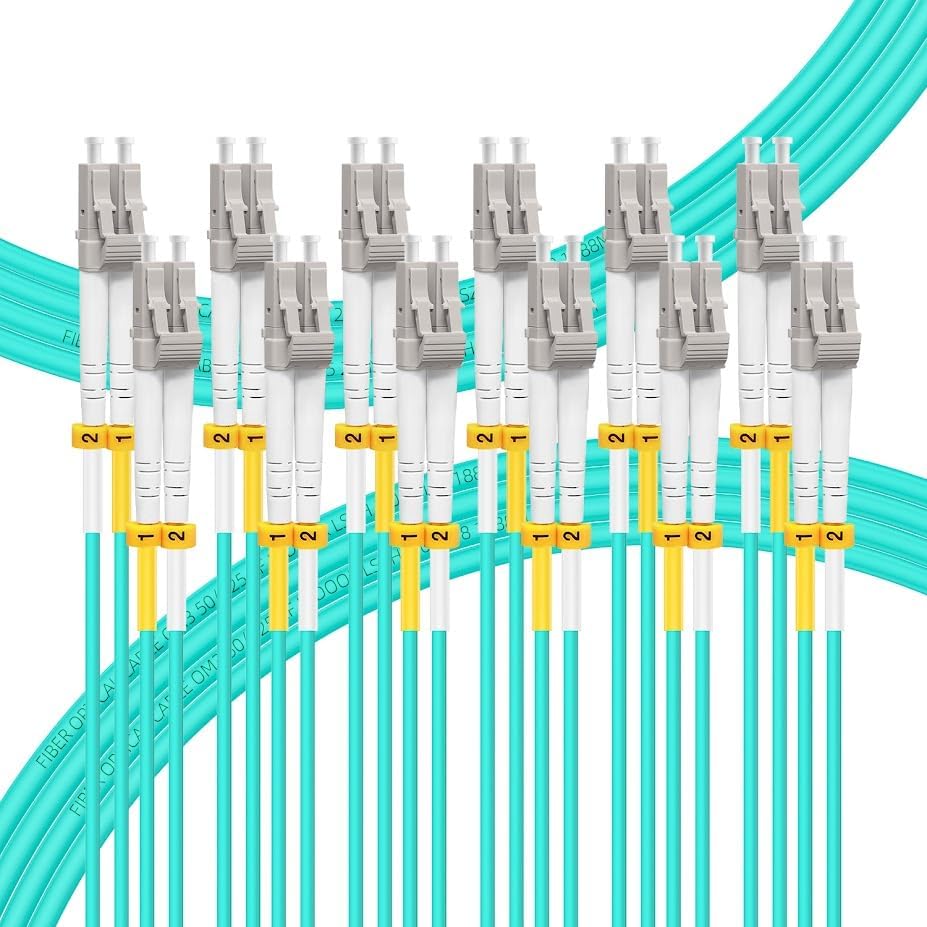
This six-pack of two-meter OM3 multimode LC-to-LC patch cords earns the highest listed rating in the group at 4.9. It combines a useful service-loop length with a 7.5 mm minimum bend radius, making it especially well suited to tightly packed cabinets, storage arrays, and other high-density optical installations.
We may earn a commission when you buy through this link, at no additional cost to you.
The supplied specifications state insertion loss of no more than 0.3 dB and return loss of at least 30 dB. Its 2.0 mm LSZH jacket, 50/125-micron fiber, UPC-polished ferrules, and labeled transmit and receive positions support dependable installation and maintenance. It is listed for 10G and 40G applications involving compatible SR, LRM, and SFP+ equipment.
OM3 multimode fiber will not serve as a substitute for single-mode cable, and the transceivers at both ends must support the appropriate optical type and distance. Two meters may also be more cable than necessary in a tightly organized rack, although that extra length can make service loops and reconnections easier. The listed maximum distances depend on the network configuration and wavelength.
This is the strongest all-around choice for buyers who want multimode performance, compact routing, and a convenient six-cord package. It suits data centers, SAN cabinets, local and wide-area networks, and enterprise equipment rooms where 10G connections use compatible OM3 optics.
A 7.5 mm minimum bend radius allows the cord to negotiate tight routes and numerous cabinet bends without relying on macro-bending loss. The result is practical for installations where cable bulk is a meaningful concern.
The OM3 construction is intended for 10G SR, 10G LRM, and SFP+ connections using compatible multimode equipment. It gives network builders a familiar option for short, high-speed cabinet interconnections.
We may earn a commission when you buy through this link, at no additional cost to you.
This three-meter SC/APC-to-SC/APC simplex patch cable is designed for fiber internet extensions, ONT relocation, and other FTTH-related applications. Its 4.7 rating and distinctive armored construction make it a practical residential and installation-focused alternative to the more conventional duplex rack jumpers.
We may earn a commission when you buy through this link, at no additional cost to you.
A stainless-steel tube reinforces the optical core, adding resistance to bending, pressure, wear, and pet chewing. The outer 3.0 mm LSZH jacket also improves structural protection and provides a clean white appearance that can blend with white routers, enclosures, and trim. The stated wavelength range is 1310 to 1550 nanometers.
Because it is simplex, the cable provides one optical strand rather than the two strands found in most duplex patch cords. It is also a white SC/APC product, so buyers should verify that their equipment actually accepts SC/APC connectors and green polish. A free SC/APC adapter is included, adding convenience for extension work.
Choose this cable when relocating an ONT, extending an indoor fiber connection, or protecting a single-mode link in a home where cable damage is likely. It is less appropriate for conventional duplex data-center links, but its reinforcement and included adapter make it well targeted to FTTH and home network optimization.
The internal stainless-steel armor is the defining feature, helping protect the fragile glass core from pet chewing and everyday wear. It is a meaningful advantage in homes, offices, and installation areas where cords may be exposed.
The three-meter length offers more room to reposition an ONT or extend a fiber internet connection. The included SC/APC adapter helps simplify that arrangement when the existing installation uses matching connectors.
We may earn a commission when you buy through this link, at no additional cost to you.
This one-meter OM3 duplex jumper is a focused choice for connecting an SFP-equipped device to nearby compatible optical hardware. Its 4.8 rating reflects strong customer feedback, and the short aqua-colored cable suits compact server, switch, and media-converter installations.
We may earn a commission when you buy through this link, at no additional cost to you.
The construction combines a PVC or LSZH cable jacket, aramid reinforcement, zirconia ceramic ferrules, and a heat-resistant connector. The manufacturer states that every cable receives insertion-loss testing and lists multimode insertion loss at no more than 0.3 dB and return loss of at least 30 dB. It also cites TIA/EIA, IEC, CE, and RoHS standards.
The one-meter length may be limiting when a switch and patch panel are separated by more than a few feet, and the cable cannot be used with single-mode optics. Its primary advantage is a compact, direct connection for multimode SFP equipment rather than a multipack intended to cover an entire cabinet.
Buy this jumper for short links between a compatible SFP transceiver and nearby network equipment. It is especially useful for a single workstation, server, or switch port where a full cabinet set would create unnecessary excess cable.
The patch cord is designed around common multimode SFP transceivers, giving installers a straightforward option for short equipment connections. Its duplex form supports paired transmit and receive fiber paths.
Aramid reinforcement and zirconia ceramic ferrules are intended to improve mechanical strength and connector alignment. The stated testing and standards references add confidence for organized network deployments.
We may earn a commission when you buy through this link, at no additional cost to you.
This four-pack of two-meter OS2 duplex patch cords combines SC/UPC and LC/UPC connectors, making it useful when both connector styles appear within the same network. Its 4.7 rating and broad stated compatibility make it a premium-oriented choice for mixed structured-cabling environments.
We may earn a commission when you buy through this link, at no additional cost to you.
The 9/125-micron OS2 fiber and 1310/1550 nanometer range support links listed at up to 10 kilometers at 1310 nanometers or 40 kilometers at 1550 nanometers, subject to the optics and network. A 2.0 mm LSZH jacket, zirconia ceramic ferrules, and a 15 mm minimum bend radius support dense routing and stable signal transmission.
Mixed connector ends require suitable SC and LC ports or adapters, and the 15 mm bend radius is wider than the 7.5 mm specification offered by some multimode cables. Distance ratings also describe the fiber and optical conditions rather than a guarantee for every transceiver, protocol, or route. Buyers should check the equipment and planned path before committing.
This is a strong choice for data centers, cloud storage networks, server farms, community networks, and telecom rooms that use both SC and LC interfaces. The four-cord pack makes it easier to deploy several consistent links without mixing unrelated cable constructions.
The SC-to-LC combination bridges two common interface types without requiring a separate conversion cable at each endpoint. It is well suited to patching equipment with unlike connector styles.
OS2 fiber provides a useful balance for structured links ranging from relatively short equipment connections to substantially longer runs. Actual reach still depends on the transceivers, wavelength, and route.
We may earn a commission when you buy through this link, at no additional cost to you.
This five-pack of one-meter OS2 duplex LC jumpers is aimed at technicians who want several compact single-mode cords for nearby equipment. Its 4.6 rating is solid, and the combination of a short length, tight bend radius, and five-cord quantity makes it practical for concentrated installations.
We may earn a commission when you buy through this link, at no additional cost to you.
The cable is listed with insertion loss no greater than 0.3 dB, return loss of at least 50 dB, a 2.0 mm LSZH jacket, UPC polishing, zirconia ceramic ferrules, and aramid internal reinforcement. The 7.5 mm minimum bend radius helps it fit narrow spaces, while stated transmission reaches include 10 kilometers at 1310 nanometers and 40 kilometers at 1550 nanometers.
The one-meter length is restrictive for widely separated devices, and the product remains tied to OS2 single-mode optics. Its quoted long-distance capability should not be confused with guaranteed performance across all transceivers or network conditions. A five-cord pack can also be more than needed for a single connection.
Choose it for local-area networks, SANs, data centers, premises wiring, and other compact single-mode installations. It is a good option when maintaining several short links and when tight routing matters more than cable reach.
The listed 7.5 mm bend radius is among the most compact specifications in this comparison. That makes the short jumper easier to place behind panels, within trays, or around closely spaced equipment.
Five matching jumpers make it convenient to standardize several nearby links. The detachable duplex clip also allows individual fibers to be accessed when required.
We may earn a commission when you buy through this link, at no additional cost to you.
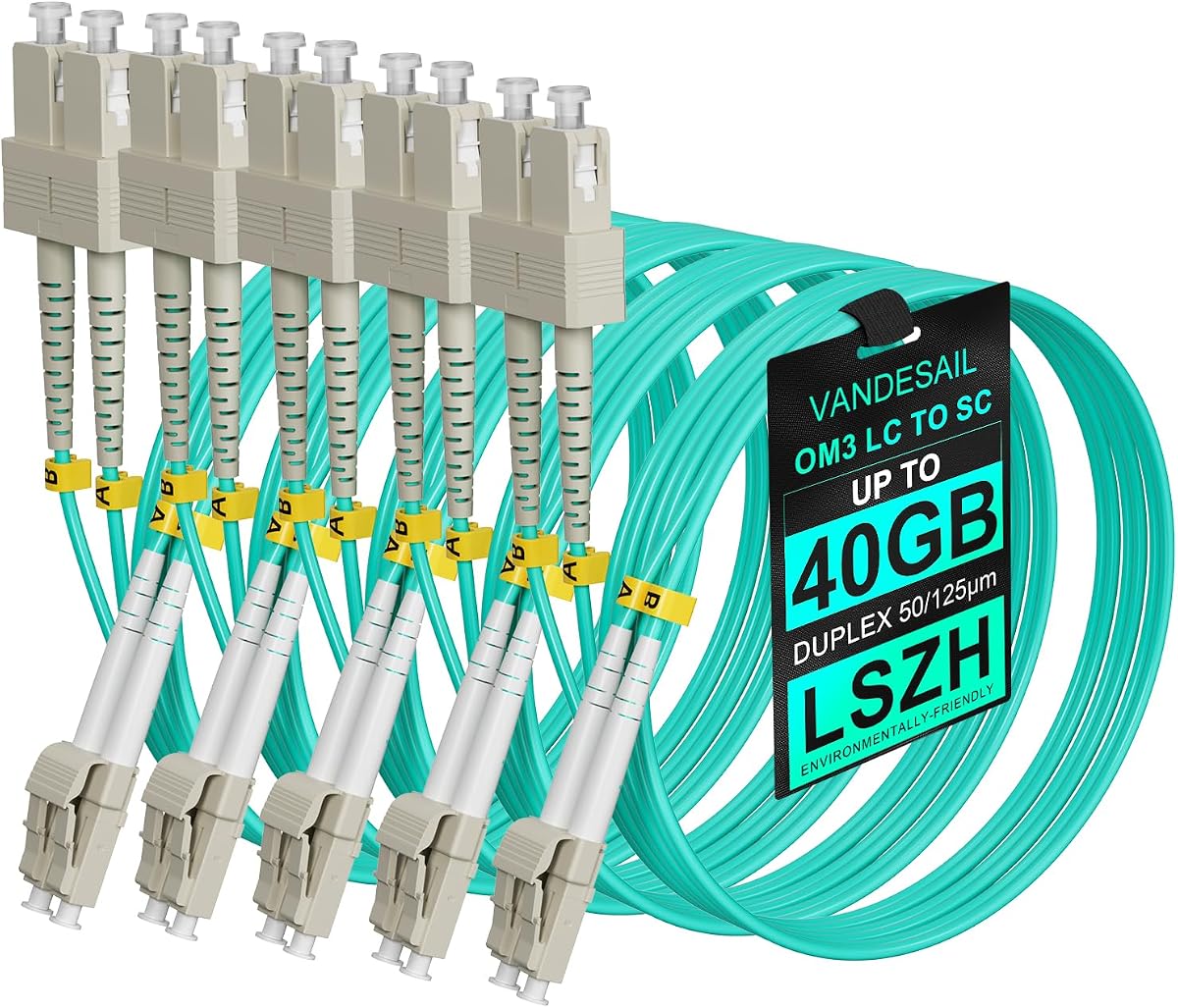
This individually tested LC-to-SC duplex patch cord provides a practical bridge between small-form-factor LC interfaces and SC equipment. Its 4.6 rating reflects a favorable user response, while its OM3 construction targets modern multimode networks operating at 10 Gbps and beyond.
We may earn a commission when you buy through this link, at no additional cost to you.
UPC-polished cores, tested connectors, and bend-resistant construction are intended to maintain stable signal quality in demanding installations. The LSZH jacket is designed to limit smoke and toxic fumes under fire conditions, and the stated operating range is minus 20 to plus 70 degrees Celsius. The listed applications include LANs, WANs, fiber modules, converters, servers, and storage devices.
The supplied listing does not state the physical length, so buyers must confirm that the available cable is long enough for the route. It also requires one LC and one SC endpoint, and it will not work with single-mode transceivers. The broad application list does not remove the need to check optical mode, connector polish, and device compatibility.
This cable is a good fit for data centers, telecommunications rooms, and enterprise networks where equipment mixes LC and SC ports. It is particularly attractive when a specific short mixed-connector link is needed and individually tested construction is a purchasing priority.
Individually testing the patch cords helps identify optical issues before installation. UPC polishing and a low-loss design support consistent performance across critical links.
The bend-resistant design helps maintain signal transmission in tight paths and complex equipment-room routes. It reduces the need to create large service loops to accommodate a less-flexible cable.
We may earn a commission when you buy through this link, at no additional cost to you.
This two-meter OM3 LC-to-LC duplex cable is a versatile jumper for short and medium cabinet connections. Its 4.8 rating is among the strongest in the group, and the specification set clearly targets high-density 10G, 40G, and 100G Ethernet environments.
We may earn a commission when you buy through this link, at no additional cost to you.
The patch cord lists a 7.5 mm minimum bend radius, 2000 MHz·km bandwidth at 850 nanometers, insertion loss no greater than 0.3 dB, and return loss of at least 30 dB. Maximum listed Ethernet distances include 550 meters for 1Gb, 300 meters for 10Gb and 40Gb, and 200 meters for 100Gb, depending on the optical configuration.
This remains an OM3 multimode cable, so it requires compatible multimode optics and is not appropriate for a single-mode transceiver. The two-meter length is a useful middle ground, but it may still be short for connections between separate racks. It is sold as one cable, so installing many links may mean placing separate orders.
It is a strong recommendation for data centers, SAN cabinets, local and wide-area networks, and commercial premises using compatible 10G SR, 10G LRM, or SFP+ equipment. Adjustable clips and A/B labeling make it particularly convenient for organized installation and troubleshooting.
The listed bandwidth and reach figures align well with dense short-reach networks. Buyers should still verify that the connected transceivers use the same fiber mode and optical reach.
Adjustable connector clips permit individual fiber access, while A/B markings clarify transmit and receive orientation. These details help reduce common installation and maintenance errors.
We may earn a commission when you buy through this link, at no additional cost to you.
This five-pack of two-meter OS2 LC-to-LC duplex cables is a straightforward choice for enterprise and data-center cabling standards. Its 4.8 rating and individually tested construction make it appealing to buyers who value consistent performance across several links.
We may earn a commission when you buy through this link, at no additional cost to you.
The patch cords use OS2 9/125-micron single-mode fiber, UPC-polished ferrules, and an LSZH jacket. They are described as compliant with TIA/EIA-568-C.3 and are individually tested for insertion loss and return loss. The stated equipment compatibility includes SFP modules, switches, routers, patch panels, media converters, and other optical network devices.
The product is best understood as a standardized short-to-medium structured link, not a guarantee of a specific maximum distance. Actual performance depends on the transceivers and route, and single-mode optics must be used at both ends. Because no bend-radius value is stated, installers with severe space constraints may want to compare the product with options that list a specific radius.
The five-cord pack is well suited to teams standardizing multiple switch-to-patch-panel or switch-to-transceiver connections. It is a strong general recommendation for data centers, enterprise networks, telecom systems, and fiber backbone work where LC-to-LC single-mode links are the norm.
Matching cables simplify documentation, spare inventory, and future repairs. A five-cord set is practical for a small server room, network cabinet, or structured-cabling project.
The listed range of compatible network equipment makes LC-to-LC a broadly useful configuration. Verify optical mode and transceiver specifications before installation.
We may earn a commission when you buy through this link, at no additional cost to you.
This five-meter LC-to-SC OS2 duplex patch cord is intended for routes that extend beyond the reach of a short rack jumper. Its 4.8 rating, individually tested connectors, and multipack quantity make it a practical choice for telecom rooms, enterprise networks, and structured-cabling installations.
We may earn a commission when you buy through this link, at no additional cost to you.
The five-meter, or 16.4-foot, length provides room to connect separated equipment while preserving a manageable amount of slack. UPC connectors are individually tested, and the LSZH jacket is intended for locations where low smoke and low halogen emissions under fire conditions matter. The stated uses include data-center interconnects, intranets, broadcasting, security systems, and structured-cabling projects.
Five meters can be excessive for adjacent switch and patch-panel ports, and the mixed LC-to-SC termination requires compatible equipment at each end. The cable must also be paired with appropriate single-mode equipment. No detailed insertion-loss, return-loss, or bend-radius values are supplied in the listing, so buyers needing highly controlled specifications should confirm those details.
Buy this set when you need a moderate-length mixed-connector single-mode link, particularly between equipment in different rack positions or nearby telecom cabinets. The five matching cords make it useful for organized deployments rather than a one-off connection.
The five-meter span accommodates routes that do not fit comfortably within a single rack. It also leaves room for safe servicing without requiring an extremely short or visually cumbersome run.
LC-to-SC construction is useful when connected devices use different connector formats. The listed compatibility with switches, routers, transceivers, media converters, servers, and cabinets supports varied network roles.
We may earn a commission when you buy through this link, at no additional cost to you.
A suitable patch cord begins with an exact match for your equipment and route. Connector type, polish, fiber mode, optical reach, physical length, and bending requirements should be confirmed before considering secondary features such as jackets, labeling, and multipack quantities.
Connector endpoints must physically match the ports or adapters on the equipment. LC-to-LC is common for compact transceivers and patch panels, while LC-to-SC and SC-to-SC are useful in installations that use larger SC interfaces. Connector shape alone is not enough: the fiber mode and polish must also be appropriate for the connected optics. Reviewing both ends prevents a cable that looks correct from producing an incompatible or degraded link.
OM3 is a multimode option intended for short, high-speed links, while OS2 is a single-mode option for longer-distance networking and backbone applications. The two are not generally interchangeable because the optical source, wavelength behavior, and transceiver specifications differ. Select the mode required by the transceivers or equipment at both ends. Installing an OM3 cord on a single-mode link or using a single-mode cord on multimode equipment can produce an unreliable connection.
UPC and APC refer to connector end-face polish. UPC is common on many LC and SC network connections, while APC is frequently associated with SC/APC FTTH equipment. Polish type should correspond with the adapter and transceiver arrangement, and mixing polished connector types can impair performance. Specifications such as insertion loss, return loss, ceramic ferrules, and individual testing provide useful indicators of alignment and signal integrity.
Measure the complete route rather than estimating only the straight-line distance between devices. Include cabinet depth, service loops, bend clearance, patch-panel depth, and room for future maintenance. A short one-meter jumper is ideal for adjacent equipment, while two meters can offer more routing flexibility. Longer five-meter cords are useful when devices are separated, although excess cable should be coiled safely rather than left under unnecessary strain.
Bend radius matters in racks, under desks, and inside crowded cabinets. Products with a stated 7.5 mm minimum bend radius offer greater routing flexibility than those specifying 15 or 16 mm. A tighter stated radius can make a cord easier to route without sharp turns or excessive service loops. It does not eliminate the need to handle the fiber gently, but it provides useful tolerance for dense installations where every centimeter of cabinet space matters.
LSZH jackets are designed to produce low smoke and no halogen gas under fire conditions, making them suitable for indoor structured-cabling areas. Armored cords add mechanical protection for exposed or high-wear routes, such as residential fiber extensions where pets or daily handling could damage the cable. Standard flexible jackets are appropriate for protected cabinet locations. Consider both the environment and the amount of handling the cord will receive rather than selecting protection that is unnecessary for the route.
A patch cord for a dense SAN cabinet is often selected for compact routing, service loops, and easy port identification. A residential FTTH extension may instead need armored construction, an SC/APC interface, and enough length to relocate an ONT. Longer enterprise links require compatible OS2 optics and appropriate optical reach. Matching the patch cord to the job prevents a technically capable cable from being awkward, incompatible, or unnecessarily difficult to route.
Multipacks can simplify cabinet builds by providing several consistent cords at once, but the quantity should match the installation rather than creating unnecessary spares. Dust caps protect polished ends during storage and installation, while detachable clips permit individual fiber access. A/B labels and numbered jacket rings help identify transmit and receive paths, reducing errors in busy patch panels. These features are especially valuable for repeated maintenance and troubleshooting.
Before installation, inspect the connectors and jacket for cracks, pinched fibers, contamination, or damage. Keep the ferrule end faces clean and protected with the supplied dust caps until the cable is ready to connect. Confirm that the connector, polish, fiber mode, and transceiver are compatible. Do not force a connector into a port; alignment should occur naturally, and resistance usually indicates a mismatch or debris that needs attention.
Route the patch cord with a smooth bend and respect the stated minimum bend radius. Secure it with appropriate cable-management hardware without crushing the jacket or creating tight kinks. In a duplex cord, keep the transmit and receive fibers routed together and use the A/B labels consistently. When a service loop is needed, create a broad, supported loop rather than a small coil that places tension on either connector.
For routine care, clean only with an approved fiber-optic method and keep hands away from polished end faces. Inspect accessible portions of the cord during maintenance, looking for jacket abrasion, sharp bends, loose clips, or connector contamination. Replace a cord that has been pinched, kinked beyond its bend rating, or damaged at a ferrule. For indoor deployments, confirm that the installation remains consistent with the cable's LSZH or armored construction.
OM3 is a multimode fiber designed primarily for short, high-speed links such as cabinet interconnections and compatible 10G equipment. OS2 is single-mode fiber intended for longer-distance links and backbone applications. The two use different optical characteristics, so the cable must match the transceivers and other equipment at both ends.
No, not as a compatible optical link. The multimode and single-mode fiber types have different core sizes and light-propagation characteristics, and their compatible transceivers are designed accordingly. Use a patch cord whose fiber mode matches the installed transceivers, or change both ends of the link as part of a properly planned equipment migration.
UPC and APC describe the polish and end-face geometry of a fiber optic connector. UPC is common on many standard LC and SC links, while SC/APC appears in many FTTH installations. The connector polish should match the adapter and transceiver arrangement, and different polish types should not be forced together without a proper adapter.
Choose the shortest length that reaches the equipment while allowing safe bends and manageable service slack. Measure cabinet depth, routing paths, and maintenance space instead of relying only on the distance between visible ports. One-meter cords suit many adjacent connections, two meters add routing flexibility, and five meters help with more separated equipment.
Yes, especially in crowded racks and dense patch panels. A stated 7.5 mm bend radius offers more routing flexibility than a 15 or 16 mm specification, making it easier to avoid sharp turns and excessive service loops. The cable should still be installed without kinks, crushing, or repeated stress outside its specified limits.
Armored construction adds mechanical protection around the optical core, helping resist wear, pressure, bending, and pet chewing. It is especially useful in residential or exposed routes where a standard flexible jacket could be damaged. In protected server rooms, a conventional LSZH patch cord may be sufficient.
An LC-to-SC cable connects equipment with different connector formats without requiring the installer to treat each side as a separate link. This can simplify work in telecom rooms and enterprise networks that contain a mixture of compact LC interfaces and larger SC ports. Both ends must use compatible fiber mode, polish, and optical equipment.
Keep the dust caps on both connectors, avoid coiling the cable into a tight loop, and store it in a clean, dry place away from direct sunlight and sharp objects. A loose, supported coil helps prevent stress on the ferrule and fiber. Clean the connector end faces before installation if the caps have been off for an extended period.
The six-pack of two-meter OM3 LC-to-LC cords stands out as the most flexible general recommendation for compact, high-speed multimode cabinet work, while the armored SC/APC single-mode cable offers a specialized alternative for protected FTTH extensions. The four-pack of OS2 SC-to-LC jumpers provides a more versatile single-mode option for mixed enterprise equipment.
Prioritize exact compatibility before secondary features. Confirm connector type, polish, fiber mode, transceiver specifications, route length, and bend-radius requirements. Then consider jacket construction, dust protection, labeling, and multipack quantity, which become especially valuable in crowded cabinets and structured-cabling projects.
Ratings, product listings, and prices can change over time, so verify the current specification and availability before ordering. For fiber installations where compatibility is uncertain, check the port markings and transceiver documentation rather than relying on connector appearance alone.