As an Amazon Associate we earn from qualifying purchases. We may earn a commission when you buy through links on this page, at no additional cost to you.As an Amazon Associate we earn from qualifying purchases.Purchases through our links may earn us a commission, at no extra cost to you.
An inline amplifier for speakers can turn a phone, turntable, computer, or other line-level source into a more capable audio system, provided it is designed to power the speakers you own. The right choice depends on impedance, channel count, input options, and whether you need Bluetooth or a compact preamp instead.
This guide compares ten compact amplifiers and preamplifiers based on the supplied specifications, including output capability, speaker compatibility, input and output connections, gain, sound controls, enclosure design, and supported applications. It covers true power amplifiers for passive speakers as well as line-level devices that require a separate power amplifier.
Each review explains the product's strongest use case, practical limitations, and ideal buyer. The top selections include a versatile mini power amplifier, a Bluetooth model for convenient streaming, and a higher-end amplifier for more demanding systems. Prices and availability can change, so verify current retailer details before purchasing.
Top 3 Picks for Best Inline Amplifier for Speakers
Best Budget
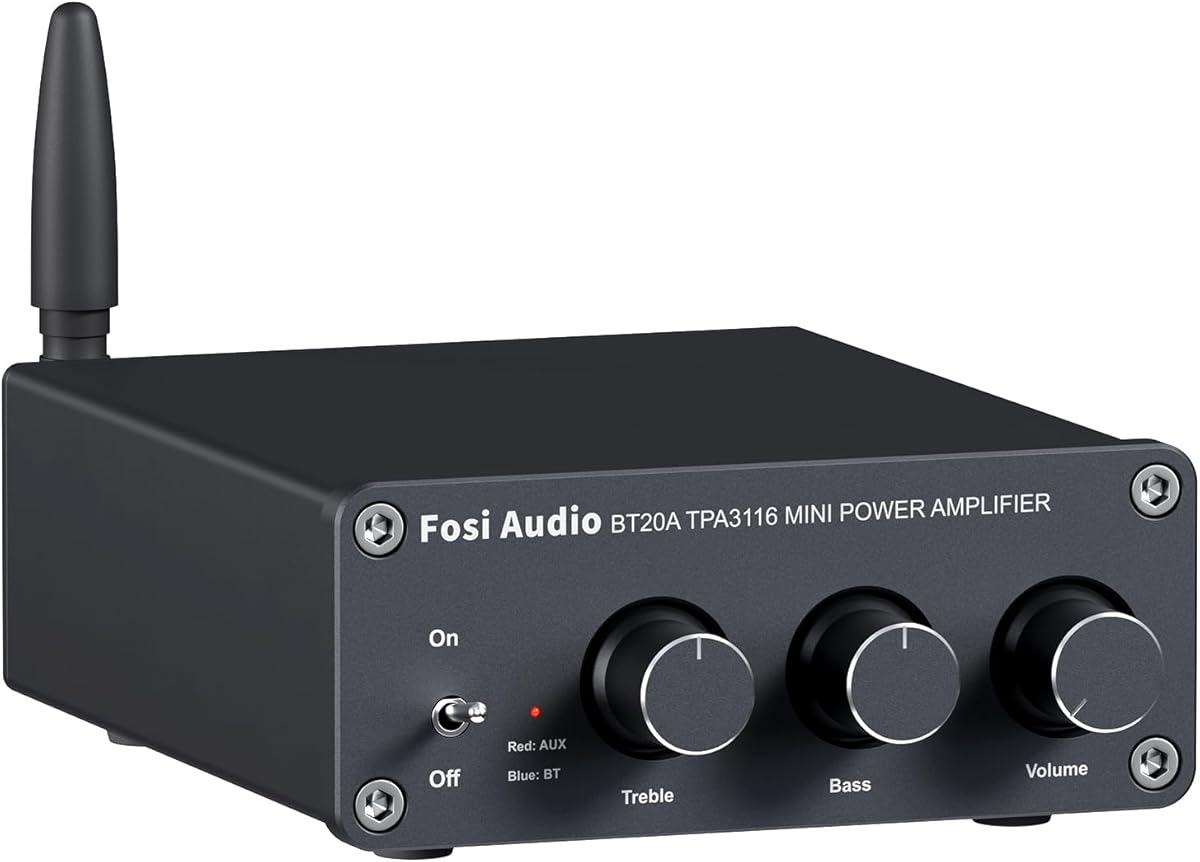
Fosi Audio BT20A Bluetooth Stereo Amplifier, 2 Channel Home Audio Component Amplifiers for Passive Speakers, Mini Class D Amp Receiver 200W for Indoor/Outdoor/Garage/Ceiling/Bookshelf Speaker
Top 10 Best Inline Amplifier for Speakers in 2026 Compared
The table below compares the ten products by channel configuration, power role, connections, and standout features. Pay particular attention to the distinction between true speaker amplifiers and line-level preamplifiers that cannot directly power passive speakers.
The Douk Audio L1 Mini is a stereo line-level booster and preamplifier with a 4.1 rating. It is designed to raise the output of relatively low-level sources so they can feed an amplifier, mixer, or active speaker system more effectively. Its standout qualities are the broad selection of analog connections, adjustable gain up to 20dB, and a compact all-metal enclosure.
Pros
Broad source compatibility
Adjustable signal gain
Useful volume control
Compact metal construction
Cons
Cannot power passive speakers
Requires compatible power supply
We may earn a commission when you buy through this link, at no additional cost to you.
The device accepts 3.5mm AUX, stereo RCA, and 5-DIN inputs, then provides stereo RCA and 5-DIN outputs. This makes it useful for connecting phones, tablets, computers, televisions, portable CD players, and other sources that lack a suitably strong line-level output. The gain circuit and volume control let the user match the output more closely to the next device in the chain, while the stated voltage-boost design supports output amplitude of up to plus or minus 12.5V when operating from 26V.
Its NE5532P op-amp uses a pluggable socket, allowing technically inclined users to experiment with alternative dual op-amps. A sealed potentiometer, double-sided PCB, and metal enclosure are intended to support smooth frequency response, low distortion, durability, and electromagnetic shielding. The important limitation is that this is not a power amplifier. It cannot directly drive passive speakers and must feed a separate power amplifier or another device designed to provide speaker current.
This is a good choice for someone building a compact analog chain around a mixer, powered speakers, home stereo, karaoke setup, or existing amplifier. It is particularly useful when a source seems too quiet but is not itself defective. Buyers seeking a box that connects directly to passive bookshelf speakers should choose a true power amplifier instead.
Flexible Analog Routing
The unusually broad input selection lets the L1 Mini serve as a practical bridge between consumer devices and a traditional stereo system. RCA and 5-DIN connections also make it suitable for semi-pro and multi-zone audio installations.
Useful for Source Matching
Rather than adding dramatic power, the adjustable 20dB boost solves a narrower and often more achievable problem: bringing a weak source to a useful line level before it reaches the next stage.
The Douk Audio L1-MiINI is a compact stereo line-level booster with a 4.3 rating. It is closely related to the larger L1 Mini in purpose, using an adjustable gain circuit to bring low-output sources up to a more useful level before they enter another amplifier or powered speaker system. Its defining features are the 20dB maximum gain, volume control, and space-saving metal construction.
Pros
Very compact construction
Adjustable gain control
Dual op-amp upgradeability
Noise-rejecting metal enclosure
Cons
Not a passive-speaker amplifier
Fewer interfaces than L1
We may earn a commission when you buy through this link, at no additional cost to you.
Inputs are provided through 3.5mm AUX and stereo RCA connections, while the output uses stereo RCA. The product supports common sources such as phones, tablets, televisions, computers, MP3 players, portable CD players, and game consoles. Its built-in amplification and voltage-boost circuit can operate from 26V, allowing an output amplitude of up to plus or minus 12.5V and a maximum gain of 20dB.
The dual-side PCB, pluggable NE5532P op-amp, and sealed volume potentiometer emphasize signal quality and user control. The op-amp can be exchanged for another compatible dual device, while the metal body provides durability and helps reject electromagnetic interference. Compared with the L1 Mini, this version has a more compact footprint and fewer interfaces, including no stated 5-DIN connection.
Choose the L1-MiINI when a small, simple line-level booster is needed in a crowded cabinet, portable audio setup, karaoke system, or recording project. It does not replace a power amplifier for passive speakers. Its value lies in source compatibility and clean gain adjustment rather than raw speaker-driving capability.
Small Footprint, Clear Purpose
The L1-MiINI is easy to incorporate where space is limited. Its straightforward RCA and 3.5mm interfaces cover most consumer sources without adding unnecessary complexity.
Upgradeable Signal Path
The socketed NE5532P op-amp gives experienced hobbyists a way to explore alternate dual op-amps while retaining a compact, line-level-focused design.
The Fosi Audio V1.0G is a two-channel Class D mini amplifier with a 4.6 rating, the highest in this guide. It is a genuine speaker amplifier designed for home and small professional audio applications. Its balanced mix of compact size, efficient operation, integrated speaker protection, and a stated 50 watts per channel makes it an excellent general-purpose choice.
Pros
Highest rating in the list
Compact two-channel design
Efficient Class D operation
Includes power supply
Cons
No Bluetooth connectivity
50W per channel limit
We may earn a commission when you buy through this link, at no additional cost to you.
At its core is the Texas Instruments TPA3116D2 digital power-stage chip. The amplifier supports a supply range from 12V to 24V, offering flexibility beyond a single operating point. Its advanced oscillator and phase-locked-loop circuitry includes multiple switching-frequency options intended to avoid AM interference, while the aluminum enclosure and low-loss design promote efficient, cool operation.
A built-in speaker-protection circuit adds a layer of reassurance for a compact system, although users should still observe appropriate wiring, impedance, ventilation, and power-supply practices. The package includes the amplifier, power adapter, AC cord, and manual, making setup more straightforward than sourcing every accessory separately. Compared with the larger Fosi models, it is deliberately modest in output power and focused on efficiency rather than elaborate tone controls or wireless features.
The V1.0G is best for bookshelf speakers, small stereo systems, desktop listening, and compact installations where efficient two-channel amplification matters. It is the most broadly sensible pick in the list for buyers who want a direct passive-speaker solution without Bluetooth complexity. Larger or less efficient passive speakers may require one of the higher-output models.
Efficient Everyday Amplification
Class D efficiency keeps heat and idle loss under control, making the V1.0G well suited to continuously available home audio systems and compact installations.
Simple, Protected Package
The included power supply and integrated speaker protection reduce the number of separate components required for a basic passive-speaker setup.
The Fosi Audio BT20A is a two-channel Class D amplifier with a 4.5 rating and a strong focus on straightforward home use. It combines analog RCA input, Bluetooth streaming, speaker-level output, and basic bass and treble adjustment in a compact enclosure. The stated maximum output is 100 watts per channel, making it a more capable inline amplifier than a typical line-level booster.
Pros
Affordable entry-level design
Simple wireless streaming setup
Useful tone controls
Wide room-placement options
Cons
No phono input
Maximum rating differs continuously
We may earn a commission when you buy through this link, at no additional cost to you.
Its one-touch power switch and uncomplicated installation make it appealing to first-time mini-amplifier buyers. Bluetooth allows a phone to become a convenient music source without a wired connection, while RCA input supports televisions, computers, turntables with an external phono stage, and other line-level equipment. The smooth bass and treble controls provide a small amount of tonal adjustment for different rooms and speaker placements.
The stated 200W total maximum output should be understood as a headline capability rather than a guarantee of continuous output into every speaker impedance. Real performance depends on the power supply, load, signal, and thermal conditions. Buyers should match the amplifier to reasonably efficient passive speakers and use appropriate wiring. The product's simple design does not include a dedicated phono stage, digital input, or advanced network features.
This is an excellent choice for a bedroom, office, living room, garage, patio, or other area where passive speakers need more power and convenient Bluetooth streaming. It provides more everyday flexibility than the V1.0G while remaining straightforward. The all-black enclosure also lets it blend into a shelf or entertainment center without dominating the room.
Wireless Music in Minutes
Bluetooth turns the amplifier into an approachable whole-room audio component. A phone can become the source, while the connected speakers provide the larger-scale sound.
Useful for Many Rooms
The compact Class D enclosure is suitable for indoor or outdoor speaker arrangements, provided the unit is installed in a location protected from weather and moisture.
This Mini Small Stereo Audio preamplifier is a 4.5-rated signal amplifier and headphone amplifier designed around the classic dual NE5532 op-amp. It multiplies weak signals by ten, corresponding to 20dB of gain, and adds a front volume control. Its broad source compatibility makes it particularly useful with turntables, computers, mobile devices, game consoles, instruments, and other analog equipment.
Pros
Useful headphone output
Twenty-decibel signal gain
Broad source compatibility
Compact dimensions
Cons
Cannot power passive speakers
Headphone and other outputs conflict
We may earn a commission when you buy through this link, at no additional cost to you.
The connections include left and right RCA inputs, a 3.5mm input, left and right RCA outputs, a 3.5mm output, and a dedicated headphone connection. A stated 16-ohm maximum headphone impedance provides a clear limit for headphone users. The device operates from a 9–19V DC supply and draws a static current of about 8mA, making it relatively undemanding in a small signal chain.
Its most important limitation is explicitly stated: it is a preamp and cannot be used as a power amplifier for passive speakers. The headphone output also cannot operate at the same time as the other output ports. Although the product title mentions phono use, a turntable with a moving-magnet cartridge may still require a dedicated phono stage with the correct frequency response. Buyers should not assume that all turntables are directly compatible without checking their output requirements.
The product is best for headphone listening, signal conditioning before an existing amplifier, and adding a convenient volume control to a source that lacks one. It is not the right choice for someone expecting an inline box to power bookshelf or floor-standing speakers. Its strongest benefit is focused line-level control in a remarkably small enclosure.
Practical Headphone Option
The dedicated headphone output and stated 16-ohm limit give the preamp a clear purpose beyond basic source routing. Matching the amplifier to lower-impedance headphones remains important.
Useful Signal Conditioning
When a source is too quiet for a downstream component, the ten-times amplification can restore a useful operating level. The added volume knob also makes basic level matching easier.
The Fosi Audio BT20A Pro is a two-channel Class D amplifier with a 4.4 rating and a 300-watts-times-two maximum output claim. It combines Bluetooth 5.0, analog input, passive-speaker capability, bass and treble controls, and a more advanced Texas Instruments TPA3255 power stage. It is aimed at buyers who want more output and flexibility than the standard BT20A.
Pros
High stated channel power
Modern Bluetooth standard
Replaceable op-amps
Detailed tone controls
Cons
Maximum output is conditional
No network streaming functions
We may earn a commission when you buy through this link, at no additional cost to you.
The TPA3255 design uses feedback and a high-speed gate-driver approach for efficient amplification. Specified signal-to-noise ratio is at least 108dB, with total harmonic distortion stated at no more than 0.005%. Two plug-in NE5532 op-amps can be replaced with listed alternatives such as LME49720HA, MUSES02, OPA2604AP, OPA2134PA, LM4562, or NJM4556AD, giving audiophiles some control over the final tonal character.
Bluetooth pairing can be cleared by holding the volume control for five seconds, and a memory function helps simplify reconnection. An alert tone provides connection feedback. Bass and treble controls can be set to the midpoint for a more neutral starting point. The package includes the amplifier, Bluetooth antenna, 32V/5A power adapter, AC cord, and manual, giving the buyer the core components needed for installation.
This amplifier fits a mid-range desktop, home stereo, patio, garage, or small venue where wireless convenience and substantial maximum output are both important. It is not a network streamer, and the headline wattage should not be treated as continuous output for every load. The replaceable op-amps and advanced power stage make it especially attractive to users who enjoy fine-tuning an inexpensive compact system.
More Headroom Than Entry Models
The higher specified output makes the BT20A Pro a better candidate for larger passive speakers or a system that may be driven harder than a background-listening setup.
A Practical Audiophile Touch
Replaceable op-amps provide a degree of customization usually absent from basic mini amplifiers, while the specified distortion and noise figures indicate a refined signal chain.
The Fosi Audio TB10D is a two-channel TPA3255 Class D amplifier with a 4.5 rating. It is designed for passive bookshelf speakers and other compatible loads, with a stated 300 watts per channel and support for speakers from 2 to 8 ohms. The combination of high maximum output, compact construction, RCA input, and bass and treble controls makes it a versatile desktop or home-audio component.
Pros
Strong stated output level
Supports common speaker impedances
Built-in protection circuits
Tone controls included
Cons
Maximum power is conditional
No Bluetooth included
We may earn a commission when you buy through this link, at no additional cost to you.
Unlike a pure preamp, the TB10D includes a power stage capable of driving passive speakers. Its RCA inputs accept sources such as phones, computers, DVDs, CD players, laptops, and televisions. A dedicated power switch simplifies everyday operation, while the tone controls allow modest adjustments for different speaker characteristics and room acoustics.
Built-in protection circuits are intended to support stable operation and component longevity, although correct speaker impedance and wiring remain essential. The stated 600W total is a maximum figure rather than an assurance of continuous output under every condition. Buyers should consider the included power supply requirements, speaker sensitivity, and amplifier-to-speaker matching before expecting the headline rating to translate directly into loudness or effortless high-volume playback.
The TB10D is a good match for a compact but powerful stereo system, a home theater, a game room, a dining area, a personal studio, or a system using a bass shaker. It is less convenient for users who want immediate Bluetooth streaming, but the direct speaker outputs and tone controls compensate with broader wired-system flexibility.
Speaker Matching Made Easier
The stated 2–8 ohm support covers many common passive speakers, allowing the amplifier to serve as a central component in many home and desktop systems.
Beyond Conventional Bookshelves
Support for a bass shaker broadens the possible use case, allowing the same compact Class D platform to handle conventional stereo speakers and additional low-frequency effects.
The Fosi Audio V3 is a two-channel Class D power amplifier with a 4.4 rating, built around the TPA3255 chip and a 48V power supply. It is designed to drive 2–8 ohm passive speakers while retaining a compact form suited to bookshelves, desktop systems, and home theaters. Its standout features include upgraded passive components, a substantial cooling design, replaceable op-amps, and an adjustable pre-out.
Pros
High-quality component selection
Advanced cooling design
Upgradeable dual op-amps
Flexible pre-out control
Cons
No Bluetooth connectivity
Large power claims require context
We may earn a commission when you buy through this link, at no additional cost to you.
Japanese NCC and ELNA capacitors, German WIMA capacitors, and Japanese Sumida inductors are used in the signal and power stages. The stated specifications include signal-to-noise ratio up to 110dB, a SINAD rating up to 88dB, and a low noise floor of 140 microvolts. The replaceable stock NE5532 op-amps can be exchanged for numerous compatible eight-pin dual options, including Sparkos SS3602, MUSES02, OPA2604, OPA2134PA, OP249, AD827, RM4559, LM4562, and LME49720HA.
Top and bottom vents combine with a whole-body heatsink to dissipate heat efficiently. That design matters in a compact Class D amplifier intended to deliver meaningful power. The maximum output is stated at 600 watts, or 300 watts per channel, but actual performance depends on speaker impedance, signal level, supply conditions, and thermal limits. The pre-out function is controlled by the main volume, which adds useful flexibility for linking the amplifier with other equipment.
The V3 is best for a compact but serious passive-speaker system, a desktop audiophile setup, or a home theater where analog flexibility and component quality matter more than wireless convenience. It is also a strong match for hobbyists who enjoy replacing op-amps. Buyers who only need simple Bluetooth should consider a less complex model.
Thoughtful Component Selection
The named capacitor, inductor, and op-amp choices make this model more attractive to component-aware listeners who want to explore sound differences within a compact platform.
Cooling Supports Compact Power
The vented chassis and integrated heatsink are especially relevant when a high-output mini amplifier is operated near its limits. Adequate clearance remains necessary.
The WiiM Vibelink Amp is a premium stereo power amplifier with a 4.4 rating. It delivers a stated 100 watts per channel at 8 ohms and 200 watts per channel at 4 ohms, using PFFB technology, an ESS 9039Q2M DAC, and a Texas Instruments TPA3255 amplifier chip. The result is a feature-rich inline solution for passive speakers, particularly for owners of compatible WiiM streamers.
Pros
PFFB amplification technology
High-resolution digital inputs
Direct analog input
Premium thermal management
Cons
No built-in streaming functions
Analog input output is lower
We may earn a commission when you buy through this link, at no additional cost to you.
The unibody aluminum enclosure is designed for rigidity and durability, while a copper heat pipe and graphene heatsink provide advanced thermal management. Variable sample rates and bit depths are supported for high-resolution streaming, FLAC, and vinyl rips. Optical and coaxial digital inputs can deliver bit-perfect 192kHz/24-bit playback, giving the amplifier considerable flexibility for a modern source component.
The analog RCA path bypasses analog-to-digital conversion, allowing analog signals to remain in the analog domain. However, the product specification notes an important distinction: the unit provides 60W output through RCA input and 100W through digital input. It is also a pure power amplifier and does not itself provide streaming functions. Users wanting internet music services need a compatible WiiM streamer, such as the Mini, Pro, Pro Plus, or Ultra.
This amplifier is best for a thoughtfully assembled hi-fi system where a separate streamer provides control and the Vibelink handles clean, powerful amplification. Its anti-pop design, automatic standby, and 12V trigger also make it convenient for integrated installations. It is the premium choice here, but the extra capability is most valuable when the source and speakers can take advantage of it.
High-Resolution Source Support
Optical and coaxial inputs support high-resolution playback, while the ESS DAC and variable-rate handling make the Vibelink particularly attractive to digital-source owners.
A Serious Matching Partner
The product is designed to pair naturally with WiiM streamers, creating a flexible two-box system in which one component manages playback and the other delivers power.
The Stetsom HL 400.1 is a single-channel Class D full-range amplifier with a 5.0 rating. It is optimized to deliver 400 watts RMS at 2 ohms, making it different from most stereo mini amplifiers in this guide. Its strength is concentrated power in a compact mono package, with adjustable input level, selectable high-pass and low-pass modes, and installation-oriented features.
Pros
Highest listed product rating
High single-channel power
RCA and high-level inputs
Flexible crossover configuration
Cons
Not a conventional stereo amplifier
Designed around 2-ohm loads
We may earn a commission when you buy through this link, at no additional cost to you.
The amplifier includes RCA inputs and high-level speaker inputs, allowing it to accept a conventional line source or integrate with a factory-style audio system. Independent right and left inputs provide flexibility during system integration, while the variable crossover can tailor the output to different speaker arrangements. Those controls are valuable when a subwoofer, high-pass filtering, or a specialized full-range installation is required.
The black housing is designed for efficient heat dissipation, and the included mounting brackets help position the unit securely in a vehicle, workshop, compact stereo installation, or dedicated audio cabinet. As a mono model optimized for a 2-ohm load, it is not a direct replacement for a conventional two-channel home amplifier. A stereo system would generally require two units or a separate multi-channel amplifier.
The HL 400.1 is a specialized choice for installers and technically confident users who need one powerful, adjustable channel rather than balanced stereo output. It is particularly relevant to full-range custom speaker systems and subwoofer applications. Conventional bookshelf or floor-standing speaker owners seeking one simple amplifier should favor a two-channel model.
Purpose-Built Filter Control
The variable crossover and selectable modes make the amplifier adaptable to system design in ways that a basic stereo mini amp cannot easily match.
Convenient Installation Features
RCA and high-level inputs, along with mounting brackets, support both standalone and integrated audio installations where space and wiring options matter.
We may earn a commission when you buy through this link, at no additional cost to you.
Buying Guide – How to Choose the Best Inline Amplifier for Speakers
Choose an inline amplifier by first separating line-level boosting from true power amplification, then match its channels, output, connectivity, and controls to the source, speakers, room, and installation. Specifications provide a useful starting point, but compatibility matters more than headline wattage.
Line-Level Booster or Power Amplifier
A line-level booster raises a weak voltage signal and sends it to a separate amplifier, mixer, or powered speaker. It does not provide the current required by conventional passive speakers. A power amplifier includes a speaker-driving stage and connects directly to speaker terminals. This distinction is the most important purchase decision: the Douk Audio L1, L1-MiINI, and Mini Small Stereo Audio preamplifier are not substitutes for a true passive-speaker amplifier.
Channel Count and Speaker Layout
Most home stereo systems require two channels, one for each speaker. The Fosi V1.0G, BT20A, BT20A Pro, TB10D, V3, and WiiM Vibelink Amp all provide stereo power. The Stetsom HL 400.1 is a one-channel model, making it more appropriate for a subwoofer, specialized full-range installation, or a multi-amplifier system. A mono unit can be used twice for stereo, but that increases cost, wiring, and physical space requirements.
Speaker Impedance and Power Matching
Check the speaker manufacturer's recommended impedance range before selecting an amplifier. The Fosi TB10D and V3 are stated for 2–8 ohm speakers, while the Stetsom HL 400.1 is optimized around a 2-ohm load. Other models may support common passive speakers, but their supplied specifications do not always list a precise impedance range. Speaker sensitivity, impedance, room size, and preferred listening volume determine how much power is genuinely useful.
Source and Connectivity Requirements
List the devices that will feed the amplifier before buying. RCA stereo input is the most common analog connection, while 3.5mm input can simplify phone and computer hookups. Bluetooth is convenient for casual streaming, and the BT20A and BT20A Pro include it. The WiiM Vibelink Amp accepts analog, optical, and coaxial digital sources but requires a separate streamer for network music services. The Douk L1 adds 5-DIN connections for more specialized routing.
Wattage Claims and Continuous Output
Maximum wattage can describe different operating conditions, so the wording and test assumptions matter. The Fosi models advertise headline figures ranging from 50 watts per channel to 600 watts total, while the Stetsom specifies 400 watts RMS at 2 ohms. A seller may state maximum peak-style capability, and real output will vary with impedance, supply voltage, signal level, and cooling. RMS specifications, where provided, offer a more consistent basis for comparison.
Tone Controls and System Adjustment
Bass and treble controls are helpful for compensating for room placement, speaker differences, and broad tonal preferences. The BT20A, BT20A Pro, TB10D, and V3 provide them. However, excessive boosting can create audible distortion or cause the amplifier to approach its limits. Digital or analog adjustment should begin at the neutral position, followed by small changes while evaluating the complete system rather than only one frequency range.
Enclosure, Cooling, and Placement
Class D efficiency helps control heat, but any compact amplifier still needs airflow. The Fosi V3 uses top and bottom vents plus a whole-body heatsink, while the Stetsom includes mounting brackets for installation. A small enclosure is convenient on a shelf or desk but may be less appropriate in a closed cabinet. Consider the length of speaker cables, available input connections, power-adapter placement, and whether the unit can operate without obstruction.
Signal Purity and Upgradeability
Low noise, low distortion, and clean analog routing matter more in complex systems. Specifications for signal-to-noise ratio, SINAD, total harmonic distortion, and noise floor can help distinguish models, although these figures are not always measured under identical conditions. Several Fosi units use socketed dual op-amps, allowing compatible alternatives to be installed. The WiiM Vibelink adds a dedicated DAC and high-resolution digital inputs for a different route to signal flexibility.
How to Use and Care for Your Inline Amplifier for Speakers
Begin by identifying the amplifier's role. Connect a true power amplifier's input to a line-level source, such as a computer, television, CD player, streamer, or turntable equipped with a suitable phono stage. Then connect the left and right speaker outputs to the corresponding passive speakers. For a line-level booster, connect the source to the booster's input and its output to a separate power amplifier or powered speaker system.
Power the equipment off while wiring connections. Match polarity consistently, keep left and right channels correctly identified, and check speaker impedance against the amplifier's stated limits. Begin with the volume at a low position, confirm that the source is producing sound, and then increase the level gradually. If the amplifier has bass and treble controls, start them in the neutral position before making adjustments.
Keep the unit's vents unobstructed and avoid placing it inside a tightly enclosed cabinet unless the manufacturer specifically permits it. Use the supplied or specified power supply rather than an improvised adapter with an uncertain voltage or current rating. For Bluetooth models, forget the device in the amplifier's menu before pairing it again. Clean the enclosure with a dry or lightly damp cloth, keep liquids away from openings, and inspect cables for damage before reconnecting the system.
Frequently Asked Questions
Can an inline amplifier directly power passive speakers?
Only a model designed as a power amplifier can directly drive passive speakers. A preamplifier or line-level booster only raises the voltage of an input signal and still needs a power amplifier or powered speaker system. The Douk L1, L1-MiINI, and Mini Small Stereo Audio preamplifier are therefore not replacements for a passive-speaker power amplifier.
What is the difference between a preamp and a mini power amplifier?
A preamplifier controls and conditions a line-level signal, often adding volume adjustment and gain. A mini power amplifier adds a speaker-driving stage that supplies current to passive speakers. Some products include both a preamp and power amplifier, while others in this guide perform only one of those roles.
How many watts do I need for my speakers?
The answer depends on speaker sensitivity, impedance, room size, listening distance, and how loudly you plan to listen. Matching an amplifier to the speakers is more important than chasing the highest wattage figure. Avoid driving a speaker below its recommended impedance and leave enough amplifier headroom for clean playback at your preferred level.
Can I connect a turntable directly to these amplifiers?
It depends on the turntable's output. A phono cartridge generally needs a phono preamp with the correct RIAA curve, while a built-in phono stage or line-level turntable may connect directly to an analog input. Do not treat a generic line preamp as a guaranteed phono stage, and verify the cartridge type and manufacturer recommendations first.
Is Bluetooth better than a wired connection?
Bluetooth offers convenient wireless streaming and is useful for casual listening or when running cables is inconvenient. A wired digital or analog connection can be preferable when the source supports it because it removes wireless compression and potential interference. The BT20A and BT20A Pro provide both Bluetooth and analog options for that flexibility.
Do compact Class D amplifiers run hot?
Class D amplifiers are generally efficient and can run cooler than many older designs, but they still dissipate heat and require ventilation. The Fosi V3 uses vents and a heatsink, while other models need unobstructed space around their enclosures. Persistent thermal warnings, unusual heat, or shutdowns can indicate inadequate clearance, excessive output, or an incompatible load.
Do I need a separate streamer for the WiiM Vibelink Amp?
The Vibelink Amp is a pure power amplifier and does not include streaming functions. It can accept analog, optical, and coaxial digital audio, but users who want network music services can connect a compatible WiiM streamer. The product is designed to work particularly well with WiiM Mini, Pro, Pro Plus, and Ultra models.
Can one mono amplifier create a stereo system?
You can use two mono amplifiers for left and right channels, or use one for a subwoofer or specialized full-range installation. The Stetsom HL 400.1 is designed as a one-channel 400-watt RMS model optimized for a 2-ohm load. Its independent left and right inputs and adjustable crossover make it particularly relevant to custom installations.
Final Thoughts on Choosing the Best Inline Amplifier for Speakers
Prioritize compatibility over headline specifications. Confirm whether you need a line-level booster or a true power amplifier, check the speakers' impedance and sensitivity, identify the exact sources you want to connect, and allow room for proper ventilation. Power amplifiers such as the BT20A Pro, TB10D, and V3 may suit larger or less efficient speakers better, while the Stetsom HL 400.1 is a specialized mono solution rather than a conventional stereo replacement.
Finally, verify current retailer information before ordering because prices, bundles, and availability can change. The product guidance in this guide is based on the supplied specifications, so the most dependable result comes from treating amplifier output, source compatibility, speaker requirements, and installation conditions as a single system rather than selecting on wattage alone.
Our hygrometer for incubator guide compares ten digital thermometers and humidity monitors, helping you choose accurate, readable, reliable monitoring for eggs.
Compare 10 H11 H8 H9 LED headlight bulbs for brightness, beam pattern, installation, cooling, durability, and vehicle fit in this expert guide for drivers.