
VEVOR 1500W Sump Pump Battery Backup
4.3Editor score
1500W continuous inverter output
Supports pumps up to 3/4 HP
Three-stage battery charging
LCD and LED status indicators
Looking for the best inverter for sump pump? This guide compares ten battery backup systems for capacity, pump compatibility, charging, monitoring, and
An inverter for a sump pump is more than a basic power converter: it is an emergency bridge between your pump, its deep-cycle battery, and household electricity. The right system should start or continue drainage when utility power fails while providing stable, clean output that is suitable for motors and other sensitive equipment.
This guide compares ten inverter and UPS-style sump pump backup systems using their published specifications, including continuous output, pump support, battery compatibility, transfer speed, outlets, displays, charging features, and safeguards. The list covers compact 1500W models through higher-capacity dual-pump systems and a general-purpose 3000W pure sine wave inverter.
Each review explains who the product is best suited for, along with the tradeoffs that matter before installation. Ratings reflect the supplied customer feedback, while technical details come from the listed product information. Prices and availability can change, so check the current listing and total system requirements before buying.
4.3Editor score

4.7Editor score

4.3Editor score
The comparison below places every inverter side by side, with emphasis on sump-pump suitability, inverter capacity, battery charging, monitoring, and installation flexibility. Specifications are based on the supplied product listings and should be verified against your pump, battery, and electrical setup.



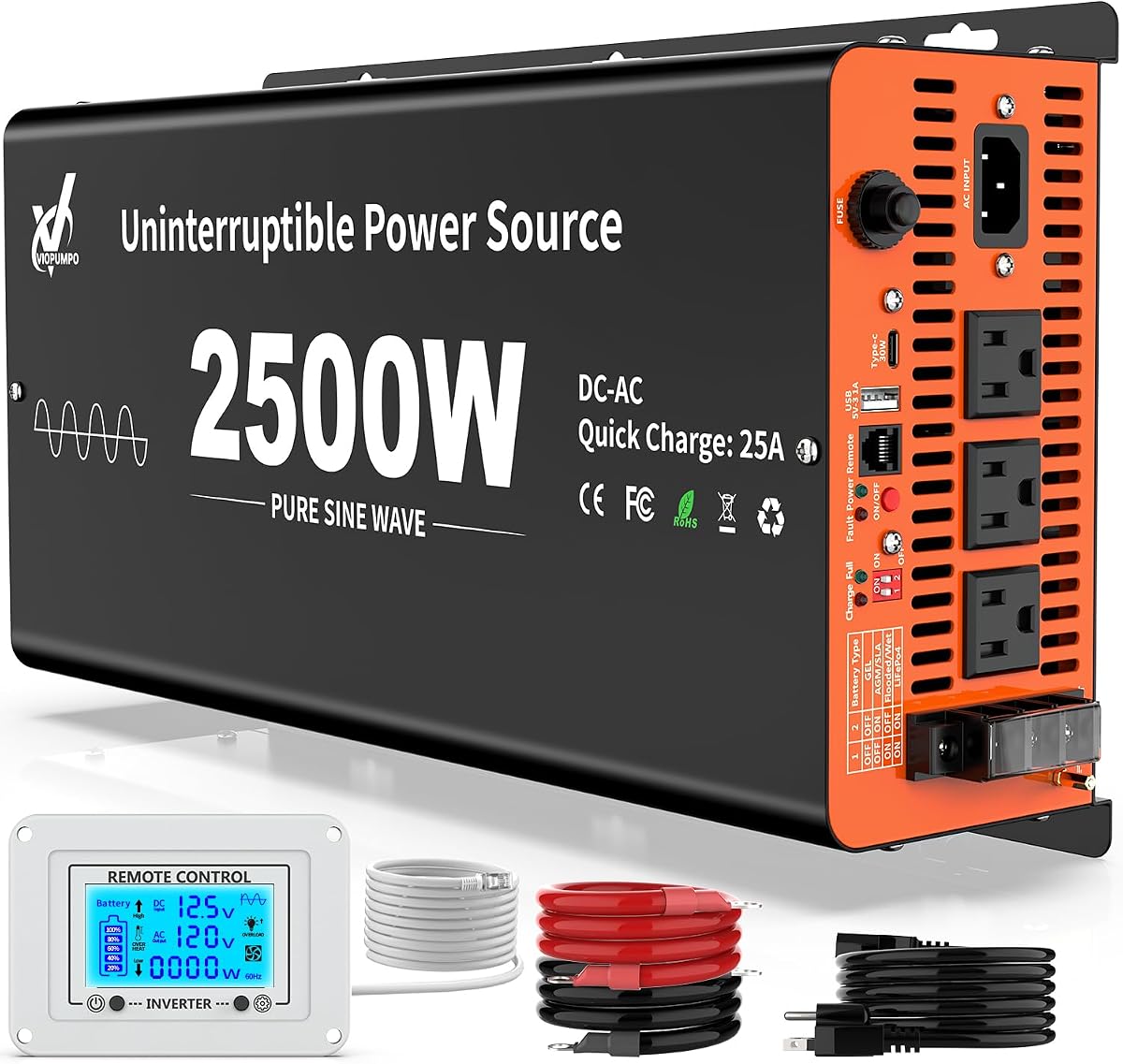

This 2500W battery backup system stands out as the most complete option in the roundup for a household that wants dependable pump support and useful emergency power beyond a single outlet. It combines pure sine wave AC output, automatic transfer to a 12V deep-cycle battery, a 25A charger, three AC outlets, USB and Type-C ports, and a wired remote controller with an LCD display.
We may earn a commission when you buy through this link, at no additional cost to you.
The system is especially useful for a primary sump pump and a limited selection of essential loads. Its selectable charging modes support LiFePO4, AGM, gel, and flooded deep-cycle batteries, while protections cover overcharge, low voltage, overload, short circuits, and overheating. The included approximately 3 AWG, 31.5-inch battery cables help reduce voltage loss during demanding motor startups.
There are important installation caveats. The battery is not included, and the floating-neutral hardwire output must not be connected directly to utility or generator power. Users also need to leave additional room around the housing for wiring and ventilation. These limitations make it less convenient than a simple plug-in unit, but they also give an installer more control over a professionally planned system.
This is the strongest all-around recommendation for homeowners with a moderate-size pump who want a dedicated backup inverter, clear status monitoring, and the option to run several essential devices. Confirm the pump's startup requirements, select a suitable deep-cycle battery, and use the manual for all final connections.
Three grounded AC outlets and both USB and Type-C ports allow the inverter to support a sump pump alongside selected household electronics. The output remains useful during an outage without turning the unit into a whole-home generator.
The remote LCD provides visibility into battery voltage, load status, and operating mode. That information makes routine checks faster and helps identify a weak battery or overloaded output before a storm arrives.
We may earn a commission when you buy through this link, at no additional cost to you.
The Viopumpo 2500W system is a well-rounded sump pump backup inverter aimed at users who need straightforward automatic switching, clean AC output, and clear operating information. It supports resistive and inductive loads, uses a pure sine wave waveform, and includes a wired LCD remote for checking voltage, power, and battery charge status.
We may earn a commission when you buy through this link, at no additional cost to you.
A built-in 25A charger supports fast and trickle charging for compatible deep-cycle batteries. Protection against overcharging, low voltage, overload, short circuits, and overheating adds safeguards for long-term use. The installation approach is relatively accessible because the system is designed around connecting the AC and DC cables and plugging the pump into an outlet.
The product is not a complete battery-backed flood-prevention package on its own. A suitable deep-cycle battery is not included, and ordinary non-deep-cycle batteries are not appropriate. The listed accessories do include the inverter, cables, remote control, and manual, while the flat or wall-mounted case helps locate the unit near the pump.
Choose this model if you want a 2500W pure sine wave inverter with a strong remote-monitoring feature set and a comparatively simple installation process. Compare its charging and transfer specifications with the 10ms InsensVert model if extremely brief transfer time is your main priority.
Pure sine wave output is well suited to a sump pump motor because it provides smooth, grid-like AC without the abrupt transitions associated with modified sine wave power. It also allows the inverter to serve other suitable loads during an outage.
The unit can be placed flat or wall-mounted using its side fixing holes. Its no-additional-wiring installation approach is attractive for homeowners who can safely handle high-current battery and AC connections themselves.
We may earn a commission when you buy through this link, at no additional cost to you.
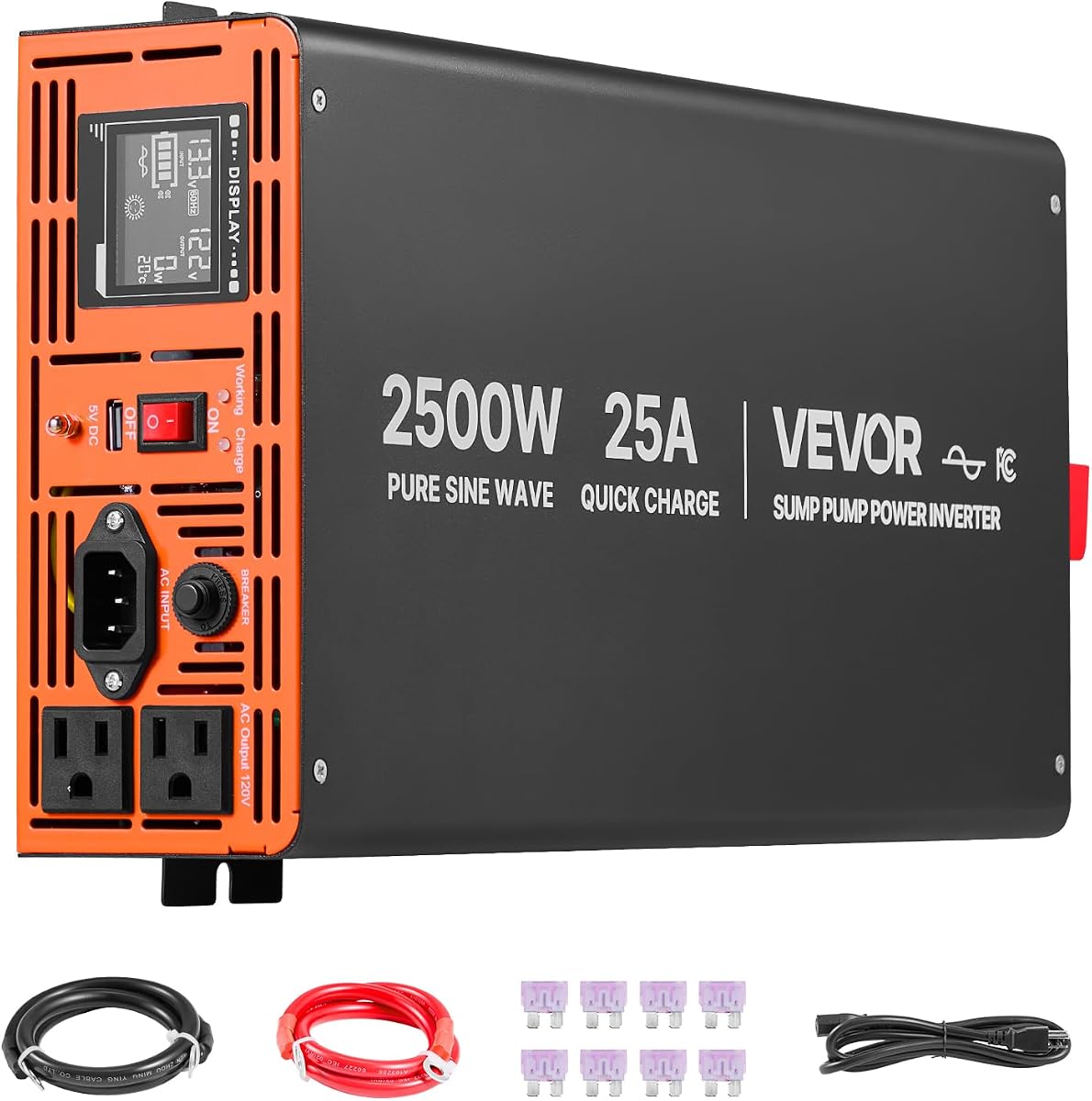
This VEVOR model combines a 2500W pure sine wave inverter with support for a 1 HP main pump and a 1/3 HP backup pump. It is a compelling choice for a home with more than one drainage device, particularly when a single pump system is not considered sufficient during severe weather.
We may earn a commission when you buy through this link, at no additional cost to you.
Its three-stage charging process moves through bulk, absorption, and float stages and is compatible with 12V lead-acid, AGM, gel, and LiFePO4 batteries. An LCD and LED indicators provide information about voltage, battery level, and operating status, while overcurrent, overvoltage, short-circuit, reverse-polarity, and high-temperature protection reduce common installation risks.
The standard three-prong plug-in design is the main convenience feature. It reduces the amount of permanent modification required and can be easier to commission than a hardwired arrangement. However, the system still needs a properly sized deep-cycle battery, and its single AC outlet plus USB port is less accommodating than the multi-outlet designs offered by some competitors.
This is a practical selection for users who prioritize dual-pump support and quick setup without moving to a general-purpose 3000W inverter. Verify both pump ratings against the system guidance and ensure the battery has enough capacity for the expected outage duration.
The stated 1 HP plus 1/3 HP support is the defining feature. It gives owners a clear configuration target and reduces ambiguity when comparing the inverter with systems intended for only one pump.
Bulk, absorption, and float stages give the charger a more structured charging cycle than a basic trickle charger. This is useful for maintaining a deep-cycle battery that will be called upon during a storm.
We may earn a commission when you buy through this link, at no additional cost to you.
The VUFUMSY system is built around two-pump operation and an automatic transfer time stated at under 15 milliseconds. With 2500W of continuous capacity, it is aimed at configurations combining a 1 HP main pump with a 1/3 HP backup pump during utility outages.
We may earn a commission when you buy through this link, at no additional cost to you.
It accepts lithium, AGM, gel, and lead-acid batteries, and the product information provides useful capacity guidance: a 200Ah battery is described as powering two pumps in the stated configuration, while a 100Ah battery is described as running one 1 HP pump. These figures are useful starting points, though actual runtime depends on duty cycles, water volume, and battery condition.
The LCD shows voltage, battery level, and system status in real time. Overload, voltage, temperature, short-circuit, and reverse-polarity protection are included, along with FCC certification. The installation is designed around mounting, plugging, and connecting rather than comprehensive rewiring, but the claim that no electrician is needed should not override local electrical requirements.
Select this model if simultaneous pump support and a sub-15ms transfer are your leading requirements. It is less necessary for a home with one small pump, where a 1500W model may be more proportionate, but its safeguards and monitoring make it a credible storm-prepared option.
A transfer time below 15ms minimizes the chance that a running pump will notice a brief power interruption. That makes this system particularly relevant to installations that already rely on a second pump.
The stated battery-capacity examples make it easier to begin planning. Since actual drain varies, treat them as starting points and consider pump amperage, battery age, and the length of the expected outage.
We may earn a commission when you buy through this link, at no additional cost to you.
The InsensVert 2500W UPS inverter is the pick for buyers who place the greatest emphasis on transfer speed. Its stated automatic switch occurs in under 10 milliseconds, while 5000W of peak power provides additional headroom for motor startup. The continuous 2500W rating and pure sine wave output make it suitable for a sump pump and other compatible equipment.
We may earn a commission when you buy through this link, at no additional cost to you.
Its display is unusually comprehensive, showing voltage, output power, battery level, frequency, internal temperature, and active protection status. Soft-start technology gradually raises output during pump startup, which can reduce current surges and help protect the motor. The inverter also includes overload, over-temperature, short-circuit, voltage, overcharge, reverse-polarity, and circuit-breaker protections.
The 25A three-stage charger supports several lead-acid types and LiFePO4 batteries. The information states that a 100Ah battery can recharge in about four hours, although charging time will vary with battery condition, chemistry, and use. The included three-prong connection scheme and two-foot 3 AWG copper cables simplify setup, but those short leads may be less convenient in a larger utility room.
This is a strong fit for a pump installation where minimal transfer interruption and detailed diagnostics matter more than having numerous outlets. It offers one of the shortest stated switch times in the roundup, along with one of the most complete monitoring packages.
The rapid transfer behavior keeps a pump running with virtually no intentional interruption. For households that cannot tolerate a restart every time the grid fails, this is one of the most meaningful specifications in the roundup.
Sump pumps draw a strong startup surge. Soft start brings the inverter into load more gradually, reducing the abrupt power demand that can stress a motor or trip an inverter protection circuit.
We may earn a commission when you buy through this link, at no additional cost to you.
This 1500W sump pump backup system offers a smaller-capacity alternative without giving up several of the convenience features found on higher-output models. It provides pure sine wave output, three AC outlets, USB and Type-C ports, a 25A multi-stage charger, and a wired remote controller with an LCD display.
We may earn a commission when you buy through this link, at no additional cost to you.
It supports LiFePO4, AGM, gel, and flooded deep-cycle batteries and automatically returns to grid power for recharging when utility service resumes. Protection against overcharge, overload, short circuits, low voltage, and overheating provides a useful safety layer. The included approximately 5 AWG, 31.5-inch battery cables are substantial for the inverter's output class.
Its main limitation is capacity. A 1500W inverter has less headroom for larger pump motors, startup surges, or several simultaneous loads than a 2500W or 3000W unit. The floating-neutral hardwire output also must not be connected to utility or generator power, so installations requiring a transfer arrangement need professional design.
This is an attractive choice for a typical residential sump pump in a relatively compact space. Its combination of remote monitoring, multiple outlets, and a fast charger is unusually complete, provided the pump's startup and running requirements remain comfortably within the inverter's capability.
The housing is smaller than the 2500W model in the same series, which can make it easier to place near the battery and pump. That physical efficiency is valuable in utility rooms where every inch of shelf space matters.
A wall-mounted controller can show battery voltage, load level, and operating mode without requiring you to inspect the inverter itself. It is particularly handy when the main equipment is installed low, enclosed, or in a separate part of the basement.
We may earn a commission when you buy through this link, at no additional cost to you.
This Viopumpo 2500W system provides pure sine wave output, three grounded AC outlets, a wired remote LCD, and automatic switching between grid and battery power. Its 25A operating current and multiple outlets make it suitable for more than one sump pump in the configuration described by the manufacturer.
We may earn a commission when you buy through this link, at no additional cost to you.
A distinctive feature is the adjustable input-voltage range of 9.5V to 11V, intended to improve compatibility with certain lithium batteries. The setting must be adjusted while the inverter is off, and changing it incorrectly can affect battery performance. Additional protections cover overheating, short circuits, low voltage, and overcharging, while a cooling system helps manage heat.
The USB and Type-C ports expand its usefulness during an outage, allowing selected phones, lighting, or small electronics to be charged. Installation is designed to avoid complicated rewiring: the user assembles the AC and DC cables, connects the pump, and chooses flat or wall placement. The included manual and remote control support a straightforward initial setup.
This system is a good match for buyers who want the Viopumpo feature set with more explicit voltage control. It is especially relevant when the battery chemistry requires precise setup, though users should follow the manual rather than changing the input setting without understanding the battery's recommended range.
The 9.5V to 11V adjustment can help match inverter behavior to compatible lithium battery characteristics. Because the setting changes how the unit draws from the battery, it should be selected deliberately and confirmed while powered off.
Three grounded outlets support a pump and other essential loads, while USB and Type-C connectivity covers smaller devices. That flexibility makes the unit more useful during an extended outage than a single-outlet inverter.
We may earn a commission when you buy through this link, at no additional cost to you.
The Renogy Inverter P2 is the most capable general-purpose inverter in the group, providing 3000W of continuous DC-to-AC output and 6000W of peak surge. That headroom is useful for a sump pump, particularly one with a substantial startup draw, and it also creates room for essential household equipment.
We may earn a commission when you buy through this link, at no additional cost to you.
Its pure sine wave output and greater than 90% conversion efficiency are designed to provide clean, efficient power. The inverter includes three AC outlets, one AC terminal block, a built-in 5V USB port, and a 16.4-foot wired remote. It is compatible with lithium, AGM, SLD, gel, and flooded batteries, making it a flexible choice for users with different battery setups.
Safety is a major strength. The unit carries UL 458 and CSA C22.2 No. 107.1 certification and includes LED fault indicators, under- and over-voltage protection, over-temperature and overload protection, short-circuit indication, cooling fans, and GFCI protection. The metal housing is designed to withstand bumps and impacts. However, this is not marketed as a dedicated sump pump UPS, and no integrated battery charger is listed.
Choose it if you want premium inverter capacity, recognized certifications, and the flexibility to power a pump, electronics, lighting, or appliances from a 12V battery source. It is best suited to buyers who understand battery charging and system integration rather than those seeking a turnkey sump-pump-specific kit.
A 3000W continuous rating and 6000W surge allowance can accommodate demanding loads more comfortably than lower-rated units. The margin is helpful because a sump pump's startup demand can be much higher than its steady operating draw.
UL 458 and CSA C22.2 No. 107.1 certification are meaningful for an electrical device intended for regular use. The included GFCI, fault indicators, and cooling system further support safe operation in demanding environments.
We may earn a commission when you buy through this link, at no additional cost to you.
The VEVOR 1500W model is a focused, budget-conscious option for a standard residential sump pump rated at up to 3/4 HP. It provides pure sine wave output, automatic battery takeover, three-stage charging, an LCD, LED status indicators, one AC outlet, and a USB port.
We may earn a commission when you buy through this link, at no additional cost to you.
It supports 12V lead-acid, AGM, gel, and LiFePO4 batteries. Bulk, absorption, and float stages are intended to optimize charging and battery life. Safety features include overcurrent, overvoltage, short-circuit, reverse-polarity, and high-temperature protection, plus a circuit breaker for an additional layer of control.
The standard three-prong plug design makes installation less complicated than a hardwired system. That simplicity is one of its strongest advantages for a straightforward backup installation. Its limitation is expansion: with only one AC outlet, the inverter is less suitable for a second pump or multiple important loads. The 1500W rating also leaves less startup and surge headroom than the 2500W and 3000W models.
This is the best-value selection in the roundup for a homeowner with one smaller pump who wants clean output, a smart charger, and a quick setup. It is less suitable for dual-pump systems, larger motors, or users who need several emergency outlets.
The stated support for pumps up to 3/4 HP gives buyers a useful target. This focused capacity can be preferable to paying for additional output that will never be used.
The plug-in approach reduces installation time, while the LCD and LED indicators provide immediate operating information. It is a practical combination for straightforward basement protection.
We may earn a commission when you buy through this link, at no additional cost to you.
The VEVOR 2000W system occupies the middle ground between the 1500W and 2500W VEVOR options. It is designed for sump pumps up to 1 HP, uses pure sine wave output, automatically switches to a battery, and includes a three-stage charger, LCD, LED indicators, an AC outlet, and a USB port.
We may earn a commission when you buy through this link, at no additional cost to you.
Battery compatibility is broad, covering 12V lead-acid, AGM, gel, and LiFePO4 types. Its protection suite includes overcurrent, overvoltage, short-circuit, reverse-polarity, and high-temperature handling, with a circuit breaker. The standard three-prong plug also supports quick setup without requiring permanent rewiring.
The single AC outlet is restrictive compared with multi-outlet competitors, and the customer feedback is less favorable than the other products in the roundup. That does not make it unusable, but it warrants more careful consideration of the listing, support terms, and installation guidance before purchase. It also lacks the 2500W model's explicit dual-pump configuration.
This model makes the most sense for a single pump up to 1 HP where 1500W feels too constrained and 2500W would provide more capacity than needed. Its clean output, smart charging, and clear status display are solid fundamentals, but the extra power and broader outlet options of a higher-ranked system may be worth considering.
The 2000W rating provides more headroom than a 1500W system while remaining below the output of 2500W and 3000W alternatives. It is a logical middle option for one appropriately sized pump.
Reverse-polarity, overcurrent, overvoltage, thermal, and short-circuit protection cover several common electrical faults. The circuit breaker adds another layer of control around the inverter output.
We may earn a commission when you buy through this link, at no additional cost to you.
Choosing a sump pump inverter means balancing motor startup requirements, battery endurance, safe electrical integration, and the amount of emergency power you expect to use. The following factors are more informative than headline wattage alone.
Begin with the nameplate information for your sump pump, especially its running amps, starting surge, and horsepower. The inverter's continuous output must comfortably exceed normal pump demand, while its surge capability should handle startup. Several products are explicitly designed for pumps up to 3/4 HP, one 1 HP pump, or a 1 HP plus 1/3 HP dual configuration. A higher-capacity inverter provides more margin, but a unit that is unnecessarily large may add cost, size, and complexity without improving the basic pumping result.
None of the included systems comes with a battery, so battery selection is part of the purchase. A deep-cycle battery is the standard choice because it can tolerate repeated charging and discharging. The products support combinations of AGM, gel, flooded lead-acid, and LiFePO4 batteries, although not every model supports every chemistry. Capacity in ampere-hours determines roughly how long the system can run, but inverter draw, pump load, battery age, and conversion losses all affect real runtime. Use the stated battery-size guidance only as an initial estimate.
Automatic transfer speed determines how quickly the inverter takes over after utility power fails. Products in this roundup range from under 10 milliseconds to under 15 milliseconds, while some descriptions simply state automatic switching. A very short transfer helps keep a running pump from restarting and reduces stress on the motor. It is particularly valuable in a dual-pump setup, where continuity of the primary pump matters and the second unit may be intended to take over.
Every system listed provides pure sine wave output, which is the preferred waveform for inductive motor loads and sensitive electronics. It is smoother and more grid-like than modified sine wave output, reducing the likelihood of unusual motor noise, heat, or interference. Pure sine wave power also makes an inverter more useful for essential household devices during an outage. If the unit will only power a basic pump, waveform quality may seem like a minor issue, but it is a meaningful advantage when the inverter serves a broader emergency-load set.
Look for a multi-stage charger that moves through bulk, absorption, and float stages, since this is better suited to maintaining a deep-cycle battery than a basic trickle approach. Several systems use a 25A charger, which can replenish a suitably sized battery relatively quickly, although actual charge time depends on chemistry and condition. A model with selectable charging modes may work better across different batteries. Also check whether the inverter includes charging at all; the Renogy P2 is a power inverter and does not list an integrated charger, so it requires a separate charging arrangement.
The number and type of outputs determine how useful the inverter will be during an outage. Three AC outlets, USB, and Type-C ports provide more flexibility than a single AC outlet, especially if you want to keep a router, lighting, communications equipment, or selected household devices running. An LCD with a wired remote can expose voltage, load, battery level, operating mode, and fault status without requiring direct access to the inverter. The most useful display is one that clearly indicates battery condition and active protections.
Decide whether you want a plug-in arrangement, a hardwired UPS configuration, or a professionally designed transfer system. Plug-in models are easier to commission, while hardwired systems can offer more installation flexibility but introduce complex safety and neutral-ground considerations. Look for overcharge, overload, low- and high-voltage, short-circuit, over-temperature, and reverse-polarity protection. A circuit breaker, GFCI, cooling system, soft-start function, and recognized safety certification add further assurance. Follow the manufacturer instructions and local electrical requirements.
A larger inverter does not automatically produce longer battery runtime if the battery remains the same size. Estimate runtime by comparing the pump's average draw with the battery's usable capacity, then subtract conversion losses and reserve capacity. Loads added to the same battery can shorten that time quickly, so a pump and a few low-draw essentials may be more realistic than a pump, freezer, router, lighting, and entertainment equipment. Test the system periodically under load and replace or recharge the battery according to its manufacturer's guidance.
Before installation, identify the pump's horsepower, running current, surge demand, voltage, and plug configuration. Read the inverter manual, confirm that the chosen battery chemistry is supported, and locate the unit in a dry, ventilated area near the battery and pump. Avoid extension cords unless the manufacturer expressly permits them for the load, and never exceed the inverter's continuous or surge ratings.
With utility power off, connect the inverter to the battery using correctly sized cables and observe polarity. Attach the pump to the appropriate AC output, then configure the charging mode and any adjustable input voltage while the inverter is off. Restore grid power and confirm that the display shows normal charging, an active battery level, and no fault warnings. Test an outage by disconnecting utility power in a safe manner and observing the automatic transfer and pump operation.
Care for the system with routine visual inspections, clean dust from vents, and check terminals for corrosion or loose connections. Test the transfer and pump operation before storm season and keep the battery charged according to its manufacturer's schedule. Replace a damaged cable or failed battery promptly, and have any hardwired neutral, grounding, or transfer work reviewed by a qualified electrician.
Yes, all of the systems in this guide list the battery as a separate purchase. Select a compatible 12V deep-cycle battery in AGM, gel, flooded, or LiFePO4 form, depending on the inverter's supported chemistries. Battery capacity should reflect the pump's power draw and the desired outage runtime.
Only if the inverter's output and surge ratings support the combined load. The VEVOR 2500W and VUFUMSY systems are specifically described as supporting a 1 HP main pump and a 1/3 HP backup pump. Check startup requirements, outlet loading, and battery capacity before operating two pumps at once.
The correct size depends on the pump's nameplate running and starting current rather than horsepower alone. A 1500W model may suit a pump up to 3/4 HP, while 2000W to 2500W units provide more startup headroom and can support a 1 HP pump. Leave capacity above the pump's expected draw to account for aging and voltage changes.
A pure sine wave closely resembles utility power and is smoother than a modified waveform. It is particularly helpful for motor loads and lets the inverter support compatible sensitive electronics without unnecessary interference, heat, or noise. All ten products in this guide offer pure sine wave output.
Runtime varies with battery size, pump draw, battery age, and inverter losses. A higher-capacity ampere-hour battery generally runs the pump longer, while adding outlets for other devices reduces runtime. Use the manufacturer's capacity guidance as a starting point and perform a monitored test under realistic pumping conditions.
Not directly unless a correctly engineered transfer system and applicable electrical codes allow it. The 1500W and 2500W systems in particular state that their AC hardwire terminals must not be connected to utility or generator power. Follow the manual and consult a qualified electrician for any transfer or hardwired installation.
No. Most of the sump-specific products include a built-in 25A or multi-stage charger, but the Renogy Inverter P2 is a general-purpose inverter without a listed integrated battery charger. Confirm charging requirements before installation and arrange compatible charging equipment when necessary.
Test it at least before each storm season and periodically throughout the year. Confirm that the battery holds a suitable charge, the display shows no active fault, the inverter transfers to battery power, and the pump starts normally. Periodic testing helps reveal a worn battery, loose terminal, damaged cable, or failed protection circuit before it is needed.
The 2500W Sump Pump Battery Backup System for Basement Flood Protection is the strongest overall option because it combines 2500W pure sine wave output, a 25A smart charger, three AC outlets, and detailed remote monitoring. The VEVOR 1500W system is the most budget-focused choice for a smaller single pump, while the Renogy Inverter P2 3000W offers the most continuous capacity and recognized safety certifications for a flexible general-purpose setup.
Prioritize the pump's actual startup and running requirements, then choose a compatible deep-cycle battery with enough usable capacity for the desired runtime. Pure sine wave output, fast transfer, proper protection, and a clear battery monitor matter more than adding outlets you will never use. Installation style should match your electrical skill and local requirements, with qualified help for hardwired or transfer-switch work.
Finally, check the current listing for the latest specifications, included accessories, warranty information, availability, and price. Inverter systems are usually sold without batteries, and the complete installed cost can vary substantially with battery capacity, cable length, pump requirements, and any electrical work. Compare the full backup setup rather than judging only by the inverter's headline wattage.