
VEVOR Rotary Laser Level Kit
4.0Editor score
1,650-foot receiver range
360-degree rotating scan
IP54 water-resistant housing
A laser level for grading gives contractors, landscapers, and survey crews a fast way to establish consistent elevations across drainage, foundations, concrete slabs, and prepared surfaces. The best models combine dependable accuracy, long receiver-assisted range, quick self-leveling, and protection against dust, rain, vibration, and frequent transport.
We compared ten rotary and self-leveling laser kits using the specifications and features supplied for each product. The list covers red and green beams, differing working diameters, self-leveling ranges, environmental ratings, included tripods and grade rods, receiver packages, and practical distinctions for outdoor and indoor construction work.
Each review explains the product's strongest use case, notable specifications, and honest trade-offs. The top picks represent a budget-oriented all-in-one option, a high-rated precision choice, and a premium professional kit. Product prices and availability can change, so confirm current details before purchasing.
4.0Editor score

4.7Editor score

4.3Editor score
As an Amazon Associate we earn from qualifying purchases.
The comparison below places all ten kits side by side, emphasizing the distinctions that matter most for grading: accuracy, working range, beam color, environmental protection, self-leveling capability, and the accessories included with each package.

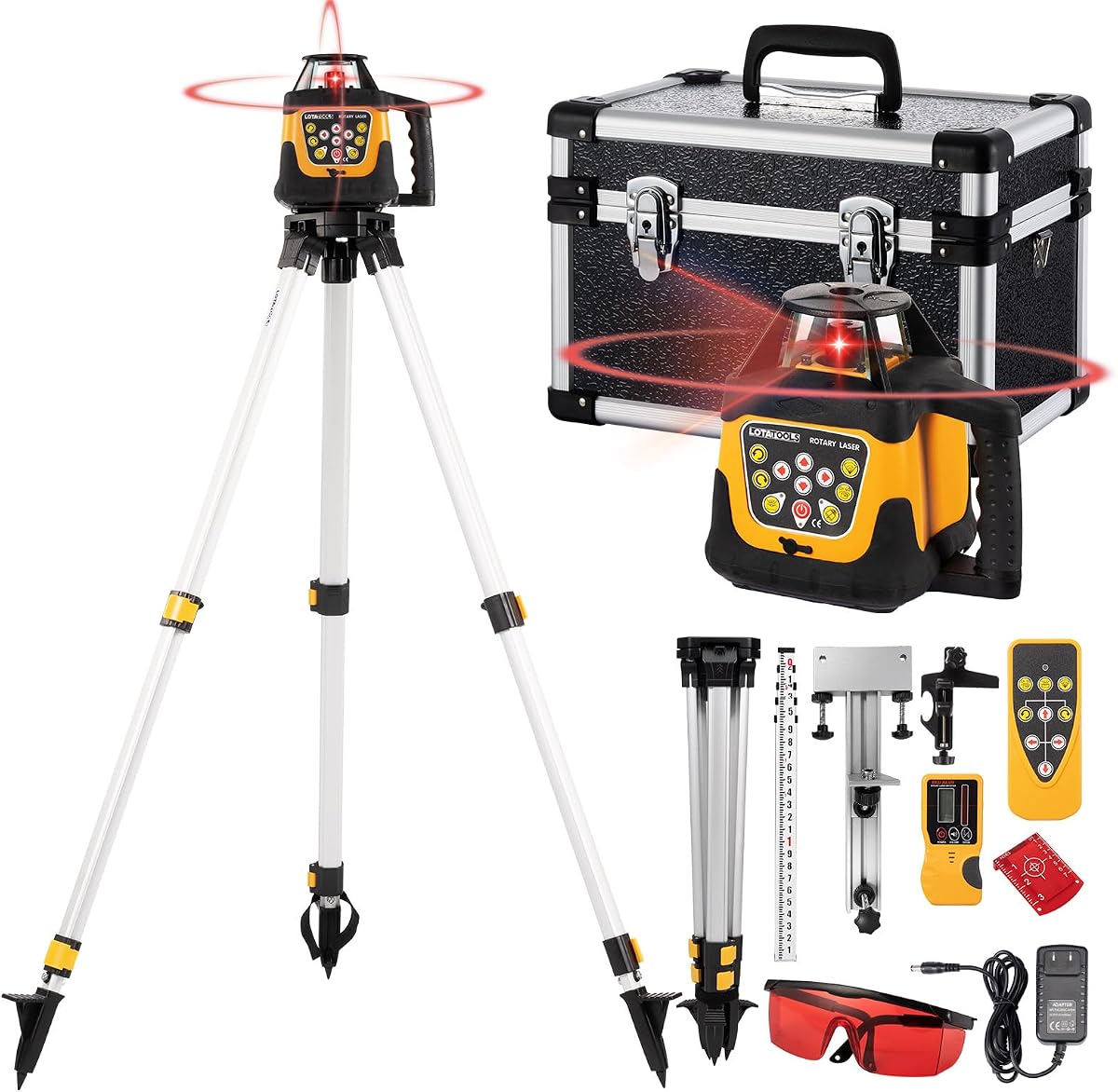


This VEVOR rotary laser kit is the value-oriented selection in a list where most competitors include extensive site-ready accessories. Its 4.0 rating reflects a generally capable package centered on a red 360-degree self-leveling laser, a receiver, tripod, grade rod, remote control, laser glasses, and a hard case. The stated accuracy is 0.06 inch per 100 feet.
We may earn a commission when you buy through this link, at no additional cost to you.
The kit's strongest attraction is its combination of working range and included equipment. With the receiver, the advertised range reaches 1,650 feet, while variable rotation speeds of 0, 60, 120, 300, and 600 rpm and several scan angles allow the operator to adapt the beam pattern. Four 1.2-volt NiMH cells provide a stated 8–12 hours per charge, and the 5/8-inch mounting thread fits common rotary-laser tripods.
The trade-off is its IP54 protection rating, which is below the IP66 rating offered by many competitors in this guide. That distinction matters when the laser will regularly sit in heavy rain, dusty excavation areas, or wash-down environments. Its red beam is also less conspicuous in bright outdoor conditions than a green beam, making the receiver more important for practical daytime work.
This is a sensible choice for a contractor who needs a complete grading and layout package without paying for the premium brand names. It is especially attractive for general construction, excavation, foundation layout, and property-scale work where a receiver, grade rod, tripod, and transport case are all needed. For exposed sites with severe weather, a higher-rated model may be more appropriate.
Multiple rotation speeds and selectable scan angles make it possible to narrow the visible beam for a particular measurement or use a broader sweep across a large area. The included remote also reduces the need to walk back to the instrument when a control change is required.
The receiver, grade rod, tripod, laser glasses, charger, remote, and toolcase create a turnkey package. That combination is especially useful for users who do not already own compatible grading accessories.
We may earn a commission when you buy through this link, at no additional cost to you.
The DOVOH H3-360G-KIT is a green-beam rotary laser kit with a 4.3 rating and a clear emphasis on outdoor visibility. It is rated as a Class II, 520-nanometer laser below 1 milliwatt, and its beam is stated to deliver three times the output power of common laser levels. The receiver provides an operational range of 400 feet, although that figure should not be confused with the distance at which the beam itself is directly visible.
We may earn a commission when you buy through this link, at no additional cost to you.
A green beam makes this kit appealing for interior layout, exterior grade checks, and work around partially shaded structures. The receiver is essential outdoors, particularly in direct sunlight, and the included target plate and green glasses help locate the beam. A double shockproof assembly surrounds the core with two rubber cushioning layers, while dual 2,600mAh batteries are designed to support extended work.
Its principal limitation is range compared with the other rotary kits listed. Several competitors advertise 1,650 to 2,300 feet with a receiver, making the DOVOH more suitable for residential, small commercial, and localized grading projects. The grade rod is also not included and must be purchased separately. The stated five-year accuracy warranty is reassuring, but it should be read alongside the separate two-year quality warranty described for other issues.
Choose this model when beam visibility is a higher priority than maximum working diameter. It is a good fit for contractors who work in mixed indoor and outdoor environments and appreciate a robust green-beam setup with a receiver, target plate, glasses, and two batteries. For expansive sites, a long-range kit would reduce the need to reposition the instrument.
The green 520-nanometer beam is easier for many users to see than a traditional red beam, especially in interiors and shaded outdoor areas. The receiver remains the dependable method for establishing a precise reading in direct sunlight.
The double shockproof assembly adds cushioning around the internal mechanism. That design is useful for mobile crews that regularly transport the unit between foundation, landscape, and drainage assignments.
We may earn a commission when you buy through this link, at no additional cost to you.
This self-leveling rotary laser kit offers a balanced set of specifications for large-scale grading. It carries a 4.3 rating, uses a red Class II 635-nanometer laser rated below 5 milliwatts, and states an accuracy of plus or minus one-eighth inch at 100 feet. The included receiver expands the working range to as much as 2,000 feet in diameter.
We may earn a commission when you buy through this link, at no additional cost to you.
Its automatic self-leveling mechanism operates within plus or minus 5 degrees, reducing manual setup time on uneven terrain. The accessory list is unusually complete: receiver and clamp, remote control, target plate, laser glasses, a five-section grade rod, 5.5-foot aluminum tripod, wall mount, and protective aluminum carrying case. That makes it a strong turnkey choice for a crew that does not already own these components.
Compared with the most precise options in this roundup, its one-eighth-inch rating is less exact. The red beam also has the familiar outdoor visibility limitation of shorter-wavelength beams, so the receiver is needed for distant daytime measurements. Its IP66 housing, however, provides better stated protection than the IP54-rated VEVOR kit and is appropriate for dusty or wet construction environments.
This package is well suited to grading, foundation layout, concrete alignment, drainage, and general outdoor elevation work. It particularly appeals to users who value range and included equipment more than class-leading accuracy. For a demanding staking or precision grading workflow, verify the required tolerance and consider a more tightly specified model.
A 2,000-foot receiver-assisted working diameter can reduce the number of times the laser must be moved across a large property. This is valuable for terrain grading, long foundation runs, and site-wide elevation checks.
The tripod, grade rod, receiver, remote, target plate, glasses, wall mount, and case cover the core needs of a new grading setup. Crews can organize the equipment in one protective case between assignments.
We may earn a commission when you buy through this link, at no additional cost to you.
This rotary laser level kit stands out with the highest listed rating in the comparison, at 4.7, and specifications that make it credible for demanding elevation work. It claims accuracy of plus or minus one-sixteenth inch per 100 feet and a receiver-assisted working range of up to 2,296 feet. Its housing carries an IP66 rating, and the stated operating range is 14°F to 122°F.
We may earn a commission when you buy through this link, at no additional cost to you.
The ability to work in both rotary and transit modes is one of its most useful distinctions. A continuous 360-degree sweep supports elevation transfer and general grading, while single-beam transit operation can be useful during excavation, foundation work, drainage layout, and interior elevation tasks. Automatic self-leveling is designed to stabilize within seconds after the unit is placed on the tripod.
One operational note is that the laser displays flashing dots while auto-leveling, and the beam may not yet be directly visible at that stage. Once leveling stabilizes, the unit begins rotating and produces a continuous line. Buyers should also note that the supplied description provides less detail about included accessories than many other products, although the kit includes a receiver, tripod, 9-foot grade rod, and aluminum case.
This is the strongest all-around recommendation for a buyer who values precision, range, durability, and operating flexibility. It should appeal to contractors handling large grading projects, drainage networks, foundation elevations, and concrete formwork. Users who need additional controls or mounting hardware should confirm the package contents before ordering, but the core grading functions are impressively well specified.
The one-sixteenth-inch accuracy and 2,296-foot working range combine to support extended elevation transfers. This makes the model practical for large properties where frequent relocation would otherwise slow the workflow.
Rotary mode provides a continuous sweep, while transit mode concentrates the beam for elevation transfer. Using both functions allows the same instrument to handle broad grading checks and focused layout tasks.
We may earn a commission when you buy through this link, at no additional cost to you.
The Topcon RL-H5A is a professional construction laser with a 4.5 rating and a specification centered on refined self-leveling performance. The self-leveling motors are accurate to plus or minus 10 arc seconds, and the instrument can cover an 800-meter diameter when paired with the included LS-80 receiver. That range comfortably accommodates large grading and construction environments.
We may earn a commission when you buy through this link, at no additional cost to you.
Electronic self-leveling is designed for fast startup: the operator presses the power button and can begin work after the unit stabilizes. If the instrument is disturbed on the job, it automatically relevels itself, reducing the need for manual recalibration. The IP66 housing is specifically positioned to withstand dust, showers, and even torrential rain, making the unit suitably robust for exposed work.
The supplied information is relatively brief, and the kit listing does not describe a tripod, grade rod, charger, or other accessories. While the laser, receiver, sensor holder, and carrying case are included, users may need to source additional setup equipment. This can make the total ownership experience less convenient than the more comprehensively bundled rotary kits in the comparison.
For contractors who prioritize a recognized professional platform, tight self-leveling specification, and broad range, the RL-H5A is a persuasive choice. It is well suited to grading, excavating, and general construction. Buyers should compare the required supporting equipment with the supplied components, but the core instrument and receiver provide a focused professional package.
Electronic self-leveling and automatic releveling help the instrument return to its working state after a bump. This is valuable on active sites where vibration and accidental contact are common.
The IP66 enclosure is designed to protect against both dust and heavy water exposure. It is a reassuring choice for outdoor grading, excavation, and drainage projects where weather is unpredictable.
We may earn a commission when you buy through this link, at no additional cost to you.
This green rotary laser level kit combines a 2,300-foot receiver-assisted working diameter with a stated accuracy of plus or minus one-tenth inch at 100 feet. Its 4.3 rating reflects a well-rounded specification set that includes a bright green Class II laser, automatic self-leveling within plus or minus 5 degrees, and an IP66 dust- and water-resistant housing.
We may earn a commission when you buy through this link, at no additional cost to you.
The included package is ready for field deployment. It comes with the rotary laser, receiver and clamp, remote control, target card, protective glasses, five-section grade rod, 5.5-foot aluminum tripod, and durable carrying case. This breadth makes it convenient for contractors replacing a complete setup rather than only a laser unit or receiver.
Its primary advantage over red-beam alternatives is visibility. Green light is often easier to locate in shaded conditions and interior environments, although direct sunlight still calls for receiver-based detection. Buyers should interpret the 2,300-foot figure as an operating diameter with the receiver, not as a distance at which the beam remains directly visible.
The kit is a strong option for landscape grading, construction layout, and mixed indoor-outdoor elevation work where both beam visibility and long range matter. Its one-tenth-inch accuracy is more than sufficient for many general grading tasks, while the included accessories eliminate much of the initial setup burden.
The green beam improves visual acquisition in many working conditions, while the 2,300-foot receiver range covers large sites. The result is a versatile instrument for both precise spotting and extended elevation transfer.
Receiver, grade rod, tripod, remote, target card, glasses, and case are all included. The package can be moved between jobs without requiring a separate collection of accessories.
We may earn a commission when you buy through this link, at no additional cost to you.
The Johnson Level & Tool 40-6517 is a self-leveling rotary laser system with a 4.1 rating. Its identifying specifications are a red beam, a 29-by-7-inch format, and a Class IIIa laser classification with maximum output at or below 5 milliwatts. The supplied information is concise, so this review focuses on the product's format rather than unsupported performance claims.
We may earn a commission when you buy through this link, at no additional cost to you.
Rotary laser systems are particularly useful when a crew needs one reference elevation across a broad area. A self-leveling design can reduce the manual adjustment required after placing the unit on a tripod, while the red beam remains familiar to many construction and surveying users.
The absence of published range, accuracy, ingress-protection, and accessory details in the supplied product data makes direct comparisons more difficult. Potential buyers should request those specifications if the work demands a particular tolerance or exposure rating. The Class IIIa designation also deserves attention when comparing the unit with lower-class green or red alternatives.
This system may appeal to users who prefer a compact Johnson rotary format and do not need the very long working diameters advertised by several competitors. It is best considered for general construction, interior layout, and moderate-scale elevation work after confirming accuracy, range, battery life, and included components.
The system follows the standard rotary-laser layout used for continuous elevation reference. That familiarity can make setup and training straightforward for construction crews accustomed to this tool category.
The available product information does not state working range, accuracy, or sealing level. Those details should be confirmed for a demanding grading application rather than inferred from the self-leveling designation alone.
We may earn a commission when you buy through this link, at no additional cost to you.
The Klein Tools 93RLS is the premium-oriented pick in this guide, with a 4.3 rating and a focus on battery life, visibility, and job-site protection. It projects horizontal and vertical green lines with 360-degree coverage, includes an integrated plumb spot, and has a stated range of 1,150 feet when used with the included detector.
We may earn a commission when you buy through this link, at no additional cost to you.
Its built-in rechargeable battery is specified to run for up to 24 hours continuously. That figure is especially appealing for long grading days because it reduces the need to swap cells or interrupt work for charging. Impact sensing automatically pauses operation if the unit is disturbed, while audio and visual indicators help the operator detect the laser signal in challenging conditions.
The kit includes a detector, detector mount, 9-foot grade rod, charging cable, rugged carrying case, and heavy-duty tripod with 5/8-inch mounting threads. The IP66 housing supports use in dusty and wet environments. One consideration is the Class 3R green laser classification, which calls for appropriate laser-safety awareness around people and reflective surfaces.
This is a strong choice for professional crews that value long runtime, clear signals, and a comprehensive kit. It suits outdoor grading, foundations, landscaping, and general construction where a single battery charge should last through a demanding shift. The 1,150-foot range is shorter than some competitors, but the green beam and all-day power distinguish it from long-range red kits.
The integrated rechargeable battery is rated for up to 24 hours of continuous operation. That runtime is a meaningful convenience for full-day grading and layout assignments.
Audio and visual indicators make it easier to interpret detector signals. Impact sensing also pauses the laser if it is disturbed, helping preserve setup integrity on active sites.
We may earn a commission when you buy through this link, at no additional cost to you.
The VEVOR 2000-Foot Rotary Laser earns a 4.4 rating and combines a green beam, long advertised range, and extensive control options. It scans 360 degrees, supports rotation speeds of 0, 60, 120, 300, and 600 rpm, and offers selectable scan angles of 5, 45, 90, and 160 degrees. A detector expands the working distance to 2,000 feet.
We may earn a commission when you buy through this link, at no additional cost to you.
Its self-leveling tolerance is plus or minus 3 degrees, and the tool can also be aligned manually. Four 1.2-volt NiMH batteries provide a stated 8–12 hours of operation and include a charger. A remote control works from up to 65 feet away, and the standard 5/8-inch thread allows use with compatible tripods and accessories.
One important limitation is that the supplied data does not state an accuracy figure. That omission makes the tool harder to evaluate for precision grading than models with a clearly published tolerance. The description also emphasizes that a receiver is required for outdoor and indoor use because the beam is not reliably visible to the naked eye under those conditions.
Despite that caveat, the VEVOR is a feature-rich option for users who need a long-range green system and extensive beam-control options. It is well suited to large grading areas, foundation layout, and general construction. Buyers whose work depends on a defined measurement tolerance should verify accuracy with the seller before committing.
Five rotation speeds and multiple scan angles give the operator control over how broadly the laser sweeps. This is useful when the task requires a narrow, concentrated reference or a wider site-wide scan.
A remote control with a stated 65-foot range allows adjustments without walking back to the unit. The common 5/8-inch mounting thread also supports compatibility with existing equipment.
We may earn a commission when you buy through this link, at no additional cost to you.
This industrial rotary laser level kit has a 3.8 rating and distinguishes itself with a 16.4-foot, five-section telescopic grade rod. The red Class II laser is rated at 635 nanometers and below 5 milliwatts, with a stated accuracy of plus or minus one-eighth inch at 100 feet. Its receiver-assisted operating range reaches up to 2,000 feet in diameter.
We may earn a commission when you buy through this link, at no additional cost to you.
The included 5.5-foot aluminum surveying tripod has quick-clamp legs extending to 65 inches. The long grade rod is graduated in both tenths and inches, making it useful when transferring elevations and checking deeper grades. The kit also includes a receiver and clamp, remote control, laser glasses, target plate, wall mount, and protective aluminum case.
A disturbance alarm is included to alert the operator if the instrument is bumped, while automatic self-leveling operates within plus or minus 5 degrees. The IP66 housing is designed to resist dust, rain, and impacts. Its one-eighth-inch accuracy is adequate for many general construction tasks but trails the one-sixteenth-inch and one-tenth-inch models in this comparison.
The package is best for crews that need a long grade rod and complete mobile setup rather than the tightest published tolerance. It works for general site grading, excavation, structural alignment, and foundation layout. The lowest listed rating in the group should prompt buyers to evaluate the full package and warranty terms carefully before making a final decision.
The 16.4-foot rod is longer than the 9-foot and standard five-section rods supplied with most competitors. That reach can reduce the need to move the receiver during elevation transfers.
Automatic self-leveling, a disturbance alarm, and an IP66 housing support dependable field use. The tripod and case complete a setup that is easy to transport between grading assignments.
We may earn a commission when you buy through this link, at no additional cost to you.
The right laser level for grading should deliver the accuracy, beam performance, working range, and environmental protection required by your project. These factors also determine how much additional equipment and setup time the instrument will demand.
Accuracy is the first consideration for grading because a small elevation error can become a significant problem over long distances. The products in this guide publish tolerances ranging from approximately one-eighth inch per 100 feet to one-sixteenth inch per 100 feet, with the Topcon model using a self-leveling motor specification measured in arc seconds. Match the tool to the work: general site grading may not require the tightest figure, while drainage, slab formwork, and finished elevation checks may benefit from more precise specifications.
Choose the published accuracy that fits your tolerance requirements, and do not treat a range figure as an accuracy guarantee. Confirm the measurement standard and test conditions when a project has formal elevation requirements.
Working range determines whether the laser can remain in one position while the receiver reaches distant stakes, machine controls, or grade checks. Advertised figures in this roundup range from 400 feet with a receiver to as much as 2,300 feet in diameter. Remember that receiver-assisted range is not the same as visible-beam distance, and larger sites may also require the unit to be repositioned depending on obstacles, terrain, and ambient light.
For broad properties and long grading runs, prioritize a generous receiver range. For compact residential work, a shorter-range model may be sufficient and easier to manage.
Red and green beams serve the same grading function, but green is generally easier for the human eye to detect in many conditions. A green beam can be especially useful for interior layout, shaded areas, and quickly finding the line without taking your eyes far from the work. Red lasers remain a proven choice and may be less expensive, but direct outdoor visibility is often weaker.
Whichever color you choose, use the receiver for dependable elevation readings in bright conditions. Beam color affects visibility, not the need for a proper receiver on an active grading site.
Automatic self-leveling reduces setup time and the chance of an incorrect manual adjustment. The listed self-leveling ranges are plus or minus 5 degrees for several models and plus or minus 3 degrees for the VEVOR green unit. Digital models such as the Klein also include impact sensing, while the Topcon is described as automatically releveling after disturbance.
Look for quick stabilization, clear alerts, and the ability to relevel without repeating the entire setup. These features are especially valuable on uneven terrain and busy active sites.
Laser levels are routinely exposed to rain, mud, concrete dust, falling debris, vibration, and temperature changes. An IP66 rating is the strongest common rating among the selections here, while the VEVOR 1,650-foot kit uses IP54 protection. The Topcon and several other rotary systems also carry IP66 ratings, making them better aligned with prolonged outdoor exposure.
For frequent all-weather use, favor an IP66 model. If the tool will mostly operate indoors or under temporary cover, lower ratings may be sufficient, but the enclosure should still withstand the realities of transport and handling.
A rotary laser is only one part of a complete grading setup. Most of the recommended kits include a tripod and receiver, but grade rod lengths vary considerably. The industrial kit offers a 16.4-foot five-section rod, while the Klein and top-rated rotary kit include nine-foot rods, and several other packages use five-section configurations. Tripods may include quick clamps, adjustable legs, and standard 5/8-inch threads.
Choose a stable tripod and a rod long enough for the elevations being checked. Confirm that the included accessories fit your machine setup and transport requirements before purchasing.
Runtime affects productivity on large jobs. Two VEVOR kits state 8–12 hours of operation from four NiMH cells, while the Klein offers a built-in rechargeable battery rated for up to 24 hours. The DOVOH includes dual 2,600mAh batteries. Integrated batteries are convenient, whereas removable cells can be advantageous for crews that keep spare charged batteries on hand.
Choose a runtime that covers a normal shift, allowing a reasonable reserve for setup, delays, and difficult conditions. Confirm whether the charger, batteries, and power connections are included.
The most useful packages include the laser, receiver, tripod, grade rod, charger, case, remote, target plate, and protective glasses. Johnson Level & Tool 40-6517 and Topcon RL-H5A have comparatively concise bundles based on the supplied information, so buyers may need to source additional accessories. A comprehensive kit can be more economical than assembling each component separately, especially for a new setup.
Compare the entire package rather than the laser alone. Useful additions are those that directly support setup, visibility, transport, protection, or measurement.
Begin by selecting a stable tripod location with a clear line of sight to the work area. Set the tripod securely, mount the rotary laser using the standard 5/8-inch thread, and allow the unit to complete its self-leveling cycle before taking readings. Confirm that the receiver has power and that the grade rod is securely extended. On uneven ground, adjust the tripod until the level is centered and stable.
For outdoor measurement, pair the laser with its receiver and use the receiver rather than trying to judge the visible beam at long distance. Set the receiver to the approximate grade, allow it to find the beam, and then read the rod at the receiver's reference point. Recheck the rod graduations and avoid confusing the receiver reading with the rod reading. For transit work, select single-beam mode when a focused elevation transfer is needed.
Treat the instrument as precision equipment even when its housing is impact-resistant. Use the case for transport, keep the lens clean, remove dirt from the tripod clamps, and avoid immersing the unit. After a severe bump or unexpected vibration, check that it has releveled and verify the beam height against a known reference before continuing. Charge batteries as directed, inspect cords and contacts, and store the kit dry.
The appropriate tolerance depends on the project. General site grading may work with a one-eighth-inch-per-100-feet specification, while drainage, slab formwork, and finished elevation checks can justify one-tenth or one-sixteenth inch. Consider the required finished grade, distance from the laser, and local inspection criteria rather than choosing solely by the smallest published number.
Green beams are usually easier for the eye to locate in shaded and interior conditions, but neither color should be expected to remain directly visible across a large site in direct sun. A receiver remains the dependable tool for distant outdoor readings. Compare accuracy, range, battery life, and environmental ratings alongside beam color.
It is the maximum working distance over which the receiver can detect and interpret the rotating laser. It is not the distance at which the beam itself remains visible to the naked eye. Terrain, obstructions, weather, ambient light, and receiver quality can all affect practical performance, so the stated maximum should be treated as a laboratory specification.
An IP66 rating is preferable for tools that regularly face heavy rain, dust, wash-down conditions, or demanding transport. The protection rating does not make the laser immune to impact, immersion, or misuse, but it indicates stronger resistance to dust and powerful water jets than lower-rated models. Indoor-only users may need less environmental protection.
A rotary laser creates a continuous 360-degree reference useful across broad work areas, while a transit laser concentrates a beam for elevation transfer. Some models, including the top-rated rotary kit in this guide, support both modes. Choose a dual-mode tool for varied work or a rotary-only model when continuous coverage is the primary requirement.
At minimum, you need a stable tripod, rotary laser, receiver, and grade rod. A target plate, laser glasses, remote control, charger, and hard case can improve setup speed, visibility, convenience, and transport protection. Several kits include these accessories, while others require separate purchases.
A long receiver range allows one setup to serve a large portion of many sites, but terrain, obstructions, elevation changes, and site geometry can still require repositioning. For very large properties, it is sensible to plan multiple setups and confirm that the advertised diameter applies to the configuration and conditions in which it will be used.
Set the laser on a stable tripod, allow it to finish self-leveling, and confirm that its indicator shows a stable operating state. If impact sensing or a disturbance alarm is present, verify that the instrument has resumed correctly after any movement. Then check the receiver and grade rod against a known reference elevation before recording field grades.
The VEVOR Rotary Laser Level Kit is the practical value choice, combining a long receiver range with a receiver, tripod, grade rod, remote, and case. The top-rated Rotary Laser Level Kit is the strongest all-around option for buyers prioritizing ±1/16-inch accuracy, a 2,296-foot working range, IP66 protection, and both rotary and transit modes. For premium convenience, the Klein Tools 93RLS stands out with its green beam, 24-hour integrated battery, impact sensing, and complete accessory set.
Other options deserve consideration for particular workflows. The industrial kit offers a notably long 16.4-foot grade rod, the Topcon RL-H5A is a focused professional choice with precise arc-second self-leveling, and the DOVOH H3 uses a bright green beam for mixed indoor and outdoor work. Prioritize the accuracy required by your finished grade, the real-world range of your site, IP66 protection for regular outdoor exposure, and an accessory package that matches your existing equipment.
Before purchasing, verify the current specifications, package contents, safety classification, warranty terms, and accessory compatibility. Product prices, promotions, and availability change over time, so check current seller listings and manufacturer information at the moment of purchase. The right laser should not only advertise the right range; it should also make your setup faster, your readings more dependable, and your grading workflow more efficient.