
Portable Solar Generator with 40W Panel
4.8Editor score
300W station with panel
280Wh lithium battery capacity
Pure sine wave AC
Camping flashlight included
Our expert guide compares 10 lithium portable solar power stations for capacity, output, charging speed, portability, UPS support, and off-grid usefulness in
Lithium portable solar power stations combine rechargeable battery storage, AC and USB outputs, and solar charging in one self-contained unit. The best models balance usable capacity against weight, appliance compatibility, recharge speed, and the ability to sustain critical devices during outages or remote trips.
We compared all ten stations using their stated battery capacities, continuous and surge outputs, charging options, port layouts, solar-input capabilities, UPS features, weight, and intended uses. The list ranges from highly portable units for phones and camping gear to higher-capacity systems for refrigerators, tools, RVs, and essential home backup.
Each pick highlights a distinct use case, from a budget-friendly camping kit to feature-rich premium systems. Ratings reflect the supplied customer feedback, while practical details such as output limits, included accessories, app controls, and required solar equipment can vary. Availability and market conditions also change, so verify current specifications before purchasing.
4.8Editor score
4.7Editor score

4.7Editor score
The comparison below shows how the ten stations differ in energy capacity, continuous output, solar potential, and portability, with the strongest options appearing for campers, RV travelers, homeowners, and mobile professionals.




The Jackery Explorer 300 is a compact 292Wh portable power station built for hikers, campers, and travelers who need more than a small power bank without carrying a bulky generator. Its 4.6 customer rating reflects a strong balance of portability, output, and useful features. At 7.5 pounds, it is particularly easy to move between a daypack, tent, vehicle, or roadside kit.
We may earn a commission when you buy through this link, at no additional cost to you.
Two AC outlets provide up to 300W of continuous power and 600W of surge capacity. A 100W USB-C PD port handles modern phones, tablets, and compatible laptops more efficiently than basic USB-A charging, while two USB-A ports, a 120W car port, and the AC outlets cover a broad mix of electronics. The station is also described as suitable for cameras, drones, laptops, and CPAP use when device requirements and available energy are appropriate.
The LiFePO4 chemistry is an important strength. Jackery states that the battery supports more than 4,000 charge cycles before reaching 70 percent capacity, translating into a service life of more than 11 years under the stated conditions. Solar charging is flexible: a compatible 100W Jackery panel can bring the unit to 80 percent in approximately 2.8 hours, while a portable 40W panel can do so in around 7.5 hours.
This is the most compelling option for a weekend camp, road trip, photography day, or emergency kit where portability matters more than extended appliance runtime. The main limitation is its 292Wh capacity, which will not support large refrigerators for long periods. Solar panels are not included, so buyers wanting immediate off-grid charging must budget for compatible equipment separately.
The integrated handle and 7.5-pound weight make the Explorer 300 easier to carry than similarly capable stations. It suits users who need dependable power for a weekend away but do not want to compromise their packing space or mobility.
USB-C PD, multiple USB-A connections, a 12-volt car socket, and two AC outlets provide more flexibility than a basic charging station. This makes one unit practical for phones, cameras, laptops, and selected camping appliances.
We may earn a commission when you buy through this link, at no additional cost to you.
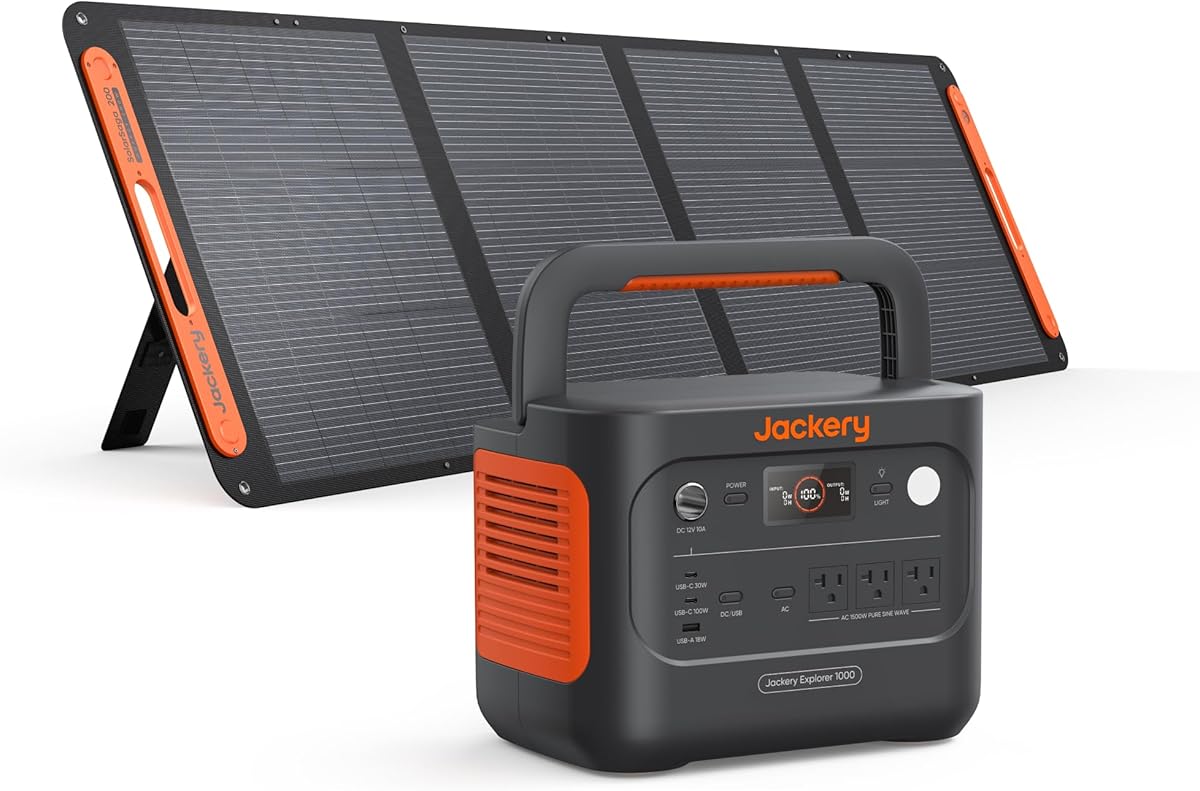
The Jackery Solar Generator 1000 v2 is an integrated power station and solar bundle for users who want meaningful household or campsite power without sourcing a panel separately. It combines 1,070Wh of capacity with 1,500W of continuous AC output, a 3,000W surge peak, and a supplied 200W foldable solar panel. Its 4.5 rating indicates a well-regarded package with broad camping and emergency appeal.
We may earn a commission when you buy through this link, at no additional cost to you.
The included panel can recharge the station to 80 percent in approximately six hours under suitable conditions. Jackery also supports faster charging through a 600W alternator charger, which can complete a recharge in about three hours. An emergency charging mode enabled through the Jackery app can fill the battery in one hour, while the normal full-charge mode takes about 1.7 hours to support long-term battery health.
Three pure sine wave AC outlets, two USB-C ports, one USB-A port, a DC car port, and an LED light provide a versatile connection layout. The battery uses durable LFP chemistry and is stated to retain more than 70 percent of its original capacity after 4,000 cycles. App controls add quiet overnight charging, energy-efficiency operation, and manual selection of charging modes.
This package is an excellent choice for medium-sized camps, road trips, and temporary backup needs involving several devices or selected appliances. It is less convenient for users who must carry it over long distances, and the one-hour charging feature requires deliberate activation in the app. The included panel is nevertheless a major advantage for anyone beginning a portable solar setup.
The matching 200W panel removes the most common setup decision for new users. Once sunlight conditions are favorable, the station can also be replenished through AC, an alternator charger, or other supported sources.
App-based emergency charging, quiet charging, and energy-efficiency settings give owners meaningful control over replenishment speed and noise. The default mode is intentionally balanced to protect battery health.
We may earn a commission when you buy through this link, at no additional cost to you.
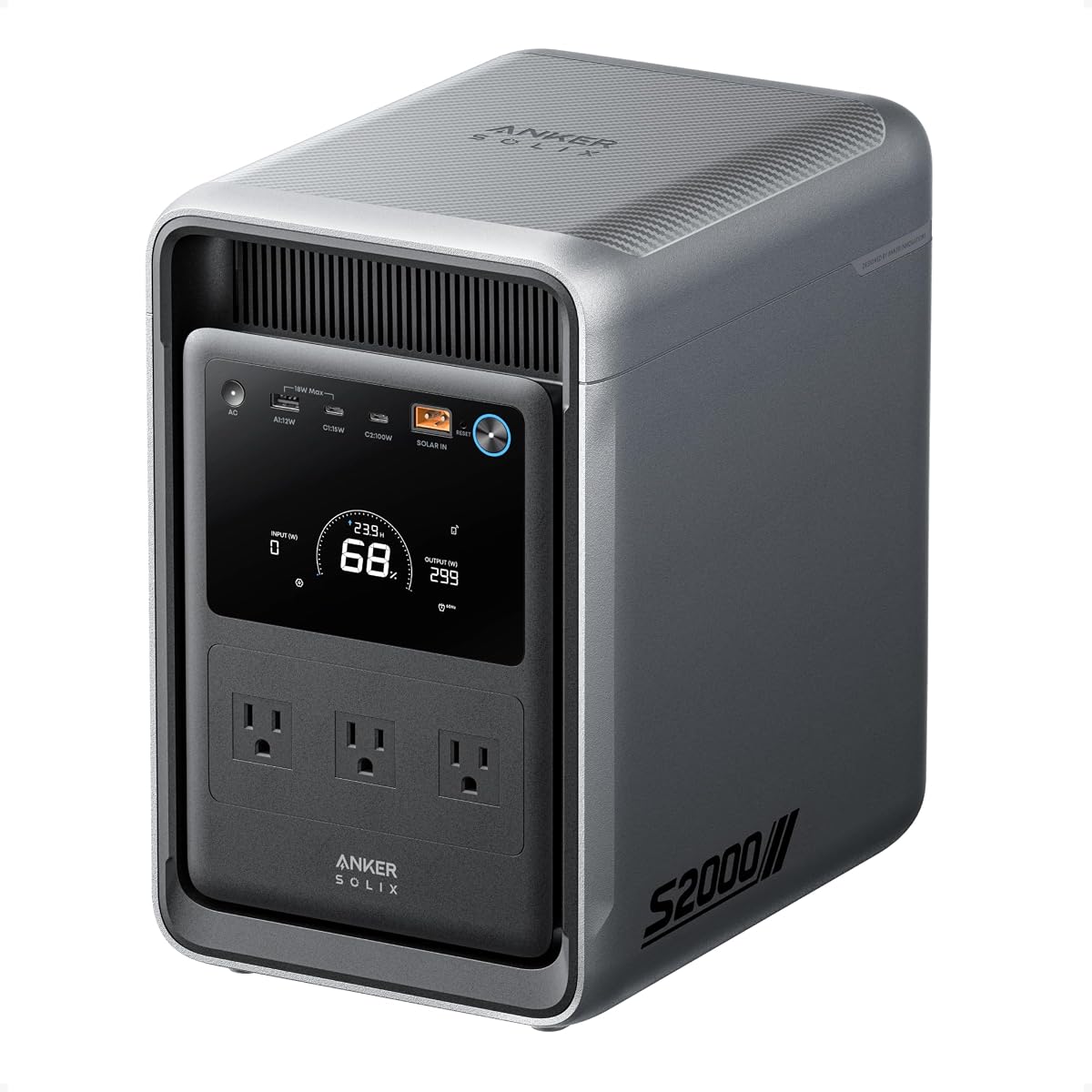
The Anker SOLIX S2000 is a high-capacity power station aimed at users who need dependable electricity for a refrigerator, communications equipment, tools, and essential home devices. It combines 2,010Wh of capacity with 1,500W of continuous output and 3,000W of peak power. Its 4.7 rating makes it one of the strongest customer-rated options in this guide.
We may earn a commission when you buy through this link, at no additional cost to you.
Efficiency is a defining feature. Anker states that a 6-watt idle draw and 10 percent higher efficiency allow the unit to run 20 percent longer than other 2kWh systems, producing an estimated 35-hour refrigerator runtime. Actual duration depends on the refrigerator model, operating conditions, ambient temperature, and usage habits. The LFP battery contains 314Ah cells and is stated to offer a 15-year lifespan equivalent to 10,000 cycles.
Charging is exceptionally flexible, with support for combined AC and solar charging, wall outlets, generators, solar panels, alternator chargers, and car outlets. Solar input reaches 400W. At 35.7 pounds and measuring 8.2 by 11.1 by 12.7 inches, it is smaller and lighter than many large stations, though it remains a substantial piece of equipment.
The S2000 is best for homeowners preparing for outages, campers who need higher output, and users who want a long service life. Its lack of a dedicated 12-volt DC port is worth noting for RV or automotive accessory setups, but the two AC outlets and front/rear arrangement still support numerous common devices.
A 2,010Wh battery and 1,500W continuous output create considerably more headroom than compact camping stations. That makes the system suitable for refrigerators, routers, lighting, selected tools, and other essential loads.
The claimed 10,000-cycle life and 15-year lifespan make the S2000 appealing to buyers planning years of regular use. Lower idle consumption can also extend usable runtime between charging sessions.
We may earn a commission when you buy through this link, at no additional cost to you.
The BROWEY S1600 stands apart with solar hardware built directly into the enclosure. Its 1,024Wh LFP battery, 1,600W continuous pure sine wave output, and 3,200W peak capacity make it suitable for refrigerators, CPAP machines, tools, camping equipment, and emergency backup. Its 4.8 rating indicates particularly strong customer satisfaction within the category.
We may earn a commission when you buy through this link, at no additional cost to you.
The integrated panel and MPPT controller provide a convenient way to begin charging without assembling a separate panel-and-station bundle. It can collect sunlight while devices are operating and can also connect with other compatible solar panels. The stated 40W solar charging rate is modest compared with dedicated high-wattage panel setups, but the built-in design adds versatility at locations where deploying a separate panel is inconvenient.
Eight ports cover AC, DC, and 100W USB-C PD, allowing several classes of device to operate at once. The advanced battery management system is described as protecting against overvoltage, overheating, and short circuits. The LiFePO4 cells are stated to last more than ten years and to retain at least 80 percent capacity after 3,000 cycles.
This model is a practical choice for campers, RV travelers, and households seeking a self-contained solar station. The built-in panel is the central advantage, although buyers needing rapid bulk solar charging may prefer a larger unit with a higher solar-input rating. Its 1,600W output still provides ample power for many mid-size appliances.
The integrated solar array and MPPT controller make the station ready for renewable charging straight from the package. Its ability to operate while collecting sunlight is useful when devices still require power.
Eight AC, DC, and USB connections support phones, laptops, medical devices, tools, and household loads. The 100W USB-C PD output is particularly useful for compatible modern electronics.
We may earn a commission when you buy through this link, at no additional cost to you.
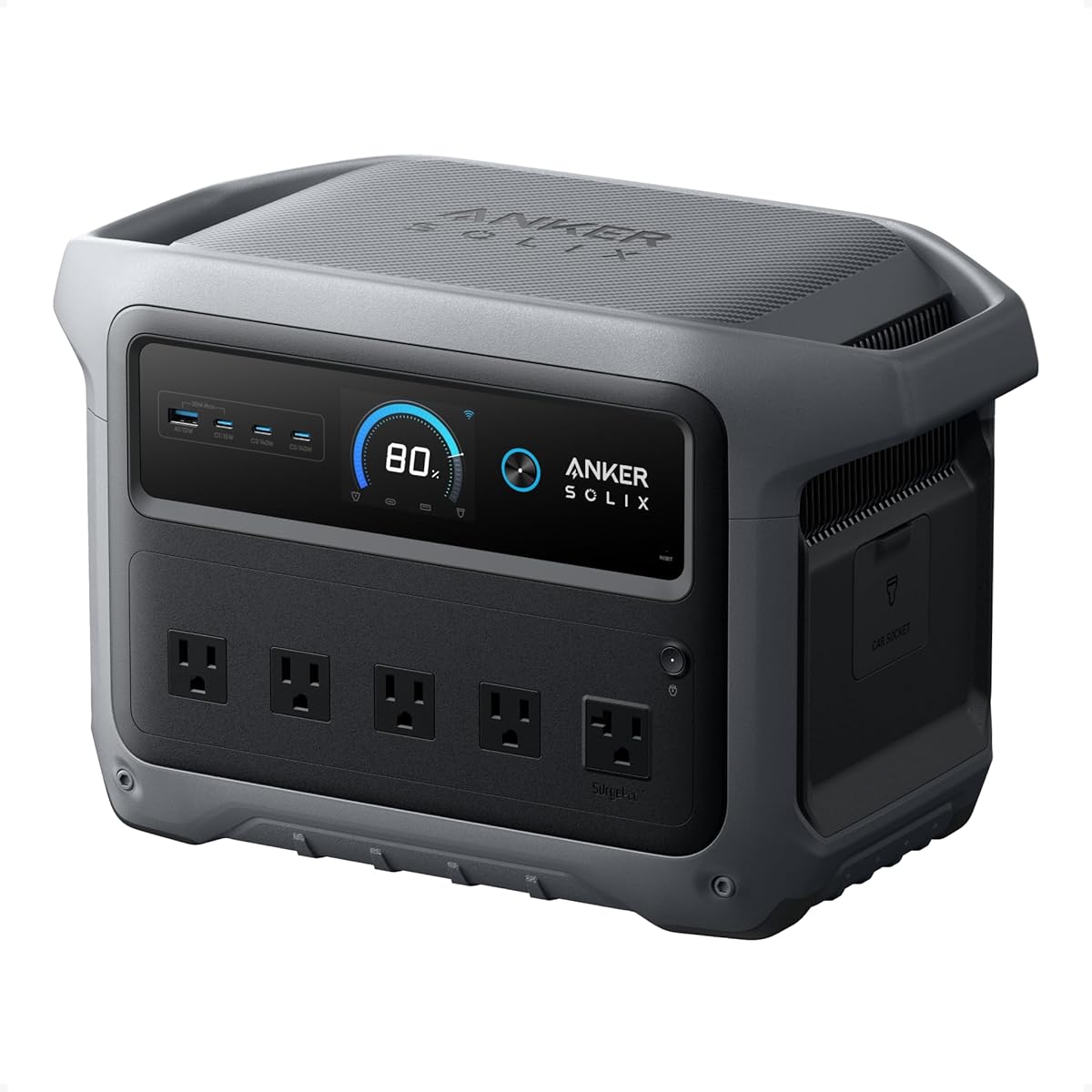
The Anker SOLIX C1000 is a roughly 1kWh station that emphasizes fast recovery, flexible charging, and broad compatibility. Its 1,056Wh LFP battery, eleven ports, and 2,400W SurgePad technology make it attractive for RV users, campers, and households preparing for outages. The 4.7 customer rating reflects a favorable balance of performance and convenience.
We may earn a commission when you buy through this link, at no additional cost to you.
UltraFast recharging is the model’s headline feature. With the function enabled in the Anker app, the battery can reach 80 percent in 43 minutes under the stated 68–122-degree Fahrenheit operating range and reach a full charge in under an hour. A smartphone is required for app control. Solar input is rated up to 600W, enabling a complete solar recharge in about 1.8 hours under suitable conditions.
SurgePad output provides up to 2,400W, giving the unit more appliance flexibility than its nominal one-kilowatt-hour capacity might suggest. Eleven ports support numerous devices simultaneously, while the LFP battery is stated to provide 3,000 cycles over a ten-year lifespan. The enclosure is also described as 15 percent smaller than comparable one-kilowatt-hour units.
This is a strong choice for people who need to replenish power quickly before leaving for a trip or when an outage warning arrives. The necessity of the app for the fastest mode may be inconvenient, and users should confirm an appliance’s surge requirements before relying on the 2,400W mode. Otherwise, charging speed and multi-device support make the C1000 stand out.
A sub-hour full charge and 43-minute 80 percent recharge are especially useful when departure time is fixed. Solar and car charging add other ways to replenish the battery away from a wall outlet.
The extensive connection layout allows phones, laptops, camping equipment, and selected appliances to share the station. App-based monitoring helps users customize charging behavior and review power statistics.
We may earn a commission when you buy through this link, at no additional cost to you.
The BLUETTI Elite 300 is the most substantial option here, with 3,014Wh of capacity, 2,400W of continuous output, and 4,800W of surge capacity. It is designed for RV travel, home backup, and extended off-grid use where running a refrigerator, router, television, CPAP machine, lights, or water pump may be necessary. Its 4.7 rating confirms strong reception among buyers seeking serious capacity.
We may earn a commission when you buy through this link, at no additional cost to you.
RV compatibility is unusually clear. A TT-30 outlet and 12-volt 30-amp DC output provide dedicated ways to operate RV appliances such as 12-volt refrigerators, water pumps, and diesel heaters. For home use, the battery can maintain essential equipment during outages, while a 4,800W surge assists with resistive loads such as kettles. Runtime still depends on each appliance’s consumption and how long it operates.
A 10ms UPS switch provides automatic backup for computers, routers, and home-office equipment when mains power fails. Smart app controls let users monitor consumption, manage outputs, and adjust settings. Recharging is available through AC outlets, solar panels, or a car charger, with the unit able to reach 80 percent in as little as 78 minutes under favorable conditions.
The Elite 300 is best for RV owners and households that need more runtime and specialized ports than a one-kilowatt-hour unit can deliver. Its compact form for a three-kilowatt-hour station helps with storage, although it remains far too heavy for casual backpack carry. A compatible solar panel is not included and must be selected separately.
The TT-30 socket and 30-amp DC output simplify connections to common RV systems. These dedicated interfaces are more useful to RV travelers than relying exclusively on standard household outlets.
The 3,014Wh capacity provides a large buffer for extended outages and multi-day trips. It also gives room to operate several essential devices without continually cycling the battery.
We may earn a commission when you buy through this link, at no additional cost to you.
The BLUETTI Elite 30 V2 is an entry-level station that still manages 600W of continuous output in a 9.4-pound package. Its 288Wh LFP capacity suits camping lights, speakers, laptops, car refrigerators, CPAP devices, and selected small appliances. The 4.4 rating is solid, although it is the lowest customer rating among the ten selections.
We may earn a commission when you buy through this link, at no additional cost to you.
Power Lifting Mode can raise available output to 1,500W for demanding loads, while normal operation supplies the stated 600W. The station is compatible with a small kettle, toaster, and other compact appliances within the relevant limits. Improved cell technology and smart cooling are said to reduce power consumption by 50 percent, helping extend runtime.
Charging options include AC wall input, solar, and a car connection. Wall charging is adjustable between 200W and 380W, with 0–80 percent achieved in about 45 minutes and a full battery-safe charge in 70 minutes. The BLUETTI PV60L solar panel is a compatible option, though no panel is included in the package.
The Elite 30 V2 is best for travelers who want more capability than a power bank but need a genuinely portable unit. Its 10ms UPS can protect laptops, routers, and CPAP equipment during short outages. The small capacity is the clear limitation, so users should estimate the combined energy demand of essential devices before relying on it overnight.
A 600W continuous rating is unusually capable for a 288Wh portable unit. It creates room for small appliances while preserving a compact form suited to camps, road trips, and storm preparation.
Adjustable wall input and a 70-minute full charge reduce downtime between uses. The rapid UPS response adds useful continuity for sensitive electronics during brief power interruptions.
We may earn a commission when you buy through this link, at no additional cost to you.
The Anker SOLIX C1000 Gen 2 combines 1,024Wh of capacity with an upgraded 2,000W continuous output, making it a versatile modern power station for outage preparation, remote work, RVs, and off-grid living. Ten ports allow up to ten devices to be powered, and the 4.7 rating indicates strong customer confidence across the product line.
We may earn a commission when you buy through this link, at no additional cost to you.
HyperFlash technology supports a full recharge at 1,600W in approximately 49 minutes when the appropriate function is enabled through the Anker app. Solar input reaches 600W at up to 60 volts, and the unit can complete a full solar recharge in about 1.8 hours under appropriate conditions. A 10ms UPS switch helps maintain laptops, routers, and CPAP machines during brief outages.
The LFP battery retains at least 80 percent capacity after 4,000 cycles, supporting a stated ten-year lifespan. The chassis is 14 percent smaller and 11 percent lighter than similar models according to Anker, which improves its suitability for movement between rooms, vehicles, and outdoor locations. Time-of-use mode helps control consumption for remote setups and off-grid monitoring.
This model is a particularly attractive all-rounder for buyers who want substantial output without moving to a three-kilowatt-hour system. It is well suited to charging many devices at once and running moderate household loads. A compatible solar panel is not included, and the app-dependent fast-charge function should be enabled before departure or use.
The 49-minute recharge capability is valuable during sudden outage preparation. Solar input offers another rapid replenishment route, while app controls help tailor behavior to the application.
Ten output ports reduce the need for multiple adapters and power blocks. The 2,000W continuous output also offers more appliance capability than most compact one-kilowatt-hour alternatives.
We may earn a commission when you buy through this link, at no additional cost to you.
The BLUETTI AC180 combines 1,152Wh of LFP capacity with 1,800W of continuous output, eight outlets, and a maximum boosted output of 2,700W. It is a flexible choice for camping, off-grid work, travel, and keeping essential household devices alive during an outage. Its 4.6 rating reflects a well-balanced combination of speed and capability.
We may earn a commission when you buy through this link, at no additional cost to you.
Fast AC charging is a major strength. At a 1,440W input, the station can go from empty to full in approximately one hour. Solar input reaches 500W, allowing a solar recharge in an estimated 2.8 to 3.3 hours, while combining solar with an AC source can reduce the total charging time to around one hour under suitable conditions.
The app can temporarily raise output to 2,700W for higher-demand appliances. For continuity applications, the built-in UPS supplies emergency power in 20 milliseconds, a useful response for computers, routers, and other essential electronics. A car charging cable, AC cable, and solar charging cable are included, along with a five-year warranty.
The AC180 is best for users who want one station to handle both rapid campsite preparation and moderate household backup. It gives more output headroom than compact models without reaching the weight and capacity of a full three-kilowatt-hour system. Buyers should note that no solar panel is included and that some high-load devices may still require careful startup assessment.
The 1,440W AC input makes the AC180 quick to prepare between trips or when outage warnings arrive. Multiple input routes add flexibility when the station is used away from a wall outlet.
The app-controlled boost to 2,700W provides extra headroom for demanding loads. Eight outlets make it easier to organize phones, laptops, tools, and selected appliances around one power source.
We may earn a commission when you buy through this link, at no additional cost to you.
This portable solar generator kit is a comprehensive starter package for tent camping, RV use, travel, and basic household emergencies. It includes a 300W main station with a 280Wh lithium-ion battery, a foldable 40W solar panel, and a separate 100W portable power pack. Its 4.8 rating makes it one of the most favorably reviewed choices in the list.
We may earn a commission when you buy through this link, at no additional cost to you.
The main station offers two 110-volt pure sine wave AC outlets rated to 300W, one DC port, three standard USB ports, one QC 3.0 USB port, and an LED flashlight with reading and SOS modes. The secondary 100W unit includes two AC outlets, DC and USB connections, USB-C, and its own reading and SOS light. This arrangement gives users two separate power sources instead of forcing every device through one battery.
The panel makes the package ready for solar replenishment, although its 40W rating means charging takes longer than with a full-size portable panel. The included battery management system provides short-circuit, overcurrent, overvoltage, and overload protection. The quiet, gas-free design also makes the kit suitable for indoor use in the stated applications.
The kit is best for new users who want a complete portable setup for phones, tablets, laptops, headphones, cameras, drones, and other small electronics. The 280Wh main capacity and 300W ceiling are modest, and the product guidance specifically advises against using certain heat-generating appliances, compressors, coffee makers, hair dryers, or water pumps.
The foldable 40W panel removes the need to purchase a separate panel for basic solar replenishment. The secondary power pack adds another charging location for smaller devices.
Reading lights and SOS modes are useful around a dark campsite or during roadside emergencies. Multiple USB options make it easier to charge mixed device types without carrying every adapter.
We may earn a commission when you buy through this link, at no additional cost to you.
The right lithium portable solar power station depends on the devices you plan to run, how long they must operate, how far the unit must travel, and whether a wall outlet, vehicle, or solar panel will be the primary charging method. Capacity and output should be evaluated separately because a large battery does not guarantee support for high-wattage appliances.
Choose enough capacity for the equipment you expect to operate without the battery reaching a critical level too quickly.
Match continuous output to normal appliance demand and ensure surge capacity covers startup.
Verify both the station's maximum solar input and the specifications of any panel you plan to add.
Prioritize correct connectors, supported charging protocols, and pure sine wave AC over simple port count.
Choose a model with fast, clearly documented UPS support when uninterrupted operation of electronics matters.
Match the station's weight and size to where it will be used most often, not merely its output class.
Look for verified cycle claims and realistic battery-care guidance rather than lifespan numbers alone.
Compare supported inputs, app behavior, and everyday charging modes before choosing a model.
Before the first full use, read the included manual, identify every port and its electrical limits, inspect the enclosure and cables, and confirm that switches are set correctly. Charge from a compatible wall outlet or approved source, use the app to select the normal charging mode, and check the displayed battery level. For solar charging, position the panel in direct, unobstructed sunlight, use the correct connector and voltage, and avoid treating the charging estimate as a fixed time because weather and panel orientation change the result.
Plan the load before traveling or facing an outage. Add the approximate wattage of every device that will operate simultaneously, confirm that the total remains below the station's continuous rating, and allow extra surge capacity for motors or compressors. Do not exceed a port's maximum output. Use pure sine wave AC for sensitive electronics, and keep the station's ventilation paths clear. It is also wise to reserve some stored energy for unexpected communications, lighting, or medical-device needs rather than depleting the battery completely.
Long-term care starts with sensible charging habits. Follow the manufacturer's instructions for storage, temperature, and charge level, and avoid exposing the unit to excessive heat, moisture, impact, or a wet solar connector. Periodically inspect cables and plugs, keep the firmware and app updated where applicable, and test UPS functions before you need them. When storing a unit for an extended period, follow its prescribed maintenance schedule and recharge it under the recommended conditions so it remains ready for the next trip or outage.
A station around 280Wh to 300Wh is enough for phones, cameras, lights, speakers, and many laptops. A roughly 1,000Wh model provides more room for CPAP devices, car refrigerators, small cooking appliances, and several electronic devices. Choose based on the combined energy demand of your equipment rather than the number of devices alone, and check both watt-hours and continuous output.
Yes, if the refrigerator's running and startup requirements fall within the station's continuous and surge ratings. A mini-fridge may work well with many midrange systems, while full-size refrigerators generally benefit from a 2,000Wh-or-larger capacity. Actual runtime varies with compressor behavior, insulation, ambient temperature, and how often the door opens.
Most models in this guide support solar charging, but the accepted input wattage, voltage, connector, and charging protocol vary. Some bundles include a compatible panel, while others require one to be purchased separately. Always verify the station's solar-input specifications and the panel's electrical ratings before connecting them.
Continuous output is the power the station can maintain over time, while surge output is a brief peak available for startup. Motors, pumps, compressors, and some appliances can draw a large surge when switching on. A device must fit within both limits, with the surge requirement checked separately from normal operation.
Yes, if its wattage and the station's output are compatible. UPS mode can transfer power automatically and rapidly, reducing interruption to computers, routers, and network equipment. The Elite 300 and C1000 Gen 2 offer 10ms switching, while other models have different response times. Test the exact devices and outlets before an emergency.
LiFePO4 is generally well suited to portable power stations because it offers strong cycle life, thermal stability, and durable daily use. It usually retains more capacity over many cycles than common consumer lithium-ion chemistry. Actual lifespan still depends on temperature, depth of discharge, charging practices, and the quality of the battery management system.
The duration depends on the station's capacity, panel wattage, sunlight, angle, temperature, and charging efficiency. A 100W panel may bring the Jackery Explorer 300 to 80 percent in about 2.8 hours, while a 40W panel takes roughly 7.5 hours under the stated conditions. Real results can differ significantly when clouds, shade, or heat reduce panel output.
Follow the manufacturer's guidance for its battery management system and any storage mode. Modern stations may regulate charging and manage heat, but prolonged unnecessary charging can still affect the battery or consume standby energy. For long-term storage, use the prescribed partial-charge level and recharge schedule rather than leaving the unit connected indefinitely.
The Jackery Solar Generator 1000 v2 is the most complete package for new solar users because it includes a 200W panel, while the Anker SOLIX S2000 stands out for high capacity, efficient refrigerator support, flexible charging, and a long battery lifespan. The BLUETTI Elite 300 is the premium choice for RV travel and substantial home backup because of its 3,014Wh capacity, TT-30 connection, high-current DC output, and rapid UPS response.
For lighter use, the Jackery Explorer 300 and BLUETTI Elite 30 V2 provide practical power without the bulk of larger systems. The ZeroKor package is the most accessible starter bundle, including both a solar panel and a second portable power unit. Before choosing, calculate the energy and peak power your devices require, confirm connector compatibility, and consider whether the unit will stay beside a campsite or travel regularly.
Specifications and current product details can change, so compare the latest manufacturer information and listing before purchasing. In particular, verify solar-input limits, UPS behavior, included accessories, output requirements, and battery-care instructions for the exact model and bundle you intend to buy.