
FlexSolar 40W Foldable Solar Panel
4.4Editor score
Only 1.76 pounds
Three charging outputs
IP67 dust and water protection
Discover the best rugged solar panels, comparing durability, power output, portability, weather resistance, connectivity, charging options, and ideal uses for
Rugged solar panels are built for demanding outdoor use, from maintaining vehicle batteries to replenishing portable power stations in camp, on the trail, or during outages. A capable model should balance durable construction, useful electrical performance, manageable size, and dependable protection against rain, dust, heat, and the stresses of repeated setup.
The ten products in this guide span compact battery-maintenance kits and high-output folding systems. We compared their stated power, cell technology, efficiency, weather ratings, output options, mounting features, portability, and intended applications. The list also highlights important differences in connector compatibility, voltage requirements, direct charging, and how readily each panel can be carried or deployed.
Each review identifies the strongest feature, practical compromises, and the buyer most likely to benefit. The top selections include a feature-rich 25W battery-maintenance kit, a compact folding charger for mobile use, and a high-output bifacial panel for demanding power stations. Product availability and pricing can change, so confirm current specifications and compatibility before ordering.
4.4Editor score

5.0Editor score
4.7Editor score
This side-by-side overview compares output, portability, environmental protection, connectivity, and the most suitable application for each rugged solar panel, helping buyers narrow the field before considering compatibility and setup details.


This 25W rugged solar battery charger is built around a clear purpose: maintaining and slowly replenishing 12V vehicle, trailer, boat, and off-grid batteries. Its 5.0 rating is the highest among the products reviewed, while the gridless black surface, Grade A+ monocrystalline cells, anti-reflective glass, and stated 25% to 30% efficiency make it a persuasive all-season maintenance solution.
We may earn a commission when you buy through this link, at no additional cost to you.
The smart MPPT controller is the most important feature for buyers who want unattended operation. It uses bulk, absorption, and float stages to reduce the risk of overcharging or deep discharge, while the listed comparison with PWM controllers suggests more efficient use of available sunlight. USB output adds convenience for phones and tablets, and compatibility with LiFePO4, AGM, SLA, GEL, and lithium batteries broadens its relevance.
The aluminum frame and tempered glass are designed for year-round exposure, with a stated operating range of -46°F to 158°F. Mounting is also thoughtfully handled through pre-drilled holes, plug-and-play wiring, LED status lights, and a bracket that adjusts through 360 degrees. That makes it easier to place the panel where available sunlight is strongest, including on curved or flat roofs and decks.
Its limitations are straightforward: 25W is not intended to power a large household, and the 12V focus is narrower than the high-voltage panels designed for large power stations. Even so, it is an excellent choice for RV, trailer, boat, car, truck, and tractor battery maintenance, particularly for someone who values intelligent charging, low-light performance, and straightforward installation over maximum wattage.
The gridless surface removes the reflective grid lines found on conventional cells, while anti-reflective glass helps collect scattered light. That design is especially relevant at dawn, dusk, during cloud cover, or beneath partial shade, where maintaining a dependable trickle or maintenance charge matters more than producing maximum midday power.
The 360-degree bracket can be mounted on flat or curved surfaces and rotated toward available sunlight. Pre-drilled holes and supplied wiring reduce setup complexity, making this practical for RV roofs, boat decks, trailers, and long-term storage locations where a fixed battery maintainer should operate without constant attention.
We may earn a commission when you buy through this link, at no additional cost to you.
The FlexSolar 100W is aimed at mobile users who need more power than a small phone charger but do not want the weight of a rigid panel. It carries a 4.4 rating, folds to a compact 12.99 by 10.43 by 2.17 inches, and weighs only 4.1 pounds, making it one of the more compellingly portable options in this roundup.
We may earn a commission when you buy through this link, at no additional cost to you.
Its output configuration is unusually versatile. The panel provides PD 3.0 USB-C up to 45W, USB-A up to 18W, and a 100W DC output. A four-in-one cable includes DC5521, DC7909, Anderson, and XT60 connections, so it can serve many portable power stations, power banks, and compatible devices. The stated 23%-plus efficiency comes from monocrystalline silicon cells and E-Film lamination.
The IP67 rating and dustproof construction suit camping, fishing, RV travel, and emergency preparation. There are trade-offs, however. A portable solar panel converts sunlight when connected but does not itself store energy, so output depends on sunlight and device compatibility. Users should also check whether a portable power station imposes a lower input limit than the panel's rated output.
This is a strong choice for backpackers, road trippers, and campers who prioritize low carrying weight and broad output options. It is less appropriate for a fixed RV installation or for someone who expects one compact panel to rapidly charge a very large power station without a suitable power-input limit.
Direct USB-C and USB-A outputs are useful for phones, tablets, and power banks, while the 100W DC path serves compatible portable power stations. This combination lets one compact panel support a mixed collection of devices without requiring a separate wall charger for every type of equipment.
At 4.1 pounds and less than an inch thick when folded, the panel is easier to pack than many comparable 100W models. The included carry bag helps protect the folds and controls, while the short packed depth fits more readily into vehicle trunks, RV compartments, and backpacks.
We may earn a commission when you buy through this link, at no additional cost to you.
The Renogy 200W Portable Solar Panel combines substantial output with a relatively compact folded format. It has a 4.5 rating and uses 16BB N-Type cells with a stated 25% efficiency. At 13.89 pounds and 23.72 by 22.99 by 1.97 inches when folded, it is designed more for organized road trips, RV use, and campsite deployment than ultralight backpacking.
We may earn a commission when you buy through this link, at no additional cost to you.
Three direct charging outputs provide useful flexibility: one USB-C PD port rated at 45W and two USB-A ports for devices such as phones, tablets, laptops, GPS units, and cameras. The MC4 output is compatible with many popular power stations, including listed Jackery, EcoFlow, and Anker models, but the four-in-one adapter is sold separately. Buyers should not assume every station connection is included.
Four kickstands allow positioning at 40°, 50°, or 60°, while reinforced grommets add confidence during setup. Its UL 61730 certification and listed CE, RoHS, FCC, CA65, PSE, and ISO 9001 claims provide additional assurance for buyers who place documentation and safety standards high on their list.
The tradeoff is weight and the need for a suitable power station with adequate input capacity. Despite that, the panel balances capacity, efficiency, direct charging, and a relatively compact fold well. It is a versatile middle ground for campers and RV travelers who need more output than a 100W panel but want less bulk than high-power 400W to 480W systems.
The built-in USB hub is a major convenience for trips where a power station is not immediately needed. A 45W USB-C PD output can serve compatible laptops and tablets, while dual USB-A ports cover smaller devices and accessories, reducing the need to carry a separate collection of wall adapters.
Three stated stand angles make it easier to adapt the panel to changing sun positions and uneven ground. The 40-degree setting suits lower light, while steeper settings can improve the angle toward midday sun. This flexibility is particularly useful on RV surfaces, tents, and campsite clearings.
We may earn a commission when you buy through this link, at no additional cost to you.
The FlexSolar 40W is a compact, lightweight alternative for campers and travelers who want to keep essential devices running without carrying a larger panel. Its 4.4 rating is supported by 24% stated conversion efficiency, three output types, and a folded weight of just 1.76 pounds. The package also includes two carabiners and a user manual.
We may earn a commission when you buy through this link, at no additional cost to you.
QC3.0 USB-A and PD 2.0 USB-C outputs are each rated up to 18 watts, and a 19V DC output can provide up to 40 watts to a compatible small station. An integrated smart IC detects connected devices, distributes charging, and provides overcurrent, overheating, and short-circuit protection. A status LED offers a simple indication of charging activity.
The panel uses monocrystalline cells and ETFE lamination, with an IP67 dustproof and waterproof rating for the panel itself. One qualification is important: the junction box is not fully waterproof, so the manufacturer recommends storing it indoors during heavy rain. The panel also does not store energy and can lose substantial output when shaded or partially covered.
For a mobile user, the trade-offs are acceptable because portability is exceptional. It is a strong fit for emergency kits, backpacks, fishing trips, and small camps where phones, tablets, and power banks are the priority. It is less suited to rapidly replenishing a large power station, and users who cannot protect the junction box from heavy rain should choose a fully sealed alternative.
The folded dimensions of 8.0 by 11.1 by 1.8 inches make the panel easy to place in a backpack, vehicle organizer, or emergency kit. At 1.76 pounds, it can be carried during hikes and mobile camping trips without feeling like a substantial piece of equipment.
The USB-C and USB-A ports support modern phones, tablets, and power banks without requiring a separate wall adapter. Smart load distribution is designed to optimize connected devices, although the manufacturer notes that using one port may deliver peak efficiency compared with sharing the panel's output.
We may earn a commission when you buy through this link, at no additional cost to you.
This 400W foldable panel is designed for buyers who want substantially more charging capability without moving into the heaviest premium systems. It carries a 4.5 rating and specifies premium monocrystalline cells with 23.4% conversion efficiency. Its output is listed as stable 400W at 40V, making power-station compatibility the central consideration.
We may earn a commission when you buy through this link, at no additional cost to you.
MC4 connectors support use with most compatible portable power stations, while the stated DC, XT60, and Anderson cable options broaden connection choices. QC3.0 USB output provides a direct path for compatible devices, while adjustable kickstands support rapid deployment on uneven campsite ground. The ETFE-laminated surface is described as dustproof and high-temperature resistant.
Reverse charging and overload protection are included for safer operation, but the IP65 rating is one step below the strongest IP68 products in this guide. At 400W, the panel is also likely to require more space, care, and transport capacity than 40W, 100W, or 200W alternatives. A large power station with suitable voltage and input limits remains essential.
The panel is a good middle ground for serious RV camping, blackout preparation, and users with medium-to-large power stations. Choose it when raw output and broad connection options matter more than ultra-low weight. Buyers with smaller stations should verify both voltage and maximum input before purchase, and those needing the strongest ingress rating may prefer a more heavily sealed model.
A 400W rating can materially shorten charging sessions for compatible high-capacity stations during strong sunlight. The 40V architecture is more appropriate for larger systems than small battery-maintenance kits, so this model serves users with more demanding appliances and greater daily energy requirements.
Folding construction and adjustable kickstands allow the panel to be deployed without assembling a rigid frame. That convenience helps when moving between RV sites, campsites, or temporary emergency locations where changing sunlight and available ground space require a flexible setup.
We may earn a commission when you buy through this link, at no additional cost to you.
The ZOUPW 100W stands out for making connection to different power stations simple. It has a 4.6 rating, Grade A+ monocrystalline cells with a stated 23.5% efficiency, and an upgraded five-in-one cable that includes DC8020, XT60, Anderson, DC7909, and DC5521 connections. The result is one of the broadest compatibility claims in this guide.
We may earn a commission when you buy through this link, at no additional cost to you.
Two adjustable kickstands can angle the panel at 45 degrees, which the manufacturer says can capture up to 25% more sunlight than laying it flat. The IP67 ETFE construction protects the panel against rain, splashes, dust, heat, and abrasion, while a zippered compartment helps shield the built-in controller and cables from moisture.
A direct charging hub includes one USB-C port at PD 15V/3A and two USB-A ports, one with QC3.0 at 12V/1.5A. These outputs suit phones, tablets, GPS devices, and cameras when a power station is not required. The controller also includes overcurrent and short-circuit protection.
The main limitation is weight. At 9.48 pounds, the panel is less convenient for long hikes, and its 100W output is not sufficient for the largest stations without extended charging. A power station's maximum input can also limit the rate. For RV and camping users who own a mixed collection of stations, this is a highly practical choice because it reduces adapter hunting.
The five connector types cover many popular station families and a generic DC5521 option. A buyer can keep the panel useful across different devices instead of maintaining separate proprietary cables, while the ten-foot cable offers more freedom in positioning the panel away from the station.
The built-in USB hub turns the panel into more than a station input. USB-C PD and two USB-A connections provide a practical way to maintain essential devices directly during a campsite, roadside stop, or outage, provided the sun is strong enough to meet the load.
We may earn a commission when you buy through this link, at no additional cost to you.
This 100W panel earns the highest numeric rating in the roundup at 4.8 and offers a compelling mix of portability, expandability, and charging safeguards. It produces a stated 19.8V/100W output through XT60 and supports 12V batteries up to 12 amps, giving it relevance for portable power stations, RV camping, and emergency backup.
We may earn a commission when you buy through this link, at no additional cost to you.
The monocrystalline cells are rated at 23.7% efficiency, and a built-in smart IC is designed to prevent reverse charging, overcharging, and overload. A bifold body with adjustable kickstands can be positioned for better sun exposure, while reinforced loops provide additional hanging options on tents or RV structures.
Its standout feature is support for series and parallel configurations. Two compatible panels can be combined to increase available output and reduce charging time for larger systems, although the user should follow the manufacturer's wiring guidance and confirm that the destination power station supports the resulting configuration.
The panel has a stated operating range of -10°C to 70°C, ETFE lamination, and dust and high-temperature resistance. Its IP65 rating provides weather protection but is not equal to the IP68 rating of the two largest ZOUPW models. The XT60-centered interface is also less universal than the five-connector ZOUPW 100W. Even so, it is an excellent expandable option for buyers who want flexible system growth.
Series and parallel support gives users a path beyond a single 100W panel. Pairing compatible units can improve total charging performance for a larger power station, making the purchase more adaptable as energy demands increase or as a second identical panel is added later.
Reverse-charge, overcharge, and overload protection help protect both the connected device and battery. A status-oriented smart IC also supports more controlled charging than an unmanaged panel, which is valuable for unattended maintenance and emergency-use setups.
We may earn a commission when you buy through this link, at no additional cost to you.
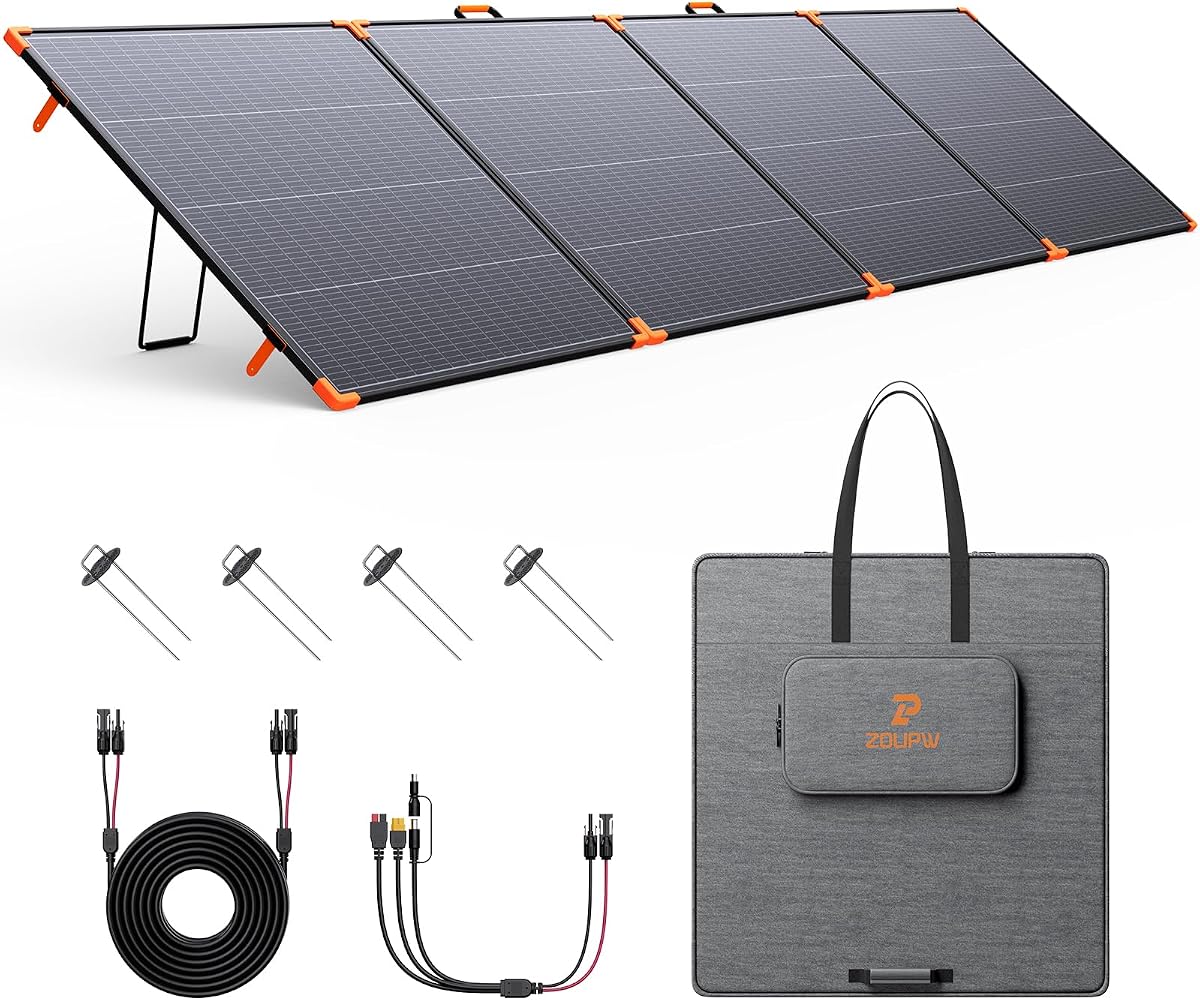
The ZOUPW 480W is the most advanced and powerful model in this guide. It has a 4.7 rating, N-Type 16BB cells, a stated 25% conversion rate, and a bifacial design that can collect reflected light from the opposite side. It is intended for large power stations, serious RV off-grid systems, and high-demand emergency applications.
We may earn a commission when you buy through this link, at no additional cost to you.
Bifacial construction is its defining feature. On bright, high-albedo surfaces such as snow or sand, the manufacturer claims up to a 30% increase in output from reflected light. Integrated bypass diodes and multiple anti-shading protections are also included. The 42.5V high-voltage architecture is intended to pair with large, compatible power stations rather than low-voltage entry-level models.
Despite its high rating, the panel weighs 22.5 pounds. Composite construction replaces traditional glass and creates a stated 21.3 watts-per-pound density, while the folding design allows one-person deployment. Its IP68 rating, scratch-resistant coating, and stated heat tolerance up to 140°F provide a strong environmental case for prolonged outdoor use.
The package includes a storage bag, a two-foot 12AWG four-in-one cable, a 13-foot 12AWG extension, and four ground stakes. Buyers must still avoid long-term fixed series or parallel use, combining panels with different aging levels, heavy loads, and persistent shading. For a demanding off-grid setup, this is the premium option, with output and sealing that justify its greater size and complexity.
Unlike a conventional one-sided panel, the bifacial design can generate from reflected light in addition to direct sunlight. The possible benefit is especially relevant on snow, sand, pale gravel, or other reflective ground, where placement can materially influence total production.
IP68 sealing, composite construction, and scratch resistance make the panel well suited to demanding outdoor deployments. The folding format improves transport relative to several rigid 400W-class alternatives, although 22.5 pounds remains a meaningful load for a solo setup.
We may earn a commission when you buy through this link, at no additional cost to you.
The ZOUPW 450W is engineered for large solar generators rather than general-purpose portable charging. Its 45.9V open-circuit voltage, 4.6 rating, and stated compatibility with large EcoFlow, Anker, and Bluetti systems make it a specialized option for high-capacity RV and emergency power setups.
We may earn a commission when you buy through this link, at no additional cost to you.
N-Type monocrystalline cells use a 16-busbar design intended to reduce internal resistance and micro-crack risk. The manufacturer states that the cells can retain peak 25% efficiency over time and generate up to 10% more power in cloudy conditions, early mornings, and late afternoons than traditional P-Type designs. Four kickstands adjust to 45 degrees for more useful sun positioning.
Environmental protection is strong. ETFE coating, sealed lamination, IP68 rating, smart bypass diodes, and resistance to rain, marine spray, and dust suit demanding travel. The package includes a 13.12-foot extension, four-in-one adapter, ground stakes, and a storage bag. A 36-month warranty and stated customer-support commitment add reassurance for high-value equipment.
Compatibility is the decisive limitation. The panel is explicitly not compatible with low-voltage units below 30V, including listed Jackery 1000, 500, and 300 models and the Bluetti EB70S. It also weighs 29.5 pounds and is not recommended for long-term fixed, series, or parallel installations. For the right high-voltage system, it is a powerful and well-protected option; for anything smaller, it is unsuitable.
The 45.9V open-circuit voltage is the key specification to verify. It enables efficient transfer into large power stations, but it also makes the panel unsuitable for many lower-voltage models. Checking the station's input range before ordering is essential to avoid an incompatible system.
The 16-busbar N-Type layout is designed to carry current more efficiently while limiting cell damage. Bypass diodes add partial-shade resilience, although the manufacturer still advises against prolonged operation in shaded conditions or use in mismatched series and parallel configurations.
We may earn a commission when you buy through this link, at no additional cost to you.
This 25W kit is a straightforward option for maintaining 12V batteries in RVs, boats, cars, ATVs, and other vehicles. It has a 3.3 rating, the lowest among the ten products, and focuses on the essential jobs of a solar battery maintainer rather than powering large devices or filling a portable power station.
We may earn a commission when you buy through this link, at no additional cost to you.
Premium monocrystalline silicon cells provide the stated power in a compact package. The smart charge controller uses multi-stage charging to help prevent overcharging and extend battery health, with up to 30% higher efficiency claimed against conventional PWM controllers. USB output allows the panel to support small devices such as phones and lights.
The aluminum frame is described as corrosion resistant, and the tempered-glass face receives an IP67 waterproof rating. An adjustable mounting bracket fits flat or curved surfaces such as RV roofs and boat decks, while the included cables and connectors support a plug-and-play setup. The product can also assist smaller off-grid loads such as lighting, pumps, or charging stations when conditions are appropriate.
Its 25W output is the defining constraint, and the 3.3 rating suggests mixed experiences among buyers. It is best suited to maintenance, trickle charging, and small loads rather than meaningful household energy production. Buyers wanting greater sophistication should consider the 25W MPPT kit in first place, while simple users who prioritize a rugged frame and easy installation may still find this model adequate.
The kit focuses on a common need: keeping a vehicle or marine battery topped up during storage or extended periods of limited use. Multi-stage charging helps manage the battery more carefully than a basic unregulated trickle charger, while the smart controller reduces the need for manual supervision.
The adjustable bracket can be oriented on flat or curved installations, making the kit useful where a square roof panel would be awkward. A corrosion-resistant aluminum frame also suits environments where exposed metal must withstand moisture and changing weather conditions.
We may earn a commission when you buy through this link, at no additional cost to you.
The right rugged solar panel depends on the device being powered, the environment, and the balance between output, weight, protection, and connector convenience. Review the following factors before choosing a fixed battery charger, portable folding panel, or high-voltage power-station model.
Begin by identifying what the panel must charge and how quickly. A 25W panel is appropriate for maintaining a 12V battery or supporting very small loads, while a 40W to 100W folding panel suits phones, tablets, power banks, and smaller stations. A 200W to 480W model is more appropriate for larger power stations, sustained travel, or greater household-style loads. Output is only one part of the equation, because a destination device may impose a lower input limit. A 100W panel connected to a station capped at 60W will not charge at the panel's full rated rate.
Monocrystalline cells are used throughout this guide and generally provide a strong balance of efficiency, durability, and usable performance in partial light. Stated conversion rates range from 23% to 25% in the featured portable models, while the battery-maintenance kits use premium monocrystalline designs without presenting the same numerical efficiency figure. N-Type 16BB and bifacial constructions can offer additional benefits, including lower internal resistance, stronger low-light performance, and potential gains from reflected light. These claims should be understood in context: real output changes with temperature, shade, angle, dust, and available sunlight.
IP ratings describe resistance to solids and liquids, but they do not mean every connector, junction box, or control component has the same protection. The featured panels range from IP65 to IP68. IP67 panels are protected against temporary immersion conditions, while IP68 models offer the strongest stated ingress protection in this roundup. The 40W FlexSolar includes an important caveat that its junction box is not fully waterproof and should be stored indoors during heavy rain. Always protect exposed connectors and follow the manufacturer's handling instructions.
Folding construction is only convenient if the weight is manageable. The 40W panel weighs 1.76 pounds, the FlexSolar 100W weighs 4.1 pounds, and larger models climb well beyond 20 pounds. A 25W rigid battery charger is easy to mount permanently but may be less convenient to move between campsites. Consider who will carry the equipment, how often it must be repositioned, and whether vehicle storage space is available for a larger folded unit.
Connector shape is only one part of compatibility. Voltage, current, input limits, and the power station's permitted wiring configuration all matter. XT60 is common among portable stations, while DC8020, Anderson, DC7909, and DC5521 cover other models. The ZOUPW 100W supplies five connector types, making it versatile across brands. By contrast, the 450W and 480W high-voltage panels target large systems and may damage or fail to operate with low-voltage stations if connected improperly.
USB-C PD and USB-A outputs let a panel charge compatible phones, tablets, GPS units, cameras, and smaller electronics without a portable power station. This can simplify a mobile kit and reduce the number of wall adapters needed. However, USB output does not make a panel an energy-storage device. It still operates only when sunlight is available, and output may fall when multiple ports are used, the panel is shaded, or ambient conditions are unfavorable.
Fixed battery-maintenance kits benefit from permanent mounting brackets that can be rotated toward the sun. Portable folding panels usually include kickstands, while reinforced loops or grommets can support hanging setups. Check whether the panel must sit on an RV roof, a tent, a boat deck, a rocky campsite, or uneven ground. Also consider wind: a lightweight panel needs stable placement, and a larger model may need multiple ground stakes or careful positioning.
Long-term ownership depends on more than the panel's construction. The listed ZOUPW products include substantial warranty periods, with the 450W and 480W models stating 36-month coverage and the 100W model stating 12 months. Product listings also mention technical or customer support, but buyers should confirm the current terms directly. Retain the purchase record, follow setup instructions, and avoid prohibited modifications or installations that could affect coverage.
Before installation, identify the battery type, power-station requirements, and correct connector. Check voltage and input limits against the product instructions, and do not connect panels with different ages, specifications, or operating histories in series or parallel unless the manufacturer explicitly permits it. For a battery maintainer, connect the controller and wiring as directed before positioning the panel in full sun. For a folding model, unfold it carefully, deploy the kickstands, and route cables so they cannot be pinched or exposed to concentrated heat.
Position the panel where it receives direct sunlight with no shade from trees, tents, vehicles, or structures. Adjust the angle throughout the day when practical, particularly for rigid 25W battery chargers with a rotating bracket and portable panels with adjustable kickstands. Keep the surface free of dust, mud, bird residue, and grass. Do not place heavy objects on flexible or folding cells, step on the panel, or touch its surface during operation.
During storage, disconnect the panel from batteries or power stations if the instructions recommend it, especially during severe weather. Fold portable panels only after they are cool and dry, and keep connectors protected from moisture and dirt. Store the 40W FlexSolar's junction box indoors during heavy rain, and avoid immersing any panel beyond the conditions permitted by its rating. Clean the surface gently with a soft cloth rather than abrasive tools or harsh chemicals.
Yes, if the panel's voltage, connector, and current output match the power station's permitted solar input. MC4, XT60, Anderson, DC7909, DC8020, and DC5521 connections appear across the featured products, but the connector alone does not guarantee compatibility. Check the station's input range and maximum wattage before connecting, because a low-input-limit station will charge more slowly than the panel's nameplate output suggests.
All three ratings indicate protection against dust and water, but they represent different levels of resistance. IP65 protects against dust and water jets, IP67 allows temporary immersion under specified conditions, and IP68 indicates a higher level of protection against prolonged water exposure. Ratings apply to specific tested components, so junction boxes and connectors may have weaker protection than the visible panel surface.
No. A higher wattage can shorten charging time for a suitable high-capacity system, but it does not help if the destination device has a lower input limit or incompatible voltage. It also adds weight, bulk, and cost. A 25W panel may be ideal for maintaining a 12V battery, while a 100W to 480W model becomes more useful when you need to replenish portable power stations or operate more demanding equipment.
The portable panels in this guide are solar converters rather than integrated battery banks. They generate power when exposed to sunlight and deliver it directly to connected devices, but they cannot provide energy at night or after sunset without an attached battery or power station. A portable power station adds that storage function if it is charged while the sun is available.
Only when the manufacturer supports that configuration and the connected equipment has compatible voltage and current ratings. Some featured 100W panels support series or parallel expansion, while the 450W and 480W models specifically discourage long-term fixed series or parallel use. Never combine panels of different sizes, ages, or electrical specifications without confirming compatibility, and follow the supplied wiring instructions exactly.
A properly selected 25W panel with a smart controller can help maintain a compatible 12V battery during storage. Multi-stage or MPPT control helps prevent overcharging, but you must still use the correct battery chemistry, provide ventilation where required, and verify the wiring and charge settings. Inspect the battery and panel periodically, particularly if the vehicle or boat is exposed to extreme heat.
Use a soft, lint-free cloth and clean water for ordinary dust or light dirt. Avoid abrasive pads, sharp tools, and harsh chemical cleaners that could scratch the laminate or damage the solar cells. Never clean the panel while it is hot, and keep moisture away from the junction box, controller, and connectors. Regular light maintenance helps preserve output without putting unnecessary stress on the surface.
Many can charge phones and tablets, and some include higher-powered USB-C PD outputs suitable for compatible laptops. The 100W FlexSolar provides 45W USB-C PD, while the Renogy 200W also includes a 45W USB-C port and dual USB-A outputs. Actual charging speed depends on sunlight, panel temperature, device acceptance, and whether multiple outputs are used simultaneously.
The strongest overall choice is the 25W gridless battery-maintenance panel because it combines a 5.0 rating, intelligent three-stage MPPT charging, useful low-light construction, and flexible mounting for RV, trailer, boat, and vehicle batteries. The FlexSolar 40W is the most practical lightweight option, while the ZOUPW 480W bifacial model leads the premium group with high output, two-sided light collection, and IP68 protection.
Before buying, prioritize the type of power you need. Choose a 25W model for battery maintenance, a 40W to 100W folding panel for mobile devices and smaller stations, and a 200W to 480W system for larger power stations. Confirm voltage, connector type, maximum input, weight, environmental protection, and the availability of direct USB charging before making a final decision.
Current specifications, ratings, availability, and pricing can change, so review the latest product listing and the instructions for your battery or power station. That final compatibility check can prevent the most common installation problems and ensure the selected rugged solar panel is used within its intended limits.