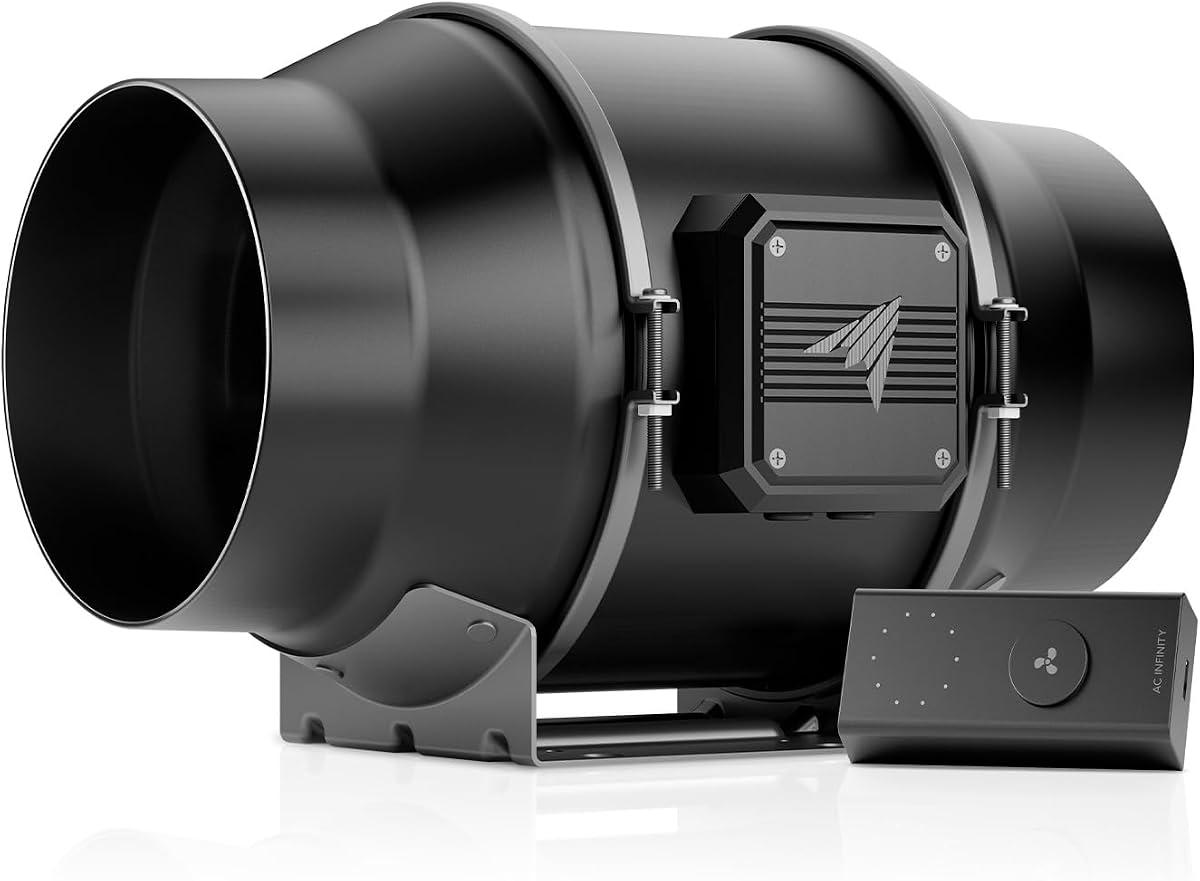
AC Infinity CLOUDLINE S6
4.8Editor score
402 CFM airflow
Wired 10-speed controller
Dual ball bearings
A grow tent inline duct fan controls the movement of air through a tent or growing room, helping manage heat, humidity, odors, and stagnant conditions. A capable unit should balance useful airflow with controlled noise, durable construction, flexible speed adjustment, and an installation method that suits the growing space.
This guide compares ten inline duct fans and complete filtration kits using the information supplied for each product. The evaluation considers airflow claims, motor technology, sound levels, control options, duct compatibility, odor-control components, installation hardware, and the spaces each product is designed to serve.
Each selection highlights a different practical strength, from straightforward and economical ventilation to intelligent environmental sensing, high-volume air movement, or a coordinated fan-and-filter system. Ratings and product details reflect the supplied listings, while prices and availability can change, so readers should confirm current information before purchasing.
4.8Editor score

4.3Editor score

4.3Editor score
As an Amazon Associate we earn from qualifying purchases.
The table below compares the complete lineup by airflow, sound level, controls, and included components, making it easier to identify the right fan for a tent, greenhouse, or other enclosed ventilation project.
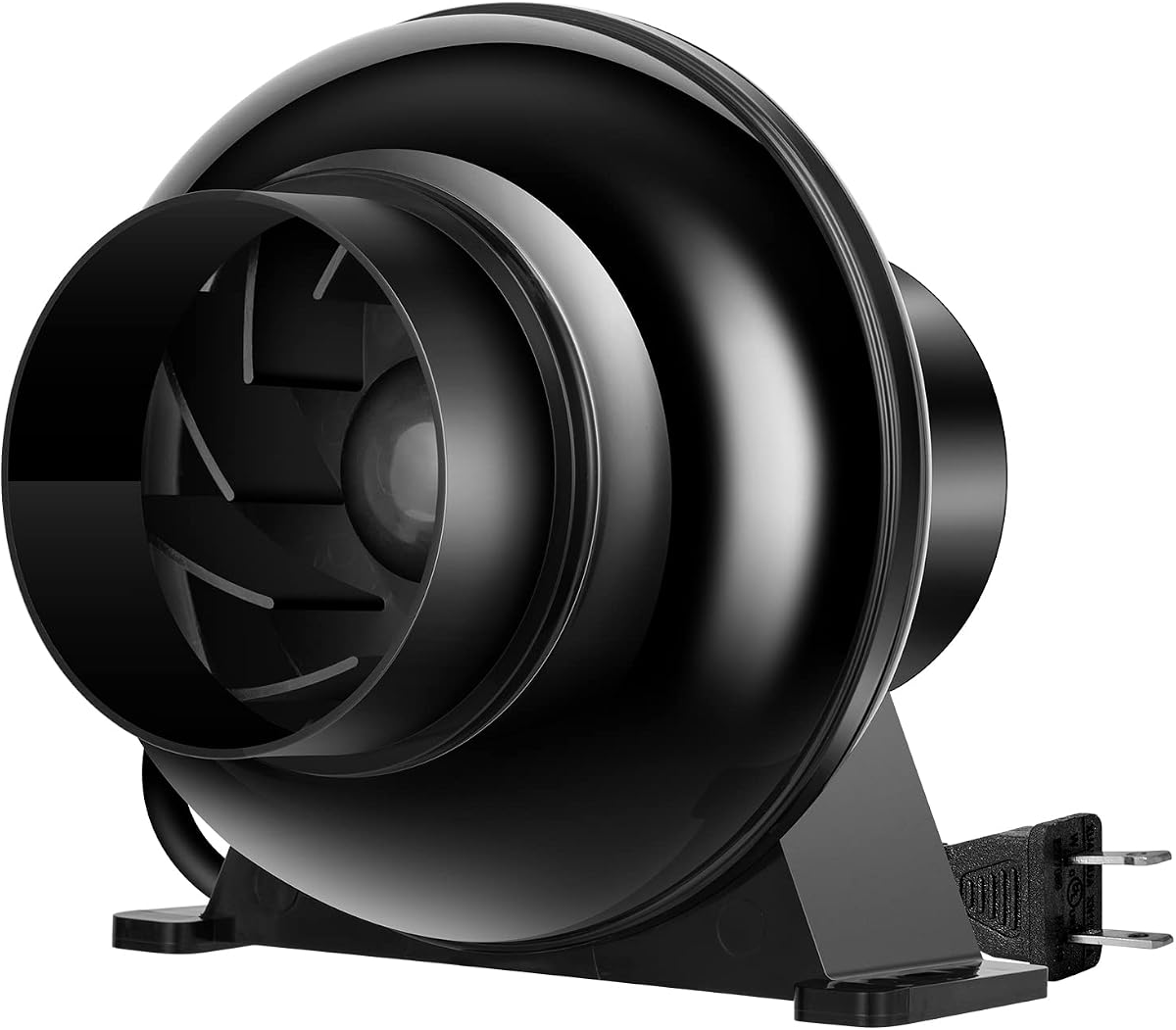


The VIVOSUN P4 is a compact four-inch inline fan built around an upgraded EC motor, quiet operation, and precise manual airflow control. Its supplied rating is 4.3, and the combination of 130 CFM airflow, a stated 26 dB(A), and stepless adjustment makes it a well-rounded option for many grow tents and enclosed rooms.
We may earn a commission when you buy through this link, at no additional cost to you.
The biggest attraction is the unusual degree of control provided by the stepless regulator. Growers can raise or lower the airflow continuously rather than choosing among fixed presets, making it easier to respond to changing heat and humidity. The EC motor is designed for strong performance with low energy consumption, while the ABS housing and PBT blades add practical durability.
Its limitations are important to consider. Maximum airflow is lower than that of the 195, 210, 280, 400, and 402 CFM alternatives, so it may be better suited to a modest tent or as part of a multi-fan arrangement. It also lacks the automatic temperature and humidity response offered by the smart sensing model.
The P4 is a strong all-around recommendation for someone who values quiet operation, smooth adjustment, and straightforward installation. Its broad mounting compatibility and low-voltage safety features also make it practical for home growers who want reliable ventilation without an elaborate control system.
The stepless controller is particularly useful when a grow room needs more cooling at night and gentler circulation during cooler periods. Continuous adjustment gives the user finer control than a simple low-and-high switch.
A stated 26 dB(A) operating level makes the P4 suitable for spaces where fan noise could interfere with work, observation, or rest. The EC motor also supports energy-efficient ventilation with reduced heat output.
We may earn a commission when you buy through this link, at no additional cost to you.
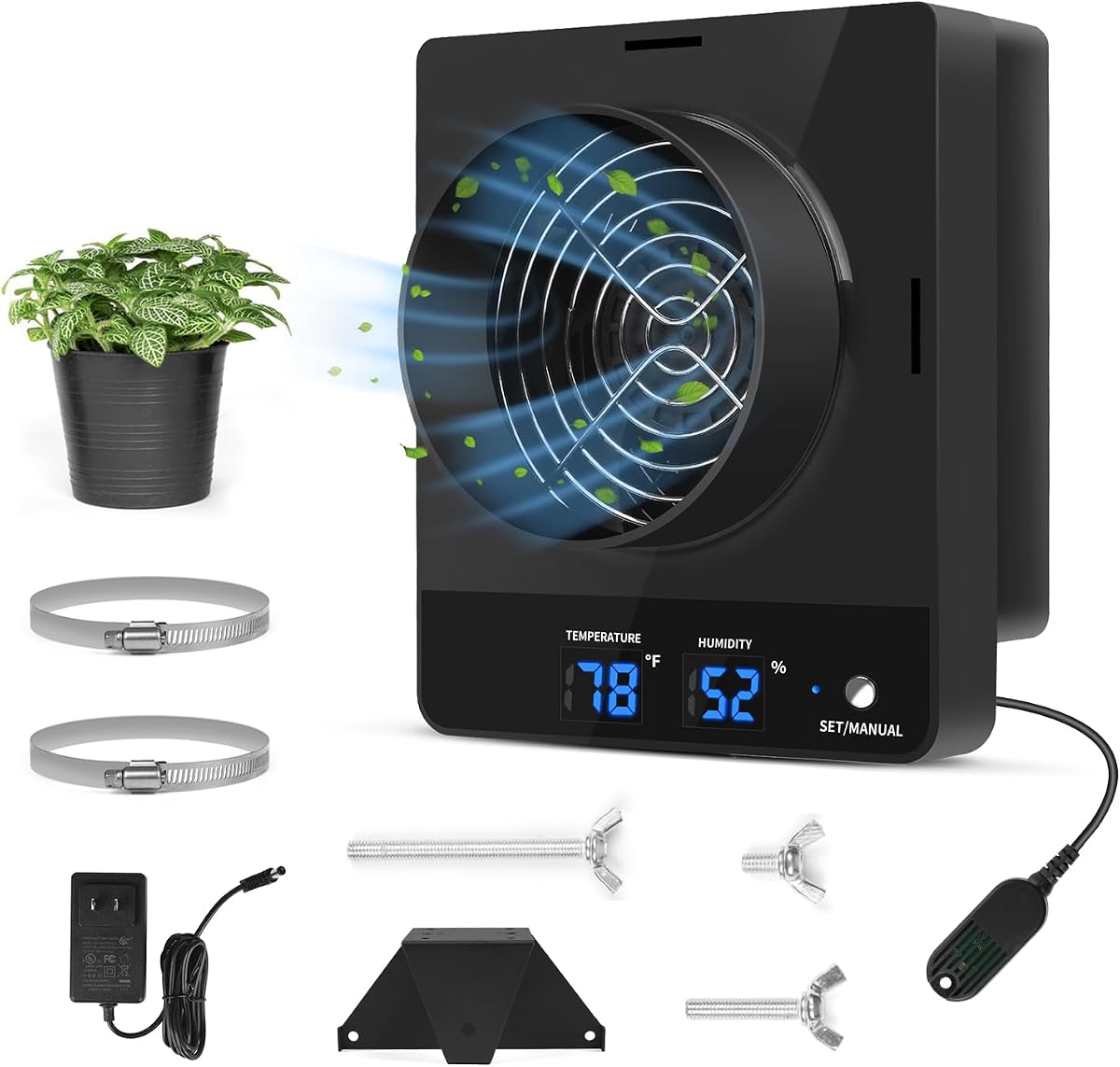
This four-inch grow tent inline duct fan is the only model in the group built around automatic temperature and humidity sensing. It carries a 4.1 rating, and its defining benefit is the ability to activate the fan when configured environmental limits are exceeded and stop it when conditions return below the set thresholds.
We may earn a commission when you buy through this link, at no additional cost to you.
The LCD shows real-time temperature and humidity readings, making the setup easier to understand and adjust. Users can configure relative humidity from 1 to 99 percent and temperature from 50 to 140°F. A brief press of the set button offers manual operation without erasing automatic settings, while holding it enters automatic mode.
The listing does not provide a maximum CFM figure, so buyers cannot directly compare its air-moving capacity with the other selections. Its low-voltage DC design, low noise, stainless steel brackets, and assorted mounting screws support flexible installation, but the missing airflow specification remains a meaningful limitation for larger tents.
This fan is best for growers who value automatic operation and clear environmental feedback more than a published maximum airflow figure. It suits controlled indoor setups where defining a temperature and humidity target is easier than manually monitoring and adjusting the fan throughout the day.
The climate-control mode reduces the need for constant manual intervention. Once the selected limits are configured, the fan responds as conditions cross the programmed thresholds.
The LCD makes it possible to view current temperature and humidity while setting operating parameters. This is helpful for confirming that the inserted sensor is positioned where it can represent the space effectively.
We may earn a commission when you buy through this link, at no additional cost to you.
The VIVOSUN D4 combines a four-inch duct format with a claimed 195 CFM airflow and a 2500 RPM AC motor. Its 4.3 rating reflects a capable general-purpose ventilation fan, while the 30 dB operating specification keeps noise within a range suitable for grow rooms and workshops.
We may earn a commission when you buy through this link, at no additional cost to you.
The locking-tab flanges make hookup to vent hose straightforward, and the supplied five-and-a-half-foot cord provides some freedom in fan placement. A particularly useful maintenance detail is the detachable housing, impeller, and blades, allowing buildup on the airflow components to be cleaned without replacing the entire fan.
The motor is ETL listed and includes automatic reset protection against overheating. Its AC motor differs from the EC and DC motors used by several competitors, which may matter to buyers accustomed to variable-speed electronic controls. The D4 does not offer the same stepless or multi-speed adjustment as the P4, CLOUDLINE S6, and several other models.
For a grower seeking substantial airflow from a four-inch inline fan without a bundled carbon filter, the D4 is a persuasive option. It is especially useful for moving hot air, circulating fresh air, and helping reduce humidity in moderate grow spaces.
The removable impeller and blades make regular cleaning more manageable. Keeping the air path clean can help the fan maintain consistent airflow and makes the unit easier to service.
The ETL-listed AC motor and automatic reset function provide a straightforward ventilation solution. The 195 CFM rating gives the D4 more moving capacity than most four-inch alternatives in this guide.
We may earn a commission when you buy through this link, at no additional cost to you.
The AC Infinity CLOUDLINE S6 stands apart with a 4.8 rating, 402 CFM airflow, and a six-inch duct format. It is the strongest premium choice in the lineup for a large tent, grow room, or other space that benefits from substantial, controllable airflow without excessive operating noise.
We may earn a commission when you buy through this link, at no additional cost to you.
Its PWM-controlled EC motor is designed for quiet, energy-efficient performance with minimal heat and noise. A mixed-flow design with a stator blade and hydrodynamic wind circles is intended to maintain delivery in high-resistance areas, while dual ball bearings suit demanding continuous operation.
Control is comprehensive: the included wired controller offers ten speeds, and the fan is also compatible with UIS controllers that support intelligent programming. That gives growers a path from simple manual adjustment toward automated schedules, depending on the wider control system used.
The six-inch format requires compatible ducting and adequate space, so it is less convenient for small tents built around four-inch ports. Even so, the combination of airflow, quiet operation, fine speed selection, and programmable compatibility makes this a compelling premium recommendation for serious ventilation setups.
At a stated 402 CFM, the CLOUDLINE S6 offers exceptional air-moving capacity. It is a strong match for larger grow tents and rooms where a lower-output inline fan would need to run continuously.
The wired ten-speed controller supports precise manual adjustment, while UIS controller compatibility expands the potential for programmed operation. This makes the fan suitable for growers who want more than a basic dial.
We may earn a commission when you buy through this link, at no additional cost to you.
This filtration kit combines a 190 CFM four-inch inline fan, a speed controller, a 12-inch high carbon filter, eight feet of ducting, and a rubber coupler. With a 4.3 rating, it is the most directly configured option for a grower who wants both air movement and odor control in one coordinated package.
We may earn a commission when you buy through this link, at no additional cost to you.
The carbon filter uses RC 412 Australian virgin charcoal with an IAV of 1200 or higher, while its double-sided galvanized steel mesh uses a hexagonal design intended to preserve open area and airflow. A removable pre-filter cloth blocks 99 percent of particles and helps keep the activated carbon layer cleaner.
The fan itself reaches 190 CFM at 2300 RPM and includes a deflector designed to focus the stream and reduce turbulent kinetic energy. Compared with a standalone four-inch model, the complete kit is more convenient for creating a sealed intake or exhaust path, although the filter and long duct run require additional space.
This is a strong recommendation for hydroponic rooms, indoor grow tents, closets, and other enclosed spaces where odor reduction is a priority. Buyers should account for the additional maintenance and replacement needs associated with a carbon-based filtration system.
The included filter, ducting, fan, controller, and coupler create a ready-to-configure ventilation path. It can be arranged as either an intake or exhaust assembly depending on the room layout.
The thick carbon bed and high-IAV charcoal are designed to adsorb odors and chemicals. The removable pre-filter adds another layer of maintenance protection by catching particles before they reach the charcoal.
We may earn a commission when you buy through this link, at no additional cost to you.
The Voltset four-inch duct fan delivers a claimed 280 CFM at 2200 RPM, giving it one of the strongest airflow figures among the four-inch options. Its 4.3 rating and 30 dB specification pair that capacity with a relatively low noise target for a high-output inline fan.
We may earn a commission when you buy through this link, at no additional cost to you.
The copper-core motor is highlighted for heat dissipation and durability, while reinforced housing and blades are designed for continuous operation. Installation is simplified with quick-release clips and universal mounting brackets, and the product can serve as either an intake or exhaust fan in grow tents, greenhouses, basements, and workshops.
The listing does not mention a speed controller, so buyers should not assume the unit offers the same fine adjustment as the P4, CLOUDLINE S6, VIVOSUN T4, or Hon&Guan booster. It also does not include a carbon filter, making it a ventilation component rather than a complete odor-control package.
The Voltset is a compelling choice for a four-inch setup where maximum airflow is the priority and basic fixed operation is acceptable. Its listed airflow, mounting system, and motor construction make it attractive for spaces where the stronger four-inch alternative still offers more versatility than a large six-inch unit.
The 280 CFM claim is a major advantage over the 130, 190, and 195 CFM four-inch choices. It may provide more cooling and dehumidification capacity without requiring six-inch ducting.
Quick-release clips and universal brackets reduce the number of separate installation steps. The fan can also be positioned for either intake or exhaust use depending on the duct layout.
We may earn a commission when you buy through this link, at no additional cost to you.
The VIVOSUN T4 Air Filtration Kit is a complete four-inch ventilation system with a 210 CFM inline fan, E12 speed controller, carbon filter, and eight feet of black ducting. Its 4.6 rating places it among the most well-regarded products in the guide, while the integrated design reduces the need to source each component separately.
We may earn a commission when you buy through this link, at no additional cost to you.
PWM control provides ten fan speeds, and the controller can recall the previous setting after being turned off and back on. It also supports three on-and-off cycle modes, allowing airflow to run in timed intervals, and can integrate with the VIVOSUN app system for remote intelligent control.
The AeroZesh fan operates at 28 dBA, while its mixed-flow design is intended to distribute air over greater distances. The carbon filter contains RC 412 Australian virgin charcoal with a 38 mm bed, and the flexible aluminum duct includes a central PET layer between protective layers plus stainless-steel clamps.
This kit is an excellent match for a grower seeking fine speed control, quiet operation, carbon filtration, and app-supported control without assembling every component separately. App functionality adds convenience, though it requires a compatible control setup, and the carbon filter will eventually need replacement as its adsorption capacity declines.
Ten selectable speeds and speed memory make the controller more adaptable than a simple variable dial. The cycle modes also allow intermittent ventilation, which can be useful when continuous full-speed operation is unnecessary.
The fan, controller, filter, reinforced ducting, and clamps form a coordinated assembly. A stated 28 dBA operating level supports relatively discreet ventilation while the carbon bed addresses odors.
We may earn a commission when you buy through this link, at no additional cost to you.
The Hon&Guan four-inch air filtration kit combines a 130 CFM inline fan, speed controller, ten-inch high carbon filter, eight feet of ducting, and a rubber coupler. Its 4.5 rating is strong, and the package is especially appealing to users who want quiet operation alongside basic odor management.
We may earn a commission when you buy through this link, at no additional cost to you.
The fan uses a DC motor and produces airflow at a stated 26 dB, matching the quietest listed operating level in the group. Its variable speed control lets users balance airflow and noise rather than relying on a single fixed output. The carbon filter uses RC 48 activated carbon with an IAV of 1200 or higher and a 38 mm charcoal bed.
The ducting uses two layers of aluminum foil with a PET layer and steel-wire helix, giving it a three-layer structure intended to resist rips and pinholes. The trade-offs are the relatively low 130 CFM airflow and the physical footprint of the ten-inch filter, which may limit placement in compact tents.
The kit is well suited to modest indoor gardens, hydroponic grow rooms, basements, kitchens, and bathrooms where low noise and a complete installation matter. It is a particularly balanced choice for users who want filtration without as much moving capacity as the VIVOSUN T4 or the 190 CFM filtration kit.
The combination of a stated 26 dB level and variable speed control gives users a way to reduce sound when full ventilation is unnecessary. That makes the package suitable for rooms where continuous high output would be disruptive.
The reinforced three-layer hose helps maintain shape and resist damage during installation. The 38 mm activated carbon bed provides the core odor-control function, while the rubber coupler helps join components securely.
We may earn a commission when you buy through this link, at no additional cost to you.
The Hon&Guan Inline Booster is a straightforward four-inch fan for growers who want quiet, adjustable ventilation with low energy use. It carries a 4.3 rating, produces 130 CFM at 4500 RPM, and draws no more than 6 watts according to the supplied listing.
We may earn a commission when you buy through this link, at no additional cost to you.
Its variable speed controller allows the user to balance airflow against noise, and the stated 26 dBA output suits a grow room, bathroom, kitchen, workshop, basement, or attic. The fan also reaches 165 Pa of air pressure, while the 100-240V specification adds broad electrical compatibility.
Installation and maintenance are straightforward. The plastic blade and body can be removed for cleaning, and the booster is intended to increase airflow in existing HVAC or ventilation paths. It does not include a carbon filter, and its 130 CFM capacity is lower than the outputs of the Voltset, VIVOSUN D4, VEVOR, and CLOUDLINE models.
The Hon&Guan booster is a strong budget-oriented recommendation for a small tent, a supplemental airflow path, or a room where low power consumption and quiet operation matter most. It is less suited to replacing a high-output system in a large grow space, but it provides useful control in a compact package.
The stated 6W maximum consumption makes this booster suitable for continuous ventilation where energy use matters. Lower output can also complement a more powerful exhaust fan as a way to improve circulation inside a tent.
The removable blade and body simplify routine cleaning, which is important in dusty or humid growing environments. Variable speed control lets users select a useful balance between circulation and sound.
We may earn a commission when you buy through this link, at no additional cost to you.
The VEVOR six-inch inline duct fan combines a claimed 400 CFM airflow with manual variable speed control. Its 4.4 rating reflects a capable high-volume option, and the size is well suited to large plant tents, hydroponic rooms, equipment rooms, kitchens, and basements that need substantial air movement.
We may earn a commission when you buy through this link, at no additional cost to you.
The AC motor produces the listed airflow at a stated 34 dB, making it the quietest claim absent from this group but still a meaningful step above the 26-32 dB figures of several smaller models. The listing says the motor saves 30 percent on energy consumption, while manual knobs allow airflow to be matched to changing conditions.
Installation supports either hanging or wall mounting, and the package includes slings, straps, and non-vibration rubber mats. Those anti-vibration accessories may help limit the transfer of movement and sound through the tent frame. As with the CLOUDLINE S6, however, the six-inch format requires compatible ducting and adequate clearance.
The VEVOR is a strong recommendation for a larger ventilation project where raw airflow is more important than having the lowest possible noise or the most granular electronic control. It offers a capable compromise between high output, manual adjustment, and straightforward installation.
The 400 CFM output is close to the top of the guide and is intended for wide areas of ventilation and dehumidification. It is well matched to larger tents or rooms where four-inch capacity may be insufficient.
The included slings, straps, and non-vibration rubber mats support several installation approaches. Users can hang the unit within a tent structure or mount it more permanently, depending on access and available space.
We may earn a commission when you buy through this link, at no additional cost to you.
The right inline duct fan depends on tent size, duct diameter, required airflow, noise sensitivity, control complexity, and whether odor filtration is part of the installation. Comparing these factors before buying helps prevent a mismatched system that is either too powerful, too restrictive, or too limited for the space.
Choose the diameter your tent already uses, or plan the full duct layout before selecting a fan. Do not force a mismatched adapter or reduce the duct size without accounting for added restriction.
Treat the CFM figure as the first capacity filter, then consider the room, equipment heat, and desired air exchange. More airflow is not automatically better if it creates unacceptable noise or cannot be controlled effectively.
For quiet spaces, favor a fan with a low stated level and variable speed control. Use flexible supports and vibration-isolating materials to keep duct movement from turning a quiet motor into a noisy installation.
Choose automatic control if you want the fan to respond without constant monitoring. Choose a simple controller if reliability, affordability, and immediate adjustment are the priority.
Buy a kit when a complete filtered exhaust path is required. Buy a standalone fan when the tent already has filtration or when the primary goal is temperature and humidity management.
Look for documented protection rather than relying on assumptions. A safer, serviceable motor design is especially valuable in humid spaces where equipment operates for long periods.
Choose a layout that lets you reach the fan, sensor, and filter without dismantling the tent. Make regular cleaning part of the plan rather than waiting for airflow or odor control to decline noticeably.
Choose mounting hardware that matches the space and support the fan securely. A stable installation helps control vibration, protects connections, and supports more consistent airflow.
Start by matching the fan to the tent port, attaching the appropriate duct, and checking that the housing has enough clearance for intake and exhaust airflow. Secure the fan with the supplied brackets, straps, or hanging accessories, connect the controller, and confirm that the electrical arrangement matches the unit's voltage specification. For a smart model, place the sensor in a representative location before setting thresholds.
Begin with a moderate speed and adjust according to heat, humidity, odor, and noise. If using an activated carbon system, route filtered air consistently through the carbon bed and monitor the pre-filter and charcoal condition. For automatic controls, set realistic temperature and humidity values, observe whether the displayed readings are stable, and revise the cycle to avoid short, repeated operation.
Inspect the fan and connections periodically. Remove accumulated dust from removable blades and housings using a method appropriate for the materials, and replace carbon or pre-filter media when it becomes saturated or clogged. Check clamps, couplers, and vibration-isolating pads for looseness, and keep electrical connections dry. Always disconnect power before cleaning or adjusting the installation.
The best size is primarily determined by the tent's existing vent-port diameter, followed by the room's heat, humidity, and odor-control requirements. A four-inch fan is common for smaller tents, while a six-inch model may be better for a larger space or a more powerful ventilation path. Always use ducting that matches the fan's specified diameter.
No. Higher airflow can improve cooling and humidity control, but the fan must still be controllable, appropriately sized, and tolerable in terms of noise. A lower-output fan with good variable speed control may be more appropriate for a small tent than an unnecessarily powerful model running continuously at maximum output.
The best operating level depends on where the tent is located and how much background noise is already present. Among the listed products, several operate at a stated 26 dB(A), while larger models list 32 or 34 dB. A variable-speed controller can reduce sound during periods when full airflow is not required.
A standalone inline fan moves air but does not inherently remove odor. Carbon filtration becomes useful when odors need to be trapped before air is released, particularly in enclosed indoor growing spaces. Complete kits include a filter, ducting, controller, coupler, and fan, which can simplify assembly and maintenance.
Either position can work, and the correct choice depends on the tent layout and the negative pressure you want to maintain. A common arrangement uses filtered intake air and an exhaust fan to pull stale, warm air out. Whatever the arrangement, check the fan's permitted direction and ensure duct connections are secure.
Manual or variable-speed control requires the grower to adjust airflow as conditions change. Automatic control uses a sensor and programmed thresholds to start and stop the fan. The smart sensing model in this guide supports temperature and humidity thresholds, while other products focus on manual speeds, cycle modes, or programmable controller ecosystems.
Inspection frequency depends on dust, humidity, and how long the fan operates. Check the blades and housing periodically, with closer attention during dusty or heavily humid conditions. Clean removable components according to the manufacturer's instructions, and replace saturated pre-filters or carbon media before odor control or airflow noticeably declines.
It may be sufficient if the fan's airflow and duct setup match the room's heat and humidity demands. Larger tents often benefit from a more powerful fan or a coordinated intake-and-exhaust system, but adding a second fan without considering duct restriction and pressure can reduce performance. Design the complete ventilation path around the tent size.
The VIVOSUN P4 is the most balanced overall recommendation because it combines 130 CFM airflow, a stated 26 dB(A), stepless adjustment, and safety-oriented EC motor design. The AC Infinity CLOUDLINE S6 is the premium choice for high-volume and programmable ventilation, while the Hon&Guan Inline Booster is an efficient budget option for quiet, adjustable circulation.
Prioritize the duct diameter first, then match airflow and controls to the tent's size and operating schedule. Add carbon filtration when odor management is important, and account for noise, maintenance, and sensor placement before finalizing the installation. Fans with adjustable speeds and removable components generally offer more flexibility than basic fixed-output units.
Ratings, specifications, availability, and prices can change, so confirm the current listing and included components before purchasing. A successful grow tent ventilation setup depends as much on a correctly sized duct path and secure mounting as it does on the fan itself.