
Upgraded Watt Meter Power Meter Plug
4.6Editor score
Eight electrical monitoring modes
Adjustable overload warning
Retains cumulative energy data
Discover the best electricity meter for RV with clear comparisons of digital kWh monitors, plug-in watt meters, surge protectors, and hardwired monitors.
An electricity meter for RV can make pedestal power easier to understand by revealing voltage, amperage, wattage, and accumulated kilowatt-hour consumption. A useful monitor must match the RV wiring configuration, support the intended socket or outlet, and provide readable data without making installation unnecessarily complicated.
This guide compares ten options spanning Form 2S digital submeters, portable plug-in analyzers, a surge protector with an energy display, and a hardwired split-core system. The evaluation focuses on electrical configuration, metering capabilities, installation method, display features, protection functions, and suitability for RVs, campsites, workshops, and rental spaces.
Each review explains what the meter is designed to measure, where it fits, and which users may benefit most. Ratings and specifications reflect the supplied product information, while practical limitations help distinguish a general energy monitor from a full RV surge protector. Prices and availability can change, so confirm current listings before purchasing.
4.6Editor score

5.0Editor score

4.8Editor score
The table below compares the ten RV energy-monitoring options by installation method, electrical configuration, measurement depth, and primary use. It includes dedicated pedestal meters, portable plug-in analyzers, a surge-protector combination, and a hardwired monitor for broader load visibility.
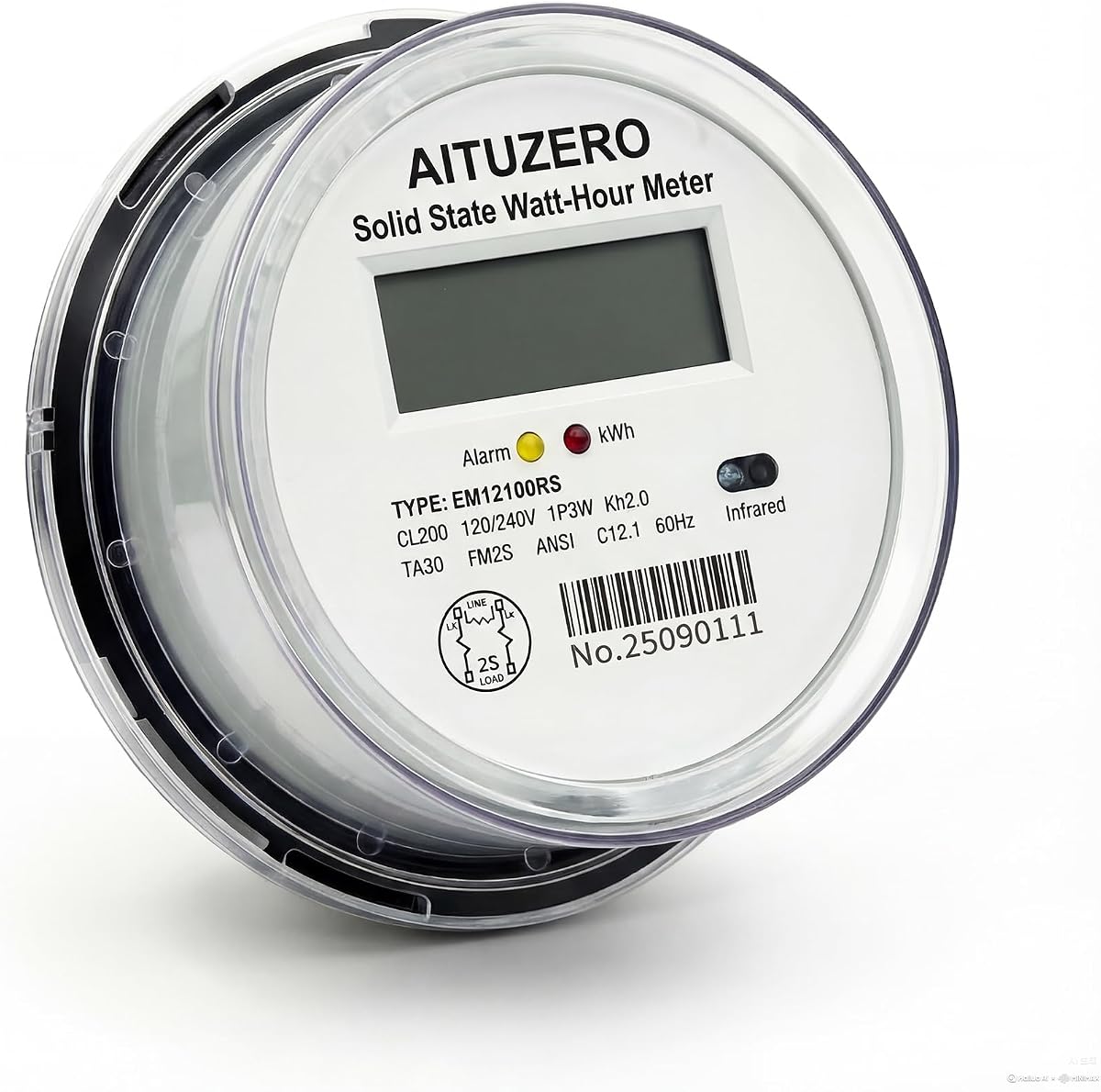


This digital sub meter has a 4.5 rating and stands out as a highly connected option for RV parks, rental units, solar systems, and other 120/240V single-phase installations. It is designed around a CL200 three-wire configuration and a standard ANSI Form 2S socket, allowing energy use to be measured at the service or sub-panel level rather than with a temporary plug-in device.
We may earn a commission when you buy through this link, at no additional cost to you.
The LCD cycles through voltage, current, power, and other system information, while pulse and reverse-flow LEDs provide quick visual confirmation of operation. Import and export measurement can help RV owners evaluate solar charging or battery behavior, and the EEPROM storage is intended to preserve usage information during power interruptions. IR access and Modbus communication extend the meter's usefulness for technicians and integrated monitoring setups.
Its primary trade-off is installation complexity. This is not a casual outlet analyzer, and it needs a compatible Form 2S arrangement, appropriate wiring, and adequate electrical expertise. Modbus support is valuable for advanced users but offers little benefit if the goal is simply checking one appliance. Buyers must also verify that their RV pedestal or service equipment uses the expected socket and conductor arrangement.
This is a strong choice for an RV park operator, landlord, solar-equipped RV owner, or technically confident installer who wants persistent kWh records and remote-monitoring capability. For a simple temporary RV energy check, a plug-in watt meter is easier. For pedestal metering and networked data collection, however, this model offers one of the most complete feature sets in the roundup.
EEPROM memory, an IR programming interface, pulse output, and Modbus communication make this meter useful beyond a basic consumption display. These features support long-term records, external counters, and centralized energy-management systems when properly configured.
Import and export energy readings can clarify the direction of power flow in solar, hybrid, backup, or sub-metered systems. That makes the device relevant to RV conversions, off-grid cabins, and separately metered tenant spaces rather than ordinary RV appliances alone.
We may earn a commission when you buy through this link, at no additional cost to you.
Rated 4.7, this 240V single-phase three-wire energy monitor offers a direct route to pedestal and residential kWh monitoring. It fits ANSI Form 2S four-jaw meter sockets and can report voltage, current, real-time power, energy consumption, and total system use. The result is a practical choice for RV spaces where a permanent meter reading is more useful than a temporary appliance-level measurement.
We may earn a commission when you buy through this link, at no additional cost to you.
The meter is engineered for systems up to 200A, making it more appropriate for RV site monitoring than small plug-in analyzers. A large backlit LCD improves visibility in garages, basements, utility rooms, and outdoor areas, while a status LED confirms that the meter is operating. Stored energy data is retained during outages, supporting continuous records when the RV system experiences interruptions.
The meter does not list Modbus, pulse output, solar import and export tracking, or an IR configuration interface. Buyers seeking those advanced integration features may prefer another Form 2S option. It also must be installed in a compatible socket, so it is less convenient than a device that simply plugs into a household receptacle.
This model is well suited to RV park managers, mobile-home owners, landlords, and anyone who needs a dedicated meter at a 240V service. It combines a straightforward form factor with meaningful load information and persistent records. Confirm socket type, conductor configuration, and local electrical requirements before installation.
The backlit display presents voltage, current, power, accumulated kWh, and total energy in a format suited to occasional campsite checks. It is easier to interpret at a pedestal than a collection of separate portable meters or appliance-level displays.
With monitoring capacity stated up to 200A, the meter is aimed at substantial RV and residential service rather than a single low-draw appliance. It provides a more relevant view of total site consumption when several household appliances may operate together.
We may earn a commission when you buy through this link, at no additional cost to you.
This 4.6-rated plug-in meter is a convenient way to observe the power consumed by an individual RV appliance. It monitors watts, kilowatt-hours, voltage, amperage, frequency, power factor, cost, minimum and maximum wattage, and elapsed operating time through seven display modes. It is best suited to diagnosing an air conditioner, refrigerator, heater, charger, or other connected device.
We may earn a commission when you buy through this link, at no additional cost to you.
The 2.36-by-1.85-inch backlit display is designed for easy reading, with a stated 180-degree viewing angle. The user can choose among five backlight durations, including a ten-minute default, one hour, four hours, eight hours, or continuous illumination. Overload protection is adjustable from zero to 3680W, and the supplied guidance recommends setting it to 1800W for general use.
Compared with a pedestal-mounted submeter, this device has a narrow scope because it only sees the load connected to its outlet. It also does not provide a whole-RV consumption total unless the monitored device represents the complete load. The overload warning is also not a substitute for RV-specific surge protection, wiring inspection, or a correctly rated breaker.
The product is an excellent first tool for RV owners who want to understand appliance demand without modifying their electrical system. It is particularly useful for comparing a microwave, space heater, air conditioner, or battery charger. Choose it for portable diagnostics rather than permanent billing or sub-panel metering.
Switching among power, energy, voltage, current, frequency, power factor, and cost modes makes it possible to identify both operating load and longer-term consumption. Minimum and maximum wattage readings also help reveal how appliance demand changes over time.
The meter can save consumption information when unplugged or when a sudden outage occurs. This makes comparisons across different trips or appliances easier without manually recording every reading before disconnecting the device.
We may earn a commission when you buy through this link, at no additional cost to you.
This 4.8-rated digital electric meter combines a focused feature set with a design expressly aimed at RV pedestals and residential monitoring. It operates at 240V, uses CL200 kWh monitoring with TA30 current measurement, and is described as meeting ANSI C12.1 industry standards. That makes it a sensible digital alternative when the goal is to read total energy from a compatible socket.
We may earn a commission when you buy through this link, at no additional cost to you.
The precision LCD provides a clear live view of electricity consumption, while the C1S configuration and four-jaw socket compatibility simplify installation in a matching meter base. The product also emphasizes resistance to dust, water, and pressure, which is relevant to utility rooms, outdoor RV service areas, workshops, and other environments where temperature, humidity, and dust may vary.
The product information does not mention import and export metering, Modbus, pulse output, IR programming, or retained records. Those omissions make it less attractive for advanced solar, automation, or centralized monitoring projects. The meter also cannot be expected to work with an outlet or pedestal that uses a different socket design, so physical compatibility must be checked before buying.
This is a practical choice for an RV owner, property manager, or workshop operator seeking a dedicated digital kWh meter without a broad communications feature set. Its combination of 240V operation, CL200 monitoring, clear display, and environmental protections offers a focused solution for compatible RV pedestals and household panels.
A dedicated digital kWh display can be more helpful at a campsite than estimating RV demand from a generator or battery monitor. It presents the site measurement in a dedicated meter format intended for RV pedestal and residential use.
Dust, water, and pressure resistance features provide added confidence for use in outdoor utility boxes and exposed RV service locations. The protective housing is intended to maintain consistent operation across varying environmental conditions.
We may earn a commission when you buy through this link, at no additional cost to you.
With a 3.5 rating, this 50-amp RV surge protector is the roundup's clearest combination of energy monitoring and electrical protection. It is designed for NEMA 14-50 outlets and provides a 16,000-joule surge rating. Unlike a simple kWh display, it also includes protection for RV electronics against lightning-related or sudden grid spikes.
We may earn a commission when you buy through this link, at no additional cost to you.
The LCD shows accumulated kWh and real-time voltage, current, active power, power factor, frequency, and energy. That allows an RV owner to check demand while operating several appliances and balance loads before a pedestal breaker trips. A built-in temperature sensor adds visibility into abnormal heat at the connection, while LEDs indicate whether the surge-protection module remains active.
The tradeoff is that protection and measurement are combined in a single 50-amp plug-in product, which may not suit every RV configuration. A Class A motorhome or fifth wheel using the specified outlet may benefit, but owners with a different connection or separate pedestal meter need a different solution. The lower 3.5 rating also warrants more careful consideration than the higher-rated alternatives.
This product is best for RV owners who want both a meter and surge protection in one device, particularly those staying at metered campsites or managing several appliances. It should complement—not replace—proper grounding, correct wiring, and a sound RV electrical-maintenance routine. Buyers should verify outlet compatibility and understand the protection limits before relying on it.
The 16,000-joule surge module adds a layer of protection that ordinary kWh meters do not provide. At the same time, the LCD turns the protector into a useful tool for checking cumulative energy and active demand during a campsite stay.
Watching current, active power, and power factor can help owners avoid placing too much demand on a pedestal connection. The internal temperature watch is particularly relevant when high loads are sustained in a plug that may otherwise be difficult to inspect continuously.
We may earn a commission when you buy through this link, at no additional cost to you.
This 4.6-rated plug-in meter offers an accessible way to monitor RV appliance consumption, with eight display modes covering watts, kilowatt-hours, voltage, frequency, current, power factor, unit cost, and total cost. It is a natural choice for owners who want useful energy information without installing a meter socket or opening an electrical panel.
We may earn a commission when you buy through this link, at no additional cost to you.
The standard US plug and outlet arrangement allow quick setup, and the ABS housing is described as durable, fireproof, and resistant to drops. A white-on-black backlight makes the screen easier to read, and it turns off automatically after ten minutes of inactivity if no button is pressed. The user can also disable it manually and reactivate it with any button.
Its default overload threshold is 1800W, and the display flashes an overload warning when connected demand exceeds that level. That makes configuration important rather than optional. Like other outlet-level monitors, it cannot reveal consumption from other appliances running elsewhere in the RV, and it offers no surge suppression despite warning users about excessive load.
This meter is best for temporary testing, travel-day troubleshooting, and building awareness of how individual appliances affect RV power demand. It is also an approachable alternative to a more involved pedestal submeter. Verify that the connected device remains within the meter’s practical limits, and use a dedicated surge protector for protection from power spikes.
The unit-price and total-cost modes make it possible to see how operating time translates into a cost estimate. Users can compare appliance demand and accumulated consumption without needing a separate calculation every time they check the display.
A five-second press of the M button clears cumulative data and restores the factory settings. Normal operating data is retained when the plug is removed or a sudden power failure occurs, though live electrical values are not retained.
We may earn a commission when you buy through this link, at no additional cost to you.
This 4.8-rated CL200 submeter is the most technically advanced option in the list, with RS485 Modbus RTU communication, pulse output, import and export measurement, and a detailed real-time display. It is intended for RV parks, rental properties, garages, workshops, solar systems, and other environments where connected energy data may be more valuable than a simple standalone display.
We may earn a commission when you buy through this link, at no additional cost to you.
Its Form 2S plug-in design fits compatible four-jaw meter sockets, and labeled rear terminals organize communication and monitoring connections. The large backlit LCD cycles through L1 current, L2 current, active power, reactive power, apparent power, power factor, frequency, and accumulated kWh. Multiple meters can be joined on an RS485 network for centralized collection through compatible gateways, data loggers, or energy-management systems.
Those capabilities also create the main complexity barrier. RV owners without a compatible socket or network equipment may get little benefit from the advanced communication functions. The product also uses non-volatile EEPROM storage and a front IR interface, requiring suitable configuration tools and some familiarity with electrical submetering. It should be installed in accordance with applicable electrical practices.
This meter is a strong match for an RV park operator, landlord managing separately metered spaces, builder, technician, or solar owner with a sophisticated monitoring setup. For those users, the ability to centralize data and distinguish import from export can justify the added complexity. For basic campsite readings, a simpler LCD submeter may be more convenient.
RS485 Modbus RTU support allows compatible meters to communicate over a shared network. This is valuable for operators who need remote access, historical tracking, or consolidated reporting across many RV sites, tenant units, workshops, or auxiliary buildings.
Measuring both imported and exported active energy helps users understand the balance between consumption and generation. The reverse-current indicator provides quick feedback when power direction changes, supporting solar, backup, and RV charging analysis.
We may earn a commission when you buy through this link, at no additional cost to you.
This meter holds the highest supplied rating at 5.0 and offers the most direct combination of RV positioning, 240V two-wire support, CL200 kWh monitoring, and a clear LCD display. It is designed for RV pedestals, campers, trailers, rental units, workshops, garages, and home electrical monitoring, making it one of the most broadly applicable pedestal meters in the roundup.
We may earn a commission when you buy through this link, at no additional cost to you.
The Type C1S and Form 2S-style structure is compatible with standard four-jaw meter sockets, while TA30 current measurement and CL200 kWh tracking cover common RV energy-monitoring needs. The screen provides an easy-to-read digital indication of consumption without the menu complexity of a networked submeter. Its rugged housing is intended for everyday RV and household environments.
The defining compatibility limitation is the two-wire design. It should not be assumed to fit a 120/240V three-wire installation, and it is not a substitute for a plug-in analyzer or surge protector. The product information also does not list import and export metering, Modbus, pulse output, IR access, or outage data retention, so buyers should not expect those advanced functions.
This is the strongest general recommendation for an RV owner who has confirmed a compatible 240V two-wire, four-jaw meter socket and wants a clear kWh display. It is especially useful at campsites, rental properties, and home service panels. Verify the conductor arrangement and socket before purchase, and use qualified electrical guidance for installation.
The digital display provides a practical way to observe total kWh use at a compatible RV pedestal. It can help travelers understand consumption patterns and help property operators verify usage associated with an individual site or unit.
The same Form 2S meter format serves campers, trailers, mobile installations, rental units, garages, and workshops. That versatility makes it a straightforward choice for users who want one metering approach across several kinds of 240V installations.
We may earn a commission when you buy through this link, at no additional cost to you.
This 4.8-rated digital meter is tailored to 240V three-wire systems used in RV trailers, campers, and home electrical environments. It combines CL200 kWh monitoring with TA30 current measurement and a high-resolution LCD, offering a clear and practical way to review electricity consumption where the electrical configuration matches.
We may earn a commission when you buy through this link, at no additional cost to you.
The meter is described as meeting ANSI C12.1 specifications and provides defense against dust, water, and pressure. Those attributes suit outdoor RV pedestals, utility areas, garages, and residential locations where the instrument may encounter humidity, dust, or voltage fluctuations. Its C1S structure is compatible with four-jaw meter sockets, helping keep installation consistent with common service hardware.
Its three-wire requirement is also the essential caveat. RV electrical systems are not all wired identically, so the meter base, conductors, and pedestal configuration must be checked before buying. Like the simpler digital options, it does not list Modbus, pulse output, reverse-flow measurement, or retained-record functions, and it is not a surge protector.
This is a strong option for an RV owner with a confirmed three-wire installation who values a dedicated digital kWh readout and environmental protections. It is also suitable for workshops, garages, and residential panels sharing the same configuration. Correct socket matching and safe installation remain the deciding factors.
A high-resolution LCD, 0.5-level measurement accuracy, CL200 kWh monitoring, and TA30 current measurement provide a focused set of readings. This is enough detail to assess consumption and spot unusually high demand without adding networked complexity.
Dustproof, waterproof, and pressure-resistant construction supports use in RV service areas and other demanding environments. Consistent readings remain important when the meter is exposed to changing moisture, dust, and electrical conditions.
We may earn a commission when you buy through this link, at no additional cost to you.
This 4.4-rated hardwired meter is a different kind of electricity meter for RV use: rather than requiring a Form 2S socket, it uses a split-core current transformer around one live conductor. That arrangement can simplify installation on an RV generator, panel, workshop circuit, or appliance branch when the installer does not want to cut the monitored wire.
We may earn a commission when you buy through this link, at no additional cost to you.
The panel display reports voltage, current, wattage, kWh energy, frequency, and power factor. Its 80-260VAC range covers common residential and RV-related circuits, while its 100A current measurement and stated 22,000W power rating support substantial loads. A backlit display and visual overload alarm help flag conditions that exceed the selected threshold.
Because the CT surrounds one conductor, this is not a complete whole-RV meter. On a 120/240V split-phase system, the supplied guidance recommends monitoring one leg with each meter or using separate meters. Hardwiring also requires appropriate electrical knowledge, access, and safety precautions. A power meter should not be confused with a surge protector or a complete pedestal-monitoring system.
This option is best for technically confident RV owners, converters, or workshop operators who want flexible circuit-level visibility. It can help evaluate generator load, a specific RV circuit, or appliance consumption without relying on a compatible meter socket. The trade-off is that installation and interpretation are more involved than with a plug-in analyzer.
The split-core current transformer clamps around an existing live conductor, avoiding the need to cut that wire. This makes the system useful for adding measurement around an accessible branch without replacing the complete metered socket.
Voltage, current, wattage, kWh, frequency, and power factor provide a broad view of the monitored circuit. The 100A sensor range and overload indication are especially relevant when checking how RV appliances contribute to generator or service demand.
We may earn a commission when you buy through this link, at no additional cost to you.
The right RV energy meter depends on the electrical arrangement, the information you want to collect, and how much installation you are prepared to perform. Start with the socket and voltage configuration, then consider measurement depth, protection, data retention, and display requirements.
The first step is to identify the exact electrical system behind the meter location. Several options in this guide operate at 240V, but some support a two-wire arrangement while others are explicitly designed for three-wire systems. A plug-in watt meter usually measures a single 120V branch load and is not equivalent to a 240V pedestal submeter. Mismatching the product to the wiring can prevent operation, produce incorrect results, or create safety concerns.
Choose based on the conductor configuration, not simply the voltage printed on the listing. Confirm the socket style, number of jaws, service arrangement, and whether neutral or a separate control line is present. When the information is unclear, have the RV pedestal or panel inspected before ordering a permanently installed meter.
The roundup includes four broad installation approaches: a plug-in outlet analyzer, a 50-amp surge-protector combination, a Form 2S digital submeter, and a hardwired split-core display. Plug-in devices are the easiest to move between outlets and are ideal for appliance-level testing. Form 2S meters suit compatible RV pedestals, rental spaces, and service panels, while the hardwired model provides branch-level visibility and greater placement flexibility.
A simple installation is not automatically the most capable. A plug-in meter may be easier but cannot total an entire pedestal load, while a socket meter may require modifying or opening a service arrangement. Select the method that matches your RV's available connection point and the level of intervention you can safely manage.
A useful display may show accumulated kilowatt-hours, current, watts, voltage, power factor, and frequency. RV travelers often care about kWh consumption and active demand, while appliance troubleshooting benefits from minimum and maximum wattage. Solar and bidirectional systems may require import and export readings, and professional energy management may depend on Modbus, pulse output, or retained records.
Avoid paying for complexity that will not be used. A clear kWh total is often more valuable than a long menu of unfamiliar values. Conversely, an RV park operator with multiple spaces may need communication outputs that a basic standalone display cannot provide. Write down the measurements you expect to use before choosing a model.
An electricity meter measures voltage, current, power, or energy, but it does not automatically protect equipment from surges. The 50-amp surge protector in this guide is distinct because it combines a 16,000-joule protection module with an energy display. The other digital meters primarily report electrical conditions and should not be described as substitutes for surge suppression.
Consider a dedicated protector if your priority includes guarding electronics from grid spikes or lightning-related events. If you only need consumption data, a standalone meter may be simpler. In either case, good grounding, sound connectors, correctly rated breakers, and regular inspection remain essential parts of RV electrical safety.
Outdoor RV pedestals may be read in direct sun, shade, or darkness, so a backlit LCD is valuable. Dedicated digital submeters commonly cycle through detailed information, while portable watt meters often require several button presses to move among modes. The screen should show characters clearly at the distance and angle normally used for campsite or panel checks.
Consider the size of the display, whether the backlight remains on long enough, and whether automatic shutoff could make a reading inconvenient. Plug-in meters may also offer adjustable backlight duration. Dedicated pedestal meters are usually less interaction-heavy, which can be beneficial when the goal is a quick consumption check before departure.
Persistent records are useful when the meter cannot be read continuously. Several digital models use EEPROM or equivalent non-volatile storage to retain energy data through outages, and the plug-in watt meters save cumulative readings when unplugged or after sudden power loss. This makes comparisons across trips and verification of remote-site consumption easier.
If data is only needed in real time, retention may not be a deciding feature. If you plan to use the readings for tenant allocation, solar-flow analysis, or historical load management, prioritize a model that explicitly retains accumulated kWh and configuration values. Import and export data can be especially important when energy may flow in both directions.
RS485 Modbus RTU, pulse output, and infrared configuration can turn a submeter into part of a larger monitoring architecture. These features are useful for data loggers, energy-management systems, remote RV parks, solar installations, and multi-unit property metering. They also require compatible equipment and some configuration expertise.
For a single RV, a standalone LCD may provide everything needed without an added learning curve. When comparing advanced products, check the protocol, wiring requirements, number of supported devices, and availability of compatible gateways. Avoid selecting a communication feature simply because it sounds advanced unless you have a clear plan for collecting and using the data.
A meter must be appropriate for the load it will monitor. Dedicated pedestal models may be rated for substantially higher amperage than compact plug-in analyzers, while a hardwired split-core model is limited by its 100A sensor and power rating. Overload warnings indicate that demand exceeds a configured threshold; they do not guarantee safe operation of an RV circuit.
Review both the current range and the wattage limit. Also consider whether the meter measures only one leg, the whole system, or one connected appliance. A high rating alone does not make a meter suitable for every electrical configuration. Match the measurement scope and conductor arrangement to the equipment being monitored.
Begin by identifying the intended measurement point. For a plug-in watt meter, connect the meter first and then energize the appliance being evaluated. For a Form 2S submeter, shut down the appropriate circuit, verify the socket and conductor configuration, and have the installation completed in accordance with applicable electrical practices. Never assume a pedestal wiring arrangement based only on its appearance.
After installation or connection, confirm that the display activates and that the current, voltage, and power readings are plausible. Allow the relevant load to run for several minutes before studying minimum and maximum demand. Set the overload threshold appropriately for a plug-in analyzer, and avoid allowing warnings to persist. Use meter readings to balance loads, not as a substitute for correctly sized breakers and connectors.
Keep the meter dry when possible, clean the display and exterior with a dry cloth, and inspect plugs or sockets for heat, discoloration, looseness, or damage. Do not open a permanently installed electrical meter unless authorized and qualified to do so. Record kWh readings before trips, preserve relevant settings, and replace damaged components rather than continuing to operate with compromised connections.
An RV electricity meter generally measures accumulated kWh and electrical parameters at a 240V pedestal, service panel, or sub-meter socket. A watt meter is often a plug-in device that measures the load connected to one standard outlet. The former is better for total site consumption, while the latter is better for testing individual appliances.
A standard 120V plug-in watt meter cannot be connected directly to a 240V pedestal. It may, however, be used on a correctly supported 120V outlet inside the RV when connected to an appliance. For total pedestal demand, choose a meter explicitly designed for the pedestal's voltage, wire configuration, and socket.
Not automatically. A two-wire meter is designed for a two-wire electrical configuration, while a three-wire meter is intended for systems with the additional conductor arrangement. The device must match the existing meter base and wiring. An incorrect match can prevent operation and may create unsafe conditions.
Usually not. A metering device reports voltage, current, power, frequency, or energy but does not automatically divert surge energy. Products that explicitly include surge protection, such as the 50-amp protector in this guide, perform an additional protective function. Proper grounding and sound wiring remain necessary even with a surge protector.
Kilowatt-hours measure electrical energy over time. One kilowatt-hour represents one kilowatt used for one hour, and RV energy meters accumulate this value to show total consumption. Tracking kWh can help compare RV demand, understand an appliance's contribution, or verify usage at a metered campsite.
Only if you plan to integrate the meter with a data logger, gateway, PLC, pulse counter, or centralized energy-management system. For checking a single RV or campsite, a standard LCD display is usually sufficient. Advanced communication features are more valuable to RV park operators, landlords, and installers managing multiple spaces.
A split-core meter measures the conductor passing through its current transformer, so it does not automatically represent the complete RV. On a 120/240V split-phase arrangement, separate meters may be needed to monitor each leg. It is best suited to measuring a specific generator, panel, branch, or load.
An overload warning means the measured demand has exceeded the meter's configured threshold. Reduce or remove the load, confirm that the threshold matches the intended equipment, and allow the meter to recover before operating the load again. Persistent warnings should prompt a review of the RV's electrical capacity and connections.
The 240V 2 Wire Digital KWH Meter is the strongest general choice for a compatible RV pedestal because it combines the highest supplied rating with a focused digital kWh display. The Upgraded Watt Meter Power Meter Plug is an accessible budget option for appliance-level testing, while the RS485 Modbus CL200 submeter is the most capable choice for advanced RV park, rental, solar, or centralized monitoring projects.
Prioritize compatibility before any feature. Match the voltage, two- or three-wire arrangement, socket type, conductor route, and intended current level to the actual RV installation. Then decide whether you need a portable outlet analyzer, a permanent kWh submeter, a surge-protection combination, or a hardwired branch monitor. A simpler meter that fits correctly is more useful than a feature-rich model wired incorrectly.
Current listings, ratings, availability, and prices can change over time, so review the latest product details before buying. Confirm the meter's installation instructions, electrical limits, and compatibility with the RV pedestal or panel. A qualified electrician or RV electrical technician can provide valuable guidance when the existing wiring is unclear.