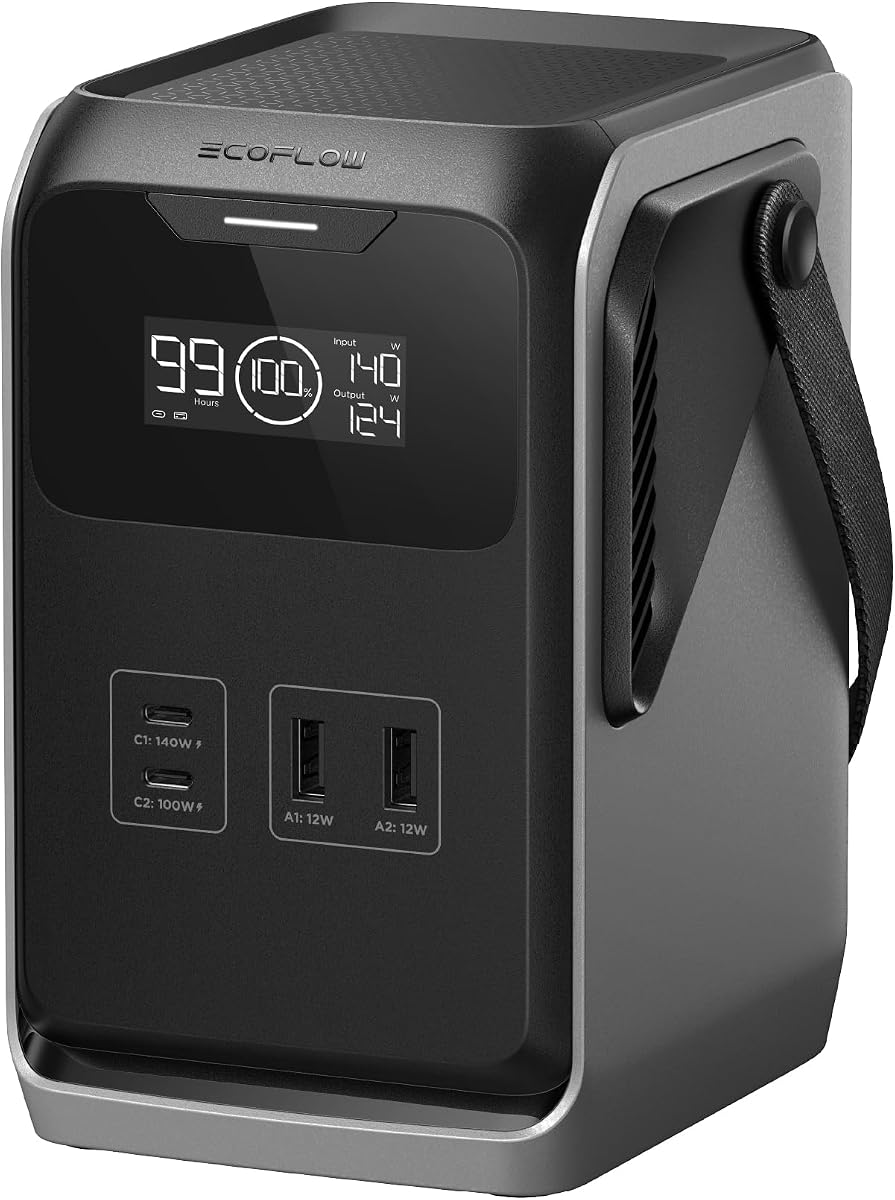
EcoFlow TRAIL 200 DC
4.2Editor score
192Wh portable capacity
220W total DC output
Four USB charging ports
UN38.3 drop certification
EcoFlow Power Stations compared for capacity, output, charging speed, portability, backup features, and expanded energy options.
EcoFlow power stations combine rechargeable batteries, inverters, and multiple outlets in portable packages suited to home emergencies, camping, RV travel, mobile work, and everyday energy management. A strong model should provide enough continuous power for your essential devices, recharge efficiently, operate quietly, and offer a form factor suited to where you plan to use it.
This guide compares ten EcoFlow options using the supplied specifications, including battery capacity, continuous output, surge capability, charging methods, UPS transfer time, noise levels, expansion potential, and portability. The list covers compact units for phones and outdoor gear as well as substantial systems designed to support household appliances and extended outages.
Each review identifies the strongest reasons to consider a particular model and also explains where another choice may be more suitable. Product ratings reflect the listed customer feedback, while technical claims come from the supplied product information. Availability, configuration, and prices can change, so readers should confirm current details before purchasing.
4.2Editor score

4.7Editor score

4.2Editor score
The comparison below highlights the main differences among EcoFlow's portable, camping-oriented, RV-focused, and high-capacity power stations. Review the output, battery, charging, and portability specifications together because the most capable unit is not necessarily the easiest one to carry or the most suitable for a particular application.

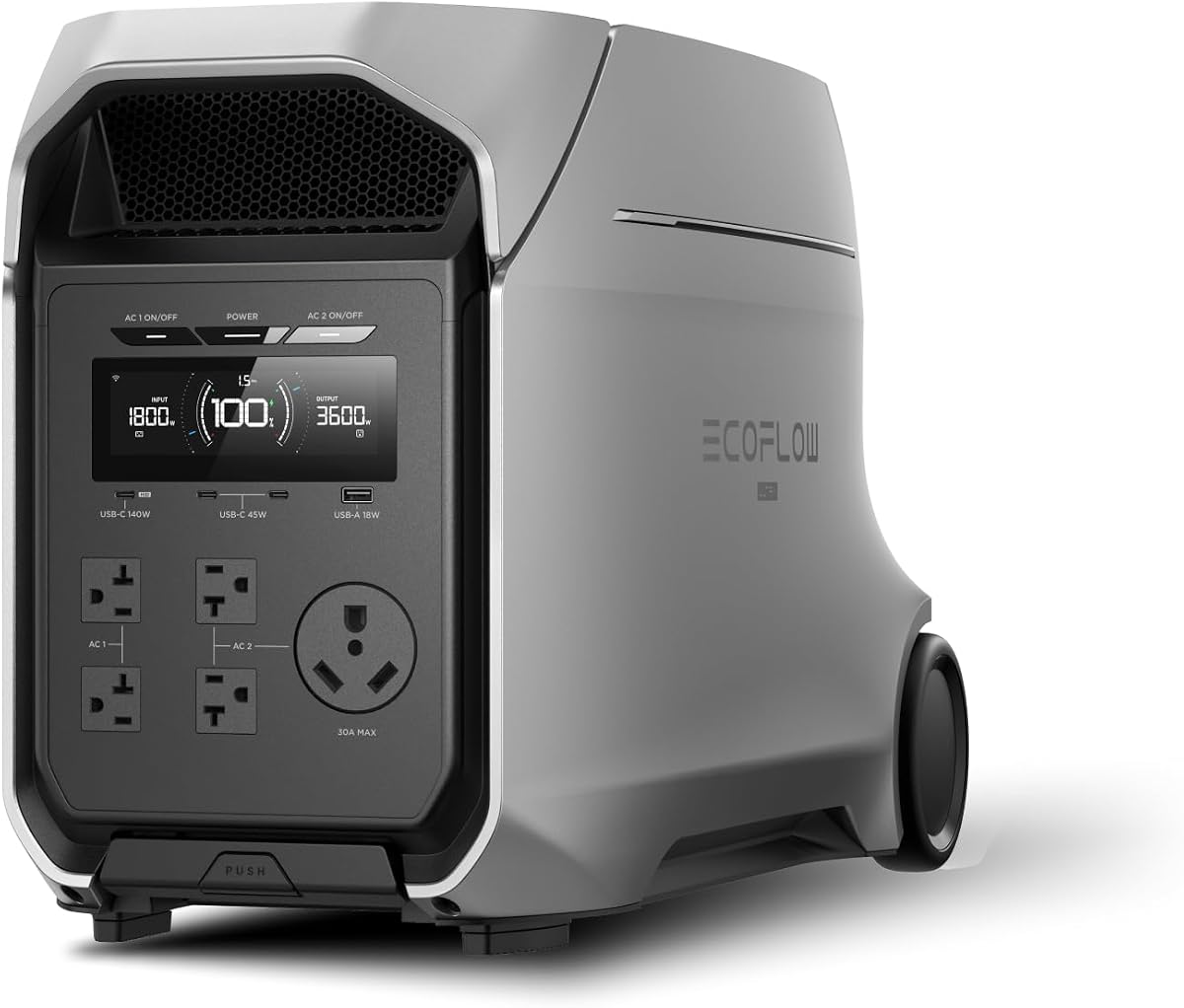


The EcoFlow DELTA 3 Max stands out as the most balanced all-purpose model in this guide, earning a 4.7 rating from the supplied customer feedback. Its 2048Wh LFP battery sits in a useful middle ground between small camping units and larger home-backup systems, while the listed 2400W continuous output and 3400W X-Boost mode provide considerable appliance flexibility.
We may earn a commission when you buy through this link, at no additional cost to you.
Fast charging is one of its most persuasive features. EcoFlow states that the unit can move from zero to 80 percent in about 1.13 hours, a useful advantage when an outage warning arrives and you need to restore power quickly. Its transfer time of less than 10 milliseconds also makes it more appropriate for computers, routers, and other sensitive electronics that may restart when utility power changes.
There are trade-offs. Its 2048Wh battery provides less endurance than the 3072Wh, 3600Wh, and 6144Wh models in the list, so extended outages or several high-draw appliances may require careful prioritization. It is also naturally bulkier and heavier than the RIVER and TRAIL series. Even so, the fast recharge, quiet operation, strong output, and five-year extended service make those limitations reasonable for many homes, RVs, and campsites.
Choose the DELTA 3 Max if you want one capable system for everyday portable power, weekend trips, and emergency backup without moving to a much larger installation. It is especially attractive to households that value quick recovery, low-noise operation, and sophisticated app controls more than maximum stored energy. For someone needing several days of essential power, the DELTA 3 Ultra or DELTA Pro would offer a more suitable capacity foundation.
The stated 1.13-hour window from zero to 80 percent reduces downtime when the unit is being prepared for travel or an approaching outage. Combined with a transfer time below 10 milliseconds, it supports a practical home-backup role while still working as a portable power source.
The 3400W X-Boost output exceeds the nominal 2400W rating, giving compatible appliances additional headroom. Buyers should still verify an appliance's startup and running requirements, since boost modes are not substitutes for accurate load planning.
We may earn a commission when you buy through this link, at no additional cost to you.
The EcoFlow DELTA Pro is a substantial portable power station with a 3600Wh LFP battery, 3600W continuous AC output, and a 4.6 customer rating. It is a natural choice for homeowners seeking more resilience than a compact camping unit or RV owners who want substantial output without moving directly to the largest DELTA Pro Ultra configuration.
We may earn a commission when you buy through this link, at no additional cost to you.
Its most significant strength is flexibility. The unit can expand from 3.6kWh to as much as 25kWh with compatible DELTA Pro Extra Batteries and Smart Generators, making the initial purchase adaptable to changing energy needs. Fifteen output methods cover two USB-A ports, two fast USB-A ports, two 100W USB-C ports, five AC outlets, two DC outlets, a car output, and an Anderson port.
The charging options are similarly broad. EcoFlow lists wall outlets, solar, EV charging, a car outlet, and its Smart Outdoor Generator as methods of replenishment. The stated solar charging time of 2.8 hours requires four 400W panels, and the 1.8-hour wall recharge requires a 240V, 3000W supply. These qualifications matter because smaller wall connections or fewer panels will not produce the same result.
This is not the easiest model to move casually, and maximizing its capacity requires additional purchases. Nevertheless, the substantial battery, abundant ports, dual-unit pairing capability, and scalable energy make the DELTA Pro a compelling premium choice for extended backup, mobile work, and larger RV systems. It is less appropriate for hikers or travelers who value minimal size above output flexibility.
A 3600Wh starting capacity already exceeds that of most camping models in the list, while compatibility with extra batteries and a Smart Generator extends the platform to 25kWh. That scalability is valuable for users whose backup requirements may grow over time.
Fifteen output configurations and two 100W USB-C ports give this model unusual flexibility for phones, computers, household equipment, and RV loads. The breadth of connections can eliminate the need to carry separate adapters during travel.
We may earn a commission when you buy through this link, at no additional cost to you.
The EcoFlow DELTA 3 Ultra Plus combines 3072Wh of storage with 3600W continuous output and a 4.6 rating. It sits close to the ideal center of this roundup: more energy than the DELTA 3 Max models, more compact positioning than the DELTA Pro Ultra, and several premium conveniences for homes, RVs, and extended trips.
We may earn a commission when you buy through this link, at no additional cost to you.
Its 7200W surge rating provides useful starting headroom for appliances and tools that briefly draw more power during startup. The sub-10-millisecond automatic switchover keeps computers, routers, and medical devices running when grid power fails. At just 25dB under load, the cooling system also makes the unit practical indoors or in an RV where a noisy generator would be disruptive.
Capacity can expand from 3kWh to 11kWh, allowing users to cover multi-day outages or longer RV travel. Six charging methods include home outlets, solar, car chargers, EV stations, generators, and the EcoFlow Smart Generator. The under-one-hour 80 percent charging claim depends on the appropriate source and conditions, so buyers should confirm compatible charger requirements.
The main drawback is weight: a unit with this capacity and output is not intended for casual backpacking. Another consideration is that the supplied information emphasizes the standard 3600W output rather than highlighting a higher X-Boost mode. For users who need high capacity, quiet backup, rapid charging, and future expansion without selecting the largest system, the DELTA 3 Ultra Plus is difficult to dismiss.
The listed 25dB operating level is especially helpful during overnight outages, home-office use, and campsite operation. Quiet cooling lets the unit serve sensitive electronics without introducing the constant noise associated with combustion generators.
The base 3072Wh battery is suitable for a solid reserve of essential power, while expansion to 11kWh supports longer outages and trips. Expansion is especially attractive for households that want to start with one unit and increase storage later.
We may earn a commission when you buy through this link, at no additional cost to you.
The EcoFlow DELTA 3 Max Plus is rated 4.5 and pairs a 2048Wh LFP battery with 3000W nominal output and up to 3800W in X-Boost mode. Its defining attraction is charging speed: EcoFlow states that the unit can reach 80 percent capacity in 43 minutes, making it particularly compelling for RV travelers who need to replenish while moving between destinations.
We may earn a commission when you buy through this link, at no additional cost to you.
Five charging methods include an AC wall outlet, solar panels, a car connection, a Smart Generator, and combined PV-plus-car charging. This gives users multiple ways to prepare for the next leg of a journey. For home backup, the unit's under-10ms transfer time can protect sensitive electronics, while quiet operation makes overnight use less disruptive.
Extra batteries can raise total storage from 2kWh to 10kWh, which is meaningful for multi-day camping or longer outages. The app provides battery monitoring, scheduling, and output-priority controls. The 3800W X-Boost output is also higher than the 3400W figure listed for the standard DELTA 3 Max, although the nominal output also differs.
Its main trade-off is that the standard DELTA 3 Max offers a similar 2048Wh capacity and a higher 4.7 rating, while the Max Plus emphasizes 3000W nominal output and faster charging. Buyers who do not require that charging speed or extra power may find more value in the standard model. For fast turnarounds and RV flexibility, however, the Max Plus is a persuasive option.
A stated 43-minute charge to 80 percent helps reduce the pause between uses. The result depends on the correct charging setup, so RV owners should check input requirements before relying on a specific recharge schedule.
The 3000W nominal rating and 3800W X-Boost mode can support compatible household appliances and power tools. Expansion to 10kWh gives travelers a path to longer off-grid periods without replacing the main unit.
We may earn a commission when you buy through this link, at no additional cost to you.
The EcoFlow DELTA 3 Ultra delivers 3072Wh, 3600W continuous output, 7200W surge capability, and a 4.6 rating. It is designed for users who need to run more than ordinary travel electronics and want backup support for appliances, routers, computers, and selected medical equipment.
We may earn a commission when you buy through this link, at no additional cost to you.
One of its strongest qualities is the transition between utility power and battery power. The automatic UPS switchover occurs in less than 10 milliseconds, reducing the likelihood that sensitive electronics will shut down during an outage. Its 25dB operating level also distinguishes it from noisy fuel-powered alternatives, making it practical for overnight use in a home or RV.
The bundle includes an XT60 solar cable, which is useful for compatible solar setups. Four charging options are listed: wall outlet, solar panel, car input, and EcoFlow Smart Generator. The LiFePO4 battery, EV-grade CTC structure, and 24/7 battery protection system are designed to support long-term daily use and operation in challenging temperatures.
Compared with the DELTA 3 Ultra Plus, this version has fewer listed charging methods and no supplied expansion range, though it may still be expandable through compatible EcoFlow equipment. It is also too substantial for light hiking. For users who prioritize near-instant backup and quiet appliance support, however, the standard Ultra offers many of the most compelling features in the roundup.
The sub-10ms UPS response is a major advantage over systems that require manual switching or take noticeably longer to change sources. It helps preserve continuous operation for sensitive connected devices.
Including an XT60 solar cable makes it easier to connect a compatible panel, although the cable alone does not determine charging speed. Panel size, sunlight, and the unit's input limits still need to be considered.
We may earn a commission when you buy through this link, at no additional cost to you.
The EcoFlow RIVER 2 bundle includes a portable power station and a magnetic power bank, offering a practical mix of household backup and everyday phone power. It carries a 4.5 rating and focuses on convenience rather than the large appliance capacity found in the DELTA line.
We may earn a commission when you buy through this link, at no additional cost to you.
The included 5000mAh power bank supports Qi 2.0 MPP wireless charging up to 15W for compatible Apple devices and up to 5W for Android devices. Its integrated 30W Type-C cable can charge an iPhone 15 or 15 Pro to 50 percent in 30 minutes, while the power bank itself can move from zero to 70 percent in the same amount of time when recharged over PD 3.0.
The power station offers up to 600W output and can run six essential appliances at once, including a 300W AC outlet plus USB and other connections. It also reaches a full charge over AC in one hour using EcoFlow's X-Stream technology. That combination makes it useful for a weekend trip, a temporary office, or a power interruption involving lights, networking, and communications.
It cannot match the storage or appliance-running power of the DELTA 3, DELTA Pro, or DELTA Pro Ultra. Users needing to run a refrigerator, microwave, heater, or power tool should look to a larger model. Within the compact category, though, the RIVER 2 stands out for its useful power-bank bundle and rapid wall charging.
The bundled magnetic bank can be removed and used independently, which helps when a phone needs a small boost away from the main station. Wireless and wired charging options also accommodate different device preferences.
With up to 600W output and a 300W AC outlet, the RIVER 2 can cover several smaller essentials at once. It is better suited to lights, electronics, and communication equipment than major household appliances.
We may earn a commission when you buy through this link, at no additional cost to you.
The EcoFlow RIVER 3 is a compact 245Wh power station bundled with a 5000mAh Qi2 Rapid Power Bank. It has the highest listed rating in the roundup at 5.0, though customer ratings should be considered alongside the model's relatively small battery capacity and more specialized travel use case.
We may earn a commission when you buy through this link, at no additional cost to you.
Its X-GaNPower technology is intended to improve energy efficiency for appliances below 100W while reducing size and controlling volume to under 30dB from 1.5 feet. The included magnetic power bank provides wireless charging up to 15W for compatible Apple devices, up to 5W for Android devices, and 30W wired output. It can recharge an iPhone 15 or 15 Pro to 50 percent in 30 minutes over the built-in Type-C cable.
The main station reaches a full charge in one hour over AC and accepts up to 110W of solar input, allowing a recharge in about 2.6 hours under the listed conditions. That combination of speed and compactness makes it well suited to weekend travel, emergency preparation, or keeping a small collection of devices alive during an outage.
The 245Wh reserve cannot power large household appliances for long, and buyers should not equate the included power bank's charging capability with the main station's AC output. Within compact systems, however, the RIVER 3 offers a polished package: fast wall charging, efficient GaN architecture, quiet operation, and a genuinely useful phone battery.
The included Qi2 bank means users do not need to purchase a separate magnetic battery for compatible phones. That makes the bundle especially convenient for travelers who want both a small station and an everyday portable charger.
A one-hour AC recharge is convenient at home, while the 110W solar input provides a practical off-grid replenishment option. The listed 2.6-hour solar time depends on suitable sunlight and compatible equipment.
We may earn a commission when you buy through this link, at no additional cost to you.
The EcoFlow TRAIL 200 DC is built for lightweight outdoor carry, combining a 192Wh LiFePO4 battery with 220W of total direct-current output. Its 4.2 rating is the lowest listed here, but the model serves a clearly defined niche: portable charging for compatible outdoor equipment without the bulk of an AC-equipped station.
We may earn a commission when you buy through this link, at no additional cost to you.
EcoFlow describes it as 48 percent lighter and 60 percent smaller than the RIVER 3 at a similar capacity. The four-port layout consists of two 12W USB-A ports, one 100W USB-C input-and-output port, and one 140W PD 3.1 USB-C input-and-output port. Pure DC output can support up to 90 percent of typical essential outdoor gear according to the supplied information.
Durability is a major strength. The battery cells work with an intelligent battery management system, while five internal and external protection layers and UN38.3 drop certification support use during hiking, climbing, and travel. EcoFlow states that the LiFePO4 cells can deliver up to five years of dependable outdoor power.
The significant compromise is the absence of standard AC outlets. Users cannot power ordinary wall devices without compatible USB-C equipment or another solution, and the package does not include a charging cable. For lightweight camping, hiking, and charging phones, cameras, lights, or compatible USB-C gear, the focused design is an advantage rather than a flaw.
Avoiding a conventional AC inverter and using pure DC output keeps the unit compact and light. That focus makes the TRAIL 200 DC easier to carry than larger general-purpose stations when every gram matters.
The 100W and 140W USB-C ports offer meaningful charging performance for compatible laptops, cameras, and other gear. Users should check their device's required protocol and cable support before departure.
We may earn a commission when you buy through this link, at no additional cost to you.
The EcoFlow DELTA Pro Ultra is the highest-capacity model in this guide, beginning with a 6144Wh battery and a 7200W inverter. It carries a 4.2 customer rating, yet its specifications target a distinct market: households seeking serious electrical storage and the ability to operate major appliances during extended grid interruptions.
We may earn a commission when you buy through this link, at no additional cost to you.
Its inverter supports both 120V and 240V equipment. EcoFlow says the unit can run almost any heavy household appliance, including a 3-ton central air conditioner. Tripling the inverters can raise total AC output to 21.6kW, while expanding the battery from one unit to 15 can reach 90kWh. For a standard North American household, EcoFlow estimates that configuration could secure more than 30 days of essential power.
One 6144Wh battery can be recharged in two hours when using an appropriate source. Wall outlets, solar, EV charging, and outdoor generators are supported. The app can prioritize home circuits, analyze consumption, and help shift energy use, while the online UPS offers a 20ms transfer time. The stated UL1973 and UL9540 certifications add a notable level of assurance for home installations.
This system is not realistically portable in the same way as the TRAIL or RIVER products. It also costs more in terms of space, installation planning, and expense, and the inverter and battery arrive in separate packages. It is most appropriate for homeowners seeking a comprehensive stationary backup rather than occasional camping power.
A 6144Wh starting point and 7200W output place this model well beyond ordinary emergency kits. The ability to support 240V loads and major appliances makes it relevant for households that cannot depend on a few small outlets alone.
Expansion to 90kWh and 21.6kW across multiple inverters creates unusually long-term potential. Buyers should assess installation requirements, permitted configurations, and their actual essential-load needs before ordering.
We may earn a commission when you buy through this link, at no additional cost to you.
The EcoFlow DELTA 2 Max Extra Battery is not a standalone power station; it is an expansion battery designed to add 2048Wh of LiFePO4 storage to a compatible DELTA 2 Max. It earns a 4.6 rating and should be considered by existing DELTA 2 Max owners who need more runtime rather than by shoppers seeking a complete all-in-one package.
We may earn a commission when you buy through this link, at no additional cost to you.
Adding up to two of these batteries can raise a compatible system's total capacity to 6144Wh. That extra reserve can extend home backup, support longer RV trips, and reduce the need to recharge between uses. The same added capacity can also provide more operating time for outdoor work or a larger collection of travel devices.
Battery longevity is the accessory's clearest technical advantage. EcoFlow states that the LFP chemistry can support 3000-plus cycles and up to ten years of daily use before reaching 80 percent of original capacity. These claims make the battery a long-term addition to a compatible EcoFlow setup rather than a short-term convenience pack.
Compatibility is the main limitation. A buyer without a DELTA 2 Max cannot use this product as an independent source of power, and the extra battery adds weight and storage requirements. For the right owner, however, it is an efficient way to increase usable energy while retaining the main unit's inverter and controls.
Extra batteries provide a direct way to increase stored energy while preserving a compatible DELTA 2 Max platform. This can be more economical than replacing an entire setup when additional capacity is the only requirement.
The stated 3000-plus-cycle rating and ten-year daily-use target make the LFP battery well suited to owners who intend to use their system frequently. Actual longevity still depends on temperature, charging habits, and operating conditions.
We may earn a commission when you buy through this link, at no additional cost to you.
The right EcoFlow power station depends less on maximum headline output than on matching stored energy, appliance demands, charging access, and portability to your routine. Use the following factors to narrow the field before deciding which model deserves the space and budget.
Capacity is measured in watt-hours, and it indicates how much energy the battery can store. Smaller models such as the 192Wh TRAIL 200 DC and 245Wh RIVER 3 are convenient for phones, cameras, lights, and other portable electronics, while the 2048Wh to 6144Wh DELTA models can support more demanding equipment. Runtime is not determined by capacity alone: the device's wattage, conversion losses, battery age, and ambient conditions all affect how long it can run.
Choose enough capacity for your realistic essential loads rather than the largest number available. Extra capacity improves resilience during prolonged outages but also adds weight, charging time, and cost.
Continuous output is the level the unit can maintain while an appliance operates, while surge output covers brief startup demands. A model may have a 2400W nominal rating and a higher X-Boost figure, as seen with the DELTA 3 Max, or a 3600W continuous and 7200W surge rating, as offered by the DELTA 3 Ultra family. Compare both values with the running and starting requirements of intended equipment.
Use continuous output as the main guide and treat surge as additional startup headroom. A high headline surge number cannot compensate for insufficient sustained power.
Fast charging can make a station much more useful during short warning periods. Claimed recharge times depend on the exact source: the DELTA 3 Max reaches 80 percent in about 1.13 hours, the DELTA 3 Max Plus does so in 43 minutes, and the RIVER 3 completes a full AC recharge in one hour. Solar times also depend on compatible panels, available sunlight, and the unit's solar-input limit.
Select a model with charging methods available where you will actually use it. Check whether a wall adapter, high-wattage outlet, car connection, or solar panel is included or must be purchased separately.
For outages, transfer time matters because sensitive electronics can restart when the power source changes. The DELTA 3 Max, DELTA 3 Max Plus, DELTA 3 Ultra, and DELTA 3 Ultra Plus list automatic transfer below 10 milliseconds. The DELTA Pro Ultra uses a 20ms online UPS response, while the DELTA Pro supports home backup but does not list an equally specific transfer figure in the supplied information.
Prioritize sub-10ms switching for computers, routers, medical equipment, or other devices that benefit from seamless transition. Confirm that the power station is configured for UPS behavior before an outage occurs.
Ports determine which devices can be powered directly and whether adapters are required. The DELTA Pro offers 15 output methods, including five AC outlets, two 100W USB-C ports, USB-A connections, DC outputs, a car socket, and an Anderson port. The TRAIL 200 DC focuses entirely on USB connections, while the RIVER bundles include magnetic power banks for compatible phones.
List your devices and check voltage, connector type, and charging protocol. A powerful AC inverter is of little use if the needed adapter or port is missing.
Portable power is relative. The TRAIL 200 DC is designed as a light handheld unit, the RIVER 2 and RIVER 3 are compact travel systems, and the DELTA models provide progressively more capacity and output. The DELTA Pro Ultra is a substantial home-scale product rather than a casual hiking companion. Weight matters for carrying between a vehicle, campsite, and home, while footprint may be more relevant in an RV or utility room.
Choose a unit you will actually transport to the locations where it is needed. A smaller station left at home is often less useful than a moderately larger model that accompanies every trip.
Portable power stations have no combustion engine, but fans and electrical components still produce sound. The DELTA 3 Ultra and DELTA 3 Ultra Plus list operation at just 25dB under load, while the RIVER 3 controls volume to below 30dB at 1.5 feet. Quiet operation makes a unit easier to use near bedrooms, offices, patient spaces, and campsites.
Pay attention to advertised noise conditions and allow clearance for cooling. Quieter operation is particularly valuable when the station provides automatic backup at night or during work.
Expansion can extend a system as energy needs change. The DELTA Pro can reach 25kWh, the DELTA 3 Ultra Plus can expand to 11kWh, and the DELTA 3 Max Plus to 10kWh. The DELTA Pro Ultra reaches an exceptional 90kWh, while the DELTA 2 Max Extra Battery can bring a compatible system to 6144Wh. Expansion improves longevity because owners can add storage instead of replacing the entire inverter platform.
Confirm compatibility, required cables, and installation conditions before planning an expansion. Also consider whether your current use actually requires more energy before buying additional hardware.
Before first use, read the supplied safety instructions, confirm the battery is adequately charged, and inspect the unit and cables for visible damage. Set up the power station on a stable, dry, ventilated surface. Identify which appliances you intend to run, check their wattage, and test essential outputs before relying on the system during an outage. Do not exceed the unit's continuous output or surge ratings.
Charge through compatible inputs and use the EcoFlow app to monitor battery status, temperature, charging schedules, and active outputs where supported. For home backup, configure UPS behavior and test it under a safe, controlled interruption. For solar charging, use appropriately rated cables and panels and position them where they receive unobstructed sunlight. Avoid using charging methods or output configurations that are not listed for the specific model.
Long-term care matters. Store the unit within the manufacturer's recommended temperature range, avoid moisture, dust, and physical impact, and do not leave it in a vehicle exposed to extreme heat or cold. Periodically check the battery level and inspect connectors. Recharge before long periods of storage, use only compatible accessories, and contact EcoFlow support if a battery swells, becomes unusually hot, shows damage, or behaves abnormally.
The best camping model depends on how much energy and output you need. The TRAIL 200 DC is the lightest and most specialized, while the RIVER 2 and RIVER 3 suit travelers needing more flexible charging. RV campers should consider the DELTA 3 Max or DELTA 3 Ultra families for greater output, quiet operation, and expansion.
No. A higher battery capacity provides more stored energy and potentially longer runtime, but it also adds weight, size, and charging demands. Choose a capacity that covers your realistic loads rather than automatically selecting the largest model available.
Continuous output is the power a unit can sustain while a device is operating. Surge output provides temporary extra headroom for startup demands. Always check both figures and ensure the appliance's running requirements remain comfortably below the sustained limit.
Many DELTA models can run a refrigerator, subject to the refrigerator's startup and running wattage. The DELTA 3 Max, DELTA 3 Max Plus, DELTA 3 Ultra family, DELTA Pro, and DELTA Pro Ultra offer enough output for many such appliances, but the unit must have sufficient remaining capacity as well.
It means the power station can switch from grid power to battery power in less than 10 milliseconds. That very short transition helps computers, routers, and other sensitive devices continue operating without an obvious restart, provided the station has been configured correctly.
Battery-powered EcoFlow stations can be used indoors and do not produce combustion-engine exhaust. Models such as the DELTA 3 Ultra and DELTA 3 Ultra Plus operate quietly, but you should still maintain airflow around the unit and follow the manufacturer's temperature, clearance, and placement instructions.
Solar compatibility depends on the model's supported solar input, connector, and voltage requirements. Some listings include an XT60 cable or specify a maximum solar input, while others require separate compatible equipment. Confirm both the station and panel specifications before connecting them.
No. It is designed to add 2048Wh of storage to a compatible DELTA 2 Max system. It cannot power devices independently and must be paired with the intended unit, but it can increase total compatible capacity to as much as 6144Wh.
The EcoFlow DELTA 3 Max is the strongest all-around choice because it combines 2048Wh of storage, 2400W nominal output, 3400W X-Boost capability, fast charging, quiet operation, and sub-10ms backup transfer. The DELTA Pro is preferable for larger and more expandable systems, while the DELTA Pro Ultra serves the demanding home-backup market.
For mobile users, the RIVER 2 and RIVER 3 provide compact packages with useful magnetic power banks, while the TRAIL 200 DC offers the lightest specialized outdoor design. Prioritize the capacity your essential loads genuinely require, verify output and port compatibility, and consider expansion only if it serves a clear near-term or long-term goal.
Finally, confirm the current product configuration, included accessories, compatibility, and latest specifications before buying. EcoFlow updates models and accessories over time, and availability or prices can change. Comparing the current listing with your load list is the safest way to select the right EcoFlow power station for home, camping, RV, or mobile use.