
WVOVW 6 Pack Egg Crate Acoustic Foam
4.2Editor score
Six 12-inch square panels
Egg-crate surface structure
Fire-retardant polyurethane construction
Foam for noise reduction comes in several forms, each suited to a different kind of unwanted sound. Open-cell acoustic panels help control echoes and reverberation inside rooms, while dense closed-cell sheets reduce vibration, road noise, and heat transfer. Choosing the right foam starts with identifying the noise source and the surface that needs treatment.
This guide compares ten acoustic foam and sound-damping products spanning studio panels, egg-crate designs, closed-cell rolls, vehicle mats, and dual-layer insulation. The comparison considers dimensions, material construction, installation method, intended applications, and special features such as waterproofing, fire resistance, flexibility, and quick shape recovery.
Each review explains how the product fits into a broader noise-control strategy and highlights realistic trade-offs. The list includes options for home studios, offices, home theaters, cars, HVAC equipment, pipes, appliances, and other vibration-prone surfaces. Product availability and prices can change, so verify current listing details before purchasing.
4.2Editor score

4.4Editor score

4.5Editor score
As an Amazon Associate we earn from qualifying purchases.
The table below compares all ten options by format, thickness, coverage, and primary noise-control role, making it easier to identify the right product for a room, vehicle, appliance, or mechanical system.



The Focusound Acoustic Foam Panels are a 52-piece wedge-panel set with a 3.7 rating. Their greatest strength is the number of small panels included, which gives a room taker a flexible way to cover broad wall areas, corners, and smaller acoustic-treatment zones. The triangular grooves increase exposed surface area and are intended to absorb echoes, waves, reverberation, and flutter echoes.
We may earn a commission when you buy through this link, at no additional cost to you.
Each panel measures 12 by 12 inches and is one inch thick. That shallow profile makes the set lighter and easier to arrange than bulkier egg-crate products. The package also includes 300 pieces of double-sided adhesive tape, allowing installers to position panels without separately sourcing mounting hardware. The material is described as high-density, air-permeable, non-toxic, and resistant to burning.
The main drawback is that one-inch-thick wedge foam is primarily a room-acoustics treatment, not a complete barrier against sound entering from outside. Its relatively modest rating also suggests that buyers should pay close attention to the listing details and customer feedback for their particular application. The adhesive may be suitable for many dry surfaces, although careful surface preparation remains important.
This set makes sense for a home office, small recording corner, vocal booth, or entertainment room where the main objective is reducing reflections rather than creating a sealed acoustic enclosure. It is especially attractive to users who want many mounting points and the freedom to place smaller panels around doors, windows, and wall junctions. For that broad-coverage role, it is a practical room-treatment choice.
Because the panels are small and numerous, they can be distributed rather than concentrated in one location. This helps treat first-reflection points, corners, and other areas where a few large panels might be difficult to position.
The included double-sided tape removes the need to buy a separate basic mounting solution. Installers should still clean the wall, press each panel firmly, and allow the adhesive to set before testing the acoustic result.
We may earn a commission when you buy through this link, at no additional cost to you.
This 24 Pack Pyramid Acoustic Foam has a 4.0 rating and uses a two-inch-thick pyramid design to increase surface area and improve the absorption of echoes and reverberation. Its stated high Noise Reduction Coefficient makes it especially relevant to recording studios, podcast rooms, home theaters, offices, and gaming environments where reflections interfere with clear sound.
We may earn a commission when you buy through this link, at no additional cost to you.
The product is made from flame-retardant acoustic foam and weighs little enough for straightforward wall or ceiling placement. Installation can use construction adhesive or suitable double-sided tape, although neither is included. Its alternating triangular faces create a recognizable studio look and make it easier to cover a meaningful surface with multiple repeated modules.
Despite the soundproofing language used in its market title, the listing explicitly states that the foam is intended for absorption rather than full soundproofing or isolation from outside noise. It cannot by itself stop sound from traveling through a wall, door, window, or open doorway. Two-inch depth may also require more care when mounting overhead.
This is a good fit for users who understand the difference between acoustic treatment and noise isolation. It is particularly attractive for controlling flutter echoes around recording equipment, improving clarity in a small theater, or reducing conversational reverberation in a work area. For those goals, the deeper profile offers a stronger treatment than thin, one-inch wedge panels.
The two-inch pyramid profile provides more material and a deeper surface for interacting with incoming sound waves. That makes it more appropriate for rooms where echo and reverberation are more noticeable than exterior noise.
The repeating pyramid geometry can complement recording and media rooms while contributing useful acoustic treatment. Its visual consistency makes it easier to create a symmetrical installation than with unrelated panel sizes.
We may earn a commission when you buy through this link, at no additional cost to you.
The WVOVW 6 Pack Egg Crate Acoustic Foam carries a 4.2 rating and offers a balanced combination of depth, surface structure, and manageable panel size. Its one-and-a-half-inch thickness sits between thinner wedge foam and deeper two-inch egg-crate products, making it versatile for walls, doors, studios, offices, and vocal areas.
We may earn a commission when you buy through this link, at no additional cost to you.
The egg-crate shape creates an intricate three-dimensional surface. According to the product information, some sound reflects from the surface while another portion enters the foam, where friction and interaction with the sound-absorbing material converts energy into heat. The panels are made from polyurethane and are described as non-toxic and compliant with California Technical Bulletin 117-2013.
The set arrives vacuum-sealed for shipping, so panels may need time to separate and recover their intended shape after opening. This is a normal handling characteristic rather than a functional defect, but it does require planning before installation. The egg-crate design is also visually pronounced, which may not suit every decorative setting.
This is an appealing pick for cost-conscious buyers who want more depth than one-inch wedge foam without moving into the largest wall-sized panels. It can be used for targeted treatment, door surfaces, and small studio areas. For larger rooms, multiple packs would normally be required, but the compact panels are easier to handle and place individually.
At one-and-a-half inches, the panels offer a middle-ground profile that can be effective without appearing as bulky as the deepest products. This makes them useful for small rooms, vocal booths, and localized reflection points.
Because the set is vacuum-sealed, separate the interlocking panels and leave them in a ventilated area until they regain their shape. Mounting only after the foam has recovered helps it sit flush and maintain the intended acoustic profile.
We may earn a commission when you buy through this link, at no additional cost to you.
Siless Liner 157 is a self-adhesive closed-cell polyethylene foam roll with a 4.5 rating, the highest among the products in this guide. It provides 36 square feet of coverage at four millimeters thick, making it a substantial option for vehicle sound-deadening, heat insulation, and vibration control across doors, floors, trunks, and other panels.
We may earn a commission when you buy through this link, at no additional cost to you.
The closed-cell structure is described as waterproof, oil-resistant, lightweight, flexible, odorless, and highly compressible. Its adhesive layer is intended to remain in place while the material follows curved or irregular vehicle surfaces. The listing also states that it can block up to 98 percent of radiant heat transfer and provides an operating range up to 215 degrees Fahrenheit.
This is a roll-format material rather than a decorative room panel, so installation requires cutting and fitting it to the target areas. Surface preparation is critical because dirt, wax, moisture, or loose paint can impair adhesion. It also lacks the sculpted profile of studio foam and is not intended to improve the appearance of a media room.
The product is best for vehicle builders, drivers seeking a quieter cabin, or installers tackling multiple noisy panels. Its combination of broad coverage, waterproof construction, heat resistance, and vibration-damping characteristics makes it a strong specialist choice for automotive and mechanical applications where open-cell acoustic foam would be less suitable.
Unlike an open-cell absorber, this polyethylene liner does not absorb water, making it better suited to cars and other exposed or humid environments. It also provides a more consistent barrier against heat and vibration.
The 36-square-foot roll can cover several sections of a vehicle without numerous small pieces. Cutting it to fit different cavities and contours allows one material to serve doors, floors, hoods, and trunks.
We may earn a commission when you buy through this link, at no additional cost to you.
The Geynnple High Density Wall Panel is a single 48-by-24-inch acoustic panel with a 4.1 rating. Its two-inch depth and broad face give it a strong fit for home studios, offices, podcasting spaces, and other rooms where one large treatment surface is more convenient than many small tiles.
We may earn a commission when you buy through this link, at no additional cost to you.
The high-density foam is designed to absorb sound and improve room acoustics, while the quick-recovery characteristic helps it regain its shape after compression or shipping. The listing identifies intended uses such as music recording, podcasting, and quieter workspaces. Visually, the black panel can blend into dark studio interiors without the busy pattern of egg-crate foam.
Only one piece is included, and adhesive is not part of the package. A preferred double-sided tape or construction adhesive must therefore be obtained separately. Because the panel is large, installation requires at least two strong mounting points and careful handling to avoid creasing or damaging the foam.
This panel is most useful when a buyer wants to cover a substantial section of a wall with a single piece and values fast shape recovery. It may be less suitable for buyers seeking a complete, ready-to-install room kit, since additional panels and mounting materials may be needed. For localized treatment of a large studio wall, however, it offers useful coverage and depth.
The wide dimensions reduce the number of mounting points and seams compared with a grid of small tiles. This can make the installation look cleaner while still providing meaningful surface coverage.
A large foam panel needs secure support across its width. Use an adhesive approved for the surface and enough attachment points to prevent the lower edge from peeling away.
We may earn a commission when you buy through this link, at no additional cost to you.
The Kaqiluo High Density Self-Adhesive Closed Cell Foam has a 4.1 rating and combines sound insulation with cold protection. The material is described as a dense rubber-plastic foam with a density above 50 kilograms per cubic meter and enhanced hardness, intended to reduce echoes, reflections, reverberation, and flutter within a space.
We may earn a commission when you buy through this link, at no additional cost to you.
The sheet covers 5.8 square feet and is ten millimeters thick, measuring 12 by 71 inches. Its entire back has a self-adhesive layer, so it can be mounted without separate tape. It can also be cut into different shapes, giving installers flexibility for cars, apartments, studios, classrooms, factories, and other spaces.
The listing specifies B1 flame-retardant performance and complete waterproofing. That combination is useful where moisture is present or where the material may be exposed to tougher conditions than standard decorative acoustic foam. Its density and rigidity can make it less visually attractive, and cutting requires clean, controlled strokes to avoid tears or visible creases.
Kaqiluo is a practical option for people who want one material to address sound and thermal transmission. It works particularly well on vibration-prone panels, equipment housings, vehicle surfaces, and utility areas. Those wanting sculpted studio panels for reflection control should choose acoustic foam, while those needing a dense barrier or damper may appreciate this option more.
The high-density closed-cell formulation is intended to resist compression and dissipate vibration rather than merely soften reflections. That makes it useful on equipment enclosures, vehicle panels, and other solid surfaces.
The continuous roll format allows the foam to be tailored around irregular shapes. Measure each area first and use a sharp cutting tool so edges fit closely and adhesive is not exposed beyond the intended area.
We may earn a commission when you buy through this link, at no additional cost to you.
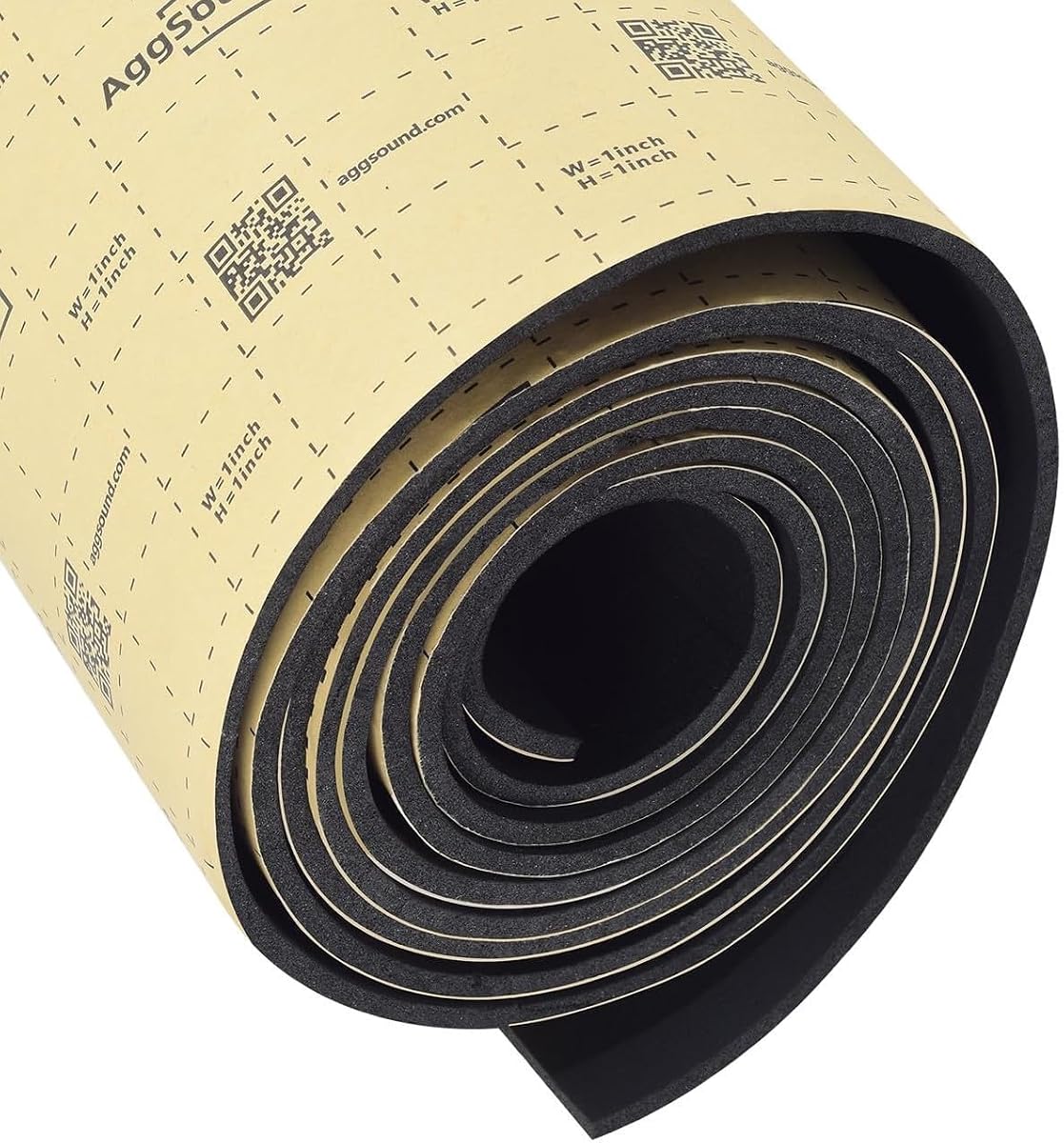
The AggSound Car Sound Deadening Mat has a 4.4 rating and provides six square feet of three-layer, four-millimeter foam. Its stated purpose is to reduce road and engine noise while blocking radiant heat, making it a focused automotive treatment for doors, hoods, floors, trunks, and firewalls.
We may earn a commission when you buy through this link, at no additional cost to you.
The high-density closed-cell material is described as resistant to collapse and compression over time. A heat-resistant adhesive helps it remain attached during warm weather, while the flexible construction allows it to be trimmed around complex contours. The smooth backing peels away for a neat finish, and the product can fit into gaps without preventing doors or panels from closing.
Six square feet is less coverage than the Siless Liner roll, making this more appropriate for one vehicle section or a focused upgrade than a complete whole-car installation. The material also requires disassembly, cleaning, cutting, placement, and reassembly. Incorrect preparation can lead to poor adhesion or a less effective fit.
This mat is a good option for drivers who want to address a specific noisy panel rather than treat an entire vehicle. It can also be used in cars, trucks, and RVs for heat shielding, vibration absorption, and sound control. Installers should follow the included general process and ensure every surface is clean and dry before mounting.
The layered construction combines sound damping with heat resistance and shock absorption. That combination is useful in areas exposed to both road vibration and engine or exhaust heat.
The foam can be cut to follow door cavities, floor channels, trunk shapes, and firewall contours. Careful fitting helps the material sit flat without interfering with panel closure.
We may earn a commission when you buy through this link, at no additional cost to you.
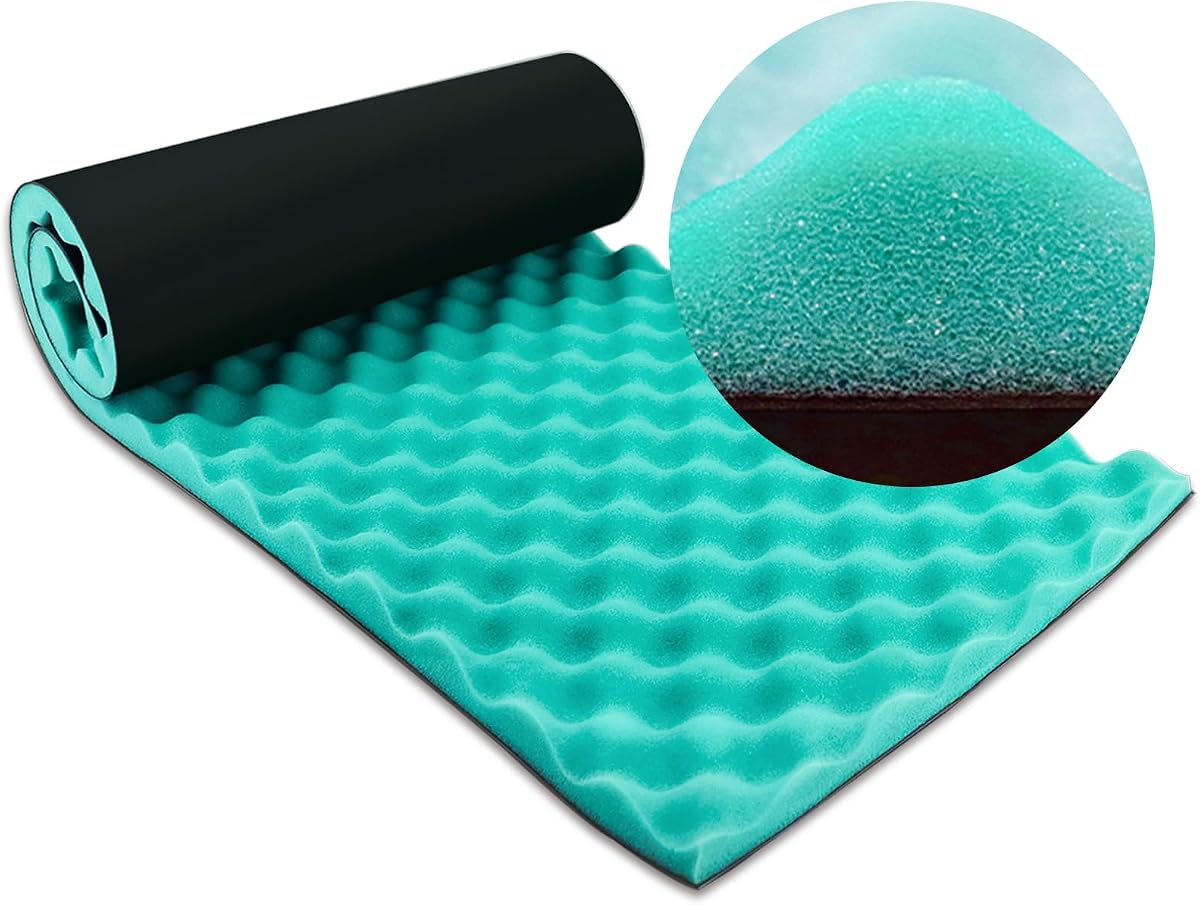
The BXI Dual-Layer Noise Reduction Foam has a 3.7 rating and combines egg-crate acoustic foam with a rubber-backed barrier in one one-inch-thick roll. Rather than focusing only on room reflections, it is designed to absorb sound while dissipating vibrational energy, making it relevant to machinery, pipes, HVAC equipment, doors, and windows.
We may earn a commission when you buy through this link, at no additional cost to you.
The listed dimensions are 39.4 by 13.4 inches with coverage of 3.66 square feet and a weight of two pounds. The product information reports an average transmission loss of 24 decibels, an absorption coefficient of 0.74, and an NRC of 0.75. These manufacturer-provided figures should be understood as stated specifications rather than independent test results.
Installation requires attention to orientation. The foam side should face a pipe, while the rubber side should contact a flat surface such as a door or window. The material is described as tear-resistant, waterproof, heat resistant, non-toxic, and suitable for indoor or outdoor work, but its rigid composite structure is less flexible than ordinary acoustic foam.
BXI is most useful when a single project needs both acoustic absorption and vibration damping, particularly around mechanical equipment. Its specialized design makes it less convenient for creating a standard studio wall, but more appropriate for wrapping pipes or covering vibrating housings where a conventional panel would not address movement.
The egg-crate layer helps absorb airborne sound and reduce echoes, while the rubber layer dissipates vibration. Combining both functions makes this useful where equipment noise includes both direct sound and structural movement.
For pipes, the foam side should face inward toward the pipe. On doors or windows, the rubber side should contact the flat surface, creating the intended barrier-and-absorber arrangement.
We may earn a commission when you buy through this link, at no additional cost to you.
The Egg Crate Foam Wall Panel earns a 4.4 rating and combines a large 48-by-24-inch format with a two-inch-deep egg-crate profile. Its three-dimensional structure increases the surface area available to interact with sound, helping reduce transmission and improve the acoustic character of studios, offices, home theaters, and podcast spaces.
We may earn a commission when you buy through this link, at no additional cost to you.
The panel is made from high-density, flame-retardant polyurethane and is described as non-toxic, tasteless, easy to clean, and suitable for long-term acoustic use. Its black appearance and large dimensions fit particularly well into professional-looking installations where smaller foam tiles would create many more joints and mounting points.
Only one panel is included, so buyers will need additional panels for comprehensive room treatment. The deep sculpted surface also takes up more space than flat acoustic fabric panels, and the product should not be mistaken for a complete soundproofing system. Mounting hardware or adhesive should be selected according to the wall and desired permanence.
This is an excellent choice for a home studio or media room that needs a relatively small number of large acoustic surfaces. It balances visual impact, depth, and straightforward placement better than a pack of tiny tiles. The result is especially compelling when the installation is intended to look cohesive rather than like a grid of separate foam blocks.
A single 48-by-24-inch panel covers a meaningful portion of a wall without the numerous edges found in a small-tile installation. Fewer seams can produce a more polished and professional appearance.
The two-inch egg-crate geometry creates a highly textured surface with more area than a flat panel. That helps it address echo and reverberation in rooms where clear recordings or comfortable listening are the priorities.
We may earn a commission when you buy through this link, at no additional cost to you.
The TroyStudio XPE Foam Roll has a 4.2 rating and combines sound isolation, heat resistance, and vibration control in a self-adhesive sheet. Its closed-cell cross-linked polyethylene structure is described as highly tear-resistant, waterproof, odor free, impact resistant, and capable of performing from 14 to 212 degrees Fahrenheit.
We may earn a commission when you buy through this link, at no additional cost to you.
The roll measures 13 by 78 inches, is 0.4 inches thick, covers 7.04 square feet, and weighs 300 grams. According to the listing, the dense microcellular structure can reduce noise by up to 23.5 decibels. That figure is a product claim, so buyers evaluating performance should distinguish between manufacturer specifications and independently verified room results.
Unlike porous studio foam, XPE is primarily a barrier and damping material. It can reduce the passage of sound through a surface and dissipate impact energy, but it does not provide the same high-frequency absorption as an open-cell wedge panel. The self-adhesive backing is convenient, though long-term performance depends on cleaning and preparing the substrate.
TroyStudio stands out for unusual versatility. It is listed for recording studios, walls, ceilings, car doors, HVAC systems, pipes, appliances, floating floors, vents, and generator enclosures. That range makes it useful for a mixed-property owner who wants one durable material for several noise and heat-control tasks.
XPE's tear resistance, waterproof construction, and broad temperature tolerance make it suitable for demanding surfaces. It is particularly useful in vehicles, mechanical areas, and around household equipment where a lightweight open-cell absorber would be less durable.
The sealed structure is better for stopping transmission and dampening vibration than for absorbing echoes. Combine it with porous acoustic panels when a room needs both reverberation control and a durable isolation layer.
We may earn a commission when you buy through this link, at no additional cost to you.
The most effective foam depends on whether you need to absorb reflections, dampen vibration, block transmitted sound, or combine heat insulation with noise control. Use the following factors to match the material, shape, dimensions, and installation method to your space.
Start by distinguishing echo, airborne sound, structural vibration, and exterior noise. Echoes and reverberation are commonly reduced with porous wedge or egg-crate acoustic foam, while vibration is better addressed by dense closed-cell material. Sound traveling through a wall, ceiling, door, or appliance enclosure may require an isolation barrier, careful sealing, and sometimes multiple construction methods rather than foam alone.
Open-cell acoustic foam has a porous structure that allows sound energy to enter the material, where it is dissipated through friction and heat transfer. It is well suited to studios, offices, theaters, and vocal booths. Closed-cell foam has a sealed cellular structure and is generally denser, more waterproof, and better at resisting vibration and heat transfer, making it useful in vehicles, HVAC systems, around pipes, and on equipment housings.
Wedge and egg-crate profiles increase surface area compared with flat foam, giving sound more opportunities to interact with the material. Egg-crate shapes tend to look deeper and more industrial, while wedges can create a cleaner geometric appearance. Flat dense sheets are less effective as room absorbers but may be better for covering a solid panel or wrapping a mechanical component.
Greater thickness usually allows deeper acoustic structures and can improve low-frequency absorption when the panel is properly positioned, but it also requires more space and secure mounting. Density matters as well: a soft, lightweight foam is effective for absorption, while a dense closed-cell product resists compression and handles vibration. Check both measurements rather than assuming the thickest panel is automatically the most useful.
Small tiles offer flexible placement around doors, corners, and first-reflection points, while large panels cover broad walls with fewer seams. Packs of small panels may suit a room assembled over time; one or two large panels may be better for a focused home studio. Rolls and sheets are often more practical for vehicles and mechanical equipment because they can be cut into custom shapes.
Fire-resistance information is especially relevant for studios, offices, vehicles, and enclosed mechanical spaces. Moisture resistance is critical in cars, bathrooms, basements, HVAC environments, and outdoor installations. Products also have different operating-temperature limits, so confirm that the material can tolerate the heat and cold of its intended location before installation.
Some sets include double-sided tape, while others require construction adhesive, mechanical fasteners, or a separate mounting system. Self-adhesive products are convenient but perform best on clean, dry, smooth surfaces. Acoustic foam can also be installed between studs or in suspended ceiling grids, while dense closed-cell sheets commonly adhere directly to panels, doors, ducts, and equipment housings.
Look for a shape-recovery feature if panels may be compressed during shipping or installation. Closed-cell foam is generally easier to wipe clean and resists moisture, while porous acoustic panels should be kept away from water and dust. Direct sunlight, high heat, and constant compression can affect different materials differently, so compare care guidance with the location and expected handling.
Begin by identifying the sound source and the surface that transmits it. For studio echo, position porous panels at reflection points, behind speakers, around microphones, or along the rear wall. For vehicle noise, apply dense closed-cell material to doors, floors, trunks, hoods, and firewall areas after removing trim where practical. For mechanical equipment, wrap pipes or cover vibrating housings with the appropriate face oriented toward the vibration source.
Prepare the mounting surface thoroughly. Remove dust, oil, wax, moisture, and loose paint, then make sure the area is dry and structurally sound. Cut material with a sharp tool, allowing a small amount of extra material for contours where necessary. Apply adhesive only to the intended face, press firmly, and avoid repeatedly lifting or stretching the foam, as that can damage both the material and the adhesive.
For ongoing care, dust porous panels gently with a soft brush or vacuum attachment and keep them away from moisture. Clean closed-cell sheets with a damp cloth and mild soap, then let them dry completely. If open-cell foam arrives compressed, separate the pieces and allow them to recover in a ventilated area. Replace panels that remain misshapen or panels whose adhesive has failed, especially when they are part of a critical acoustic installation.
No. Acoustic foam primarily absorbs echoes, flutter echoes, and reverberation inside a room. It does not by itself prevent sound from entering through walls, windows, doors, floors, or ceilings. Complete noise isolation generally requires dense barriers, decoupled structures, weatherstripping, and careful sealing of penetrations, with foam used to improve the internal acoustic treatment.
Not necessarily. A thicker open-cell panel can provide more depth for absorbing midrange and higher-frequency reflections, while a dense closed-cell sheet may be better for vibration and transmission control. Choose thickness based on the noise mechanism, available space, mounting security, and whether you need absorption, isolation, damping, or a combination of all three.
Pyramid or egg-crate open-cell foam is generally the most useful starting point for controlling reflections and reverb in a recording space. Large panels can cover key walls efficiently, while smaller tiles offer flexibility around corners and equipment. Thick closed-cell foam may supplement the setup for vibration control, but it should not replace porous treatment when echo is the primary problem.
Yes. Closed-cell foam is well suited to vehicle applications because it is waterproof, durable, compressible, and effective at reducing vibration and panel noise. It can be applied to doors, floors, hoods, trunks, and firewalls, although the surface must be cleaned thoroughly for the adhesive to bond properly.
The amount depends on room size, surface finishes, furnishings, and the severity of the problem. Start with the areas where echo is strongest, such as first-reflection points, behind speakers, above listening positions, and corners. Many installations improve with targeted treatment rather than covering every wall, and adding bass traps or other low-frequency controls may be necessary for larger rooms.
Use an adhesive or mounting method compatible with the wall material, and avoid applying rigid foam directly to surfaces that need to flex. Clean the wall before mounting and press the panel into place without crushing its profile. Where removal is important, a suitable removable double-sided tape can be more practical than permanent construction adhesive.
Painting is generally not recommended because coatings can seal the open pores and reduce absorption. For porous foam, use gentle vacuuming or a soft brush and avoid soaking it in water. Closed-cell sheets are easier to wipe clean and tolerate damp cleaning better, but harsh chemicals and high heat should still be avoided.
Sound absorption reduces echoes and reverberation within a room by converting acoustic energy into a small amount of heat. Soundproofing, or sound isolation, aims to prevent sound from passing between spaces. Foam is usually strongest for the first task, while effective isolation depends on dense barriers, resilient channels, airtight construction, and careful attention to doors, windows, and other weak points.
The WVOVW Egg Crate Acoustic Foam stands out as a budget-friendly room treatment, while the large Egg Crate Foam Wall Panel offers an excellent balance of depth, coverage, and appearance for studios and media spaces. For vehicle and heat-control applications, the Siless Liner Closed Cell Foam provides extensive coverage, waterproof construction, and strong vibration-damping characteristics.
Prioritize the noise mechanism before choosing a shape. Use porous wedge or egg-crate foam for echo and reverberation, and use dense closed-cell material for vibration, road noise, mechanical equipment, moisture exposure, and thermal insulation. Measure the target area, verify whether adhesive is included, and check safety and temperature specifications before installing anything.
Finally, review the current listing and product details before ordering, since availability, seller information, included accessories, and prices can change. The right foam is the one that fits the surface, addresses the actual noise problem, mounts securely, and remains practical to maintain in the intended environment.