
VSD M18 Macro Pad
4.4Editor score
Eighteen programmable macro keys
Custom animated LCD icons
Single and multi-step actions
Our Stream Deck for Managing Gaming Overlays guide compares ten programmable controllers for scene switching, audio control, macros, LCD layouts, and streaming
A stream deck can transform overlay management from a sequence of keyboard shortcuts into a tactile set of dedicated controls. The right device helps creators switch scenes, trigger alerts, adjust audio, launch macros, and organize game-specific commands without interrupting the action on screen.
We compared the included products by examining their key counts, LCD displays, rotary controls, touch interfaces, macro support, lighting, platform compatibility, and integrations. The list covers premium control surfaces, compact macro pads, and specialized options designed for gaming, live production, audio control, and desktop productivity.
Each review explains the product's strongest features, practical limitations, and ideal setup. The top selections reflect the balance of hardware, customization, and utility described in the available product information, while current prices and availability should be checked before purchasing.
4.4Editor score

4.8Editor score

4.8Editor score
The comparison below organizes all ten controllers by control layout, customization options, macro capability, and the most relevant features for gaming overlays and live production.




The Elgato Stream Deck + XL is the most versatile option in this guide for creators who want dedicated control over scenes, overlays, and broader production workflows. Its 4.8 rating reflects a particularly strong proposition: 36 macro keys, six multifunction dials, and an expanded touch strip combine numerous controls in a single platform, while the included Stream Deck app supports customization for PC and Mac.
We may earn a commission when you buy through this link, at no additional cost to you.
For gaming overlays, the 36 keys provide enough room to separate scene switching, starting and stopping streams, recording, audio controls, alerts, applications, and game-specific commands. Multi Actions can combine an entire sequence behind one press, which is useful when a creator wants a single button to prepare a broadcast state rather than trigger only one command. The dials add precision for levels and repeated adjustments, while the touch strip can present important information or additional action pages without consuming more physical buttons.
Custom profiles are another major strength. Users can create layouts for individual games, projects, scenes, or team members, then move between them as the session changes. Hundreds of listed integrations extend the device beyond OBS-style controls, covering areas such as DAWs, video switchers, and creative applications. The principal trade-off is physical scale: a platform with this many controls may occupy more desk space than a small macro pad, and buyers should assess whether every function is necessary for their particular setup.
This is the strongest recommendation for a creator who wants one dependable command surface for a busy streaming operation, rather than a basic keypad for occasional scene changes. It is especially attractive for users who value structured profiles, granular buttons, rotary control, and a high screen-to-button ratio. Those who only need a few overlay commands may find a smaller device easier to manage, but the Stream Deck + XL offers the most complete control architecture in the group.
Thirty-six dedicated keys let an operator group scene changes, recording controls, alerts, and audio commands into a visual layout. That separation reduces dependence on layered keyboard shortcuts and makes common actions easier to identify during a live broadcast.
The six dials and expanded touch strip complement the macro keys with fast visual feedback and precise adjustments. They are useful for anything that benefits from gradual control rather than a single fixed command.
We may earn a commission when you buy through this link, at no additional cost to you.
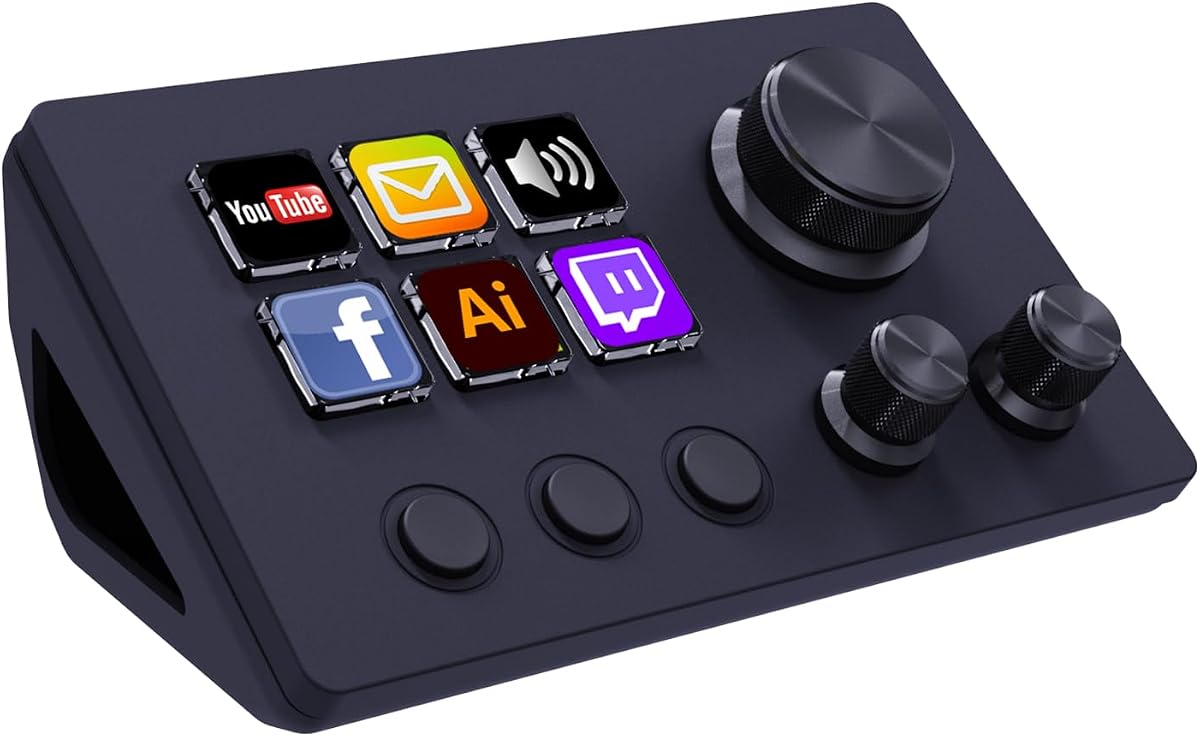
The VSD M18 offers an approachable way to build a dedicated gaming-overlay controller without requiring a large premium platform. Its 4.4 rating reflects a useful combination of 18 programmable controls, customizable LCD imagery, sequential macros, and broad compatibility with Windows and macOS. The device includes 15 visual keys and three physical buttons, creating more control capacity than many entry-level keypad models.
We may earn a commission when you buy through this link, at no additional cost to you.
The LCD keys accept JPG, PNG, and GIF images, allowing users to label each command with recognizable game scenes, overlay elements, or application shortcuts. Single commands are only part of the offering: multi-step sequences can launch applications, enter text, open files or websites, control media, or switch OBS scenes. Operation Follow can run steps in a custom order or simultaneously, which helps compress complicated production routines into one press.
Its outer RGB ring supports automatic cycling and custom tones, adding visual appeal to a dim gaming setup. Built-in utilities for reminders, clocks, stopwatches, weather, and calendars extend its value beyond streaming. The main compromise is platform coverage: native Linux plug-and-play support is not available, although development documents are provided for custom secondary development. It also lacks rotary controls for precise live adjustment.
This is a compelling choice for a streamer or gamer who wants many programmable keys at a modest entry point. It is especially effective when scenes, alerts, and application launches are the priority. Users needing extensive live mixing or a more established integration ecosystem may prefer a higher-end deck, but the M18 covers the central requirements of fast, visual overlay management.
Animated icons make the M18 useful during intense sessions because users can recognize commands at a glance. Assigning distinct graphics to scenes and overlays reduces reliance on a memorization-heavy keyboard layout.
Multi-step and simultaneous macro execution turns the pad into more than a collection of shortcuts. A single command can combine an application launch, a scene change, and another production action.
We may earn a commission when you buy through this link, at no additional cost to you.
The VSD N4 Pro is a feature-rich production controller aimed at streamers, editors, and gamers who want more than a basic macro pad. Its 4.4 rating is supported by a distinctive mix of 10 customizable LCD keys, four RGB knobs, an interactive touch bar, a built-in USB dock, and an adjustable 60-degree stand. The hardware is designed to serve as both an overlay command center and an audio-oriented desktop controller.
We may earn a commission when you buy through this link, at no additional cost to you.
Each LCD key can hold single commands, chained operations, or custom PNG, JPG, and GIF icons, while unlimited independent scene presets are intended to avoid repeated setup. The device can act as a USB sound deck for triggering sound effects and managing background-audio commands. This distinction is important: it sends audio control commands to the computer and does not include built-in speakers for direct sound output.
More than 500 downloadable plugins are listed, expanding the controller beyond the included widgets and layouts. Fully adjustable, audio-synced RGB lighting supports GIF, MP4, and MOV media, while switchable haptic keys let users tune the typing feel. The passive USB dock adds connectivity for peripherals and storage devices. These features increase complexity, and the N4 Pro has fewer direct keys than the 36-button Elgato platform, so users should prioritize value from rotary controls and plugins over raw button count.
It is best suited to a creator who treats overlays as part of a larger live-production system. The N4 Pro can consolidate scene commands, audio actions, applications, and visual effects without requiring several unrelated devices. It may feel excessive for a simple webcam overlay, but for a gaming stream with animated elements, background audio, and multiple production states, it offers one of the most integrated control surfaces in the comparison.
Unlimited independent presets allow a creator to save distinct control layouts for streaming, editing, gaming, and office tasks. Switching profiles can prevent a live-show layout from being cluttered by unrelated commands.
The N4 Pro can send play, pause, and other audio operations through compatible computer software. This supports sound-effect workflows, but it should not be mistaken for a self-contained speaker or conventional audio mixer.
We may earn a commission when you buy through this link, at no additional cost to you.
This compact stream controller focuses on six customizable keys and three dials, making it a practical option for creators who want a small, dedicated command surface. Its 4.5 rating is supported by straightforward customization, Action Flow sequencing, and compatibility with both Windows and macOS. It supports the software many overlay workflows depend on, including OBS, YouTube, Discord, Photoshop, and Adobe Premiere Pro.
We may earn a commission when you buy through this link, at no additional cost to you.
Users can drag operations onto the keys, assign single or multiple actions, and add JPG, PNG, or GIF imagery. The Action Flow function executes several macro actions in a chosen order, allowing a compact set of controls to represent a larger workflow. The three dials can be assigned to functions such as volume, fast-forward, and rewind, providing tactile adjustments that a simple keypad could not offer.
The main limitation is its small number of direct keys. Six buttons are sufficient for a streamlined setup with only the most important scenes and overlays, but a complex broadcast with separate controls for recording, streaming, audio, alerts, and applications will require grouping or multiple profiles. The absence of a touch display also means it cannot present the same amount of contextual information as larger LCD-equipped decks.
The controller is best for a minimalist desk, a secondary laptop setup, or a creator who values dials over a large button matrix. It is also a sensible choice for gamers who only need quick access to a few overlay elements. Those who expect a large visual command center should consider a higher-key-count alternative, but this device delivers a focused and uncomplicated way to manage essential commands.
Six keys and three dials create a compact surface without giving up tactile adjustment controls. It suits simple overlay configurations that do not require a large number of permanent shortcuts.
Action Flow expands what the device can accomplish despite its limited key count. Related operations can be grouped into an ordered sequence and triggered from one control.
We may earn a commission when you buy through this link, at no additional cost to you.
The TreasLin VSDinside N1 combines 18 macro keys with a rotary selector that changes the device among shortcut, calculator, and numeric-keypad modes. Its 4.3 rating reflects a versatile interface for creators who want an overlay controller that can also handle compact numeric input. Fifteen visual LCD buttons, two clickable buttons, and one rotary knob provide a clear mix of display and physical controls.
We may earn a commission when you buy through this link, at no additional cost to you.
VSD Craft software supports drag-and-drop assignment, screenshots, and custom image icons. Scenario profiles can be prepared for daily use, editing, live streaming, and media control, with automatic workflows capable of running multiple tasks in a specified order. The marketplace lists thousands of free and premium options, including more than 200 plugins, icon profiles, and scenes for platforms such as OBS, Discord, and Twitch.
Dynamic icons add visual movement and help distinguish active or context-sensitive commands. The numeric-keypad mode may also reduce dependence on the computer keyboard during certain live-production tasks. The trade-offs are modest but relevant: Spotify integration requires an active Premium account, and the supplied information does not list native Linux support. A creator working primarily in the Windows or macOS ecosystems will find that limitation less consequential.
The N1 is a good match for a creator who wants substantial macro capacity plus a few unconventional controls. It is less attractive for someone who only needs a few scene buttons, but its mode switching and profile structure make it useful across gaming, editing, and general desktop tasks. For value-focused users seeking more than a basic keypad, it presents a broad set of controls in a familiar configuration.
The rotary selector moves among shortcut, calculator, and numeric modes, expanding the device beyond traditional scene controls. That flexibility is particularly helpful when a compact keyboard lacks a dedicated numeric section.
Separate daily, work, live, and media profiles keep commands organized around the current task. Automatic workflows can then perform several steps in the intended order.
We may earn a commission when you buy through this link, at no additional cost to you.
The VSD M18 Stream Controller is a macro-focused alternative for creators who prioritize a large number of programmable keys and visual labels. It carries a 4.5 rating and shares an 18-key architecture consisting of 15 visual LCD keys and three physical buttons. Each visual key can be assigned an individual action, a sequence, or custom JPG, PNG, or GIF artwork.
We may earn a commission when you buy through this link, at no additional cost to you.
Single-click commands can launch macros, insert text, open files or websites, manage media, and change OBS scenes. The Operation Follow feature can execute multiple operations simultaneously or in a specific sequence, making it possible to turn several routine steps into one press. This is particularly useful when an overlay change should also launch or activate another production element.
A surrounding RGB light ring supports automatic cycling and custom colors, adding atmosphere to a gaming desk without contributing to functional control. Compatibility is listed for Windows 11 and later and macOS 11 and later, with OBS, Streamlabs, YouTube, Discord, and other mainstream applications among the supported software. Built-in plugins cover reminders, clocks, stopwatches, weather, and calendars.
This M18 is most appropriate for users who want many scene, alert, and application shortcuts but do not need a large touch panel or precision dials. It is visually engaging and straightforward to organize. If exact audio-level adjustments or live contextual information are central priorities, a deck with knobs or a screen may serve better; otherwise, this controller delivers a generous and accessible macro toolkit.
The majority of the controls are visual LCD keys, allowing each overlay or scene action to carry a distinct image. Animated artwork can further separate frequently used commands from occasional ones.
The RGB perimeter provides a customizable visual accent with automatic or selected colors. It is decorative rather than a functional control, but it complements a dark streaming setup.
We may earn a commission when you buy through this link, at no additional cost to you.
The TreasLin VSDinside N3 offers a balanced 12-control layout for managing overlays, scenes, social tools, and general desktop commands. Its 4.3 rating reflects a mix of six visual LCD buttons, three tap buttons, and three rotary buttons. It supports Windows and macOS, including OBS Studio, Streamlabs, Twitch, YouTube, Discord, Voicemod, and common creative applications.
We may earn a commission when you buy through this link, at no additional cost to you.
One-touch commands can handle macros, text entry, files, websites, media, OBS scene changes, social posts, audio adjustments, microphone muting, and lighting controls. Individual or multiple actions can be assigned to a key, while the six visual buttons support static or animated images. The marketplace includes more than 200 listed plugins, icon profiles, and scenes, providing another route to build specialized layouts.
The compact control count is the clearest trade-off. A streamlined creator may find 12 controls sufficient, while someone managing numerous scenes, recording functions, and overlays may prefer a larger grid. The three rotary buttons help compensate for the smaller number of dedicated visual keys, but they cannot present as much information as an LCD. Spotify integration also requires a Premium account.
The N3 is a sensible middle-ground option for users who want more than a basic six-key pad without moving to a large multi-dial platform. Its mix of screen-based and physical controls supports different command types, and the dynamic icon options make it easier to identify a scene at a glance. It is a particularly balanced recommendation for compact streaming desks and mixed gaming-and-productivity setups.
Six LCD buttons, three tap buttons, and three rotary controls provide variety without creating a crowded surface. Users can place visual scene commands beside tactile audio or playback adjustments.
Dynamic icons make the N3's visual keys more informative than simple static labels. Creators can establish a recognizable visual language for scenes, alerts, and application actions.
We may earn a commission when you buy through this link, at no additional cost to you.
This six-key stream controller is designed for creators who want a small, uncomplicated way to control a few essential overlay and scene actions. Its 4.5 rating is supported by flexible assignment, Action Flow sequences, three dials, and compatibility with both Windows and macOS. The physical design is intentionally limited, making it easier to learn than a large multi-function control surface.
We may earn a commission when you buy through this link, at no additional cost to you.
The six customizable keys can each hold a single action or multiple actions, with JPG, PNG, and GIF images used as visual labels. One-click operations include launching macros, entering text, opening files and sites, controlling media, and switching OBS scenes. Action Flow handles multiple actions in a specified order, allowing the small keypad to cover a broader broadcast routine than its key count initially suggests.
The three dials can be used for tasks such as volume and playback control, while the software supports major applications including PowerPoint, YouTube, Discord, Excel, Word, Photoshop, and Adobe Premiere Pro. Hundreds of plugins and 60 icon packs broaden the possibilities. However, six keys remains a severe limitation for creators who want every scene, overlay, and recording function on a permanent button, and there is no display for contextual information.
This model suits a minimalist gaming setup, a secondary streaming computer, or a user who prefers to memorize a few reliable controls. It also carries a stated 24-month warranty and includes tutorial and customer-support options. For a full production desk, choose a larger keypad; for a focused, small-space overlay controller, this is one of the more straightforward options in the comparison.
A limited set of keys can reduce the cognitive load compared with a crowded panel. Users who consistently switch only a few scenes may prefer this clarity to a larger command surface.
Hundreds of plugins and 60 icon packs support productivity features such as reminders, clocks, stopwatches, weather, and calendars. These extras extend the controller beyond streaming tasks.
We may earn a commission when you buy through this link, at no additional cost to you.
The SOOMFON Stream Controller Studio Deck is a polished control surface that combines 10 customizable LCD keys, four multifunction knobs, and a sliding touch display. Its 4.8 rating places it among the strongest-rated products here, and the touchscreen offers a more flexible navigation model than a conventional static keypad. It is designed for streamers, editors, game developers, and other multitaskers.
We may earn a commission when you buy through this link, at no additional cost to you.
The LCD keys support static or animated icons, making common overlay commands easy to distinguish. Users can swipe through multiple pages of scenes, commands, or profiles in a manner similar to a phone screen, while the four knobs provide precise adjustments for volume, brightness, zoom, and other variables. One-touch commands can paste text, open websites, launch applications, or play audio.
A substantial plugin marketplace gives the device additional room to grow, with hundreds of downloadable options. The trade-off is that ten macro keys are fewer than many gaming-oriented decks provide, and the sliding display must do some of the navigational work. Compatibility is limited to macOS Catalina 10.15 or higher and Windows 10 64-bit or higher, while Spotify integration requires Premium.
The SOOMFON is best for a creator who wants a visually sophisticated command surface with strong live adjustment controls. Its touchscreen is particularly useful when an overlay workflow contains more pages of actions than could reasonably fit on a fixed grid. It may not be the first choice for someone who needs dozens of permanent macro keys, but for tactile dials, a large touch area, and animated icons, it is a compelling premium choice.
Swiping between pages means the physical key count does not need to represent every possible action. Additional scenes, commands, and profiles can remain organized on separate touchscreen pages.
Four rotary controls support the kind of gradual adjustment that scene buttons cannot provide. Mapping them to volume, brightness, zoom, or other adjustable properties makes them useful during a live session.
We may earn a commission when you buy through this link, at no additional cost to you.
The Megtran M3 is a 15-key stream controller built around smooth magnetic keys, three precision knobs, and customizable LCD backgrounds. Its 4.5 rating makes it a strong option for gaming, office work, live streaming, and video editing. The magnetic design focuses on low trigger latency and comfortable repeated input, while the LCD grid offers enough direct controls for a meaningful overlay layout.
We may earn a commission when you buy through this link, at no additional cost to you.
Users can drag files, browsers, applications, images, and videos onto the 15 LCD keys, then assign screenshots or GIFs as icons. The background library and custom image or video options make the interface visually engaging, particularly during game broadcasts. Three knobs provide additional tactile control, and compatibility includes OBS, Photoshop, Adobe Premiere Pro, Zoom, and DaVinci Resolve, with ready-made plugins available through STATION SPACE.
The main technical consideration is magnetic calibration. The product information notes that external magnetic interference can shift the key baseline and cause keys to stop responding, so calibration should be performed according to the on-screen software instructions before use. This is more hands-on than a conventional membrane or mechanical keypad, although the claimed smooth, responsive feel and all-day comfort make it attractive for frequent input.
The M3 is a strong recommendation for a creator who wants a sizable LCD keypad, rotary adjustment, and a polished visual experience without moving to a 20-key-plus platform. It works particularly well for creators who divide time between streaming, editing, and general computer tasks. Those willing to follow the calibration guidance should find a responsive and highly customizable control surface.
The transparent magnetic keys are designed for low trigger latency and smooth repeated presses. This makes the surface appealing for high-frequency editing as well as intermittent overlay switching.
Custom images, videos, screenshots, and GIFs make the interface easier to interpret at a glance. This visual customization can reinforce a game's color scheme or the structure of a broadcast layout.
We may earn a commission when you buy through this link, at no additional cost to you.
The right stream deck depends on the number of commands you need, the precision of live adjustments, the software you use, and how much desk space and setup effort you are willing to accommodate.
Key count determines how many overlay scenes, recording controls, alerts, and application shortcuts can remain directly accessible. A six-key deck works well for a simplified workflow, while 10 to 18 keys suits more elaborate configurations. The Elgato Stream Deck + XL offers 36 keys for creators who want a large, permanently organized command surface rather than relying on profiles or layered pages.
Choose a key count that matches the number of commands you use during a live session. More keys are not automatically better if they force you to search a crowded panel.
LCD icons make commands recognizable without memorizing every shortcut, while animated graphics can communicate status or distinguish a scene group. A touch strip or touchscreen provides another navigation layer and can display contextual information. The SOOMFON deck uses a sliding screen, whereas the Elgato model uses an expanded touch strip, and several smaller options rely entirely on icons and physical keys.
Prioritize a display that makes your most common actions easy to identify. Touch navigation is valuable when the total command set is larger than the visible key grid.
Rotary controls are valuable for volume, brightness, zoom, and other settings that benefit from gradual adjustment. They are especially useful during a live broadcast, where overshooting a fixed button can be inconvenient. The N4 Pro, SOOMFON Studio Deck, and several compact controllers include knobs, while the larger Elgato platform provides six multifunction dials.
If your overlay workflow includes frequent live mixing or camera framing, include at least one precise control. For fixed scene changes alone, macro keys are sufficient.
Single commands are simple, but multi-step macros can launch applications, enter text, switch scenes, and prepare a broader production state. Feature Action Flow or Operation Follow to determine which products support ordered or simultaneous execution. N4 Pro also supports chained operations, while the six-key controllers use drag-and-drop assignment and Action Flow.
Choose a controller that can make repeated workflows one press away. Confirm that the software supports the sequence order and timing behavior you need.
A useful deck should work with the software already in your production chain. OBS appears across the range, and many devices also list Streamlabs, Twitch, YouTube, Discord, and common creative applications. Pay attention to stated operating-system requirements, particularly for Windows 10, Windows 11, macOS Catalina, and newer macOS releases. Some models provide SDK documents, while native Linux support is not always available.
Check the operating system, streaming application, and any third-party services you want to control before buying. Compatibility claims should align with your exact setup.
Plugins expand a controller beyond its bundled functions and can provide specialized commands for audio, social media, productivity, and editing. The Elgato device lists hundreds of integrations, the N4 Pro lists more than 500 downloadable plugins, and VSDinside controllers offer extensive marketplaces. Plugin availability matters when a required application does not support a direct native action.
Look for an ecosystem that includes your essential applications, but avoid buying solely for future potential. A smaller, well-maintained integration set may be more useful than a large catalog with missing essentials.
Profiles allow one device to serve different games, projects, team members, or production roles. They are especially valuable for a multi-scene creator who does not want every command visible at once. The Elgato model supports unlimited custom profiles, the N4 Pro stores unlimited independent presets, and several VSDinside products offer task-based modes for daily work, editing, live streaming, and media.
Frequent profile switching is valuable when each game uses a different overlay set. If your controls never change, a single clear layout may be simpler.
Physical design affects desk space, visibility, and setup effort. The N4 Pro includes a foldable 60-degree stand and USB dock, while larger grid devices can dominate a compact desk. Magnetic-key products may require calibration, as noted for the Megtran M3. Warranty information also varies, with listed coverage ranging from 24 months to 36 months, so buyers should consider both the support term and the product-specific care instructions.
Account for desk space, viewing angle, cable placement, and maintenance before committing. A controller that fits comfortably is more likely to remain organized and used consistently.
Begin by installing the device's software and connecting the controller with its specified USB cable. Update the software if necessary, select the appropriate operating-system profile, and open the configuration area for each LCD key. Assign the overlay and scene commands that matter most before adding decorative or rarely used shortcuts.
Organize the layout from left to right by function: put scene switches together, place recording and streaming controls in a dedicated group, and reserve separate areas for alerts, audio, applications, and game commands. Use recognizable icons, and test every key in the actual broadcast software. Then create a multi-step macro only after confirming that each individual command works.
For long-term care, keep the device away from excessive moisture, strong magnetic interference, and forceful impacts. Wipe the keys and display with a soft, dry cloth rather than aggressive cleaning products. If a magnetic-key device reports inconsistent input, follow its calibration instructions. Update the software periodically and revisit profiles whenever the overlay or game workflow changes.
Yes, most of the products listed support OBS or closely related streaming software. Their programmable keys can be assigned to scene changes, recording controls, applications, media commands, and multi-step workflows. Compatibility details vary by model and operating system, so verify the exact software and platform requirements before configuring a new controller.
Macro keys trigger fixed commands or predefined sequences, making them ideal for changing scenes, starting recordings, or opening applications. Rotary dials adjust a value continuously, which is useful for volume, brightness, zoom, and similar settings. The strongest control surfaces combine both so creators can switch states and fine-tune them without reaching for a conventional keyboard.
A small deck with six keys can handle a focused workflow, while 10 to 18 keys offers room for several scenes, alerts, and application controls. A 36-key platform is better suited to creators who want many commands permanently visible. Choose based on your actual live routine rather than the largest available count.
LCD icons materially improve usability because they allow users to identify a command visually instead of memorizing every shortcut. Animated icons can further distinguish state, groups, or frequently used actions. Their value is greatest when a creator maintains a consistent icon system and keeps labels simple enough to recognize at a glance.
Most of the listed controllers support both Windows and macOS, but the minimum versions differ. Some specify Windows 10 64-bit or Windows 11 and later, while others require macOS Catalina 10.15 or macOS 11 and later. Check the individual listing before buying, particularly if you use an older operating-system installation.
Yes. These controllers can launch applications, open files and websites, enter text, control media, and operate plugins for reminders, clocks, stopwatches, weather, and calendars. Editing, office work, photography, music production, and general desktop automation are also common use cases for a programmable macro keypad.
The VSD N4 Pro can operate as a USB sound deck and send play, pause, and related audio commands to the computer, but it does not contain built-in speakers for direct sound output. Other controllers may also trigger or control audio functions through software. A separate audio interface or speaker setup is required for conventional playback through the controller itself.
Profiles are useful when different games, projects, or team members require distinct command sets. Touch pages work well when a large number of commands share one production context. The most organized setup often combines both: broad profiles for separate events and pages or dedicated groups for closely related scenes within each event.
The Elgato Stream Deck + XL stands out as the most complete option for creators who want 36 macro keys, six dials, a touch strip, broad integrations, and unlimited profiles. The VSD M18 offers a more affordable path into visual macro control, while the SOOMFON Studio Deck combines a 4.8 rating with touchscreen navigation and four multifunction knobs. Each suits a different balance of budget, layout size, and live-production flexibility.
Prioritize the functions you will actually use during a broadcast. Scene-heavy creators should examine key count, visual labels, and profile support; audio-focused users should look for reliable knobs and compatible software commands; compact-desk setups should balance screen area against available space. Confirm operating-system requirements and third-party integrations before configuring a purchase.
Product features, ratings, software compatibility, and availability can change over time, and current prices should be checked before buying. Comparing the latest listing information against your specific overlay workflow will help ensure that the selected stream deck remains practical long after the initial setup is complete.