
LifeStraw Personal Water Filter
4.8Editor score
Bacteria and parasite filtration
4,000-liter rated capacity
Compact hiking and travel design
Compare the best emergency water filter straw options for filtration, portability, capacity, ease of use, and emergency preparedness in this expert guide.
An emergency water filter straw offers a compact way to turn questionable freshwater into drinking water while hiking, traveling, camping, or responding to a disruption in normal water service. The best model balances contaminant reduction, useful flow, portability, durability, and straightforward maintenance rather than focusing on filtration claims alone.
We compared the ten featured products using their stated certifications, filtration stages, pore sizes, flow rates, capacity, weight, dimensions, construction, and intended uses. The list covers individual filters and multipacks, with special attention to practical details such as bottle compatibility, backflushing, replaceable elements, and suitability for emergency kits.
Each review explains the product's strongest benefits, limitations, and ideal user so you can judge it against your own priorities. Product availability, certification details, and prices can change over time, so confirm the current listing and specifications before purchasing, especially for a disaster-preparedness purchase.
4.8Editor score

4.7Editor score

4.7Editor score
The table below compares all ten filters by their most important practical attributes, including contaminant reduction, filtration capacity, portability, and compatibility with common hydration containers.




The LifeStraw Personal Water Filter is a straightforward personal straw for hikers, travelers, campers, and households maintaining an emergency kit. With a 4.8 rating, it combines a well-established personal-filter format with stated removal rates of 99.999999% for waterborne bacteria and 99.999% for parasites. It also addresses microplastics, making it useful where ordinary sediment-only straining would be inadequate.
We may earn a commission when you buy through this link, at no additional cost to you.
Its microfiltration membrane is described as removing the smallest microplastics found in the environment down to one micron while reducing turbidity to 0.2 microns. The product information also states that its claims were verified through laboratory testing under protocols associated with the US EPA, NSF, and ASTM. A rated lifetime of 4,000 liters, or 1,000 gallons, is generous for a personal emergency filter and is likely sufficient for repeated trips when maintained as directed.
The main limitation is that the supplied information does not specify a flow rate, so buyers who prioritize rapid drinking from a strong current cannot compare its output directly with products listed at 500 or 550 milliliters per minute. The package also contains one filter rather than several, and it does not advertise the detachable or replaceable-element design found in some competing models. Those are meaningful distinctions for long-term users.
Even so, this LifeStraw is a balanced choice for someone wanting one dependable filter without purchasing a larger system. Its low-profile design fits easily in a pocket, daypack, hiking kit, or emergency bag, while the stated capacity makes routine use realistic rather than purely situational. It is our best overall pick and the best budget-oriented choice for a personal filter, especially for users who value compactness and broad contaminant claims.
The combination of bacterial, parasite, turbidity, and microplastics reduction makes this filter more versatile than a simple mesh strainer. Its 4,000-liter capacity also gives it a practical role in both everyday outdoor use and stored emergency preparedness.
The straw shape is simple to deploy directly from freshwater or with a compatible container. If one person wants a filter that can move between a hiking pack, travel bag, and household emergency kit without unnecessary complexity, this model fits the role well.
We may earn a commission when you buy through this link, at no additional cost to you.
The Practical Survival Reusable Emergency Water Filter Straws are a two-filter set aimed at outdoor users, travelers, and preparedness-minded households. They carry a 4.8 rating and are described as removing more than 99.99% of waterborne bacteria and parasites, including E. coli, Legionella, Giardia, and Cryptosporidium. Each filter also addresses microplastics down to a stated 0.1 micron.
We may earn a commission when you buy through this link, at no additional cost to you.
The two-pack arrangement is practical because it allows one straw per person or placement in separate kits without doubling the size of each deployment. Each filter weighs two ounces and measures eight inches, making it appropriate for backpacks, cars, fishing bags, and bug-out kits. Individually sealed filters and included backflushing plungers support organized storage and routine cleaning.
A stated capacity of up to 1,800 gallons per filter, equivalent to as much as ten years for the average person, is one of the strongest longevity figures in this guide. That estimate depends heavily on usage, source-water conditions, and maintenance, so it should be treated as a rated maximum rather than a schedule. The product information also mixes 0.1-micron filtration language with broader claims, making the stated pore size and contaminant list worth checking on the current listing.
This set is best for couples, families, or anyone who wants redundancy. Two filters provide flexibility if one is being cleaned or stored elsewhere, and the 4.8 rating places it among the strongest-rated options. It is a particularly compelling emergency choice when long service life and lightweight portability matter more than knowing a precise maximum flow rate.
Two individual filters let a group avoid sharing one straw or keep filters in separate vehicles and bags. That makes the set especially useful for camping trips, power outages, and travel where access to clean water may be uncertain.
The included backflushing plungers support maintenance, while the stated capacity suggests a long working life. Users should still follow the cleaning guidance and avoid interpreting the lifespan claim as permission to skip upkeep.
We may earn a commission when you buy through this link, at no additional cost to you.
The Five-Pack Filter Straw is designed for families, friends, teams, and larger emergency preparations. Its 4.6 rating reflects a generally strong market reception, and the five-filter format is the main attraction: each person can have a dedicated straw, while extras can be placed in vehicles, packs, or home kits without creating a bottleneck at the water source.
We may earn a commission when you buy through this link, at no additional cost to you.
The filtration design combines a sediment prefilter with a 0.1-micron hollow fiber ultrafiltration membrane. According to the supplied information, it removes visible solids, reduces harmful substances by a stated 99.99999%, and improves odor. Food-grade, BPA-free materials and multiple certifications add reassurance, although the specific certification names and test reports are not provided in the product data.
Unlike several other models in the guide, this product information does not state a filtration-capacity figure or a measured flow rate. That makes it harder to compare long-term output and drinking speed directly with the LifeStraw Peak or Membrane Solutions options. The omission is especially relevant if the filters will be used heavily by a large group or stored for years without an initial test.
The pack is still highly useful for group outings and distributed emergency storage. Its simple operation, low-energy design, and no-claim setup requirement make it approachable for users who may need to act quickly. It is best selected when individual access and broad kit distribution are more important than a precisely stated lifetime or flow benchmark.
Assigning one straw to each person reduces sharing and makes group travel more comfortable. Extra units can remain at home, in a vehicle, or with a second hiking group, providing practical redundancy.
The filter is described as requiring no setup and being ready to use from its package. For users who may be unfamiliar with filtration equipment, that simplicity can be more important than advanced modular features.
We may earn a commission when you buy through this link, at no additional cost to you.
The Membrane Solutions S1 is a personal filter straw distinguished by independently stated compliance with NSF/ANSI 42, 372, and 401. Those standards cover different aspects of performance and material safety, including chlorine and taste improvement, lead-free materials, and microplastics and particulate reduction. The supplied test report is identified as NBF21-004693-01, giving this model clear documentation for buyers who prioritize verified specifications.
We may earn a commission when you buy through this link, at no additional cost to you.
It uses five stages: a coarse screen, double-layer polypropylene cotton fiber, coconut-shell activated carbon, and hollow fiber ultrafiltration membranes. The stated 0.1-micron pore size helps explain the fine filtration, while the claimed removal of 99.9999% of total coliforms focuses on microbiological contaminant reduction. A maximum flow of 16.9 fluid ounces, or 500 milliliters, per minute offers a practical drinking rate.
The S1 weighs two ounces and measures 7.1 inches, and it fits standard 28mm threaded bottles, cups, and glass containers. Both ends are removable, which supports extended use and backflushing, and it can also work with soft water pouches and gravity-fed arrangements. As stated in the product information, it does not lower total dissolved solids, so it should not be confused with a reverse-osmosis purifier for every type of source or contaminant.
It is our editor's choice because it combines documented certification, a capable flow rate, useful versatility, and a well-explained filtration system in one compact package. The S1 suits experienced hikers, international travelers, and preparedness buyers who want independent standards rather than relying only on broad performance claims. It is also a strong choice for a household that wants to compare certification and practical specifications clearly.
Listing three NSF standards and a test report gives buyers more concrete information than general filtration language alone. It also helps distinguish performance for particulates, taste, and lead-free material construction.
Compatibility with 28mm threaded vessels, soft pouches, and gravity systems expands the situations in which the S1 can be used. Removable end caps also make the backflushing process more convenient.
We may earn a commission when you buy through this link, at no additional cost to you.
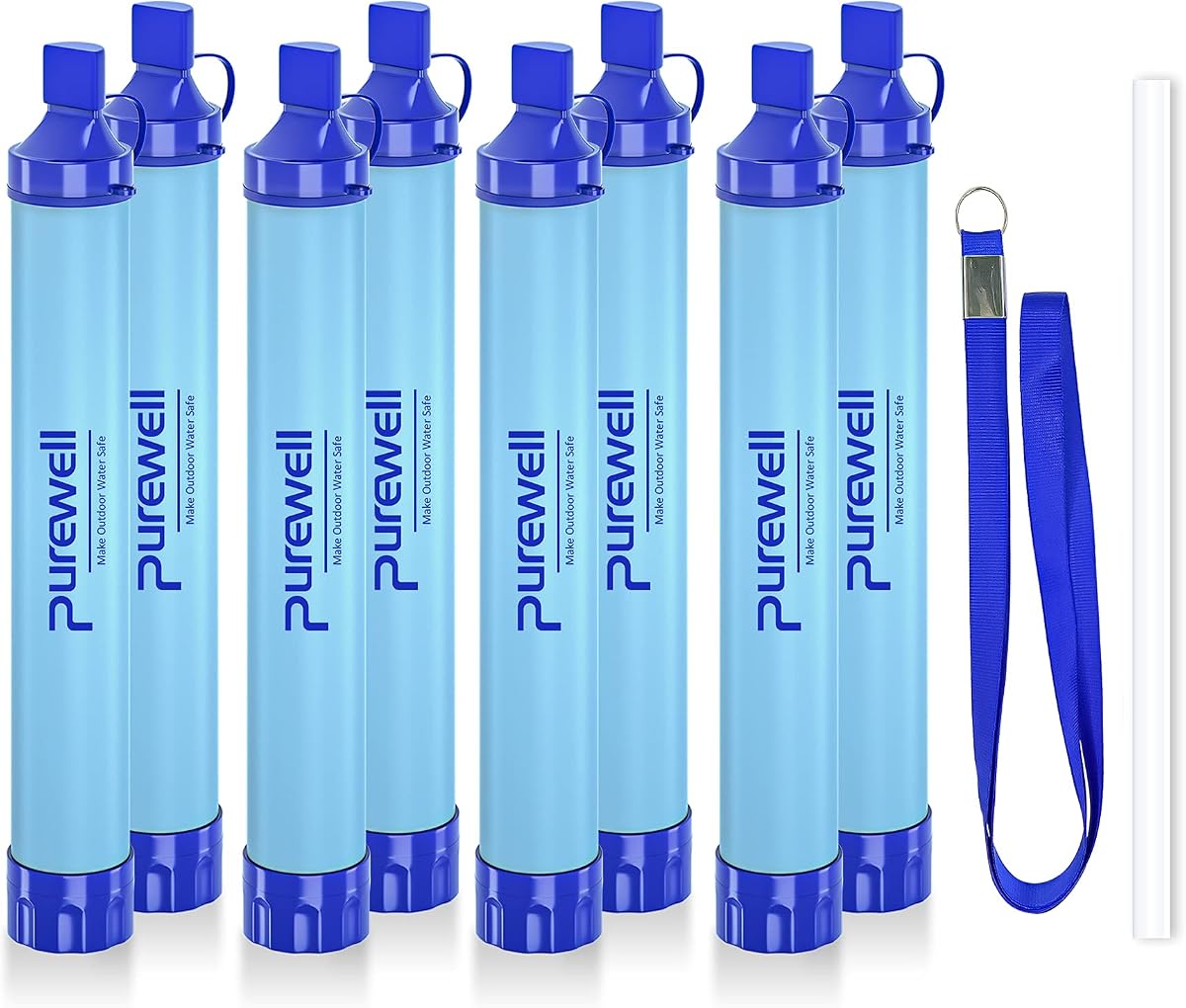
The Purewell Eight-Pack is the largest group-focused set in this guide, offering eight personal filters for camping organizations, large households, travel groups, and distributed emergency supplies. Its 4.6 rating indicates a well-regarded product, while the supplied information cites SGS and TÜV certification and identifies test report ASH15-005515-01.
We may earn a commission when you buy through this link, at no additional cost to you.
Each straw uses a five-stage system combining a hollow fiber ultrafiltration membrane, coconut-shell activated carbon, mesh plugs, and double-layer medical-grade polypropylene cotton fibers. The stated filtration claims cover bacteria, parasites, odors, residual chlorine, organic matter, and microscopic substances. A 0.01-micron pore size and 550 milliliters per minute flow rate distinguish it from many other personal filters in the list.
Each filter has a stated lifetime of 1,500 liters, or 396 gallons, and includes an 8.7-inch hose for drinking without contacting the ground. It fits standard 28mm threaded bottles, weighs less than 3.5 ounces, and can connect to a soft water bag or disposable bottle. As with the S1, it does not reduce total dissolved solids, so it is a filter rather than a desalination device.
The obvious trade-off is physical quantity. Eight filters take more room than a single straw and may be excessive for a solo traveler, but they provide useful redundancy and eliminate the need to share. This set is best for large groups, clubs, event organizers, or families that want multiple independently deployable filters and have enough storage to keep them organized.
Eight dedicated filters can serve a sizeable camping party or support several emergency kits at once. The result is more practical than forcing a large group to rotate one or two straws.
Screens, polypropylene fibers, activated carbon, and a hollow fiber membrane form a layered system. The listed 0.01-micron pore size also makes this a useful option for buyers comparing finer nominal filtration.
We may earn a commission when you buy through this link, at no additional cost to you.
The LifeStraw Peak Series is the strongest premium-oriented pick here for users who prioritize fast hydration, a familiar brand format, and broad setup flexibility. It carries a 4.7 rating and is described as removing 99.999999% of bacteria, 99.999% of parasites, and 99.999% of microplastics. Those figures place it among the strongest stated contaminant-reduction claims in this comparison.
We may earn a commission when you buy through this link, at no additional cost to you.
Its most notable practical feature is the stated flow rate of 2.5 liters per minute. That is considerably higher than the 500 and 550 milliliters per minute cited by several other filters. The membrane was re-engineered to reduce clogging from sand and silt, which may help maintain flow in turbid conditions, although users should not expect a laboratory-tested rate in every real-world source.
A removable threaded bottom cap allows attachment to standard water bottles and gravity hoses. The durable, leak-proof body is designed to withstand drops and pressure, and the BPA-free construction supports outdoor and emergency use. Its microfilter is rated for 1,000 gallons, or 4,000 liters, which matches the high-capacity LifeStraw featured earlier in the guide.
The Premium designation reflects the combination of fast flow, rugged construction, and flexible mounting rather than a uniquely replaceable component. It is an excellent choice for hikers, travelers, and users who want one filter to move between direct sipping, a bottle, and a gravity system. Buyers who value the highest stated drinking speed will find it particularly attractive.
The 2.5-liter-per-minute specification is the Peak's defining advantage. It is well suited to camp mornings, group travel, or any setting where waiting for a slow stream of filtered water would be inconvenient.
The removable threaded cap supports use with bottles and standard gravity hoses. That flexibility lets a user adapt the filter without carrying a separate straw for every drinking method.
We may earn a commission when you buy through this link, at no additional cost to you.
The Two-Pack Survival Filter is a compact set aimed at camping, hiking, backpacking, travel, and family preparedness. It has a 4.3 rating, which is lower than the ratings of the other featured products but still reflects a generally favorable customer reception. The supplied title is generic, so buyers should pay particular attention to the complete specifications and current listing details.
We may earn a commission when you buy through this link, at no additional cost to you.
Its five-stage design combines a prefilter, activated carbon layer, and fine fiber membrane to reduce sand, sediment, visible particles, taste, and odor. The product information states a filtration capacity of 1,500 gallons, or 5,700 liters, with proper use, cleaning, and maintenance. That is one of the larger stated capacity figures among the two-filter options in this roundup.
The primary drawback is the lack of a stated pore size, exact flow rate, and named certification standards in the supplied information. These omissions make direct comparison with the S1, S2, LifeStraw Peak, and Purewell less precise. The description also emphasizes reduction of visible material and unwanted taste or odor more than it does the removal percentages for bacteria and parasites listed by competing products.
For someone who mainly wants a straightforward two-pack with long stated capacity, broad container compatibility, and a slim profile, this is still a practical option. It can be used directly or connected to compatible bottles, cups, and hydration systems. The rating and less detailed performance disclosure suggest that buyers should verify current certification and contaminant claims before making a safety-critical purchase.
The slim two-pack is easy to divide between a backpack and a vehicle kit. It gives users redundancy while remaining less demanding than an eight-filter package.
The 5,700-liter figure is tied to proper cleaning and maintenance. Users should establish a sensible care routine, especially when filtering turbid sources.
We may earn a commission when you buy through this link, at no additional cost to you.
The Membrane Solutions S2 is a detachable personal filter straw offered in a four-pack, with a 4.7 rating and stated compliance with NSF/ANSI 42, 372, and 401 standards. Its standout feature is the ability to disassemble both ends and replace the filter element without replacing the entire straw shell, reducing the need to discard the outer housing as the filtering medium ages.
We may earn a commission when you buy through this link, at no additional cost to you.
The four-stage design combines a 0.1-micron hollow fiber ultrafiltration membrane, coconut-shell granular activated carbon, and double polypropylene fiber filtration. The listed claims emphasize odor and chlorine reduction, improved taste, and a flow rate of 500 milliliters per minute. Its stated lifespan of at least 20,000 liters is the highest capacity figure in the guide, which makes the replaceable design especially relevant for long-term users.
The detachable mouthpiece can connect with a common bottle for backflushing, avoiding the need for a separate syringe. It works as a personal filter, with soft pouches and disposable bottles, or as a replacement gravity filter for family or group use. An extension silicone pipe can be added for greater drinking distance, but that tubing is not included, so users must purchase it separately if needed.
This is the best premium pick for a buyer who values longevity and serviceability over the lowest purchase cost. The replaceable-element concept can make the S2 especially attractive for frequent hikers, long-term travelers, and preparedness households. It is less appealing to someone who wants a sealed, disposable-style straw with fewer parts, but for repeated use, the modular construction is a meaningful advantage.
The ability to replace only the filter element extends the useful life of the outer straw. Over many trips, that modular approach can be more practical than discarding an entire assembled filter.
The removable mouthpiece can connect to a common bottle during cleaning. This removes the need to carry a separate syringe and makes routine maintenance easier to organize.
We may earn a commission when you buy through this link, at no additional cost to you.
The Four-Pack 0.01-Micron Filter is a multipack personal purifier designed for emergency kits, hiking, camping, travel, hunting, and hurricane preparation. Its 4.5 rating reflects a solid customer reception, while the 0.01-micron filtration figure, four-unit format, and five-year shelf life make it easy to distinguish from conventional one-micron personal strainers.
We may earn a commission when you buy through this link, at no additional cost to you.
The product information states that the filters remove up to 99.99% of harmful particles down to 0.01 microns and provide 1,500 liters, or 396 gallons, of filtration. A flow rate of 550 milliliters per minute supports reasonably quick drinking. Each unit includes a seven-inch extension tube, allowing direct use from a source without kneeling on the ground, and the straws attach to hydration pouches and standard bottles.
At 5.64 ounces per unit, the filters are heavier than several competing personal straws, although four units remain manageable in a vehicle or grouped household kit. The supplied information does not name specific certification standards or identify a laboratory test report, so the 0.01-micron claim should be checked against the current product documentation. Five years is also a stated shelf-life figure rather than a guarantee of filtration performance in every storage environment.
The four-pack is best for people who want a stated five-year storage horizon, a generous flow rate, and a drinking extension. It works well for families, travelers, and preparedness users who want one filter in each vehicle or pack. Its fine stated pore size may also appeal to buyers comparing specifications closely, though certification documentation should take priority over pore size alone when assessing filtration confidence.
The stated five-year shelf life makes the multipack suitable for building emergency inventory in advance. Each filter should still remain sealed and stored according to the manufacturer's instructions.
The seven-inch extension tube keeps the user's mouth away from the ground or shoreline. That can be more comfortable and hygienic when a natural source is shallow or muddy around the drinking point.
We may earn a commission when you buy through this link, at no additional cost to you.
The Two-Pack Hollow Fiber Filter is a light, family-sized emergency option for campers, hikers, travelers, and preparedness buyers. It has a 4.6 rating and includes two filters with carry straps. The straws measure 8.27 inches and weigh just 2.5 ounces each, making them among the most compact products in this comparison.
We may earn a commission when you buy through this link, at no additional cost to you.
Each straw uses a five-stage system with a coarse screen, dual polypropylene cotton layers, activated carbon, and a 0.1-micron hollow fiber membrane. The stated flow rate is 500 milliliters, or 16.9 fluid ounces, per minute, and the filters fit standard 28mm bottles, soft pouches, and cups. They require no batteries or pump, making them suitable where power and equipment are unavailable.
The supplied capacity information is presented in two ways: 396 gallons per filter and 792 gallons combined, while another line refers to a 5,000-liter lifetime. Buyers should therefore verify the precise capacity and product identity on the current listing. Named certification standards are not included in the supplied data, another reason to examine the manufacturer documentation before relying on a specific contaminant-removal claim.
The two-pack is best for a couple or small family that wants two dedicated filters at a low weight. It fits naturally into backpacks, luggage, vehicles, and go-bags, and the removable end caps support backwash cleaning. It is a straightforward emergency tool rather than a highly modular system, which makes it easier to deploy and potentially more appealing to first-time filter users.
At 2.5 ounces each, the filters are easy to carry for extended periods. Two lightweight units provide family redundancy without turning pack weight into a major concern.
No batteries, pumps, or complicated assembly are required. The included carry straps also make it easy to keep each straw protected and accessible in separate bags.
We may earn a commission when you buy through this link, at no additional cost to you.
The right emergency water filter straw depends on the contaminants you expect to encounter, the people who will use it, and how often you intend to maintain it. Certification, flow, capacity, weight, and container compatibility should be weighed together rather than relying on a single specification.
Prioritize verifiable standards and specific contaminant claims over broad phrases such as laboratory tested. Pore size alone does not establish what a filter can remove, and marketing percentages should be considered alongside the product's certification status.
Choose a layered design that addresses both sediment and microorganisms. Do not assume the smallest listed pore size automatically makes a filter appropriate for every chemical or salt concern.
For most hikers, a stated 500 to 550 milliliters per minute is easy to compare, while the Peak is worth considering for speed. Treat published flow as a laboratory or design figure rather than a promise in every environment.
Compare capacity alongside the availability and simplicity of replacement parts. A long rating is less meaningful if the element cannot be changed or if the filter is difficult to backflush.
Choose the smallest system that meets your planned group size. Multipacks are useful for distribution, but a solo traveler may gain little from carrying multiple filters that will remain unused.
Measure your usual bottles and pouches before purchasing. A filter that works well but requires an unusual adapter may be less convenient than one that directly matches your existing equipment.
Store filters in clean, dry, accessible locations and keep replacement parts with the unit. Periodic inspections and a trial use before an emergency are more valuable than relying solely on a package label.
Match the count to realistic users and storage locations. A larger multipack is not automatically better; a well-maintained two-pack may serve a household more effectively than a larger set left unused.
Read the complete instructions for the exact model before its first use, because inlet placement, mouthpiece design, and cleaning procedures can differ. In general, identify a source of uncontaminated-looking freshwater, gather the filter and a clean receiving container, and make sure the strainer, cartridge, and mouth end are securely attached. If the setup includes a soft pouch or gravity bag, place the upstream container above the drinking end so gravity assists flow. Never use a filter that appears cracked, damaged, or improperly reassembled.
Drink slowly and allow the water to pass through the complete filtration path. If the instructions call for flushing before initial use, follow that step with clean water. Keep the inlet from contacting rocks, mud, or container bottoms, and avoid pulling sediment into the filter whenever possible. When the flow slows, move to cleaner water or backflush the element using the approved method. Do not force extreme suction to overcome a blockage, as that can indicate that the cartridge needs cleaning or replacement.
After use, backflush the filter as directed, rinse it with clean water, and allow the wetted components to dry in a sanitary location. Store it in a clean, breathable container rather than trapping moisture against the membrane, and inspect seals, caps, screens, and tubing for wear. Keep replacement elements and any special cleaning tools with the filter. If the device has a stated shelf life, mark the purchase or inspection date so it can be checked before an emergency.
No. The personal filters in this guide are intended for freshwater sources and do not remove dissolved salts or total dissolved solids. The S1, S2, and Purewell product descriptions explicitly state that they do not lower TDS, which means they are not desalination devices. Attempting to filter seawater with a standard hollow fiber straw can produce an unpleasant result and may quickly reduce flow. Use a properly designed desalination method for salt water.
The strongest models are designed to reduce waterborne bacteria and parasites, while also addressing sediment, turbidity, microplastics, chlorine, taste, and odor to varying degrees. Exact performance depends on the model and its certification. Look for a listed NSF/ANSI standard and a test report when contaminant removal is critical, and do not assume that a fine pore size means every chemical contaminant will be removed.
No. A smaller nominal pore size can indicate finer separation, but the complete filtration design and verified contaminant claims are more informative. Some of the smallest figures in this guide come from products without named certification standards in the supplied information. Compare the membrane, prefilter, activated carbon layer, intended use, and certification rather than choosing solely by the micron number.
Backflush whenever the manufacturer recommends, and also when flow begins to slow or after filtering especially silty water. The S1 and S2 provide removable ends and backflushing methods, including bottle-assisted cleaning for the S2, while the Practical Survival set includes plungers. Follow the instructions for the exact model because forcing a backflush or using the wrong direction can damage the element.
Technically, some products can be connected to gravity systems to serve more than one person, but a dedicated personal straw is more appropriate for direct drinking. The five-pack and eight-pack options are better suited to families or groups because each person can have an individual filter. Keep a separate clean container available, and never allow one child to drink from an adult's used straw if that is not the manufacturer's intended configuration.
The supplied product information emphasizes bacteria, parasites, particulates, chlorine, odor, and taste rather than viral removal. Consumers with questions about viruses should review the exact certification, test report, and manufacturer instructions for the model under consideration. For water that may be contaminated by human waste or where guidance specifies treatment for viruses, use a product explicitly certified for that risk.
Yes. Testing the filter before an emergency confirms that you understand assembly, flow, backflushing, and container compatibility. A familiarization session is especially valuable if the product has replaceable ends, an extension tube, or a gravity attachment. Follow the manufacturer's test instructions, and do not use questionable water to judge taste alone because appearance and flavor are not reliable indicators of microbiological safety.
Keep them clean, dry, and protected from physical damage in an accessible part of your emergency kit. Avoid prolonged heat, moisture, and direct sunlight, and preserve any manufacturer seals or protective caps. Label multipacks with purchase or inspection dates, keep replacement parts with the filters, and periodically inspect the housing, screens, and seals for cracking or deterioration.
The LifeStraw Personal is the most straightforward all-around option, combining a 4.8 rating with strong stated bacteria, parasite, and microplastics reduction in a compact format. The Membrane Solutions S1 stands out for three named NSF standards, a five-stage design, and a useful 500-milliliter-per-minute flow, while the S2 is the strongest premium option for buyers who value replaceable elements, detachable construction, and a very long stated service life.
Prioritize certification and intended contaminants first, then balance flow, capacity, weight, maintenance, and container compatibility. Multpacks are most useful when filters will be distributed among people or stored in separate locations, while a single straw is usually enough for an individual. Regardless of the model, obtain fresh source water, follow the instructions, backflush as directed, and maintain a separate clean drinking-water container.
Prices, availability, product details, and certification information can change, so check the current listing and manufacturer documentation before buying. Comparing the latest specifications is especially important for a safety-related purchase or for a kit intended to remain in storage for years. Use this guide to narrow the field, then select the model that best matches the water sources and scenarios you realistically expect to encounter.