
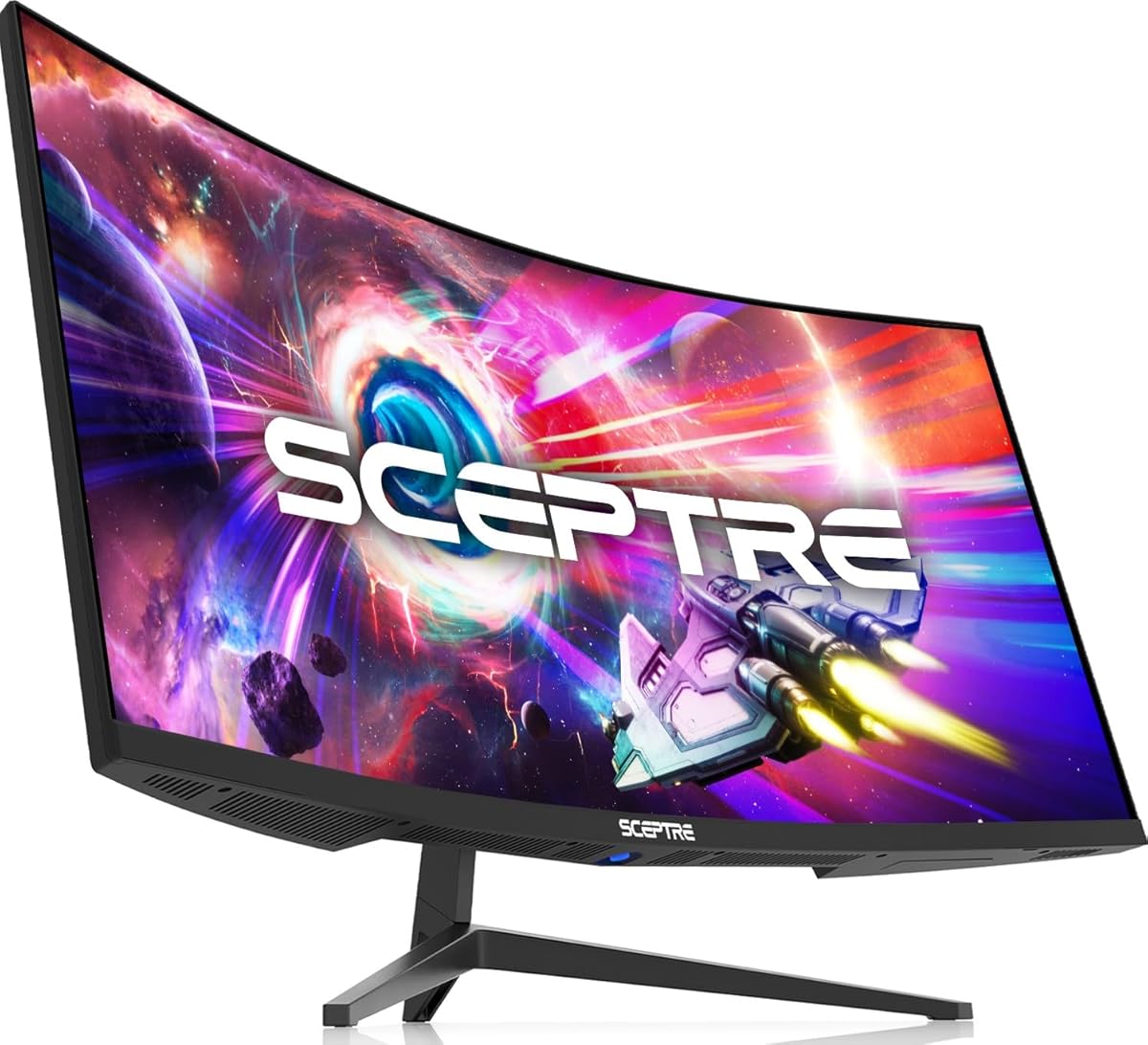
Sceptre 34-inch 240Hz Curved Gaming Monitor
4.4Editor score
240Hz curved refresh rate
Ultra-wide 3440 x 1440
One-millisecond response time
A high-refresh gaming monitor can make fast movement feel more immediate, reduce visual distractions, and give competitive players a clearer view of every action. The key is balancing refresh rate with resolution, response time, adaptive synchronization, color quality, and practical features rather than focusing on headline specifications alone.
This guide compares ten gaming monitors led by the CRUA 27-inch 540Hz model, alongside fast IPS, curved ultrawide, QHD, and QD-OLED alternatives. The evaluation considers refresh rate, panel type, resolution, latency claims, synchronization, connectivity, mounting support, built-in audio, and features that improve daily comfort.
The selections show that 540Hz is the headline feature of only one monitor, while the strongest alternatives emphasize speed at 240Hz, 310Hz, ultrawide immersion, or premium OLED picture quality. Current prices and availability can change, so shoppers should confirm specifications, compatibility, and the latest listing details before purchasing.
4.4Editor score

4.2Editor score

4.1Editor score
As an Amazon Associate we earn from qualifying purchases.
The comparison below organizes all ten monitors by panel size, resolution, maximum refresh rate, and principal gaming feature, making it easier to identify the model that best matches a particular setup.




The CRUA 27-inch 540Hz IPS Gaming Monitor is the only product in this guide built around a 540Hz refresh rate, making it the most direct answer for competitive players seeking the highest motion-handling figure available here. Its 4.2 rating reflects a strong overall proposition, but the headline attraction is clear: a refresh rate more than twice that of many conventional high-refresh gaming monitors.
We may earn a commission when you buy through this link, at no additional cost to you.
The 27-inch IPS panel combines Full HD resolution with a 1ms MPRT response time and AMD FreeSync support. Its stated color coverage reaches 120% sRGB, with brightness up to 400cd/m² and 1000:1 static contrast. These specifications are particularly relevant for fast shooters, where frequent frame changes can make clarity and consistency more valuable than a higher pixel count.
Connectivity is unusually thorough for the category. HDMI 2.1, DisplayPort 1.4, and a 3.5mm audio output provide useful options for desktop PCs, gaming laptops, consoles, and external audio. The stand also offers 120mm of height adjustment, tilt, swivel, 90-degree portrait rotation, and 75 x 75mm wall-mount compatibility. These are meaningful advantages over many speed-focused monitors with basic stands.
The principal trade-off is the Full HD resolution. A 27-inch 1080p panel can feel less detailed than a 1440p or 4K alternative, especially for desktop work, creative applications, and cinematic games. Nevertheless, gamers whose games consistently exceed 240 frames per second and who value minimal motion delay have a compelling reason to choose the CRUA. It is the leading 540Hz choice and a strong specialist pick for ultra-fast competitive play.
A 540Hz refresh rate can display far more distinct frames per second than conventional 144Hz or 240Hz panels, reducing the interval between visual updates. That advantage is most meaningful in competitive games, where opponents and projectiles move quickly and even small transitions can affect target tracking.
Height adjustment, swivel, tilt, and portrait rotation make the monitor easier to tailor to different desks and viewing habits. Portrait mode is particularly useful for coding, streaming dashboards, long documents, and other workflows that benefit from a taller display area.
We may earn a commission when you buy through this link, at no additional cost to you.
The KTC H25T7-A is a 24.5-inch Fast IPS monitor built around a 240Hz refresh rate, offering a more conventional high-speed option when the absolute maximum in this list is not essential. No customer rating is listed in the supplied product data, so the evaluation rests on the documented specifications rather than a numerical review score.
We may earn a commission when you buy through this link, at no additional cost to you.
Its Full HD 1920 x 1080 resolution, 1ms MPRT response time, and Adaptive Sync support target fast-paced gaming. The color specification reaches 114% sRGB with 1000:1 contrast and HDR10, while low-blue-light and flicker-free features are intended to improve comfort during extended use. These features make the monitor suitable for both gaming and regular desktop tasks.
HDMI 2.0 and DisplayPort 1.4 provide the main connections. The listed compatibility includes desktop PCs, gaming laptops, Nintendo Switch, Xbox, and PlayStation systems, although users should verify the exact supported modes and adapters required by their preferred console. A tilt range of negative five to positive 15 degrees and 100 x 100mm VESA compatibility cover basic positioning needs.
This is a sensible pick for someone who values a high refresh rate, familiar Full HD sizing, and broad platform support without chasing 540Hz. The main limitation is a relatively basic stand that does not offer the broad height, swivel, or pivot adjustments of the CRUA. Still, the combination of speed, color claims, eye-care features, and a three-year warranty makes it a practical alternative.
The 240Hz refresh rate and 1ms MPRT figure provide a strong foundation for competitive play. Fast IPS is also generally suited to quick transitions, helping maintain a more coherent image when enemies, vehicles, or camera angles change rapidly.
DisplayPort 1.4 and HDMI 2.0 make the monitor adaptable to a mixed entertainment setup. Because console mode support can depend on model-specific implementation, buyers should check the current listing and their console's required output format before purchase.
We may earn a commission when you buy through this link, at no additional cost to you.
The Sceptre C345B-QU240T Series combines a 34-inch 1500R curved display, 3440 x 1440 resolution, and refresh rates up to 240Hz. Its 4.4 rating and unusual mix of speed, high resolution, and built-in audio make it one of the most well-rounded entries in this comparison, even though it is not a 540Hz panel.
We may earn a commission when you buy through this link, at no additional cost to you.
A 1ms response time, two DisplayPort connections, and two HDMI ports provide a strong foundation for high-refresh PCs. The monitor also includes built-in speakers and an audio output jack, reducing desk clutter when separate speakers are unnecessary. Full 100% sRGB coverage supports colorful gaming and multimedia use, while Blue-Light Shift is designed to reduce blue-light output during long sessions.
The main compromise is the substantial demand placed on a graphics system. Driving 3440 x 1440 at 240Hz requires considerably more GPU capability than Full HD at the same refresh rate, and some games may need reduced settings or upscaling. The large curved footprint also demands sufficient desk depth and room to position the screen at a comfortable distance.
This monitor is best for a capable gaming PC, sim-racing enthusiast, or multiplayer player who wants both high resolution and fast motion. It is less appropriate for a compact desk or a system intended primarily for lightweight games. Even so, the combination of 240Hz, 1ms response, an ultrawide canvas, and integrated audio is unusually versatile for the category.
The 21:9 format provides substantially more horizontal space than a conventional 16:9 screen. That extra width can improve awareness in racing games, reveal peripheral information in shooters, and make open-world environments feel more expansive without requiring multiple displays.
Integrated speakers are useful for system alerts, casual gaming, and video playback when a full audio setup is unnecessary. An audio output jack also allows users to connect headphones or a more capable speaker system without replacing the display.
We may earn a commission when you buy through this link, at no additional cost to you.
The LG 32GS60QC-B is a 32-inch 1000R curved gaming monitor that prioritizes QHD clarity, useful competitive features, and a 180Hz refresh rate. Its 4.4 rating places it among the stronger-rated products here, while its feature set gives it a distinct identity beyond raw refresh speed.
We may earn a commission when you buy through this link, at no additional cost to you.
A 1ms GtG response time, AMD FreeSync, and a 2560 x 1440 panel provide a balanced foundation for fast action and detailed visuals. The monitor adds HDR10, up to 99% sRGB coverage, a three-side virtually borderless design, and a selection of gamer-oriented display modes. Dynamic Action Sync is included to support a more immediate connection between player input and on-screen response.
Game-specific tools are a defining strength. Black Stabilizer can help reveal detail in dark scenes, while the crosshair and FPS counter support competitive training. The aggressive 1000R curve pulls the edges of the display closer to the viewer, which can enhance immersion in racing and action games, although some users may find the curve less comfortable for general productivity.
Its most notable limitation is that 180Hz is below the 240Hz and 310Hz available elsewhere in the list. The listed stand offers tilt adjustment rather than the full height, swivel, and pivot range found on some competitors. It is still a well-equipped choice for gamers who want a curved QHD panel, synchronization, and competitive assists in a recognizable gaming display.
The crosshair overlay, FPS counter, Black Stabilizer, and multiple gaming modes can make the display more practical for competitive sessions. These tools provide useful context without requiring users to depend on separate overlays for every task.
The 2560 x 1440 resolution provides a noticeable step up in clarity from Full HD while remaining more attainable for a broad range of graphics hardware. At 180Hz, the monitor is especially well suited to fast QHD titles and mixed gaming-and-desktop use.
We may earn a commission when you buy through this link, at no additional cost to you.
The Sceptre E225W-FW144 Series is a compact 22-inch Full HD gaming monitor offering refresh rates up to 144Hz. Its 4.4 rating and restrained dimensions make it a practical option for smaller desks, dorm rooms, offices, and setups where a large ultrawide or QHD display would be inconvenient.
We may earn a commission when you buy through this link, at no additional cost to you.
The monitor includes both HDMI and DisplayPort, allowing it to work with a range of PCs, laptops, and compatible entertainment devices. Built-in speakers add simple audio for system sounds and casual media, while Blue-Light Shift is designed to limit blue-light emissions during extended viewing. The nearly bezel-free appearance also makes it easier to consider in a dual-monitor arrangement.
Compared with the fastest panels in this guide, 144Hz is less ambitious, and the supplied data does not state a specific response-time figure. That means the monitor's appeal rests more on size, connectivity, everyday usability, and clean styling than on class-leading motion specifications. Buyers who need maximum competitive performance should look to the 240Hz, 310Hz, or 540Hz options.
The Sceptre is best for a smaller space, a secondary display, or a player whose games do not consistently exceed 144 frames per second. It can serve as a straightforward central display for office work, school, streaming, and casual gaming while still offering a meaningful refresh-rate improvement over standard 60Hz or 75Hz screens.
A 22-inch display is easier to position on compact desks and often leaves more room for keyboard and mouse movement. The smaller footprint also makes the monitor more approachable for students, travelers, and users building a focused secondary screen.
The slim, nearly bezel-free design can help create a more cohesive two-screen workspace. One display can handle a game while the other presents chat, system information, a browser, or productivity applications without the visual separation of thick traditional bezels.
We may earn a commission when you buy through this link, at no additional cost to you.
The Sceptre C345B-QUT168 is a 34-inch 1500R ultrawide monitor that combines 3440 x 1440 resolution with refresh rates up to 180Hz. Its 4.2 rating reflects a capable general-purpose design, and the product's wide screen offers advantages for both games and productivity.
We may earn a commission when you buy through this link, at no additional cost to you.
A 1ms MPRT response helps keep rapid movement from lingering on screen, while 99% sRGB coverage supports accurate and vivid content. The supplied information lists two DisplayPort inputs and built-in speakers. Its five-megapixel WQHD panel and 21:9 format also provide a considerably larger workspace than a typical 16:9 display, making side-by-side applications easier to arrange.
The 21:9 format offers 30% more screen space than a conventional monitor, according to the product information. That additional area can be valuable for editing timelines, comparing documents, monitoring streaming tools, or seeing more of a virtual cockpit. The illuminated back cover adds a decorative touch, although it does not change the core gaming performance.
This monitor is a good fit for someone who values screen area and wants one display to handle both work and play. Its 180Hz ceiling is lower than the 240Hz and 310Hz alternatives, so competitive players running extremely high frame rates may prefer a faster panel. For general gaming, productivity, and ultrawide immersion, however, the specification set is persuasive.
The wide canvas can replace a less convenient multi-monitor arrangement for many workflows. Spreadsheets, editing timelines, browser windows, and communication tools gain enough width to remain visible, while games receive a more expansive field of view.
The 1500R radius offers a noticeable curve without reaching the extreme geometry of some 1000R models. Combined with a 1ms MPRT claim, it balances immersion, fast motion, and the wide viewing comfort required for extended productivity sessions.
We may earn a commission when you buy through this link, at no additional cost to you.
The Samsung Odyssey G55C is a 32-inch 1000R curved gaming monitor built around QHD resolution, a 165Hz refresh rate, and a 1ms MPRT response time. The supplied title is concise, but the product information provides a clear picture of a curved display intended for fluid action, immersive play, and comfortable everyday viewing.
We may earn a commission when you buy through this link, at no additional cost to you.
Its 2560 x 1440 resolution offers more detail than Full HD, and AMD Radeon FreeSync helps reduce image tearing by synchronizing the display and graphics output. HDR10 support, deep dark blacks, and luminous whites are highlighted as tools for improving scene contrast and visual vibrancy. The pronounced 1000R curve places the display edges closer to the viewer to strengthen the sense of immersion.
Eye Saver Mode is designed to reduce blue light, and flicker reduction is intended to make long sessions more comfortable. These features complement the curved form, although comfort still depends on desk size, viewing distance, and personal sensitivity to curvature. A 165Hz refresh rate is solid for many modern games, though it is not among the fastest options in this guide.
The G55C is best for a player who wants a visually immersive QHD monitor with synchronization and eye-comfort features. It makes more sense than a 540Hz model for mixed AAA titles, simulation games, and regular desktop use where resolution and visual depth matter alongside speed. Competitive players should ensure their games commonly exceed 165 frames per second.
The 1000R curve closely follows the natural field of view more closely than a flat display. This can make racing, flight, and action games feel more enveloping, though users sensitive to curved geometry may prefer the gentler 1500R designs in this list.
Eye Saver Mode and reduced screen flicker address two common sources of visual discomfort during long sessions. They do not eliminate the effects of prolonged screen use, but they can complement a well-positioned display and sensible viewing habits.
We may earn a commission when you buy through this link, at no additional cost to you.
The ASUS TUF Gaming VG259QMRL5A is a 24.5-inch Fast IPS monitor that reaches an overclocked 310Hz refresh rate, making it the fastest conventional 16:9 option in this comparison. Its 4.4 rating and extensive gaming feature set position it as a serious choice for competitive players who want speed close to the 540Hz category leader.
We may earn a commission when you buy through this link, at no additional cost to you.
Its most impressive figures are the up-to-310Hz refresh rate and minimum 0.3ms GtG response time. FreeSync Premium and G-SYNC compatibility are both listed, providing flexible synchronization options for different graphics hardware. ASUS Extreme Low Motion Blur Sync is also included, allowing ELMB to operate with variable refresh rate for clearer motion handling.
The monitor adds DisplayWidget Center for mouse-based on-screen control, TUF Gaming artificial intelligence features, 99% sRGB color coverage, and DisplayHDR400 certification. A height-adjustable stand supports better positioning, and the package includes a DisplayPort cable, power cord, screwdriver, quick-start guide, and warranty card. These details make it convenient to set up and tune.
As a 1080p display, it prioritizes frame rate over pixel density. That is appropriate for fast competitive games where low latency and high refresh matter more than fine image detail. The trade-off is that productivity, text rendering, and cinematic titles will not benefit from the sharper QHD or 4K panels offered elsewhere. For an esports-focused setup, however, the ASUS is a compelling high-speed alternative.
A 310Hz ceiling offers enough headroom for high-frame-rate esports titles and fast display switching. It is particularly attractive to owners of capable graphics cards who can consistently produce frame rates above the 240Hz range, although the display will not create additional frames by itself.
Support for G-SYNC and FreeSync Premium makes the monitor adaptable to different graphics-card ecosystems. ELMB Sync adds another route to cleaner motion, and the combination can be useful when tearing or ghosting is otherwise difficult to control.
We may earn a commission when you buy through this link, at no additional cost to you.
The Acer Nitro XV272U combines a 27-inch IPS panel, 2560 x 1440 resolution, and a 240Hz refresh rate over DisplayPort, giving it one of the strongest conventional performance combinations in the guide. Its 4.2 rating reflects a well-rounded monitor for gamers who want more detail than Full HD without moving to a large 4K panel.
We may earn a commission when you buy through this link, at no additional cost to you.
The listed response time is 1ms GtG, with an improved response of up to 0.5ms GtG under favorable conditions. AMD FreeSync Premium provides adaptive synchronization, while the panel's 0.233mm pixel pitch supports fine detail. Connectivity includes one DisplayPort 1.4, two HDMI 2.0 ports, and an audio output, with DisplayPort and HDMI cables included.
Ergonomics are a major strength. The stand supports a negative five to positive 15-degree tilt, 4.7 inches of height adjustment, 360-degree swivel, and plus or minus 90-degree pivot. It is also VESA compatible at 100 x 100mm. Those adjustments make it easy to align the display, create a comfortable viewing angle, or rotate it for different tasks.
The important interface distinction is that the full 240Hz refresh rate is specified for DisplayPort, while HDMI is listed at up to 144Hz. Competitive users should connect through DisplayPort to access the headline rate. The built-in two-watt speakers are useful but modest, so headphones or external speakers are preferable for serious media consumption.
The 240Hz rate provides excellent motion performance while 2560 x 1440 preserves more detail than Full HD. This balance suits players who want competitive responsiveness but still value sharper environments, clearer interface text, and a better desktop experience.
Height adjustment, full swivel, and 90-degree pivot provide more positioning options than most gaming monitors in the list. The result is easier alignment for different users, desk heights, and tasks, including vertical workflows.
We may earn a commission when you buy through this link, at no additional cost to you.
The Acer Predator X32 X is a 31.5-inch curved 4K QD-OLED gaming monitor with a 240Hz refresh rate and an extraordinary 0.03ms GtG response-time claim. It represents the premium end of this list, combining high-end speed with the deep contrast, color depth, and detail associated with OLED technology.
We may earn a commission when you buy through this link, at no additional cost to you.
True 10-bit color, 99% DCI-P3 coverage, and VESA DisplayHDR True Black 400 support make the display well suited to high-end gaming, HDR content, and color-sensitive creative work. The 1700R curve and 16:9 format create an enveloping picture without the extreme width of an ultrawide model. An image-retention refresh feature is included to help limit the persistence of static images.
The 4K resolution gives games and desktop applications exceptional clarity, but reaching 240Hz at that resolution requires a powerful graphics system and careful settings management. Users should also treat OLED care as an ongoing consideration, particularly when leaving bright interfaces or static content on screen for extended periods. The supplied 4.1 rating remains positive, reflecting a premium product with demanding requirements.
This is the right choice for an enthusiast who wants image quality and immersion to lead while retaining elite gaming performance. It is less practical for casual users, modest PCs, or tiny desks. For a high-end gaming system and a room with suitable viewing conditions, it delivers a more luxurious experience than the speed-focused IPS alternatives.
QD-OLED technology can produce very dark blacks and luminous highlights, giving games greater apparent depth. True 10-bit color and broad DCI-P3 coverage also help gradients, saturated effects, and HDR imagery appear more nuanced than on a conventional gaming IPS.
A 240Hz refresh rate and 0.03ms GtG response place this monitor among the fastest 4K options in the guide. The headline performance depends on a GPU capable of supplying the necessary frames, so system requirements should guide expectations.
We may earn a commission when you buy through this link, at no additional cost to you.
A useful high-refresh monitor is a balance of speed, image clarity, synchronization, and physical design. The following factors help explain the practical differences among the featured models and identify which specifications matter most for a particular gaming setup.
Refresh rate determines how many times the display updates each second, but the benefit depends on the frame rate your computer and game can actually deliver. The featured range extends from 144Hz to 540Hz, covering conventional fast gaming, competitive esports, and ultra-high-refresh enthusiasts. A 540Hz monitor is most compelling in games that consistently produce very high frame rates; otherwise, a 240Hz or 310Hz panel may offer a more balanced configuration.
Prioritize the highest rate your hardware can sustain consistently. The CRUA leads the list at 540Hz, while the ASUS TUF reaches 310Hz and several alternatives support 240Hz. Also check whether the advertised maximum is available through every port.
Resolution determines how much visual information the screen can display and also determines how much graphics processing is required. Full HD at 540Hz favors extremely fast frame production, whereas 1440p models provide more fine detail and a larger competitive or cinematic canvas. The Acer Predator's 4K QD-OLED panel is exceptionally detailed but places the greatest demand on a graphics card.
Match resolution to the games and hardware you own. Use Full HD for maximum high-refresh esports headroom, QHD for a stronger balance of detail and speed, and 4K or ultrawide when visual fidelity and immersion outweigh the need for maximum settings.
Fast response reduces the time a panel takes to transition from one color or brightness level to another, helping moving objects appear more defined. The list includes several 1ms MPRT or GtG claims, an up-to-0.5ms GtG claim from Acer, a 0.3ms minimum GTG figure from ASUS, and a 0.03ms GtG claim from the QD-OLED Predator. These are manufacturer specifications, and real-world performance also depends on the game, panel behavior, and settings.
Look for a fast panel combined with an appropriate overdrive setting. ELMB, blur reduction, or adaptive synchronization can also help, but aggressive overdrive may introduce flickering. A monitor that feels clean at your preferred settings is more valuable than a headline figure that produces unwanted visual artifacts.
Adaptive synchronization coordinates the display refresh with the frame rate delivered by the graphics card, helping reduce tearing. AMD FreeSync appears throughout the list, FreeSync Premium is specified for the ASUS and Acer Nitro, and the ASUS also lists G-SYNC compatibility. The breadth of support is important because the best option depends on the graphics card and driver setup used in the system.
Check both GPU compatibility and the port used. The Acer Nitro reaches 240Hz through DisplayPort but only 144Hz through HDMI, while several other products also distinguish between interface capabilities. Treat synchronization as essential for fast competitive gaming, especially when a powerful GPU can exceed the monitor's normal frame-rate range.
IPS panels are common in speed-focused gaming monitors and offer a conventional balance of clarity, viewing angles, and response. The featured color claims range from 99% to 120% sRGB, with the CRUA reaching 120%. QD-OLED takes a different approach by emphasizing high contrast, true 10-bit color, and 99% DCI-P3 coverage. HDR support ranges from conventional HDR10 on several models to DisplayHDR400 and DisplayHDR True Black 400.
Choose color performance according to your priorities: competitive players usually prioritize speed and consistency, while enthusiasts and creators may favor wide gamut, deep blacks, and HDR. Always check whether HDR is genuinely implemented rather than treating the label as a guarantee of a dramatic viewing difference.
Screen size and aspect ratio determine how the display fits a desk and how the game world appears. The guide covers 22-inch Full HD, 24.5-inch and 27-inch conventional panels, 32-inch curved QHD displays, 34-inch 1500R ultrawides, and a 31.5-inch 1700R 4K OLED. A 21:9 ultrawide offers extra horizontal space, while a 16:9 display is easier to manage and more common in compact setups.
Choose a 1500R curve for a gentler sense of immersion, a pronounced 1000R curve for a more enveloping feel, or a flat-style option for straightforward productivity. Check desk depth and ensure the monitor can be positioned at a comfortable distance before committing to a large or deeply curved model.
DisplayPort and HDMI are the essential connections for a modern gaming setup, but the supported refresh rate can differ by interface. DisplayPort is the primary path for many high-refresh PC configurations, while HDMI can be important for consoles and game systems. The CRUA includes HDMI 2.1 and DisplayPort 1.4, and several models also offer an audio output or built-in speakers for simpler entertainment setups.
Confirm the cable, port, and source-device combination before buying. Use the supplied cable when it meets the required standard, and check whether an additional cable is needed for a laptop, console, or adapter. Built-in speakers are convenient, but dedicated headphones or speakers remain preferable for competitive communication and richer media.
Ergonomic features directly affect comfort during long sessions. Height adjustment, tilt, swivel, pivot, and portrait mode allow the display to be aligned with the user's eye level and seating position. The CRUA offers a broad range of adjustments, while the Acer Nitro provides 4.7 inches of height travel, 360-degree swivel, and 90-degree pivot. Other models focus on tilt or basic wall-mount support.
Measure the available desk area and check the stand footprint before ordering. If using a monitor arm, verify VESA compatibility and the required screw pattern. For long sessions, an adjustable stand is often more valuable than a decorative feature because it makes it easier to maintain a neutral, comfortable posture.
Begin by selecting the correct DisplayPort or HDMI connection, installing the supplied driver if the manufacturer provides one, and confirming that the operating system recognizes the monitor's native resolution. Enable the intended refresh rate in the display settings and in the graphics control panel, because a capable monitor may otherwise run at a lower rate. For PC gaming, connect through DisplayPort when the listed maximum refresh rate depends on that interface.
After enabling the desired refresh rate, configure synchronization with the matching graphics-card technology. Use FreeSync or G-SYNC compatibility where supported, and adjust the in-game frame-rate limit to a stable level rather than always pushing the theoretical maximum. This can prevent fluctuations, improve consistency, and make the adaptive-refresh experience smoother. Use the monitor's OSD to select a suitable mode and fine-tune brightness, contrast, and response settings.
For OLED displays, avoid leaving static, bright content on screen for long periods and use the included image-retention refresh function according to the manufacturer's guidance. For all panels, enable eye-comfort features where needed, maintain sensible brightness, keep the screen at a comfortable distance, and use the stand's adjustment controls to preserve a neutral viewing angle. Clean the panel with a soft microfiber cloth and avoid liquid cleaners unless the manufacturer specifically approves them.
A 540Hz monitor can offer smoother motion and display more unique frames per second than a 240Hz panel. The difference is most noticeable in fast competitive games that consistently run at exceptionally high frame rates. For slower titles, mixed productivity, or a less powerful graphics card, 240Hz may deliver a more practical balance of speed, detail, and system requirements.
A powerful GPU is strongly recommended if the goal is to use the full 540Hz refresh rate. Even a high-end graphics card may struggle to render demanding games at 540 frames per second, especially at higher resolutions. Competitive games with lightweight graphics are better suited to ultra-high-refresh displays than demanding AAA titles.
Choose 540Hz Full HD when your priority is maximum competitive responsiveness and your games can produce exceptionally high frame rates. Choose 240Hz QHD when you want more detail, a stronger desktop experience, and excellent motion performance for a wider range of games. The right answer also depends on monitor size, GPU capability, and personal sensitivity to differences in clarity versus smoothness.
MPRT and GtG describe different ways of measuring or describing visual response. MPRT is based on visible motion perception and can be affected by backlight behavior, while GtG refers to the transition time between pixel color states. Neither figure alone guarantees flawless real-world performance, so overdrive behavior, synchronization, and frame consistency also matter.
An ultrawide can improve peripheral awareness and show more of the game world, which is valuable in racing, flight simulation, and some shooters. It may also make some older competitive titles appear narrower because the game does not support the full ultrawide format. Check game support and your preferred field of view before choosing a 21:9 display.
No. A higher refresh rate is only one part of the experience. Resolution, response behavior, adaptive synchronization, color accuracy, HDR quality, connectivity, ergonomics, and GPU capability all influence the result. The best monitor is the one that balances those factors for the games and tasks you actually use.
DisplayPort is generally the preferred choice for PC gaming because it commonly provides the bandwidth needed for high refresh rates at high resolutions. HDMI remains useful for consoles and compatibility, but its maximum mode can differ. Check the monitor's specifications carefully, especially when a higher rate is available only through DisplayPort.
QD-OLED monitors can deliver exceptional contrast, color, and response, making them excellent for gaming, media, and creative work. They do require sensible care because static images can present an image-retention risk over time. The Acer Predator's refresh feature and regular use of screen savers can help manage that concern.
The CRUA 27-inch 540Hz IPS monitor is the clearest choice for shoppers specifically seeking the highest refresh rate in the guide, while the Sceptre 34-inch 240Hz model offers a particularly versatile curved ultrawide alternative. For premium picture quality, the Acer Predator X32 X combines 4K QD-OLED clarity with 240Hz motion and an exceptionally fast response-time claim.
Most buyers should prioritize the balance that matches their hardware and games: the ASUS TUG VG259QMRL5A suits extreme high-frame-rate esports, the Acer Nitro XV272U balances detailed QHD output with 240Hz speed, and the Samsung Odyssey G55C provides an immersive 1000R option. Resolution, synchronization, port capabilities, and stand adjustment can be more important in daily use than a single headline specification.
Before buying, verify the monitor's current specifications, graphics-card compatibility, required cable, desk space, and latest product details. Prices and promotions can change frequently, so compare the complete feature set rather than focusing on one number. The right choice is the display whose speed, image quality, and ergonomics fit the way you actually play.